Author

admin

Browsing

House Oversight Committee Chairman James Comer, R-Ky., will accuse top Minnesota government officials of being ‘asleep at the wheel’ at the start of his panel’s high-profile hearing into alleged fraud.

In Comer’s opening statement, obtained by Fox News Digital, he is expected to question whether ‘Governor Tim Walz, Attorney General Keith Ellison, and Minnesota’s Democratic leadership’ were negligent or ‘complicit’ in the growing scandal.

‘Minnesota’s social services — which are funded by you, the American taxpayer — are being ripped off. The most vulnerable are suffering as a result,’ Comer will say, according to his prepared remarks. 

‘The fraudsters — many of whom are from Minnesota’s Somali community — have stolen from programs meant to feed needy kids, provide services to autistic children, house low-income and disabled Americans, and provide healthcare to vulnerable Medicaid recipients.’

Federal prosecutors in Minnesota have charged multiple people with stealing more than $240 million from the Federal Child Nutrition Program through the Minnesota-based nonprofit Feeding Our Future.

However, the probe has since widened to multiple state-run programs being investigated for potential fraud. Childcare providers receiving state funding, mainly within the Somali community, are also under scrutiny.

U.S. attorneys have alleged that billions more dollars could have fallen prey to fraud in the state, something Walz has pushed back on while accusing Republicans of politicizing the scandal.

‘Fraudsters like these take millions to enrich themselves while providing nothing, overstating, or outright faking the services. How many children have gone hungry because fraudsters stole money that was intended to provide them with food?’ Comer will say.

‘How many autistic children were denied services because fraudsters instead sent this money overseas? How many low-income seniors, people with disabilities, or those with mental illnesses were denied access to housing because fraudsters drained resources and pocketed the money for themselves?’

Comer will argue in his statement that the revelations so far are ‘just the tip of the iceberg.’

The Wednesday hearing, which kicks off at 10 a.m. ET, will feature testimony from three Republicans in the state legislature.

Comer summoned Walz and Ellison for a follow-up hearing on Feb. 10, but it’s not yet clear if they will attend.

House Majority Whip Tom Emmer, R-Minn., will also take part in Wednesday’s hearing, Fox News Digital was told. Emmer is a longtime critic of Walz’s administration and represents a district that’s home to two out of three of the hearing’s GOP witnesses.

This post appeared first on FOX NEWS

President Donald Trump has adopted an interventionist posture to justify toppling dictator Nicolás Maduro’s regime in Venezuela and has signaled he’ll take the same approach with other Latin American countries next as his administration seeks to assert dominance in the Western Hemisphere.

Interventionism is a foreign policy approach by which one country intervenes in another state’s affairs. The U.S. has engaged in several interventions abroad, including launching an invasion of Iraq in 2003 that led to the toppling of Iraqi dictator Saddam Hussein’s regime. 

While Trump has blasted previous administrations for actions in the Middle East and vowed he would bring an end to ‘endless wars’ while ushering in an ‘America First’ agenda prioritizing U.S. interests, Trump signed off on conducting a ‘large scale strike’ against Venezuela and capturing Maduro Saturday, prompting concern, primarily from Democrats, about starting another lengthy conflict. 

The strikes in Venezuela come on the heels of several other major military operations from the Trump administration, including strikes in Nigeria on Christmas Day against Islamic State militants in response to attacks against Christians in the region, strikes in Syria in December against Islamic State operatives after an ambush against U.S. troops there, and strikes in June against the Iranian nuclear sites of Fordow, Natanz and Isfahan. 

But unlike the strikes in the Middle East, the operations in Venezuela require additional U.S. involvement. Trump said Sunday that the U.S. will run Caracas, Venezuela, until a safe transition can occur, thrusting the U.S. into the most significant military intervention of Trump’s presidencies as he wages a campaign to ‘reassert American dominance in the Western Hemisphere.’

‘Trump has never been an advocate of regime change, but that is what he has on his hands now. Unlike the Fordow strikes, where Trump acted and then said, ‘The fight is over,’ he will not have that luxury here in Venezuela,’ retired Rear Adm. Mark Montgomery, now a senior fellow with the Foundation for the Defense of Democracies, said in a statement Saturday. 

Most Republicans have backed Trump’s actions in Venezuela, although some from the more anti-interventionist camp of the GOP have voiced skepticism, including outgoing Rep. Marjorie Taylor Greene, R-Ga., who said in a social media post Saturday, ‘This is what many in MAGA thought they voted to end.’

Meanwhile, Democrats have issued caution that the U.S. may be entangling itself in another complicated conflict. For example, Senate Minority Leader Chuck Schumer, D-N.Y., claimed that the U.S. is on the path to another ‘endless war.’

‘The American people are worried that this is creating an endless war,’ Schumer said in an interview with ABC News Sunday. ‘The very thing that Donald Trump campaigned against over and over and over again was no more endless wars. And, right now, we’re headed right into one with no barriers, with no discussion.’

Trump announced Saturday that U.S. special forces conducted a strike against Caracas, Venezuela, and seized Maduro and his wife, Cilia Flores. The two were taken to New York and appeared in a Manhattan federal court on Monday on drug charges. Both pleaded not guilty. 

In addition to running Venezuela, Trump said the U.S. was ‘ready to stage a second and much larger attack’ if needed in Caracas. Likewise, he signaled Sunday that other Latin American countries could also face regime change, singling out Cuba and issuing a word of caution to Colombia’s president, Gustavo Petro.

‘Cuba only survives because of Venezuela,’ Trump said.

‘Colombia is very sick too — run by a sick man who likes making cocaine and sending it to the United States, and he’s not going to be doing it very long,’ Trump said. 

Trump’s words and actions come as he’s revived the Monroe Doctrine, rebranded as the ‘Don-roe Doctrine,’ that originally sought to limit European influence in Latin America and to protect U.S. influence in the region.

The Monroe Doctrine, first introduced in 1823 by President James Monroe, specifically cautioned European nations against further colonization in Central and South America. Later, it was used to justify U.S. actions in the region as an ‘international police power’ under former President Theodore Roosevelt, according to the National Archives.

‘The Monroe Doctrine is a big deal. But we’ve superseded it by a lot, by a lot,’ Trump said Saturday. ‘They now call it the ‘Don-roe Doctrine.’ … We sort of forgot about it. It was very important, but we forgot about it. We don’t forget about it anymore. Under our new national security strategy, American dominance in the Western Hemisphere will never be questioned again.’

Katherine Thompson, a senior fellow in defense and foreign policy studies at the libertarian think tank the Cato Institute, told Fox News Digital Tuesday it’s too early to tell if Trump’s future approach to the Western Hemisphere will include more interventionist activity.

However, she said the ‘expansive’ definition of what America’s core interests are ‘opens the administration up to risk of strategic drift away from the ‘America First’ framework, diminishes the principle of prioritization and allows greater tolerance for an interventionist approach.’ 

So far, Trump has claimed his actions in Venezuela are complementary to his ‘America First’ priorities because he wants the U.S. to have ‘good neighbors.’ 

Retired Vice Adm. Robert Harward, a Jewish Institute for National Security of America (JINSA) 2022 General and Admirals Program participant and a member of JINSA’s Iran Policy Project, said Trump’s actions in Venezuela are on the same page as the president’s ‘America First’ agenda.

That means holding other nations who mistreat their people accountable for their own benefit and for the benefit of the American people, he said. 

‘They’re clearly aligned. This is exactly what he’s talked about. … This is an accountability for them,’ Harward said.

For those concerned about the U.S. military’s actions in Venezuela, Vice President JD Vance has attempted to soothe their fears. Vance leans toward the non-interventionist wing of the Trump administration and historically has backed a foreign policy doctrine that supports minimal interference with other nations’ affairs.

‘I understand the anxiety over the use of military force, but are we just supposed to allow a communist to steal our stuff in our hemisphere and do nothing?’ Vance said in a social media post Sunday. ‘Great powers don’t act like that.’ 

Secretary of State Marco Rubio claimed the U.S. did not require approval from Congress to conduct the strike since it wasn’t an ‘invasion’ and claimed actions in Caracas, Venezuela, were part of a ‘law enforcement function to capture a drug trafficker.’ 

The Trump administration repeatedly stated that it did not recognize Maduro as a legitimate head of state and insisted he was the leader of a drug cartel. 

But lawmakers, especially Democrats, have called into question the legality of the operation in Venezuela, which was conducted without Congress’ approval. 

‘This has been a profound constitutional failure,’ the top Democrat on the Senate Armed Services Committee, Sen. Jack Reed, D-R.I., said in a statement Saturday. ‘Congress — not the President — has the sole power to authorize war. Pursuing regime change without the consent of the American people is a reckless overreach and an abuse of power.

‘The question now is not whether Maduro deserved removal — it is what precedent the United States has just set, and what comes next.’ 

This post appeared first on FOX NEWS

In the aftermath of Nicolás Maduro’s capture by United States forces, paramilitary groups tied to the Venezuelan leader’s regime have initiated an aggressive campaign to maintain control over the country.

Mobs of motorcycle-riding civilians often armed with assault rifles, known as colectivos, have been conducting intrusive searches and establishing checkpoints to identify and punish anyone showing support for Maduro’s removal from power, Reuters reported.

The National Union of Press Workers of Venezuela reported that armed forces briefly detained fourteen journalists during Monday’s induction of Vice President Delcy Rodríguez as the country’s interim leader. Residents have also reported that some Venezuelans have been afraid to leave their homes, fearing that armed forces would seize and scour their phones for signs of dissent, The Telegraph said.

‘The future is uncertain, the Colectivos have weapons, the Colombian guerrilla is already here in Venezuela, so we don’t know what’s going to happen, time will tell,’ Oswaldo, a 69-year-old Venezuelan shop owner, told The Telegraph.

The colectivos are largely controlled by Nicolás Maduro’s close ally, Diosdado Cabello, who has a $25 million bounty from the U.S. State Department largely for his role in corruption and drug trafficking.

Cabello, who serves as the state’s Minister of Interior, Justice and Peace, is widely known for suppressing political dissent in Venezuela. The presence of colectivos, who often serve as an unofficial arm of state repression, suggests that Maduro loyalists are desperately trying to maintain their grip on the country.

The reported crackdown began with a government directive to root out dissent against the Venezuelan regime. According to Reuters, a state of emergency decree published on Monday ordered police to ‘immediately begin the national search and capture of everyone involved in the promotion or support of the armed attack by the United States.’

As someone who conducts state-run domestic espionage through widespread coordination of surveillance and counterintelligence agencies, Cabello remains a major unpredictable and dangerous figure in the wake of Maduro’s capture, Reuters reported.

‘The focus is now on Diosdado Cabello,’ Venezuelan military strategist Jose Garcia told the outlet. ‘Because he is the most ideological, violent and unpredictable element of the Venezuelan regime.’

Reuters reported that the former military officer was also recently spotted patrolling Venezuelan streets with security forces.

In a social media post by the Venezuelan government, footage reportedly showed Cabello posing with a crowd of armed militia as they shouted, ‘Always loyal, never traitors.’

Reuters added that in recent weeks, Cabello was also seen on television ordering Venezuela’s military counterintelligence agency to ‘go and get the terrorists’ and warning ‘whoever strays, we will know.’

He reportedly repeated the same rhetoric in a state television appearance Saturday, wearing a flak jacket and helmet and surrounded by heavily armed guards.

Despite the removal of Maduro, the loyalist crackdown on dissent and the media suggests that the ruling party has no intention of relinquishing its grip on power.

Reuters contributed to this report.

This post appeared first on FOX NEWS

The U.K. and France signed a declaration Tuesday pledging troops for Ukraine under a future peace deal and with security guarantees supported by the U.S. and allied partners.

The declaration was adopted in Paris by the Coalition of the Willing and sets out what leaders said was a framework for lasting peace between Ukraine and Russia, set in international law and the principles of the United Nations Charter.

Russia’s full-scale invasion of Ukraine in 2022, triggered Europe’s largest conflict since World War II.

The new agreement says that Ukraine’s sovereignty and its ability to defend itself are non-negotiable elements of any peace deal and warned that its self-defense is essential to its own security and wider Euro-Atlantic stability.

Under the plan, a multinational force for Ukraine would be deployed once a ceasefire is in place, aimed at deterring any Russian aggression and supporting the rebuilding of Ukraine’s military.

The force would be European-led with proposed support from the U.S.

The declaration also commits the Coalition to security guarantees that would be activated once a ceasefire begins.

These include commitments to support Ukraine militarily, diplomatically and economically in the event of a future armed attack by Russia.

A key U.S. role is outlined in plans for a continuous, U.S.-led ceasefire monitoring and verification mechanism, with contributions from partners.

The U.S. would participate in a special commission to manage ceasefire breaches, attribute responsibility and determine solutions.

Coalition members also agreed to carry on with long-term military support for Ukraine and pledged defense cooperation, including training, defense production and intelligence sharing.

Leaders also announced the creation of a permanent U.S.-Ukraine-Coalition coordination cell based at the Coalition’s headquarters in Paris.

The declaration was unveiled at a joint news conference by French President Emmanuel Macron, Ukrainian President Volodymyr Zelenskyy and U.K. Prime Minister Keir Starmer.

This followed talks in Paris which were attended by Jared Kushner and the U.S. special envoy, Steve Witkoff.

This post appeared first on FOX NEWS

The death of Rep. Doug LaMalfa, R-Calif., has shrunk the Republican majority in the House of Representatives to the minimum of 218 seats, presenting fresh challenges for Speaker Mike Johnson as the party heads into an election year.

LaMalfa, 65, died suddenly on Tuesday during an emergency surgery. He was a staunch ally of President Donald Trump and a reliable vote for Johnson’s priorities. His death means Johnson can only lose two Republican votes and still pass legislation along party lines.

Trump rallied behind Johnson during a retreat for House GOP lawmakers at the Trump-Kennedy Center on Tuesday.

‘A lot of times they’ll say, ‘I wish Mike were tougher,’’ Trump told assembled Republicans. ‘He’s tough. He’s tough as anybody in the room, actually. But can’t be tough when you have a majority of three, and now sadly, a little bit less than that.’

LaMalfa’s death landed on the same day that Republican Rep. Marjorie Taylor Greene’s resignation went into effect. The now-former Georgia congresswoman’s seat won’t be filled until a March 10 special election. Meanwhile, California Gov. Gavin Newsom is required by state law to hold an election for LaMalfa’s seat within the next two weeks.

Democrats are also poised to refill their ranks in the coming weeks, however. Rep. Sylvester Turner, D-Texas, died in March and an election to fill his seat is scheduled for the end of January. Likewise, Rep. Mikie Sherrill, D-N.J., was elected governor of her state in November. Her seat is set to be filled in a special election in April.

Trump dedicated his Tuesday address to LaMalfa, saying he had considered canceling the speech to Republican lawmakers.

‘I spoke to Doug, but I didn’t speak to him, you know? I mean, we never had a problem. I was really saddened by his passing and was thinking about not even doing the speech in his honor,’ Trump said. ‘But then I decided that I have to do it in his honor. I’ll do it in his honor because he would’ve wanted it that way.’

‘He would’ve said, ‘Do that speech! Are you kidding me? Do the speech,” he continued. ‘He was a fantastic person. Man, that was a quick one. I don’t know quite yet what happened, but boy is that a tough one. He was just with us. He was our friend. All of us, every one of us.’

LaMalfa was known as a champion of conservative causes as well as a kind man to both reporters and his fellow House lawmakers.

The congressman represented the 1st Congressional District in Northern California and was chair of the Congressional Western Caucus.

This post appeared first on FOX NEWS

‘Are You Not Entertained?’ With the country’s economy improving and other issues losing traction with the public, Democrats are increasingly turning to the one thing lacking in Washington: impeachment.

As they work to take back the House in the midterms, Democrats are again promising voters the equivalent of the Roman Games by restarting impeachment proceedings against President Donald Trump. For many liberal voters, impeachment has become the thrilling cage match of lawfare.

Facing a challenger on the left in New York, Rep. Dan Goldman, D-N.Y., was the latest to dangle impeachment before his constituents. He insisted that Trump can be removed for the capture of Venezuelan President Nicolás Maduro and his wife.

The same people who introduced what I called an abusive ‘snap impeachment’ against Trump are now suggesting that he can be impeached for an act that was previously upheld as lawful in the courts.

According to Goldman, the operation constitutes an undeclared war and is thus impeachable.

The professed shock over the operation is nothing short of comical from leaders who said nothing when Democratic presidents engaged in similar actions.

There were no widespread calls for impeachment when President Bill Clinton attacked Bosnia or President Barack Obama attacked Libya. In the latter case, I represented several members of Congress to challenge the undeclared war in Libya. Obama, like Trump, dismissed any need to get congressional approval before attacking the capital city of a foreign nation and military sites to force regime change. Figures like then-Secretary of State Hillary Clinton were lionized for their tough action in Libya.

Democratic members have combined a lack of memory with an equally startling lack of knowledge. Sen. Tim Kaine, D-Va., declared on national television that ‘the Constitution does not give the president the right to initiate military action.’ It is, of course, entirely untrue.

Presidents cannot declare war under the Constitution, but they can certainly order the use of military forces without such a declaration. Kaine did not appear aggrieved when Democratic presidents repeatedly and routinely attacked foreign targets without prior congressional consultation, let alone approval. That includes President Barack Obama killing an American citizen who was not charged with any crime in a drone attack under his ‘kill list’ policy.

Moreover, some House and Senate Democrats have stated that they either support or do not object to the capture.

I have long opposed undeclared wars and such unilateral actions. However, as a legal analyst, I am asked whether a president has the legal authority under governing case law to carry out such operations. Trump has that authority. We lost the Libyan case, and other challenges to such unilateral action have also failed.

This includes the litigation surrounding the capture and prosecution of former Panamanian dictator Manuel Noriega. That also involved an attack on a foreign country. Indeed, it was a larger military operation that took days on the ground to capture Noriega, followed by regime change.

Noriega raised the same international and U.S. authorities being cited today by pundits and lost across the board. In appeals that went all the way to the U.S. Supreme Court, Noriega lost on his head-of-state immunity and other claims.

If there are grounds for such claims, Maduro is even less credible in making them. Roughly 50 countries refused to recognize him as the head of Venezuela after he lost the last election and seized control of the country. While he proclaimed in court this week that ‘I am still president of my country,’ he has about the same claim to that office as Rep. Goldman.

There are good-faith objections to such military attacks on foreign countries under international law. This is a claim that other nations, such as China or Russia, could use to justify their own actions. However, this is a matter that will be resolved under U.S. law. While Mexican President Claudia Sheinbaum declared that the action violated Article 2 of the United Nations Charter, it will be Article II of the U.S. Constitution that will dictate the outcome of this case.

Now, back to the impeachment games.

Goldman and others are suggesting that they will impeach President Trump for a capture that is virtually identical to the one involving Noriega and was declared lawful by the courts. Even putting aside the criminal prosecution, they would impeach him for attacks that are legally no different from those carried out by a long list of presidents, including Democratic presidents over the last two decades.

Neither history nor the Constitution matters in the impeachment games.

In the movie ‘Gladiator,’ Emperor Commodus noted to the game organizer that the recreation of the Battle of Carthage seemed to get the conclusion wrong when the barbarians won: ‘My history’s a little hazy, Cassius, but shouldn’t the barbarians lose the Battle of Carthage?’ He then said that it did not matter. After all, these are the games, and ‘I rather enjoy surprises.’

The impulsive use of impeachment is about good entertainment, not good government. For politicians fighting to stay in power like Goldman, a flash impeachment is the same call to the mob. 

To paraphrase Senator Gracchus from the movie, ‘I think he knows what Rome is. Rome is the mob. Conjure magic for them and they’ll be distracted. … The beating heart of Rome is not the marble of the Senate, it’s the sand of the Colosseum. He’ll bring them [impeachments], and they will love him for it.’

This post appeared first on FOX NEWS
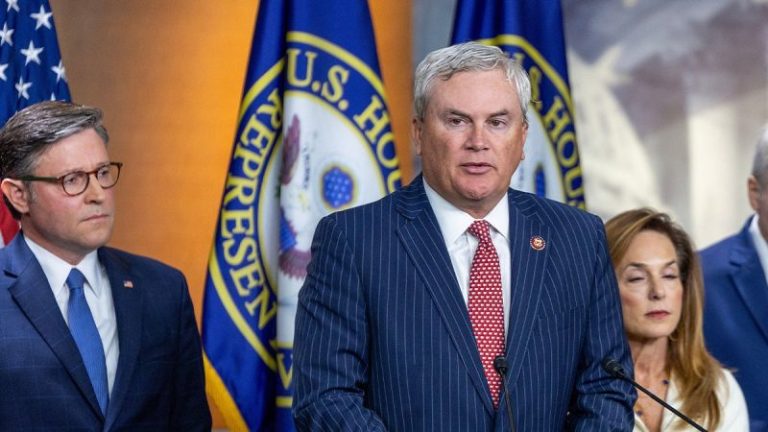
A bipartisan group of senators is still working on a fix for the now-expired Obamacare subsidies and believe that they may be nearing a proposal that could hit the Senate floor.

The confab, which met a handful of times during Congress’ holiday break, adjourned once more behind closed doors on Monday night. Sens. Susan Collins, R-Maine, and Bernie Moreno, R-Ohio, are leading the talks among several Senate Republicans and Democrats looking for a compromise solution.

Most who attended the meeting were tight-lipped on specifics of the still-simmering proposal, but Collins noted the plan was similar to the initial offering from her and Moreno.

‘Parts of the bill are similar to what Senator Moreno and I proposed originally, with a two-year extension, with some reforms in the first year and then more substantial reforms in the second year,’ she said.

Their original plan — one of several floating around in the upper chamber — would have extended the subsidies by two years, put an income cap onto the credits for households making up to $200,000 and eliminated zero-cost premiums as a fraud preventive measure by requiring a $25 minimum monthly payment.

Sen. Tim Kaine, D-Va., one of the lawmakers who has routinely attended the meetings, said the talks were going well.

‘We had a really good discussion last night,’ Kaine said. ‘I don’t want to characterize it other than we had a really good discussion.’

And Senate Majority Leader John Thune, R-S.D., said that he had gotten an update on negotiations from Moreno Tuesday morning and believed that the bipartisan huddles had been productive.

Still, any plan that hits the floor has to hit several benchmarks for Republicans, including antifraud guardrails, a transition into health savings accounts (HSAs) and more stringent anti-abortion language.

‘The keys are reforms, obviously, and then how do you navigate [the Hyde Amendment],’ Thune said. ‘I think that’s probably the most challenging part of this. But again, I think there’s potentially a path forward, but it’s something that has to get a big vote, certainly a big vote.’

The Hyde Amendment issue is a barrier for both sides of the aisle, given that Senate Republicans demand that changes be made to the subsidies, and more broadly Obamacare, to prevent any taxpayer dollars from funding abortions.

That debate received a wrinkle Tuesday when President Donald Trump told House Republicans ‘you have to be a little flexible’ when it comes to the Hyde Amendment.

That triggered mixed reactions from Republicans in the upper chamber.

Sen. James Lankford, R-Okla., said that he had ‘no idea the context’ of Trump’s remarks but affirmed that he was ardently against funding abortions.

‘I’m saying I’m not flexible in the value of human life,’ Lankford said. ‘Life is valuable. I don’t believe some children are disposable, and some children are valuable. I think all children are valuable.’

Senate Democrats largely viewed Trump’s comments as a sign of progress — that maybe Republicans would budge on the Hyde issue. But flexibility goes both ways, and Sen. Ron Wyden, D-Ore., and top-ranking Democrat on the Senate Finance Committee, wasn’t ready to budge on the matter.

‘I am not going to open the door to Hyde, given what happens and what has been seen historically when you do that,’ he said. ‘If you open the door, it will get drafty in a hurry, and I’m not going to let it happen.’

Moreno signaled that Republicans might have to make a compromise on the issue if they wanted to move ahead with any kind of healthcare fix that could pass muster in the Senate.

He noted that there was a sense that ‘maybe the Obamacare language wasn’t as adherent to that philosophy [of Hyde] as it should be.’

‘But that’s not something that we’re looking — able to change right now,’ he said. ‘Because, quite frankly, if you put Hyde up to a vote among Democrats today, as opposed to Democrats 20 years ago, it would probably fail 46 to one on the Democrat side. So unfortunately, most Democrats today feel that there should be federal funding for abortion.’

This post appeared first on FOX NEWS

(TheNewswire)

Crown Porphyry-Stockwork Drill Targets Confirmed

Vancouver, British Columbia, January 7th, 2026 TheNewswire Prismo Metals Inc. (‘Prismo’ or the ‘Company’) (CSE: PRIZ,OTC:PMOMF) (OTCQB: PMOMF) is pleased to announce it has received final assay results for samples taken at the Silver King Project from the Crown porphyry target area located on the east side of the property (Fig. 1).


Click Image To View Full Size

Figure 1.  Map showing the location of the Crown porphyry and stockwork and Black Diamond replacement exploration targets at the Silver King project.  Claim boundaries are shown in yellow.

Overlimit silver assays have been received for the samples taken in late 2025, showing high grade silver mineralization associated with quartz-sulfide veins hosted by the Crown porphyry (Fig 2, Table 1). These assays provide evidence for a high-priority drill target, especially when taken in conjunction with the high gold assays reported previously for the stockwork intrusion (see the News Release of Dec. 3, 2025).  

‘Prismo optioned Silver King with existing drill targets around the historically significant high-grade silver mine. Based on the geology and its location in a well mineralized region, we believed that additional mineralization was also likely present. Our work in the second half of 2025 indicates that we were correct, and we now have exceptional drill targets at the Crown porphyry and adjacent Black Diamond replacement areas,’ stated Craig Gibson, Chief Exploration Officer of the Company. He added, ‘With the high-grade gold assays reported in December and the copper assays at the Black Diamond replacement, we now have a very significant precious-metal and copper target at Silver King similar to other areas in this well mineralized district that includes the Magma mine and the Resolution copper deposit.’  

‘These additional assay results along with the IP survey information continue to enhance and support our exploration thesis of the Silver King mine and surrounding areas,’ stated Gordon Aldcorn.  ‘This modern-day review has yielded additional drill targets and prospective structures to our program in this already very strategically located project.’


Table 1. Assay results for selected samples from the Crown porphyry stockwork

Sample

Location

Easting

Northing

Width m

Au g/t

Ag g/t

Cu %

Pb %

Zn %

544559

Crown porphyry

492681

3687905

0.5 m

0.02

18.91

0.02

0.07

0.04

544561

Crown porphyry

492673

3687904

2 m

0.02

177

0.07

0.37

0.02

544563

Crown porphyry

492613

3687848

0.5m

0.03

176

0.09

0.01

544591*

Crown porphyry

492799

3687851

1.0

5.19

46.44

0.05

0.21

0.06

544592*

Crown porphyry

492793

3687823

1.0

4.06

13.97

0.02

0.10

0.07

*Assays previously released in News Release of December 3, 2025.


Click Image To View Full Size

Figure 2. Precious metal and copper assays from the Crown porphyry
and the Black Diamond replacement body at the Silver King Project.

IP Survey

The Company also completed a pole-dipole IP survey over a part of the Silver King project in December 2025.  This survey was designed to provide some additional 3-dimensional data for areas identified during the initial gradient array survey (see News Release dated December 3, 2025). This new survey confirmed the presence of important chargeability and resistivity anomalies at the Silver King project. The Silver King silver mine appears to be associated with a large low resistivity anomaly located on the contact of the Silver King diorite porphyry (Fig 3). There is also low resistivity anomalies associated with the Crown porphyry and near the replacement mineralization at Black Diamond (Fig 3). The highest chargeability anomalies appear to be associated with the altered country rocks along intrusive contacts, but a chargeability high is also associated with the Crown porphyry stockwork intrusion. The anomaly associated with the Crown porphyry is particularly interesting and can be traced from shallow levels to about 300 meters in depth.  


Click Image To View Full Size

Figure 3. IP resistivity map at a depth of 75 meters, overlain on geology and showing the Silver King glory hole (black line), Black Diamond replacement body in red, and the Crown porphyry-stockwork in magenta.  


Click Image To View Full Size

Figure 4. IP chargeability at a depth of 75 meters, overlain on geology and showing the Silver King glory hole (black line), Black Diamond replacement body in red, and the Crown porphyry-stockwork in magenta.  

Drilling Update

Alain Lambert, CEO of Prismo commented: ‘The results announced today confirm the vast exploration potential at Silver King. While we look forward to drilling these new targets in the future, our plans remain unchanged. Our immediate priority is to undertake our fully funded drill program, as previously announced. This drill campaign will primarily focus on the historic Silver King mine site and will be about 2,000 meters. The objective is to test the upper half of the steeply dipping pipelike Silver King mineralized body as well as potential mineralization adjacent to the dense stockwork that was the focus of historic mining.’

Mr. Lambert added: ‘We are pleased with the steady progress on the permitting front. The collaboration of Forest Service officials demonstrates a clear commitment to supporting mining activities in Arizona.’

Prismo recently announced that the Forest Service, the federal surface land management entity for Silver King, had determined that the Company’s proposed drill plan meets the regulatory requirements for processing, and that such plan is complete, as described in the regulations at 36 CFR 228.4(c).

The Forest Service is currently proceeding with the environmental analysis pursuant to 36 CFR 228(a)(5) in conformity with the National Environmental Policy Act (NEPA). This analysis is proceeding as a Categorical Exclusion, the lowest level of environment reviews applicable to projects that are not expected to have a significant effect on the environment, such as Silver King.

QA/QC

Samples were analyzed by SGS, an internationally recognized analytical lab, with preparation at the Tempe, Arizona facility and analyses at the Burnaby laboratory.  Prismo inserts controls samples consisting of a standard pulps and a coarse blanks in the sample stream, and the lab also inserts control samples.  

Qualified Person

Dr. Craig Gibson, PhD., CPG., a Qualified Person as defined by NI-43-01 regulations and Chief Exploration Officer and a director of the Company, has reviewed and approved the technical disclosures in this news release.  

About Prismo Metals Inc.

Prismo (CSE: PRIZ,OTC:PMOMF) is a mining exploration company focused on advancing its Silver King, Ripsey and Hot Breccia projects in Arizona and its Palos Verdes silver project in Mexico.

Please follow @PrismoMetals on Twitter, Facebook, LinkedIn, Instagram, and YouTube

Prismo Metals Inc.

1100 – 1111 Melville St., Vancouver, British Columbia V6E 3V6 Phone: (416) 361-0737


Contact:

Alain Lambert, Chief Executive Officer alain.lambert@prismometals.com

Gordon Aldcorn, President gordon.aldcorn@prismometals.com


Neither the Canadian Securities Exchange nor its Market Regulator (as that term is defined in the policies of the Canadian Securities Exchange) accepts responsibility for the adequacy or accuracy of this release.


Cautionary Note Regarding Forward-Looking Information

This release includes certain statements and information that may constitute forward-looking information within the meaning of applicable Canadian securities laws. Forward-looking statements relate to future events or future performance and reflect the expectations or beliefs of management of the Company regarding future events. Generally, forward-looking statements and information can be identified by the use of forward-looking terminology such as intends’ or anticipates’, or variations of such words and phrases or statements that certain actions, events or results may’, could’, should’, would’ or occur’. This information and these statements, referred to herein as ‘forward-looking statements’, are not historical facts, are made as of the date of this news release and include without limitation, statements regarding discussions of future plans, estimates and forecasts and statements as to management’s expectations and intentions with respect to, among other things: the timing, costs and results of drilling at Silver King; and the intended use of any proceeds raised under recent financings.

These forward-looking statements involve numerous risks and uncertainties, and actual results might differ materially from results suggested in any forward-looking statements. These risks and uncertainties include, among other things: the potential inability of the Company to utilize the anticipated proceeds of the Private Placement as anticipated; and those risks set out in the Company’s public disclosure record on SEDAR+ (www.sedarplus.com) under the Company’s issuer profile.

In making the forward-looking statements in this news release, the Company has applied several material assumptions, including without limitation, that the Company will use the proceeds of the Second Tranche as currently anticipated and on the timeline currently expected.

Although management of the Company has attempted to identify important factors that could cause actual results to differ materially from those contained in forward-looking statements or forward- looking information, there may be other factors that cause results not to be as anticipated, estimated or intended. There can be no assurance that such statements will prove to be accurate, as actual results and future events could differ materially from those anticipated in such statements. Accordingly, readers should not place undue reliance on forward-looking statements and forward- looking information. Readers are cautioned that reliance on such information may not be appropriate for other purposes. The Company does not undertake to update any forward-looking statement, forward-looking information or financial outlook that are incorporated by reference herein, except in accordance with applicable securities laws. We seek safe harbor.

Copyright (c) 2026 TheNewswire – All rights reserved.

News Provided by TheNewsWire via QuoteMedia

This post appeared first on investingnews.com

The growing prevalence of chronic diseases like cancer and diabetes is driving increasing innovation in medical device technology. In 2024 alone, 30 new devices were approved by the US Food and Drug Administration (FDA).

Wearable medical devices and the use of artificial intelligence in medical technology are two key trends in this sector.

Investors who want exposure to this wave of growth may want to consider NASDAQ small-cap medical device stocks. Below is a list of the top NASDAQ medical device companies based on year-on-year gains.

All data was compiled on December 31, 2025, using TradingView’s stock screener, and the medical device makers listed below had market caps between US$50 million and US$500 million at that time.

1. MDxHealth (NASDAQ:MDXH)

Year-on-year gain: 50.86 percent
Market cap: US$173.24 million
Share price: US$3.50

MDxHealth is a commercial-stage precision diagnostics company specializing in molecular tests for urologic cancers, particularly prostate cancer, using genomic, epigenetic and exosomal technologies. Its US headquarters and operations are located in Irvine, California.

The company offers non-invasive and tissue-based diagnostic assays that run on standard PCR platforms.

In September, MDxHealth acquired Exosome Diagnostics from Bio-Techne (NASDAQ:TECH) for US$15 million, adding the ExoDx Prostate urine test to its portfolio. The deal also includes a CLIA-certified clinical laboratory and related assets. The deal is expected to generate over US$20 million in revenue in 2026.

2. KORU Medical Systems (NASDAQ:KRMD)

Year-on-year gain: 50.13 percent
Market cap: US$269.6 million
Share price: US$5.82

KORU Medical Systems develops and manufactures medical devices and supplies in the US and internationally, with a focus on mechanical infusion products. Its Freedom Syringe Infusion System first received FDA clearance in 1994.

Based on this system, its primary products include the Freedom60 and FreedomEdge syringe infusion systems, Precision Flow Rate Tubing and High-Flo Subcutaneous Safety Needle Sets.

KORU Medical Systems submitted a 510(k) premarket notification to the FDA on December 30, 2025, seeking clearance for its FreedomEdge system to deliver Phesgo — a HER2+ breast cancer targeted biologic — subcutaneously, targeting infusion centers to cut chair time and boost efficiency.

The company stated this is part of its strategy to expand the indications of FreedomEdge to the wider oncology infusion center market.

3. Vivani Medical (NASDAQ:VANI)

Year-on-year gain: 1.71 percent
Market cap: US$86.81 million
Share price: US$1.19

Vivani Medical is a clinical-stage biopharmaceutical company developing miniature, long-term subdermal drug implants using its proprietary NanoPortal technology to treat chronic conditions like obesity and type 2 diabetes.

Headquartered in Alameda, California, Vivani focuses on GLP-1 implants that provide steady drug release over six months to improve adherence and tolerability compared to daily pills or weekly injections.

In August, Vivani Medical reported positive Phase 1 results from its LIBERATE-1 trial of the NPM-115 exenatide implant, confirming safety and steady drug release for obesity treatment without major side effects.

The company plans to rapidly advance its NPM-139 semaglutide implant after it achieved preclinical results of sustained 20 percent weight loss. It is planning a Phase 1 clinical study in the first half of 2026.

Securities Disclosure: I, Meagen Seatter, hold no direct investment interest in any company mentioned in this article.

This post appeared first on investingnews.com

2025 marked a turning point for investment in the cannabis sector, shifting the focus toward operational resilience and consolidation after a sluggish 2024.

Key market drivers included an upswing in merger and acquisition (M&A) activity as stronger multi-state operators (MSOs) acquired distressed assets, alongside pivotal regulatory developments.

The central theme for the year was the expected US federal shift to Schedule III, a policy rollercoaster that culminated in an executive order to expedite rescheduling, focusing investor flows into scaled, cashflow-positive MSOs.

Internationally, incremental legalization in Europe, particularly the momentum in Germany, broadened the global footprint and provided new export channels for North American producers.

Within market trends, profitability pivoted away from bulk flower to high-margin consumables, with infused pre-rolls and edibles driving category growth and supporting a rerating of resilient operators.

US cannabis rescheduling a core shift

After 2024’s punishing drawdowns, cannabis navigated a high-stakes policy rollercoaster in 2025.

The sector bottomed in Q1 as anticipated US Drug Enforcement Administration (DEA) rescheduling hearings were delayed, but ignited in late Q3 and Q4 as the narrative shifted toward a decisive executive-led reclassification.

This momentum culminated in US President Donald Trump’s December 18 executive order, which expedites rescheduling and CBD access. It triggered a parabolic surge followed by a violent ‘sell the news’ correction.

“Cannabis is not just a volatile sector or industry. It is the most volatile place,” said Dan Ahrens, managing director and portfolio manager of the AdvisorShares Pure US Cannabis ETF (ARCA:MSOS). “It just proves the point, once again, that we really, really need this federal reform to be officially completed.”

Indeed, 2025 brought plenty of ups and downs. The year opened with Schedule III buzz, which came after prior Department of Health and Human Services recommendations and initial DEA scheduling proposals from late 2024; however, proceedings ground to a halt after the DEA postponed a key January hearing by over 180 days due to administrative turnover, bias claims and leadership gaps post-election. These disruptiosn kept Section 280E tax penalties in place and banking access frozen, keeping margins for MSOs compressed.

Meanwhile, House spending bills included language prohibiting the Department of Justice (DoJ) from spending any funds on rescheduling efforts, while Senate Farm Bill revisions redefined hemp to exclude intoxicating derivatives like delta-8 THC, capping them at trace levels and effectively imposing a nationwide hemp ban on high-potency alternatives.

The MSOS ETF’s portfolio construction exemplified the broader trend of investor flows concentrating into scaled, cash-flow-positive MSOs amid reform volatility. The fund’s top three holdings — Curaleaf Holdings (CSE:CURA,OTCQX:CURLF), Trulieve Cannabis (CSE:TRUL,OTCQX:TCNNF) and Green Thumb Industries (CSE:GTII,OTCQX:GTBIF) — accounted for over 68 percent of its total holdings as of December 31, underscoring confidence in these operators as resilient proxies for US cannabis maturation while smaller single-state players face dilution.

MSOS managers reinforced the shift in the year’s third quarter by trimming three underperformers from the ETF: 4Front Ventures (CSE:FFNT), Lowell Farms (CSE:LOWL) and Gold Flora.

Despite stalls in momentum, Trump kept hope alive in the cannabis sector throughout the year.

In September, he called cannabis reform an “80-20 issue” with broad public backing, and posted a Truth Social video promoting CBD for seniors and suggesting Medicaid coverage.

Those moves, alongside Representative Greg Steube’s (R-FL) Marijuana 1-to-3 Act, aimed at legislatively shifting cannabis to Schedule III, drove a surge in Q3 without any underlying procedural progress.

As mentioned, the December 18 executive order injected fresh life into the sector, directing the DoJ and DEA to expedite cannabis rescheduling to Schedule III, while launching a CMS Innovation Center pilot for federal health programs to cover hemp-derived CBD as early as April 2026, with up to US$500 annual reimbursement for eligible patients.

CMS Administrator Mehmet Oz previously endorsed Medicare reimbursement for CBD therapies during his confirmation hearings, framing them as “low-risk, high-impact” options for age-related ailments.

European cannabis legalization and international growth

2025 brought incremental legalization or medical frameworks in multiple jurisdictions, including Czechia, Malta, Poland, Switzerland and Luxembourg, broadening the investable global footprint.

This continental momentum has directly boosted North American producers through export ramps and licensing deals, with Canadian licensed producers capturing 43 percent of Germany’s Q2 imports alone.

The country’s CanG framework and adult‑use reform, which came into effect in April 2024, have made it Europe’s most important legal market, with 2025 medical sales expected to see explosive year-on-year growth.

Cannabis company trends in 2025

In 2025, cannabis companies pivoted toward operational resilience and product innovation amid persistent commoditization pressures. After 2024’s wholesale flower price declines, down roughly 32 percent since 2021 by some estimates, stronger MSOs like Tilray Brands (TSX:TLRY,NASDAQ:TLRY) are demonstrating pricing power through branded products and category expansion into edibles, vapes and infused pre-rolls.

Deal flow rebounded from 2024’s US$1.17 billion trough, with US transactions reaching US$2.1 billion.

Against that backdrop, cash-rich MSOs pursued distressed roll-ups in oversupplied states like California and New York, with Vireo Growth’s (CSE:VREO,OTCQX:VREOF) acquisitions in Minnesota and New York exemplifying the trend, achieving critical mass with premium valuations amid hemp restrictions.

Private equity and creative deal structures dominated in the cannabis market, preparing operators for federal reform, while consolidating fragmented retail.

Investor takeaway

2025 marked a transformative year for cannabis, with regulatory breakthroughs and market maturation set against the backdrop of volatility. Trump’s execuctive order has brought new life into the sector in the US with the promise of not only banking and tax relief, but also bipartisan momentum for normalization; however, investors remain cautious.

“Everybody is waiting for it to be real and for it to be completed. Because even though we think the executive order was huge … nothing’s complete yet. Nothing’s official yet,” explained Ahrens.

Looking to 2026, he emphasized that the path forward for cannabis isn’t a straight line, but rather a series of volatile ‘waves’ tied to incremental regulatory milestones. Ahrens anticipates that while the finalization of Schedule III should trigger an initial move, it is merely the first domino; subsequent upside depends on the DoJ providing clear guidance for state-legal adult-use programs and the eventual passage of banking reform.

While he does foresee cannabis stocks uplisting to major exchanges, and Big Pharma companies beginning to make acquisitions in the space, Ahrens remains cautious about timing, noting that even with a signed order, large institutional banks will likely keep the ‘blockade’ in place until the legal ink is truly dry.

Ultimately, while 2025’s executive action has established a concrete foundation for federal reform in the US, the cannabis sector remains poised in a state of high-stakes volatility, with its full maturation dependent on official completion of milestones in 2026 and beyond.

Securities Disclosure: I, Meagen Seatter, hold no direct investment interest in any company mentioned in this article.

This post appeared first on investingnews.com