Author

admin

Browsing

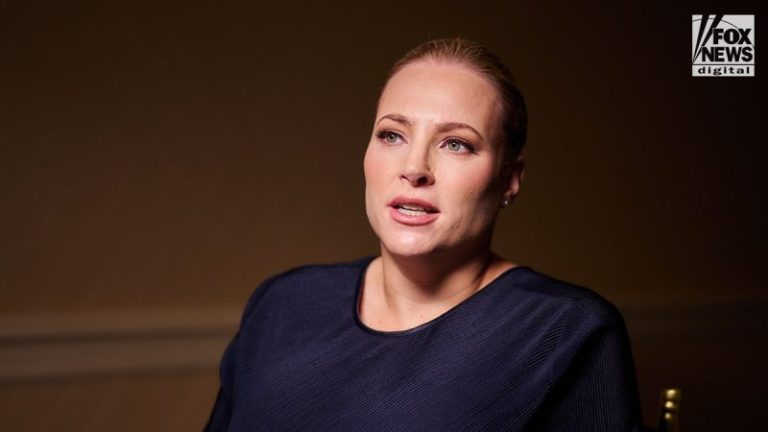
Meghan McCain believes ‘the U.S.-Israel alliance is incredibly strong’ even amid rising antisemitism across the country and increasing political pressure from both sides of the aisle. 

Fox News Digital sat down with McCain on Tuesday evening before she received the ‘Champion of Israel’ award from the American Friends of Magen David Adom (AFMDA), which supports Israel’s emergency medical and disaster response service. She noted that in her observation, issues surrounding the U.S.-Israel relationship appear to be more partisan as far as the left is concerned. 

McCain said that she sees some pro-Israel Democrats, specifically pointing to Sen. Chuck Schumer, D-N.Y., ‘hedging in different places.’ During her award acceptance speech at this year’s AFMDA New York City gala, she also called out New York City Democratic mayoral candidate Zohran Mamdani, who has taken heat for previous acceptance of antisemitic rhetoric such as ‘globalize the intifada.’ 

‘Pray for this city,’ McCain said, adding, ‘he’s an animal.’ The statement garnered applause from the audience, which gathered at Manhattan’s Cipriani Wall Street.

McCain also acknowledged that there are political elements not just on the left, but also on the right that oppose Israel, all of which she condemned. She urged those in attendance to ‘fight together to combat this destructive message of the radical left and within my own party on the alt-right.’

Despite this, the White House’s ties to Jerusalem give McCain hope that the relationship between the two nations is ironclad.

‘Of many of the reasons that I’m glad that President Trump is president is his wholehearted support of Israel is definitely one of them,’ McCain told Fox News Digital. ‘I think that we have an incredibly strong alliance and shared values and shared political interests and shared global interests.’

The former co-host of ‘The View’ also said that she believes the majority of the American public understands that ‘the interests of Israel and the interests of the United States of America are shared, especially in our fight against Islamic extremism.’

Charlie Kirk – who was also a steadfast supporter of Israel – came up both in McCain’s speech and her conversation with Fox News Digital.

‘I think we’re all sort of struggling with his assassination,’ she told Fox News Digital. ‘I am not satisfied with the reaction of the broad swath of Democrat leaders. When you have people like Ilhan Omar that are still accepted in Democrat spaces after what she said about Charlie Kirk in the wake of his passing, I mean, it’s hideous.’

Speaking to the audience of first responders and their supporters, she pointed out the contrast between those who save lives because of their beliefs and those who end them.

‘Where what you do here is about saving lives, the other side has nothing to offer but destruction. There are people all around the world and even in this country who do not want to participate in debate. They do not want to be proven wrong,’ McCain said.

‘And in the instance of people brave enough like Charlie Kirk to stand for Judeo-Christian values and the values of family and life and freedom and the right of Israel to defend itself against its enemies, they will try to destroy you by any means necessary and dance in celebration when you fall,’ she later added.

Addressing gala attendees, McCain delivered a strong defense of the U.S.-Israel alliance, as well as her personal unwavering support for the Jewish state.

‘No matter how much of the world — motivated by moral cowardice, material interest, or the sublimated antisemitism that still stalks the globe — turns away from Israel, I will not. I will never. And I speak for millions and millions of Americans who feel exactly the same,’ McCain said to a cheering crowd.

McCain credited her father, the late Sen. John McCain, R-Ariz., and his relationship with the late Sen. Joe Lieberman, D-Conn., for her desire to deliver a strong defense of the U.S.-Israel relationship.

‘My father always understood the importance of the connection between America and Israel. His deep friendship with the man who was for all intents and purposes my uncle, the late Senator Joe Lieberman, was what exposed me to Jewish life, thought, and practice from a young age,’ McCain said. Later in her speech, she added that she and her husband, Ben Domenech ‘feel the same way, as so many Americans do: that Israel’s cause is right, Israel’s fight is noble, and Israel’s means are just.’

Magen David Adom (MDA), which is essentially Israel’s version of the Red Cross, handles a wider range of issues than its American counterpart, the Red Cross, such as disaster relief and blood services. 

On Oct. 7, 2023, MDA handled over 21,600 emergency calls, five times more than the number of calls it gets on an average Saturday. Additionally, MDA dispatched 1,430 ambulances and intensive care units alongside hundreds of emergency motorcycles, three helicopters, command and control vehicles, and 24 mass casualty response vehicles equipped to deploy mobile treatment sites. Since the Israel-Hamas war began, 38 MDA personnel lost their lives.

McCain concluded her speech with a stark warning — that Israel’s fight is America’s fight and that ‘If Israel were to lose its war — God forbid — the armies of darkness would march toward us here in America, too.’

This post appeared first on FOX NEWS

Senate Republicans rammed through dozens of President Donald Trump’s nominees on Thursday in their first flex of the Senate’s new rules for confirmations.

Lawmakers voted along party lines to confirm 48 of Trump’s nominees, many being for undersecretary or assistant secretary positions in a variety of agencies throughout the federal government and ambassadorships.

Senate Republicans went ‘nuclear’ last week to make the change after a last-minute deal with Democrats fell apart.

The change ushered in by the ‘nuclear option’ allows lawmakers to confirm an unlimited number of nominees in batches, also known as en bloc, with a simple majority vote in the upper chamber. However, the process is time-consuming, given that lawmakers must jump through procedural hoops and allow for 30 hours of debate.

‘Why has not a single nominee been confirmed by voice vote or by unanimous consent? We know why,’ Senate Majority Whip John Barrasso, R-Wyo., said on the Senate floor. ‘It’s Democrat obstruction.

‘The country has never seen anything like this,’ he continued. ‘Senate Democrats are freezing the Senate floor, freezing the federal government and freezing our nation’s progress. This harms America’s safety. It hamstrings the agenda that Americans voted for.’

Among this batch of nominees were Kimberly Guilfoyle, who Trump tapped to be the U.S. ambassador to Greece, and Callista Gingrich, who was picked to be the U.S. ambassador to Switzerland.

Republicans argued that the change would benefit both parties now and in the future and viewed the change as an option of last resort to break through Senate Democrats’ blockade of Trump’s picks.

Typically, subcabinet-level nominees, particularly those with bipartisan support out of committee, are sped through the Senate either by unanimous consent or through a voice vote, two fast-track procedural moves in the upper chamber. All the nominees in this first round made it out of committee on a bipartisan basis.

However, Senate Minority Leader Chuck Schumer, D-N.Y., and his caucus wouldn’t allow either to be used and caused a backlog of nominees to lower level positions in the Trump administration to pile up. As of Thursday, the list had swollen to 173.

The only one of Trump’s nominees that easily moved through the chamber was Secretary of State Marco Rubio, who was confirmed in January on a near unanimous vote. 

This post appeared first on FOX NEWS

Shortly after announcing a strategy to go after deceptive direct-to-consumer advertising by the pharmaceutical industry, Robert F. Kennedy Jr. and the Department of Health and Human Services released a parody video of a drug advertisement – a pointed way of emphasizing the fact that the United States is largely unique in allowing drug ads.

‘Tired of endless drug ads promising quick fixes but leaving you sicker than you were before? That can change today. Ask your doctor about MAHA,’ the parody commercial begins, referring to Kennedy’s ‘Make America Healthy Again’ initiative. 

‘MAHA may cause healthier living, fewer chronic diseases, and lower drug costs,’ the video’s narrator continues. ‘Some Americans reported more time spent with family instead of at the pharmacy. Other side effects may include healthier children, a stronger nation, more transparency in healthcare, honest advertising, and accountability from Big Pharma.’

The drug advertisement parody comes after Kennedy and HHS laid out their plans to target direct-to-consumer drug advertising – something that isn’t widely allowed outside the United States – in a new children’s health strategy released earlier this month. 

The strategy said it will ramp up enforcement of current prescription drug advertising laws, with a priority on ‘egregious violations demonstrating harm from current practices.’ The strategy noted these violations could include the dissemination of ‘risk information and quality of life through misleading and deceptive advertising on social media and digital platforms.’

The strategy to go after direct-to-consumer drug ads will also include inter-agency cooperation to explore the development of potential new industry guidelines that limit direct-to-consumer advertising for certain ‘unhealthy foods’ to children. These efforts include ‘evaluating the use of misleading claims and imagery,’ the MAHA children’s strategy stated. 

Kennedy said alongside the release of HHS’s parody advertisement that the Trump administration plans to begin holding the pharmaceutical industry accountable for not sharing full safety information in their drug ads on television, radio and beyond.


‘No more hiding vital information in small print, or pushing it off to a website, or a 1-800 number,’ Kennedy said in a video released in conjunction with the parody advertisement. He also noted that regulators have been letting pharmaceutical manufacturers avoid providing complete warnings in their marketing materials.

Kennedy said in the accompanying video that, in the past, regulators let companies mention a vague ‘major statement’ of risk that required consumers to go elsewhere for important details about the drug. The secretary said this ‘loophole’ opened the door to a ‘tsunami’ of misleading advertisements.

‘Drug ads drove up prescription drug costs and distorted doctor-patient conversations. Patients saw glossy ads and often asked for new medications,’ Kennedy continued. ‘Big Pharma’s marketing hooked the country on prescription drugs. We’re taking action to end that practice.’

This post appeared first on FOX NEWS

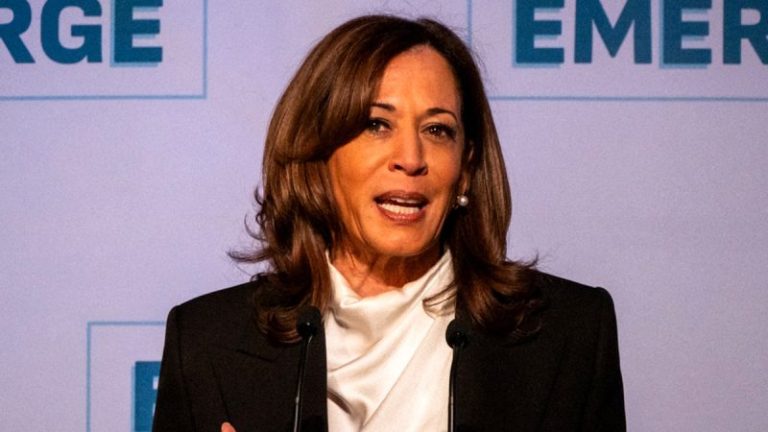
Former Vice President Kamala Harris noted that she was unaware that she had ‘pulled the pin on a hand grenade’ with her response to a question while appearing on ‘The View’ ahead of the 2024 presidential election, according to an Associated Press report about the unsuccessful candidate’s forthcoming book about her whirlwind 2024 White House campaign.

Asked whether she would have done anything differently than President Joe Biden, Harris replied by saying nothing ‘comes to mind’ and adding that she had ‘been a part of … most of the decisions that have had impact.’

‘I had no idea I’d just pulled the pin on a hand grenade,’ Harris wrote in her book, ‘107 Days,’ which is slated for release on Tuesday, according to the AP — ‘my staff were besides themselves’ regarding how she had handed a ‘gift to the Trump campaign,’ she noted, according to the outlet.

Harris explained in the book that she did not want to criticize the president or litigate matters on which they did not agree, according to the AP, but she did not grasp the extent to which her connection with Biden was holding back her presidential bid.

President Donald Trump decisively defeated Harris in the 2024 election, winning both the Electoral College and the popular vote.

‘I could barely breathe,’ Harris wrote regarding her experience of learning that she had lost the White House contest to her Republican rival, the outlet reported. She kept asking, ‘My God, my God, what will happen to our country?’

Earlier this year, Harris announced that she had decided against mounting a 2026 California gubernatorial bid.

‘In recent months, I have given serious thought to asking the people of California for the privilege to serve as their Governor,’ she noted in a statement issued in late July. ‘But after deep reflection, I’ve decided that I will not run for Governor in this election.’

This post appeared first on FOX NEWS

The House passed a short-term federal funding bill backed by President Donald Trump on Friday morning, paving the way for averting a government shutdown if the Senate follows suit.

The legislation is aimed at keeping the government funded at current levels through Nov. 21 with a measure known as a continuing resolution (CR), designed to give House and Senate appropriators more time to strike a deal on fiscal 2026 federal spending.

Fiscal 2025 is slated to end on Sept. 30, and Congress risks a partial shutdown if the CR does not make it to Trump’s desk for a signature by then.

In addition to keeping the government open until just before Thanksgiving, the legislation also includes an added $30 million to boost lawmaker security through a mutual aid fund for Capitol law enforcement and local police.

That decision was made as concerns over political violence have skyrocketed in recent months, including after the assassination of conservative activist Charlie Kirk in Utah last week.

The CR also honors a White House request for an additional $58 million in combined security funding for the judicial and executive branches, as well as $1 billion allocated for Washington, D.C.’s budget after Congress repealed that sum earlier this year.

A shutdown could be politically costly for both Republicans and Democrats.

Democratic leaders had threatened for days to oppose the bill, infuriated over being left out of CR negotiations and demanding increased funding for healthcare subsidies.

House Minority Leader Hakeem Jeffries, D-N.Y., was criticizing the CR as recently as Friday morning, less than an hour before the vote.

‘Today, there’s a choice before every single member of the House of Representatives: will we stand up for the healthcare of the American people, or will we bend the knee to Donald Trump and his continued efforts to gut healthcare for everyday Americans?’ Jeffries said.

‘We’re voting no on a partisan Republican spending bill, and we’ll continue to defend the healthcare of the American people.’

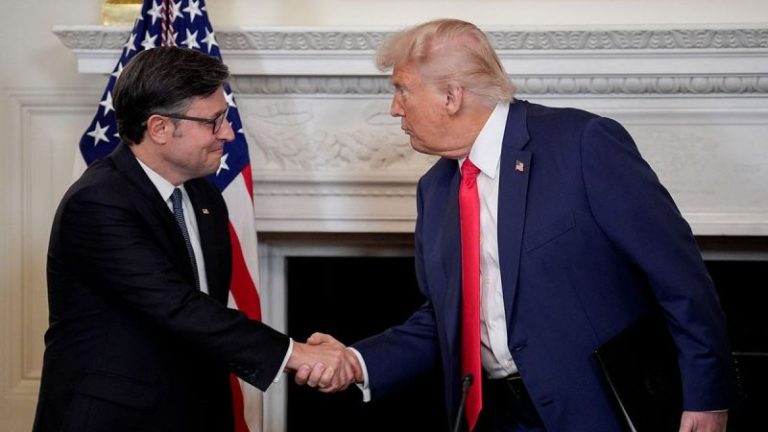
Speaker Mike Johnson, R-La., had precious little wiggle room going into the vote, affording to lose only two Republicans if all Democrats turned against it.

But in the Senate, where at least several Democratic votes will be needed to meet the 60-vote threshold to advance the legislation, Minority Leader Chuck Schumer, D-N.Y., is under significant pressure from his left flank to buck the GOP-led bill.

Schumer angered progressives in March when he cast a key vote to help avert a government shutdown with another Republican-led bill.

Republicans, meanwhile, have been readying to place the blame on a potential shutdown squarely on Democrats’ shoulders.

Trump posted on Truth Social on Thursday evening, ‘House Republicans are taking a very important Vote to pass a CLEAN TEMPORARY FUNDING BILL. The Leader of the Democrats, Cryin’ Chuck Schumer, wants to shut the Government down.’

‘Republicans want the Government to stay open. Every House Republican should UNIFY, and VOTE YES!’ Trump wrote.

Democrats released their own alternative CR plan this week, but Johnson told Fox News’ ‘Special Report’ that it was ‘filled with partisan wish lists and poison pills and demands.’

The Senate is expected to consider both versions and could take a vote as early as Friday.

This post appeared first on FOX NEWS

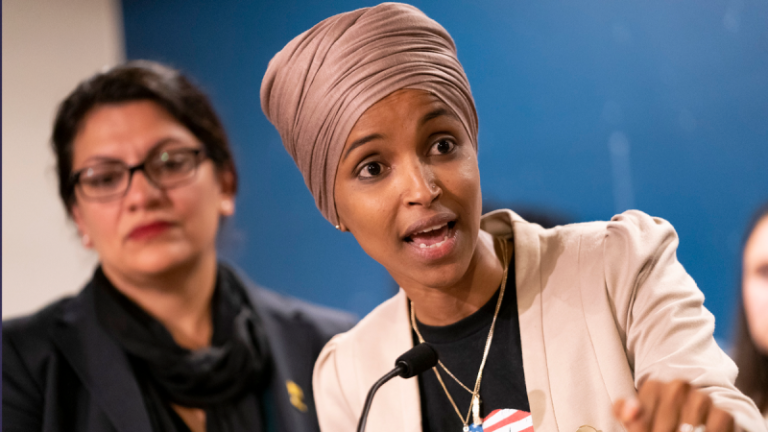
House Main Street Caucus Chairman Mike Flood, R-Neb., will refer Democratic colleague Rep. Ilhan Omar, D-Minn., for a House Ethics Committee investigation, he first told Fox News Digital.

It is the latest move in the GOP-led fallout over Omar’s response to the assassination of Charlie Kirk, a conservative activist who was shot and killed in Utah during a college campus speaking event last week.

‘I will be filing tomorrow … a complaint with the Committee on Ethics in the House of Representatives with 18 very concerning incidents and/or behaviors and/or statements that, on their face, reflect poorly on the House of Representatives,’ Flood said of Omar.

The top of the list of complaints will include the progressive Democrat’s ‘obnoxious, insulting and dismissive comments following the assassination of Charlie Kirk,’ he said.

‘Second, harboring illegal immigrants. I believe in February of this year that Omar hosted a workshop advising Somalians on how to avoid being deported after protecting the laws of the United States,’ Flood continued of his points. ‘No. 3, she’s used TikTok for mixed official and campaign content, which specifically violates other House rules.’

Flood was one of four House Republicans to help Omar narrowly avoid being censured by the House on Wednesday evening.

Rep. Nancy Mace, R-S.C., moved to force a vote on censuring Omar over her reaction to Kirk’s killing, but the move was quashed when four Republicans and all Democrats voted to table the measure.

Flood said at the time of his vote, ‘Ilhan Omar’s statements and social media posts are reprehensible and should be referred to the Ethics Committee. The appropriate time to consider a censure motion would be after ethics reviews her conduct.’

He told Fox News Digital on Thursday that initiating an ethics investigation would make a censure ‘far more credible.’

Flood pointed out that he similarly voted to table a censure threat against Rep. LaMonica McIver, D-N.J., for her conduct outside a New Jersey ICE facility before the ethics committee could issue a report on the matter.

‘And so I have gathered enough information, starting yesterday, before I voted to table, understanding that this was an issue,’ Flood said.

He also disagreed with the other three House Republicans who all said Omar’s comments were protected by the First Amendment.

‘This isn’t a free speech issue. This is a ‘Have you demonstrated that you are behaving at all times in a manner that reflects credibly on the House?’’ Flood said.

Omar specifically faced backlash over an interview with progressive news outlet Zeteo, in which she criticized Kirk’s past commentary and Republicans’ reaction to the shooting. She later accused Republicans of taking her words out of context, and she called Kirk’s death ‘mortifying.’

She previously told Zeteo days after Kirk’s assassination that he had ‘downplayed slavery and what Black people have gone through in this country by saying Juneteenth shouldn’t exist.’

‘There are a lot of people who are out there talking about him just wanting to have a civil debate,’ the ‘Squad’ member said. ‘There is nothing more effed up, you know, like, than to completely pretend that, you know, his words and actions have not been recorded and in existence for the last decade or so.’

She later posted on X amid the backlash, ‘While I disagreed with Charlie Kirk vehemently about his rhetoric, my heart breaks for his wife and children. I don’t wish violence on anyone. My faith teaches me the power of peace, empathy, and compassion. Right-wing accounts trying to spin a false story when I condemned his murder multiple times is fitting for their agenda to villainize the left to hide from the fact that Donald Trump gins up hate on a daily basis.’

Omar also reposted a video on X, where others not associated with the congresswoman said, ‘Don’t be fooled, these people don’t give a single s— about Charlie Kirk. They’re just using his death to further their Christo-fascist agenda.’

The Minnesota Democrat’s colleagues have vehemently defended her against Mace’s censure and Republican criticism.

Fox News Digital reached out to Omar’s office for a response to Flood but did not immediately hear back.

This post appeared first on FOX NEWS

A Nevada lithium project central to US efforts to secure domestic mineral supply is leaning on a half-century-old satellite program for modern answers.

The US Geological Survey’s (USGS) Landsat program, managed with NASA, has provided continuous Earth observations since 1972. Its freely available images allow scientists and industry leaders to measure landscape changes with precision.

In Northern Nevada, those insights are proving crucial as Lithium Americas (TSX:LAC,NYSE:LAC) works to advance Thacker Pass in a way that meets strict environmental and land-use standards.

“Landsat imagery is valuable for critical minerals project development because it provides consistent, long-term data that document land use changes and geological features, assess environmental receptors and support planning decisions,” said Alexi Zawadzki, president of North American operations for Lithium Americas, in a USGS report.

When planning began, Landsat data revealed that the original mine site overlapped with important sage-grouse habitat.

Although the bird is not a protected species, its sharp population decline since the 1960s has made it an indicator of ecosystem health in Nevada’s rangelands. The finding prompted developers to shift the project six miles south, away from prime territory.

Water use is another critical challenge faced by the project. Landsat data has been paired with field checks to estimate groundwater levels, using differences in vegetation to infer depth.

With this data, the Thacker Pass project aims to recycle processed water up to seven times and to operate as a “zero liquid discharge facility.”

Unlike traditional lithium brine operations, the project will extract lithium from clay deposits. Tailings will be stored in dry facilities and later reused for reclamation work.

Economic promise

Lithium Americas estimates construction of Thacker Pass could generate more than US$700 million annually and support 1,800 jobs. Once operational, economic activity linked to the mine could average US$2.1 billion per year, according to a University of Nevada, Reno, study.

Lithium is a cornerstone of batteries that power smartphones, laptops and electric vehicles. The US ranks third globally in known lithium resources but remains dependent on imports.

Due to the resource’ growing importance, developing domestic supply has become a matter of both industrial policy and national security.

Landsat’s value, is hardly confined to mining. A 2023 economic analysis placed its annual contributions to US industries at US$25.6 billion, spanning everything from gold exploration to reduced insurance costs for farmers.

For Thacker Pass, the test will come as mining gets underway. But for now, the view from space has already reshaped how the project is planned and envisioned moving forward.

By applying Landsat data, planners hope to show that resource extraction and environmental stewardship can advance together.

Securities Disclosure: I, Giann Liguid, hold no direct investment interest in any company mentioned in this article.

This post appeared first on investingnews.com

The US’ growing debt burden and rising borrowing costs are sharpening questions about the long-term credibility of the dollar, while simultaneously opening the door for cryptocurrencies to position themselves as alternatives for investors seeking protection from inflation.

A new report from Grayscale, the world’s largest digital asset investment platform, argues that macroeconomic imbalances in the US could drive increasing demand for crypto assets.

“Because of the large debt stock, rising interest rates, and a lack of other viable means for dealing with it, the US government’s commitment to control money supply growth and inflation may no longer be fully credible,” the firm said in its analysis.

A question of trust in money

Modern fiat currencies function only as long as people believe governments will preserve their value.

In practice, that means limiting money supply growth and keeping inflation low. Since the 1990s, delegating this responsibility to independent central banks has largely worked, anchoring expectations and fostering decades of relative stability.

But Grayscale notes that history is full of examples where governments have broken that trust, turning to the printing press to ease fiscal strain.

Today, the US finds itself in a precarious position: public debt has climbed to roughly 100 percent of gross domestic product, interest expenses are rising as bond yields climb, and Washington continues to run persistent deficits.

The report argues that the credibility gap is widening.

“If holders of US Dollar-denominated assets come to believe” that inflation will be tolerated as a tool for managing debt, Grayscale wrote, “they may seek out alternative stores of value.”

In most countries, inflation fears are local problems. In the case of the dollar, the stakes are far higher. The Federal Reserve estimates the US currency accounts for 60 to 70 percent of international use, compared with 20 to 25 percent for the euro and less than 5 percent for the Chinese renminbi.

That dominance means any loss of confidence in the dollar’s stability ripples across global finance. According to Grayscale, this is why risks tied to US debt are not the “most severe” compared to emerging markets but remain “the most important.”

The US fiscal picture deteriorated after the 2008 financial crisis and worsened during the pandemic. From 2007 to today, average annual deficits have swelled from 1 percent to about 6 percent of GDP, pushing total debt to nearly US$30 trillion.

Much of this was sustainable when interest rates were near zero. But the era of cheap borrowing has ended.

As debt is refinanced at higher rates, interest outlays absorb a larger share of federal spending, squeezing room for other priorities and raising the prospect of a “snowball effect” where debt grows faster than the economy.

Enter crypto

This backdrop has fueled interest in alternative monetary assets that are insulated from political pressures.

Gold has long played that role, but Grayscale points to Bitcoin and Ethereum as digital equivalents with unique advantages.

“These cryptocurrencies have certain design features that can make them a refuge, when needed, from conventional fiat money,” the report said.

Bitcoin’s supply is capped at 21 million coins, its issuance schedule is transparent, and no institution can arbitrarily inflate it.

Ethereum, while more complex due to its broader ecosystem of applications, also shares the qualities of decentralization and predictable supply controls.

In Grayscale’s view, these traits matter most when confidence in fiat currencies erodes. “The utility of these assets comes from what they do not do. Most importantly, they will not increase in supply because a government needs to service its debt.”

Despite this, Grayscale does not argue that crypto’s rise is inevitable. A credible restoration of US fiscal discipline and central bank independence could limit the appeal of alternative assets.

Feasible measures, according to the report, might include stabilizing and reducing the debt-to-GDP ratio, reaffirming the Fed’s inflation target, and resisting political pressure on monetary policy.

History itself can serve as a roadmap for this. Gold soared in the 1970s when inflation ran high and institutional credibility faltered, but lost ground in the 1980s and 1990s as the Fed restored trust and inflation fell. A similar trajectory could shape crypto’s role.

For now, the macro picture points in the opposite direction. With deficits entrenched and debt swelling, investors face a world where the dollar’s long-term credibility is in question.

In such an environment, Grayscale argues, crypto assets can serve as a crucial alternative.

“As long as those risks are getting larger, the value of assets that can provide a hedge against that outcome arguably should be going higher,” the report concluded.

Securities Disclosure: I, Giann Liguid, hold no direct investment interest in any company mentioned in this article.

This post appeared first on investingnews.com

Investor Insight

Lahontan Gold is on track to become a leading gold developer in Nevada’s Walker Lane district, presenting a compelling investment opportunity by combining a high-quality resource base with a clear path to production in Nevada’s premier mining jurisdiction — all in a rising gold price environment.

Overview

Lahontan Gold (TSXV:LG,OTCQB:LGCXF) is focused on advancing its portfolio of high-quality gold and silver projects in Nevada. The company’s flagship Santa Fe mine was a past producer that operated from 1988 to 1992, yielding 356,000 ounces of gold and 784,000 ounces of silver. Lahontan aims to unlock the mine’s full potential by expanding its resources and pushing forward on permitting.

The company recently completed a robust preliminary economic assessment (PEA) outlining a clear pathway to production. Permitting efforts are progressing with the Bureau of Land Management, and Lahontan anticipates being in a position to break ground by 2026.

Additionally, strategic drilling campaigns are planned to further expand the existing resource base.

The company’s strategy to unlock shareholder value is to advance the Santa Fe mine toward production by derisking the project through permitting and feasibility studies, while optimizing heap leach processing for maximum recoveries and economic efficiency. Concurrently, it is unlocking value from satellite deposits, including West Santa Fe, which has high-grade oxide potential, and Moho, an early-stage project with promising historic gold and silver intercepts.

Positioned as a low-cost developer in a top-tier jurisdiction, the company maintains strong institutional support with minimal dilution risk, ensuring capital efficiency and sustainable growth.

Company Highlights

  • Flagship Santa Fe Project: 100 percent owned, past-producing open-pit heap leach mine with an updated resource estimate of 1.54 million ounces indicated and 0.41 million ounces inferred pit constrained resource
  • Strategic Nevada Location: Situated in Walker Lane, one of the world’s best mining jurisdictions, with excellent infrastructure, water access, and a mining-friendly regulatory environment.
  • Strong Resource Growth Potential: The Santa Fe Mine and its satellite projects, West Santa Fe and Moho, offer exploration upside, with further drilling planned to expand resources.
  • Advancing Toward Production: With a positive Preliminary Economic Assessment (PEA) completed in late 2024, Lahontan is aggressively moving toward permitting and development.
  • Experienced Leadership: The company is led by an experienced management team with a proven track record in mine development, permitting, and value creation for investors.

Key Projects

Santa Fe Mine

The Santa Fe mine, located in Mineral County, Nevada, spans 26.4 sq km and represents Lahontan Gold’s flagship development project. With an updated mineral resource estimate of 1.95 Moz gold equivalent, the project hosts multiple oxide and sulfide zones that remain open for expansion.

Historical production from the Santa Fe mine yielded 356,000 oz gold and 784,000 oz silver from an open-pit heap leach operation. Modern exploration and metallurgical testing have identified additional high-grade mineralization that could support an expanded operation.

The recently completed PEA indicates strong economic potential, with favorable heap leach recoveries and low operating costs. Lahontan is actively working with the Bureau of Land Management to advance the permitting process, with the goal of achieving production readiness by 2026.

Lahontan has received confirmation from the Bureau of Land Management (BLM) that its Santa Fe Exploration Plan of Operations (POO) is now complete, paving the way for the project to enter the full environmental assessment (EA) under the National Environmental Policy Act (NEPA). The completion marks over two years of baseline studies, including biological, cultural, and historical assessments, and covers more than 12 sq km of the Santa Fe project with provision for over 700 drill sites. With this milestone, Lahontan expects to secure final POO approval in Q4 2025, enabling an expanded and robust drilling campaign in 2026.

West Santa Fe

The West Santa Fe project, situated just 13 km from the Santa Fe mine, is a highly prospective satellite project that could serve as an extension of the main operation. Historic drill data suggest the presence of a shallow oxide deposit, with early resource modeling indicating a potential gold equivalent resource of 0.5 to 1 Moz.

West Santa Fe’s excellent resource growth potential

Lahontan is preparing for an extensive drill program in 2025 to validate and expand this resource. Geophysical surveys and geochemical sampling have identified strong structural controls on mineralization, further supporting the potential for economic extraction. Given its proximity to Santa Fe, West Santa Fe offers a compelling low-cost, high-margin opportunity for future production.

Moho Project

The Moho project is another 100 percent owned asset within the Walker Lane district in Nevada, presenting a longer-term growth opportunity for Lahontan. The project is characterized by historic high-grade gold and silver intercepts from past drilling, with reported grades exceeding 20 g/t gold and 300 g/t silver. Initial exploration has confirmed the presence of oxidized tertiary epithermal vein systems, which are ideal for conventional heap leach processing. Core drilling in 2019 further validated the high-grade nature of Moho’s mineralization, with significant intercepts occurring at relatively shallow depths. Lahontan plans to conduct additional exploration drilling to refine resource estimates and assess potential economic viability.

Management Team

Kimberly Ann – Founder, Executive Chair, President and CEO

Kimberly Ann is a seasoned mining executive who has founded multiple junior mining companies and held senior roles, including CEO, president, CFO, and board member. Over the past 12 years, she has raised more than $210 million in project financing and participated in three junior mining M&A transactions. At Prodigy Gold, she led corporate communications, equity financings, and analyst engagement, playing a key role in the company’s $340 million acquisition by Argonaut Gold. As CFO and VP corporate development at PPX Mining, she successfully advanced the high-grade Callanquitas gold-silver underground mine into production in Northern Peru. In 2017, Kimberly founded Latin America Resource Group, transforming Jasperoide from two small concessions into a 57 sq km copper-gold project in Peru’s most prolific mineralized belt. Following LARG’s 2020 merger with Carube Copper to form C3 Metals, she positioned the company for significant portfolio growth and value creation.

Brian Maher – Founder and Vice-president of Exploration

Brian Maher is an economic geologist with over 45 years of experience in the international mining and exploration industry. Prior to Lahontan, Maher was the president, CEO and director of Prodigy Gold, where he guided the company through a period of expansive growth, exploring and developing the 6.6 Moz Magino gold deposit in northern Ontario, culminating in the $341 million acquisition of Prodigy Gold by Argonaut Gold in 2012. In 1982, he began a 16-year career with ASARCO, exploring for gold and copper deposits in a variety of geologic environments throughout North and South America. From 1998 and 2004, he was project manager for Metallic Ventures Gold, supervising underground and surface exploration, mine development and operations at an underground gold mine in Nevada.

John McNeice – CFO

John McNeice is a chartered professional accountant registered in Ontario, Canada, with over 30 years of experience in public company reporting, financial management, accounting and audit. Currently McNeice is the CFO of Gold79 Mines (TSXV:AUU), C3 Metals (TSXV:CCCM) and Northern Graphite (TSXV:NGC), where he is responsible for financial and regulatory reporting as well as day-to-day financial management. He has held CFO roles in seven public resource companies over the past 17 years and has overseen IPOs, RTOs and many quarterly, annual and periodic public company filings. From 2004 to 2007, McNeice was CFO of Ur-Energy, a uranium exploration and development company now a US-based producer of uranium. During his tenure, Ur-Energy raised an aggregate of $150 million in a series of private placements, the IPO and several significant secondary financings.

Josh Serfass – Independent Director

Josh Serfass is the executive vice-president of corporate development and investor relations at Integra Resources. Previously, he was the manager of corporate communications at Integra Gold. He was a key member of the team at Integra Gold that grew, developed and sold the past producing Lamaque mine in Val-dOr, Québec to Eldorado Gold for C$590 million in 2017. Committed to thinking differently about mining, Serfass worked with the team at Integra Gold to host the 2016 Integra Gold Rush Challenge and the 2017 #DisruptMining Challenge, initiatives that encouraged innovation and technology disruption in the mining industry.

Shane Williams – Independent Director

Shane Williams is president, CEO, and director of West Red Lake Gold Mines, leading the restart of the Madsen Gold Mine. He was previously COO of Skeena Resources, advancing Eskay Creek, and VP of Operations and Capital Projects at Eldorado Gold, where he brought the Lamaque Gold Mine from PEA to production in just 18 months. As project director, he also oversaw Eldorado’s Skouries and Olympias projects with a combined US$1 billion capex, and earlier led development of Sweden’s Kaunis Iron open-pit mine from exploration to operation in 3.5 years. Williams holds a B.Eng. in Electrical Engineering and an M.Sc. in Project Management.

Evan Pelletier – Independent Director

Evan Pelletier is a mining executive with over 30 years of underground mining experience in North America, Mongolia, Argentina, and Africa. He is currently the interim general manager of the Galena Mine with Americas Gold & Silver, and previously served as VP of Mining at Kirkland Lake (2020–2022) and mine manager at the Macassa Mine (2016–2020). At Kirkland Lake, he helped grow the company from $400 million in 2016 to $13 billion in 2022, including oversight of a nearly 2,000-metre shaft with a $450 milliom budget, delivered on time and on budget.

Max Pluss – Independent Director

Max Pluss is an investment professional with experience across hedge funds, private equity, and venture capital. He is the Founder of Rhea Capital Management, backing and incubating mission-driven companies. Previously, he was an analyst at Extract Capital, a hedge fund focused on natural resource investments, and earlier advised public company CEOs on corporate development and market positioning. pluss holds a B.A. from Colorado College and M.B.A. degrees from Columbia University and London Business School.

This post appeared first on investingnews.com

(TheNewswire)

Brossard, Quebec, September 18, 2025 TheNewswire Charbone Hydrogen Corporation (TSXV: CH,OTC:CHHYF; OTCQB: CHHYF; FSE: K47) (the ‘Company’ or ‘CHARBONE ‘) a company focused on green hydrogen production and distribution is pleased to announce the signature of Replacement Debentures of an amount of $2,050,000 (the ‘Replacement Debenture’ ) by amending certain terms of the secured convertible debentures of the Company (each, a ‘Debenture’ ) that the Company issued in connection with the private placement of debentures of an aggregate principal amount of $1,746,366 of 12% secured convertible debentures.

Before the Replacement Debenture took effect as of September 30, 2025, the Debentures were convertible into common shares of CHARBONE (each, a ‘Debenture Share’ ) at a conversion price of $0.10 per share until maturity.

Under the new Replacement Debenture:

  • The maturity date has been extended from September 30 and October 31, 2025 to September 30, 2026;

  • The convertible balance moves from $1.7 million to $2.1 million with the same annual rate of 12%, payable monthly, and

  • The conversion price of the Debentures moves from $0.10 per Debenture Share to $0.07 per Debenture Share

The new Replacement Debenture will be subject to the approval of the TSX Venture Exchange.

These changes announce today to the existing debentures is providing a new financing flexibility to Charbone by extending significantly the maturities and provide us with additional financing to complete and execute the acquisition of the operational hydrogen production and refueling equipment, announced on September 5, 2025, said Benoit Veilleux, Chief Financial Officer and Corporate Secretary of CHARBONE . ‘ As we gain momentum, we are continuously working towards optimizing our capital structure and advance our first-mover advantages as well as our shareholder interests .’

About Charbone Hydrogen CORPORATION

CHARBONE is an integrated company specialized in Ultra High Purity (UHP) hydrogen and the strategic distribution of industrial gases in North America and the Asia-Pacific region. It is developing a modular network of green hydrogen production while partnering with industry players to supply helium and other specialty gases without the need to build costly new plants. This disciplined strategy diversifies revenue streams, reduces risks, and increases flexibility. The CHARBONE group is publicly listed in North America and Europe on the TSX Venture Exchange (TSXV: CH,OTC:CHHYF), the OTC Markets (OTCQB: CHHYF), and the Frankfurt Stock Exchange (FSE: K47). For more information, visit www.charbone.com .

Forward-Looking Statements

This news release contains statements that are ‘forward-looking information’ as defined under Canadian securities laws (‘forward-looking statements’). These forward-looking statements are often identified by words such as ‘intends’, ‘anticipates’, ‘expects’, ‘believes’, ‘plans’, ‘likely’, or similar words. The forward-looking statements reflect management’s expectations, estimates, or projections concerning future results or events, based on the opinions, assumptions and estimates considered reasonable by management at the date the statements are made. Although Charbone believes that the expectations reflected in the forward-looking statements are reasonable, forward-looking statements involve risks and uncertainties, and undue reliance should not be placed on forward-looking statements, as unknown or unpredictable factors could cause actual results to be materially different from those reflected in the forward-looking statements. The forward-looking statements may be affected by risks and uncertainties in the business of Charbone. These risks, uncertainties and assumptions include, but are not limited to, those described under ‘Risk Factors’ in the Corporation’s Filing Statement dated March 31, 2022, which is available on SEDAR at www.sedar.com; they could cause actual events or results to differ materially from those projected in any forward-looking statements.

Except as required under applicable securities legislation, Charbone undertakes no obligation to publicly update or revise forward-looking information.

Neither TSX Venture Exchange nor its Regulation Services Provider (as that term is defined in policies of the TSX Venture Exchange) accepts responsibility for the adequacy or accuracy of this release .

Contact Charbone Hydrogen Corporation

Telephone: +1 450 678 7171

Email: ir@charbone.com

Benoit Veilleux

CFO and Corporate Secretary

Copyright (c) 2025 TheNewswire – All rights reserved.

News Provided by TheNewsWire via QuoteMedia

This post appeared first on investingnews.com