Author

admin

Browsing

(TheNewswire)

L’équipe Charbone a annoncé l’avancement des travaux de construction sur le site de son projet phare de Sorel-Tracy, se préparant aux livraisons d’équipements et au début de la production.

Brossard (Québec) TheNewswire – le 14 août 2025 – CORPORATION CHARBONE HYDROGÈNE (TSXV: CH,OTC:CHHYF OTCQB: CHHYF, FSE: K47 ) (« Charbone » ou la « Société »), une rare compagnie cotée en bourse spécialisée dans la production et la distribution d’hydrogène ultrapur vert en Amérique du Nord, est heureuse de fournir une mise-à-jour sur les progrès substantiels de la construction et les connexions d’infrastructures de son projet phare de Sorel-Tracy.

Interconnexion électrique terminée

Plus tôt cette semaine, une équipe d’Hydro-Québec a terminé l’interconnexion électrique du site. Il s’agissait de raccorder le réseau de distribution au premier poteau installé sur le site, après l’installation du poste de mesurage d’Hydro-Québec trois semaines plus tôt. L’énergie peut désormais circuler du réseau d’Hydro-Québec jusqu’à la zone de production via les lignes aériennes du site, ouvrant ainsi la voie à l’installation des équipements.

Infrastructures d’approvisionnement en eau installées

Entre-temps, le service de ses eaux de la Ville de Sorel-Tracy a terminé l’excavation et l’installation de la tuyauterie reliant le site de Charbone à une conduite d’eau principale de 14 pouces. Ce raccordement assurera une capacité d’alimentation en eau suffisante pour les cinq phases prévues du projet. Les deux principaux apports d’électricité et d’eau pour l’électrolyse étant désormais assurés, le site est prêt à démarrer la production d’hydrogène une fois l’installation des équipements terminée.

Travaux de génie civil en cours

Les machineries lourdes de génie civil sont arrivées sur le chantier, et les équipes de l’entrepreneur général et des sous-traitants de Charbone ont commencé les travaux. Les arpenteurs géomètres ont terminé le marquage du site nécessaire à la construction des bâtiments et des zones de production, en prévision de l’arrivée des équipements dans les semaines à venir.

Gestion de l’environnement

Lors de la préparation du site, le ministère de l’Environnement du Québec (MELCCFP) a identifié une espèce végétale rare et menacée – l’Aristide à rameaux – sur une petite partie de la propriété. En collaboration avec les experts de Tetra Tech, Charbone a réussi à relocaliser et à protéger la plante, lui assurant ainsi un habitat dédié sur le site. « Cette mise à jour marque la réalisation de trois étapes cruciales pour notre équipe », a déclaré Dave Gagnon, président-directeur général de Charbone. « Nous sommes fiers des progrès réalisés à ce jour et maintenons le cap pour le début de la production cet automne. »


Click Image To View Full Size

Clôture d’un financement de règlement de dettes par actions

Charbone a le plaisir d’annoncer la clôture d’une émission d’actions pour règlement de dettes totalisant 118 095 $. La Société a réglé avec un fournisseur sans lien de dépendance 118 095 $ de dettes par l’émission d’actions. Un total de 1 968 254 actions seront émises à la clôture, à un prix de conversion unitaire de 0,06 $. La Société estime que le règlement des dettes par l’émission de titres est approprié pour progresser vers la production de son projet Sorel-Tracy et pour répondre à la nécessité générale de gérer sa trésorerie avec prudence. Une entente officielle reflétera tout règlement de dettes et sera soumise à l’approbation de la Bourse de croissance TSX. Tout titre émis dans le cadre d’un règlement de dettes sera assujetti à une période de détention légale de quatre mois au Canada.

Mise-à-jour sur la clôture de billets convertibles de 1,5 million de dollars américains

À la suite de l’examen par la Bourse de la clôture des obligations convertibles de 1,5 M$ US (2,1 M$ CA) annoncée le 4 décembre 2024, Charbone émettra 2 109 900 bons de souscription à l’agent de placement. Chaque bon de souscription permet à son détenteur d’acquérir une action ordinaire supplémentaire de la Société à un prix d’exercice de 0,10 $ ou l’équivalent en dollars américains.

À propos de Charbone Hydrogène Corporation

Charbone est une entreprise intégrée spécialisée dans l’hydrogène ultrapur (UHP) et la distribution stratégique de gaz industriels en Amérique du Nord et en Asie-Pacifique. Elle développe un réseau modulaire de production d’hydrogène vert tout en s’associant à des partenaires de l’industrie pour offrir de l’hélium et d’autres gaz spécialisés sans avoir à construire de nouvelles usines coûteuses. Cette stratégie disciplinée diversifie les revenus, réduit les risques et augmente sa flexibilité. Le groupe Charbone est coté en bourse en Amérique du Nord et en Europe sur la bourse de croissance TSX (TSXV: CH,OTC:CHHYF); sur les marchés OTC (OTCQB: CHHYF); et à la Bourse de Francfort (FSE: K47). Pour plus d’informations, visiter www.charbone.com .

Énoncés prospectifs

Le présent communiqué de presse contient des énoncés qui constituent de « l’information prospective » au sens des lois canadiennes sur les valeurs mobilières (« déclarations prospectives »). Ces déclarations prospectives sont souvent identifiées par des mots tels que « a l’intention », « anticipe », « s’attend à », « croit », « planifie », « probable », ou des mots similaires. Les déclarations prospectives reflètent les attentes, estimations ou projections respectives de la direction de Charbone concernant les résultats ou événements futurs, sur la base des opinions, hypothèses et estimations considérées comme raisonnables par la direction à la date à laquelle les déclarations sont faites. Bien que Charbone estime que les attentes exprimées dans les déclarations prospectives sont raisonnables, les déclarations prospectives comportent des risques et des incertitudes, et il ne faut pas se fier indûment aux déclarations prospectives, car des facteurs inconnus ou imprévisibles pourraient faire en sorte que les résultats réels soient sensiblement différents de ceux exprimés dans les déclarations prospectives. Des risques et des incertitudes liés aux activités de Charbone peuvent avoir une incidence sur les déclarations prospectives. Ces risques, incertitudes et hypothèses comprennent, sans s’y limiter, ceux décrits à la rubrique « Facteurs de risque » dans la déclaration de changement à l’inscription de la Société datée du 31 mars 2022, qui peut être consultée sur SEDAR à l’adresse www.sedar.com; ils pourraient faire en sorte que les événements ou les résultats réels diffèrent sensiblement de ceux prévus dans les déclarations prospectives.

Sauf si les lois sur les valeurs mobilières applicables l’exigent, Charbone ne s’engage pas à mettre à jour ni à réviser les déclarations prospectives.

Ni la Bourse de croissance TSX ni son fournisseur de services de réglementation (tel que ce terme est défini dans les politiques de la Bourse de croissance TSX) n’acceptent de responsabilité quant à la pertinence ou à l’exactitude du présent communiqué.

Pour contacter Corporation Charbone Hydrogène :

Téléphone bureau: +1 450 678 7171

Courriel: ir@charbone.com

Benoit Veilleux

Chef de la direction financière et secrétaire corporatif

Copyright (c) 2025 TheNewswire – All rights reserved.

News Provided by TheNewsWire via QuoteMedia
This post appeared first on investingnews.com

(TheNewswire)

The CHARBONE team announced onsite construction progress at its Sorel-Tracy flagship, preparing for equipment deliveries and the start of production.

Brossard, Quebec TheNewswire – August 14, 2025 Charbone Hydrogen Corporation (TSXV: CH,OTC:CHHYF; OTCQB: CHHYF; FSE: K47) (‘ CHARBONE ‘ or the ‘ Company ‘), North America’s only publicly traded pure-play company focused on ultra-pure green hydrogen production and distribution, is pleased to provide an update on substantial construction progress and infrastructure connections at its flagship Sorel-Tracy project.

Electrical Interconnection Completed

Earlier this week, a Hydro-Quebec team completed the electrical interconnection of the site. This involved connecting the distribution network to the first pole installed on-site, following the installation of the Hydro-Québec metering station three weeks earlier. Energy can now flow from the Hydro-Quebec grid along the site’s overhead power lines to the production area, paving the way for equipment installation.

Water Supply Infrastructure Installed

Meanwhile, the Sorel-Tracy Water Department finished excavating and installing piping to link the CHARBONE site to a 14-inch main water line. This connection will ensure enough water capacity to support all five planned project phases. With both key inputs for electrolysis—electricity and water—now secured, the site is prepared to start hydrogen production once the equipment installation is finished.

Civil Construction Underway

Heavy civil construction equipment has arrived on-site, and CHARBONE’s general contractor and subcontractor teams have begun work. Surveyors have finished all necessary site markings for the construction of buildings and production areas in preparation for the arrival of production equipment in the upcoming weeks.

Environmental Stewardship

During site preparation, the Quebec Ministry of the Environment (MELCCFP) identified a rare and endangered plant species—the ‘Three-awn grass’—on a small part of the property. In collaboration with experts from Tetra Tech, CHARBONE successfully relocated and protected the plant, ensuring it has a dedicated habitat on the site. ‘This update marks the completion of three critical milestones for our team,’ said Dave Gagnon, President and CEO of CHARBONE. ‘We are proud of the progress to date and remain on track to commence production this fall.’

Closing of Shares for Debt Financing


Click Image To View Full Size

CHARBONE is pleased to announce the closing of Shares for debt settlements amounting to $118,095. The Company has settled with a arm’s length supplier $118,095 of payables through the issuance of shares. A total of 1,968,254 Shares will be issued pursuant to the closing, at a conversion price per unit of $0.06. The Company believes that the settlement of the payables through the issuance of securities is appropriate to advance towards production for its Sorel-Tracy project and the overall need to manage its cash prudently.  A formal agreement will reflect any debt settlement and will be subject to the approval of the TSX Venture Exchange. Any securities issued pursuant to a debt settlement will be subject to a statutory four-month hold period in Canada.

Update on closing US$1.5M in Convertible Notes

Following the Exchange’s review of the closing of US$1.5M (CA$2.1M) convertible notes announced on December 4, 2024, CHARBONE will issue 2,109,900 warrants to the placement agent. Each warrant entitles the holder to purchase one additional common share of the Company at an exercise price of $0.10 or USD equivalent.

About CHARBONE Corporation

CHARBONE is an integrated company specialized in Ultra High Purity (UHP) hydrogen and the strategic distribution of industrial gases in North America and the Asia-Pacific region. It is developing a modular network of green hydrogen production while partnering with industry players to supply helium and other specialty gases without the need to build costly new plants. This disciplined strategy diversifies revenue streams, reduces risks, and increases flexibility. The CHARBONE group is publicly listed in North America and Europe on the TSX Venture Exchange (TSXV: CH,OTC:CHHYF), the OTC Markets (OTCQB: CHHYF), and the Frankfurt Stock Exchange (FSE: K47). For more information, visit www.charbone.com .

Forward-Looking Statements

This news release contains statements that are ‘forward-looking information’ as defined under Canadian securities laws (‘forward-looking statements’). These forward-looking statements are often identified by words such as ‘intends’, ‘anticipates’, ‘expects’, ‘believes’, ‘plans’, ‘likely’, or similar words. The forward-looking statements reflect management’s expectations, estimates, or projections concerning future results or events, based on the opinions, assumptions and estimates considered reasonable by management at the date the statements are made. Although Charbone believes that the expectations reflected in the forward-looking statements are reasonable, forward-looking statements involve risks and uncertainties, and undue reliance should not be placed on forward-looking statements, as unknown or unpredictable factors could cause actual results to be materially different from those reflected in the forward-looking statements. The forward-looking statements may be affected by risks and uncertainties in the business of Charbone. These risks, uncertainties and assumptions include, but are not limited to, those described under ‘Risk Factors’ in the Corporation’s Filing Statement dated March 31, 2022, which is available on SEDAR at www.sedar.com; they could cause actual events or results to differ materially from those projected in any forward-looking statements.

Except as required under applicable securities legislation, Charbone undertakes no obligation to publicly update or revise forward-looking information.

Neither TSX Venture Exchange nor its Regulation Services Provider (as that term is defined in policies of the TSX Venture Exchange) accepts responsibility for the adequacy or accuracy of this release .

Contact Charbone Hydrogen Corporation

Telephone: +1 450 678 7171

Email: ir@charbone.com

Benoit Veilleux

CFO and Corporate Secretary

Copyright (c) 2025 TheNewswire – All rights reserved.

News Provided by TheNewsWire via QuoteMedia
This post appeared first on investingnews.com

Here’s a quick recap of the crypto landscape for Wednesday (August 13) as of 9:00 p.m. UTC.

Get the latest insights on Bitcoin, Ethereum and altcoins, along with a round-up of key cryptocurrency market news.

Bitcoin and Ethereum price update

Bitcoin (BTC) was priced at US$122,444, up by 2.6 percent over the last 24 hours, and its highest valuation of the day. It briefly dropped to its lowest valuation of $120,414 shortly after the opening bell.

Bitcoin has found itself at the crossroads of macroeconomic data, political influence and shifting capital flows. Inflation statistics and central bank dynamics have introduced caution, while stablecoin activity and institutional appetite are hinting at a redistribution into altcoins.

Bitcoin price performance, August 13, 2025.

Chart via TradingView.

Meanwhile, Ethereum (ETH) continued to rally, up by 4.5 percent to US$4,716.60. The cryptocurrency’s lowest valuation on Wednesday was US$4,638.43, and its highest was US$4,738.59.

Glassnode notes that ETH is a bellwether for altcoins, and its current move as capital continues to flow into exchange-traded funds suggests further upside. In an X post on Wednesday, Charles Edwards, founder of crypto quantitative digital asset fund Capriole Investments, shared data showing that 75 percent of Coinbase Global’s (NASDAQ:COIN) volume came from institutional players on Tuesday (August 12).

He pointed to the outlook for interest rates following the release of July inflation data.

Altcoin price update

  • Solana (SOL) was priced at US$200.74, up by 6.1 percent over 24 hours, and its highest valuation of the day. Its lowest valuation was US$195.81.
  • XRP was trading for US$3.27, up 0.1 percent in the past 24 hours and at its highest valuation of the day. Its lowest was US$3.24.
  • Sui (SUI) was trading at US$3.99, up by 2.3 percent over the past 24 hours, and its highest valuation of the day. Its lowest level was US$3.93.
  • Cardano (ADA) was trading at US$0.8827, up by 4.6 percent over 24 hours, and its highest valuation on Wednesday. Its lowest was US$0.8660.

Today’s crypto news to know

World Liberty Financial sets up US$1.5 billion crypto treasury

World Liberty Financial, a digital asset venture backed by US President Donald Trump and his sons, has announced plans to establish a US$1.5 billion “crypto treasury” in partnership with ALT5 Sigma (NASDAQ:ALTS).

Under the deal, ALT5 will raise US$1.5 billion through the sale of its own shares. The funds will go toward the purchase of World Liberty’s in-house token, $WLFI, and will also be used to set up a crypto treasury, settle litigation, pay down debt and for other corporate uses. It will ultimately hold about 7.5 percent of $WLFI tokens.

Unnamed institutional investors and venture capital firms participated in the share sale. Crypto treasury models have grown in popularity this year amid a friendlier US regulatory stance under the Trump administration.

The project’s leadership is heavily tied to the Trump family, with Trump himself listed as “co-founder emeritus,” and Eric, Donald Jr. and Barron Trump holding co-founder titles.

As part of the arrangement, Eric Trump will join ALT5’s board and Zach Witkoff will serve as its chair.

Bullish shares surge on NYSE debut

Bullish (NYSE:BLSH), the parent company of Bullish Exchange and CoinDesk, began trading on the New York Stock Exchange on Wednesday. Shares were priced at US$37 each, an increase from an earlier target of US$33, with 30 million on offer to raise US$1.1 billion and value the company at nearly US$5.4 billion.

Shares surged as much as 218 percent to reach US$118 on trading volume of roughly 38 million shares, before pulling back to close at US$70.65. The initial public offering pushed the company’s market cap above US$10 billion.

Banking groups push for stablecoin loophole closure

US banking groups, led by the Bank Policy Institute (BPI), are urging Congress to close a loophole that allows stablecoin issuers to indirectly offer yields through affiliates. They argue that while new stablecoin laws prevent issuers from directly offering yield, they don’t prohibit crypto exchanges or affiliated businesses from doing so.

The groups contend that this circumvents the law and could lead to a US$6.6 trillion outflow of deposits from traditional banks, potentially disrupting credit flow to American businesses and families.

Banks are concerned that yield-bearing stablecoins undermine their ability to attract deposits, which are crucial for backing loans. The offering of yield is a significant marketing draw for stablecoins, with some, like USDC, already rewarding holders on exchanges such as Kraken and Coinbase (NASDAQ:COIN).

Safe harbor programs proposed for DeFi

In a Wednesday letter, Andreessen Horowitz (a16z) and the DeFi Education Fund asked the US Securities and Exchange Commission (SEC) and Hester Peirce, head of the commission’s Crypto Task Force, to set up a safe harbor program from broker-dealer registration requirements for non-fungible token (NFT) and DeFi applications.

The group said the letter was a follow up to Trump’s Working Group on Digital Assets, which called on the SEC to give certain DeFi service providers relief from registration provisions under the Exchange Act, specifically those related to broker-dealers, exchanges and clearing agencies. SEC Chair Paul Atkins also directed staff to update “antiquated agency rules and regulations” for certain crypto and blockchain applications in July.

To avoid enforcement actions, a safe harbor provision would exempt some companies that offer crypto-related products and services from enforcement actions. a16z has sent two previous letters to the commission this year recommending safe harbors for NFTs, airdrops and network tokens.

Securities Disclosure: I, Giann Liguid, hold no direct investment interest in any company mentioned in this article.

Securities Disclosure: I, Meagen Seatter, hold no direct investment interest in any company mentioned in this article.

This post appeared first on investingnews.com

The surge in energy-intensive artificial intelligence (AI) applications is driving renewed investment and policy focus on nuclear power.

Nuclear fusion is a re-emerging cornerstone technology that could meet the twin challenges of decarbonizing the global economy while energizing the data centers needed to power the AI revolution.

Nuclear power offers a 24/7, carbon-free source of baseload electricity. Unlike intermittent clean energy sources like wind and solar, nuclear plants also require significantly less land and fewer raw materials per unit of energy, adding to their appeal.

The advantages presented by nuclear power position it as a compelling opportunity for investors looking to capitalize on the future of global energy innovation.

SMRs: The new face of nuclear

Small modular reactors (SMRs), a broad classification that covers several designs, are helping to transform the nuclear sector. Smaller than traditional reactors at a capacity of 300 megawatts electrical (MWe) or less, SMRs can be factory built with enhanced safety features and lower upfront capital costs.

For example, NuScale Power’s (NYSE:SMR) recently approved US460 SMR has passive safety features. Unlike large nuclear plants that require active cooling systems, its design uses natural forces like gravity and convection for automatic shutdown and cooling, removing the need for operator intervention or external power in emergencies.

Similarly, X-Energy’s flagship Xe-100 SMR uses proprietary TRISO-X fuel, which is designed with multiple layers of ceramic materials that cannot melt, even at extremely high temperatures. The fuel serves as the primary containment barrier, ensuring safety without active intervention. In early August, X-Energy selected Clark Construction Group to finish the building construction phase of its advanced nuclear fuel fabrication facility.

Kairos Power is also making headway with its advanced modular reactor design, which combines TRISO fuel with a molten salt cooling system. The installation of the reactor vessel for the company’s third engineering test unit in Tennessee is a key milestone in the buildout of the company’s advanced modular design.

The design of SMRs also enable them to be deployed in a diverse range of locations.

Arc Energy’s sodium-cooled fast reactor is designed to be remote, able to operate for over two decades without refueling. In June, the company signed a memorandum of understanding with energy infrastructure company Deep Atomic to jointly explore deployment opportunities across North America.

Microreactors, a much smaller subcategory of SMRs that typically produce less than 10 MWe of power, represent the next wave of flexibility. Oklo (NYSE:OKLO), an advanced nuclear technology company headquartered in California, recently secured a contract with the US Air Force to pilot a microreactor at Eielson Air Force Base in Alaska.

For its part, BWX Technologies (NYSE:BWXT) has begun fabricating the reactor core for the 1.5 megawatt Pele demonstration microreactor for the US Department of Defense, a project that highlights the military’s growing interest in portable, reliable nuclear power.

Meanwhile, California-based Hadron Energy is developing the Hadron micro modular reactor, a compact nuclear power system designed to deliver about 10 megawatts of power. Using a ceramic core and solid fuel, the patent-pending design is intended for deployment in remote or space-limited locations.

While current reactors use nuclear fission to create heat and generate electricity, nuclear fusion, a separate but similar process that is still in development, is also gaining traction.

The US Department of Energy’s (DOE) Milestone-Based Fusion Development Program was authorized in 2020 and officially launched in September 2022, with eight participants announced in May 2023.

In a webinar, Colleen Nehl of the DOE’s Office of Fusion Energy Sciences, said the eight companies were “making great progress’ and spoke about new opportunities for additional teams to secure program funding.

AI and the coming energy crunch

AI’s voracious appetite for power is forcing tech giants to rethink their energy sourcing strategies. High-performance computing demands not only massive amounts of electricity, but also near-perfect uptime.

As AI models scale and data centers proliferate, the nuclear sector’s ability to deliver constant, emissions-free electricity positions it as a foundational technology for sustainable tech growth.

This has led companies like Microsoft (NASDAQ:MSFT) and Alphabet (NASDAQ:GOOGL) to make landmark investments in nuclear fusion. In 2023, the former announced an agreement to purchase fusion energy from Helion Energy, while the latter signed a 200 megawatt fusion offtake deal with Commonwealth Fusion Systems in June.

Nuclear power can help technology companies sustainably expand their AI capabilities.

In 2024, Microsoft entered a power-purchase deal with Constellation Energy (NASDAQ:CEG) to revive the Three Mile Island nuclear facility, aimed at supporting its burgeoning AI infrastructure.

Additionally, Amazon Web Services (AWS) (NASDAQ:AMZN) committed over US$500 million toward the development of SMRs, including a project with Dominion Energy near its North Anna site, to meet its growing clean-energy demands.

In May, US President DonaldTrump issued an executive order directing the DOE to create a readily available fuel bank with at least 20 metric tons of high-assay low-enriched uranium (HALEU) for authorized advanced nuclear reactor projects, explicitly citing AI and other critical infrastructure as priorities.

HALEU is a specific type of nuclear fuel containing between 5 and 20 percent of the fissile uranium-235 isotope.

Speaking about nuclear energy in a July interview on New York radio station 77 WABC, Lee Zeldin, administrator of the Environmental Protection Agency, told host John Catsimatidis, “As it relates to the Trump administration, while we’re here, we want to do everything in our power to fast-track the process.”

Expedited review timelines from the Nuclear Regulatory Commission for TerraPower’s construction permit for the Kemmerer power station, and the Tennessee Valley Authority’s BWRX-300 reactor at Clinch River came in response to Trump’s executive order.

Managing the nuclear waste challenge

Despite its advantages, nuclear power faces the persistent challenge of disposing of spent nuclear fuel.

Nuclear power’s waste profile varies significantly depending on the technology used.

Traditional fission reactors split heavy atoms such as uranium-235, generating smaller fission products that remain highly radioactive for thousands of years.

This process also produces spent fuel, which must be securely stored and managed over the long term.

By contrast, fusion — the reaction that powers the sun — fuses light atoms like hydrogen isotopes into heavier ones, releasing helium, a non-radioactive gas. The main radioactive byproducts come from reactor components that become activated by high-energy neutrons.

Known as activation waste, these materials typically decay to safe levels within decades to centuries rather than millennia. While fusion waste is less hazardous and easier to handle, it still requires proper management, recycling or disposal.

To be safely disposed of, nuclear waste needs to be isolated from the environment for an extremely long time because many of the radioactive isotopes it contains have very long half-lives. A half-life is the time it takes for half of the radioactive material to decay. For example, plutonium-239 has a half-life of over 24,000 years.

Long-term isolation in a stable, deep geological repository is necessary to prevent this harmful radiation from contaminating the environment and endangering human health.

While the US has implemented some temporary storage solutions, the American Nuclear Society (ANS) and other organizations are advocating for a new program to establish long-term solutions.

The ANS joined seven other organizations to send a letter to US Secretary of Energy Chris Wright on July 8, asking to meet with him to discuss the issue. At the time of this writing, no meeting had been set. The Nuclear Waste Technical Review Board will convene on August 27 to review information on the DOE’s activities to manage spent nuclear fuel and high-level radioactive waste and to receive program updates from the DOE’s Office of Nuclear Energy.

Meanwhile, companies and institutions are discovering innovative solutions.

Deep Isolation is advancing directional borehole drilling, while workers at the DOE’s Savannah River site have developed a new carrier system to speed the processing of spent fuel.

Where is investment flowing?

As nuclear capabilities are built out, capital has been moving into every stage of the value chain.

Waste disposal innovators like Deep Isolation recently closed a reverse merger and an oversubscribed US$33 million private placement financing, a development that signals a potential market for nuclear waste storage solutions.

Meanwhile, the industry is addressing a shortage of domestic reactor fuel with a wave of innovation and new investment from the government and private sector. This is especially true for HALEU, a specialized fuel needed for many advanced reactor designs. The DOE is leading efforts to expand HALEU production, releasing plans to downblend highly enriched uranium (HEU) at the Savannah River site into HALEU.

At the decommissioned Paducah Gaseous Diffusion Plant, the DOE signed a lease with General Matter for a new uranium enrichment facility, while Global Laser Enrichment advanced its separate laser-based enrichment project by completing both its full license application and a safety analysis report for US Nuclear Regulatory Commission review.

The DOE also extended its US$110 million contract with Centrus Energy (NYSE:LEU) for HALEU production and launched its Fuel Line Pilot Program to fast track nuclear fuel fabrication for new test reactors in July.

Other next-generation fuel technologies are also progressing.

TRISO fuel, designed with multiple ceramic layers that prevent melting, remains a focus area. BWX Technologies’ successful testing of a new furnace for additively manufacturing TRISO fuel marked a key milestone in the company’s efforts to build an entirely new industrial supply chain, while Shine Technologies’ fuel recycling venture with Standard Nuclear signals a market for firms focused on recycling spent nuclear fuel to extract more energy.

Beyond advanced reactors, fuel improvements are also advancing. Lightbridge (NASDAQ:LTBR) will soon begin testing its enriched uranium-zirconium alloy fuel at Idaho National Laboratory.

Meanwhile, the High Burnup Experiments in Reactivity-Initiated Accident project completed its first test, aimed at understanding light water reactor fuel performance under extreme conditions.

Looking ahead

The future of nuclear power appears promising.

“Demand has gone from 1 or 2 percent compound annual (growth) to now about 4 percent and possibly even higher. And that doesn’t even include the COP28 goals of tripling nuclear by 2050,” he continued.

Building on burgeoning momentum, the DOE has officially selected 10 companies for its reactor pilot program, with a target of having at least three designs reach criticality outside of laboratories by July 4, 2026.

Given the promising outlook, investors have a compelling opportunity to capitalize on the industry’s future.

Securities Disclosure: I, Meagen Seatter, hold no direct investment interest in any company mentioned in this article.

This post appeared first on investingnews.com

Homerun Resources Inc. (TSXV: HMR,OTC:HMRFF) (OTCQB: HMRFF) (‘Homerun’ or the ‘Company’) is pleased to announce that the Company has completed the transaction for the acquisition of the exploitation rights from Guidoni Brasil S.A. (‘Guidoni), for areas granted under a lease agreement with Companhia Bahiana de Pesquisa Mineral (CBPM) in the municipality of Belmonte, Bahia, Brazil. All tenements of the Guidoni project are fully permitted for immediate extraction mining and at a lower royalty rate than the Company’s previous silica sand supply contracts in the Santa Maria Eterna District.

Further to the News Release dated February 12th, 2025, announcing the total and irrevocable assignment of all rights and responsibilities in favor of Homerun, of the rights to exploit the mining tenements 871.960/1992, 870.462/1999, 870.463/1999 and 873.387/2007, the Company has executed a Term of Assignment with Guidoni, with the Consent of CBPM, for the process number 036.5410.2020.0001386-11, assigning the above mineral rights, subject of bid number 004/2020, along with all its rights and obligations, to Homerun. Under the Guidoni Lease Terms with CBPM, the Company will pay CBPM an extraction royalty of R$26 (US$4.50) per tonne of extracted silica sand.

Brian Leeners, CEO of Homerun stated, ‘In our original strategic plan two years ago, we stated that we would work methodically to consolidate control over the unique Santa Maria Eterna silica sand deposits in the Belmonte Silica District, and we continue to execute on that mandate. This process requires major effort and considerable patience while building beneficial relationships and favourable terms and I want to thank our team for their relentless efforts in this regard. We also want to thank our partners in the District, in particular CBPM, the State-owned resource company of the Government of Bahia, Brazil. These efforts continue and between ownership via CBPM leases and an ongoing partnership with a premier silica production company in Brazil, we are now in control of a significant majority of the silica sand in the District. Dialogue and negotiations continue with historic owners and transitional owners based on long-term legal issues over the portion of the District not under CBPM concessions. This resource base, combined with our vertically integrated approach from extraction through solar glass production, positions us uniquely as both the primary demand driver and supply controller for this unique material. With centuries of supply at our disposal, we’re not just participating in Brazil’s renewable energy transformation, we’re enabling it while building a defensible competitive moat that extends well beyond any single market cycle.’

The total required payments under the Agreement are R$2,500,000 reais, to be advanced, as follows:

  • R$500,000 payable against the execution of the definitive agreement for the transfer of the Guidoni rights and obligations (PAID).

  • R$2,000,000, paid over four installments, maturing, one by one, every 6 months, from the date of payment of the first installment, adjusted by the foreign exchange rate variation from the reference rate of 1 US$ = R$ 4.9827 in relation to the actual closing exchange rate of the day before the maturing of each payment. The first of these four installments was due and paid on August 12th, 2025.

About Homerun (www.homerunresources.com)

Homerun (TSXV: HMR,OTC:HMRFF) is a vertically integrated materials leader revolutionizing green energy solutions through advanced silica technologies. As an emerging force outside of China for high-purity quartz (HPQ) silica innovation, the Company controls the full industrial vertical from raw material extraction to cutting-edge solar, battery and energy storage solutions. Our dual-engine vertical integration strategy combines:

Homerun Advanced Materials

  • Utilizing Homerun’s robust supply of high purity silica sand and quartz silica materials to facilitate domestic and international sales of processed silica through the development of a 120,000 tpy processing plant.

  • Pioneering zero-waste thermoelectric purification and advanced materials processing technologies with University of California – Davis.

Homerun Energy Solutions

  • Building Latin America’s first dedicated high-efficiency, 365,000 tpy solar glass manufacturing facility and pioneering new solar technologies based on years of experience as an industry leader in developing photovoltaic technologies with a specialization in perovskite photovoltaics.

  • European leader in the marketing, distribution and sales of alternative energy solutions into the commercial and industrial segments (B2B).

  • Commercializing Artificial Intelligence (AI) Energy Management and Control System Solutions (hardware and software) for energy capture, energy storage and efficient energy use.

  • Partnering with U.S. Dept. of Energy/NREL on the development of the Enduring long-duration energy storage system utilizing the Company’s high-purity silica sand for industrial heat and electricity arbitrage and complementary silica purification.

With six profit centers built within the vertical strategy and all gaining economic advantage utilizing the Company’s HPQ silica, across, solar, battery and energy storage solutions, Homerun is positioned to capitalize on high-growth global energy transition markets. The 3-phase development plan has achieved all key milestones in a timely manner, including government partnerships, scalable logistical market access, and breakthrough IP in advanced materials processing and energy solutions.

Homerun maintains an uncompromising commitment to ESG principles, deploying the cleanest and most sustainable production technologies across all operations while benefiting the people in the communities where the Company operates. As we advance revenue generation and vertical integration in 2025, the Company continues to deliver shareholder value through strategic execution within the unstoppable global energy transition.

On behalf of the Board of Directors of
Homerun Resources Inc.

‘Brian Leeners’

Brian Leeners, CEO & Director
brianleeners@gmail.com / +1 604-862-4184 (WhatsApp)

Tyler Muir, Investor Relations
info@homerunresources.com / +1 306-690-8886 (WhatsApp)

FOR THE ADEQUACY OR ACCURACY OF THIS RELEASE

The information contained herein contains ‘forward-looking statements’ within the meaning of applicable securities legislation. Forward-looking statements relate to information that is based on assumptions of management, forecasts of future results, and estimates of amounts not yet determinable. Any statements that express predictions, expectations, beliefs, plans, projections, objectives, assumptions or future events or performance are not statements of historical fact and may be ‘forward-looking statements’.

Neither the TSX Venture Exchange nor its Regulation Services Provider (as that term is defined in policies of the TSX Venture Exchange) accepts responsibility for the adequacy or accuracy of this release.

To view the source version of this press release, please visit https://www.newsfilecorp.com/release/262485

News Provided by Newsfile via QuoteMedia

This post appeared first on investingnews.com

The U.S. State Department found that the human rights situation in South Africa has ‘significantly worsened’ over the past year, citing reports of ‘extrajudicial killings’ and repression against racial minorities.

The State Department conducts an annual review of the human rights situations in countries across the globe, and it targeted South Africa with new criticism in the 2025 report released Tuesday. The report, scheduled to be sent to Congress on Tuesday, pointed to the U.S. receiving several reports of the South African ‘government or its agents’ carrying out extrajudicial or arbitrary killings, as well as repression of Afrikaner minorities.

‘In July the provincial police commissioner confirmed that as of April, police shot and killed at least 40 criminal suspects in shoot-outs. On September 2, police reported six suspects wanted for homicide and extortion were shot and killed by Durban police in a shoot-out. According to Reuters, eight of the police officers involved were placed on administrative leave with full pay pending investigation,’ the report said.

‘Watchdog groups noted deaths in custody often resulted from physical abuse combined with a lack of subsequent medical treatment or neglect,’ it continued.

‘According to data compiled by Agence France-Presse, there were 447 murders on farms and smallholdings between October 2023 and September 2024. In recent years, extremist political party the Economic Freedom Fighters (EFF) encouraged attacks on Afrikaner farmers, reviving the use of the song ‘Kill the Boer [Farmer]’ at its rallies and otherwise inciting violence,’ the report added.

The State Department went on to criticize wider repression tactics against Afrikaners, citing The Expropriation Bill of 2024, in particular. The legislation allows the government to seize land without compensation in some circumstances.

‘This act could enable the government to seize ethnic minority Afrikaners’ agricultural property without compensation, following countless government policies designed to dismantle equal opportunity in employment, education, and business, and extreme rhetoric and government actions fueling disproportionate violence against racially disfavored landowners,’ the report said.

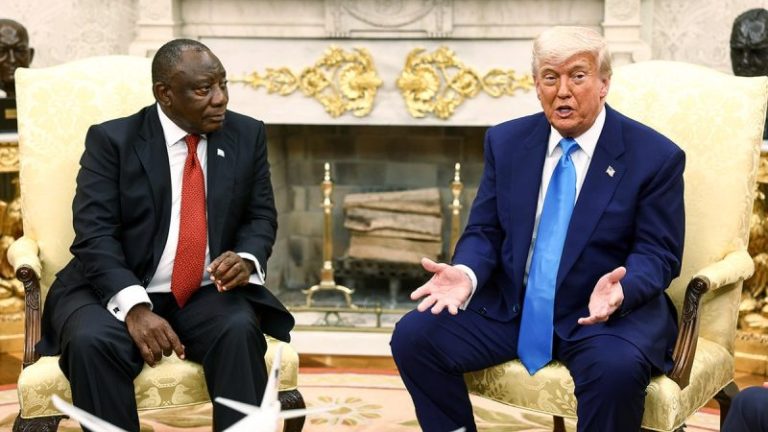
President Donald Trump confronted South African President Cyril Ramaphosa at the White House during a state visit in May.

Trump has claimed that White Afrikaner South African farmers are being slaughtered and forced off their land. The Afrikaners are descendants of mostly Dutch settlers who first arrived in South Africa in 1652.

‘Now this is very bad. These are burial sites right here. Burial sites — over a thousand — of White farmers. And those cars are lined up to pay love on a Sunday morning. Each one of those white things you see is a cross. And there is approximately a thousand of them,’ Trump said at the time. ‘They’re all White farmers. The family of White farmers. And those cars aren’t, driving, they are stopped there to pay respects to their family member who was killed. And it’s a terrible sight. I’ve never seen anything like it. On both sides of the road, you have crosses. Those people are all killed.’

South Africa denies claims of genocide and harassment, as does its president.

‘I’m not going to be repeating what I’ve been saying,’ Ramaphosa said at the May visit. ‘I would say if there was Afrikaner farmer genocide, I can bet you these three gentlemen would not be here, including my Minister of Agriculture. He would not be with me.’

This post appeared first on FOX NEWS

U.S. Attorney Jeanine Pirro on Tuesday announced an indictment in Washington, D.C., accusing Jimmy ‘Barbecue’ Chérizier and Bazile Richardson, a naturalized U.S. citizen, of conspiring to send U.S. funds to finance Chérizier’s Haitian gang.

The Department of Justice (DOJ) said Chérizier is a fugitive and is believed to be in Haiti.

His co-defendant, Richardson, who also goes by ‘Fredo,’ ‘Fred Lion,’ ‘Leo Danger,’ and ‘Lepe Blode,’ was arrested in Pasadena, Texas on July 23. 

Pirro said Tuesday that Chérizier is a gang leader who orchestrated and committed various acts of violence against Haitians.

In 2020, the U.S. sanctioned Chérizier under the Magnitsky Act for his alleged human rights violations. His indictment makes it the first of its kind for an individual sanctioned under the international Magnitsky Human Rights Accountability Act, Pirro added.

Richardson and Chérizier grew up together in Haiti, though the former later became a naturalized U.S. citizen and was living in North Carolina.

Richardson was indicted for allegedly sending money to Chérizier, knowing that he had been sanctioned under the Magnitsky Act.

‘I want to let the public know that anyone who was giving money to Chérizier, also known as Barbecue, because of his violent acts in his home country, cannot say ‘I didn’t know. I didn’t know that he was sanctioned by the U.S government,’’ Pirro said. ‘They will be prosecuted, and we will find them because they are supporting an individual who was committing human rights abuses. And we will not look the other way.’

The State Department’s Transnational Organized Crime Rewards Program announced Tuesday that it is offering a reward of up to $5 million for information leading to the arrest or conviction of Chérizier. Anyone with information about his whereabouts is encouraged to contact the State Department.

‘There’s a good reason that there’s a $5 million reward for information leading to Chérizier’s arrest. He’s a gang leader responsible for heinous human rights abuses, including violence against American citizens in Haiti,’ Pirro said. ‘The U.S. government sanctioned Chérizier in 2020 because he was responsible for an ongoing campaign of violence, including the 2018 La Saline massacre, in which 71 people were killed, more than 400 houses were destroyed, and at least seven women raped by armed gangs.’

Court documents show that Chérizier is a former officer in the Haitian National Police and leader of a gang known as the Revolutionary Forces of the G9 Family and Allies, which helped create a gang alliance called Viv Ansanm. The alliance united many of Haiti’s criminal gangs in opposition to the legitimate government of Haiti.

The indictment alleges Chérizier and Richardson, after Chérizier was sanctioned, led a wide-ranging conspiracy with people in the U.S., Haiti and other places to raise money for Chérizier’s gang activities, in violation of the sanctions.

Specifically, the two men solicited money from members of the Haitian diaspora in the U.S.

‘After sending funds to intermediaries in Haiti for Chérizier’s benefit, the U.S. and Haitian co-conspirators would send Chérizier images of receipts from money transfers,’ the DOJ said. ‘Chérizier used these funds principally to pay salaries to the members of his gang and to acquire firearms from illicit firearms dealers in Haiti.’

The Trump administration, in May, designated Viv Ansanm and Gran Grif – two of Haiti’s most powerful gang networks – as foreign terrorist organizations and specifically designated terrorists.

The move was aimed at disrupting the gangs’ operations and supporting efforts to restore order in the troubled Caribbean nation.

The designations brought serious legal consequences. Individuals or entities that provide material support to Viv Ansanm or Gran Grif could face criminal charges, loss of immigration benefits or removal from the U.S.

This post appeared first on FOX NEWS

The U.S. State Department’s annual human rights report delivered a grim assessment of conditions in Venezuela, declaring that human rights have fallen to a new low following reports of widespread abuses and state-sanctioned repression, particularly after the July 2024 presidential election when Nicolás Maduro clung to power. 

‘The human rights situation in Venezuela significantly worsened,’ the report reads. ‘Throughout the year, and particularly after the July 28 [2024] presidential election, Nicolás Maduro and his representatives engaged in serious human rights abuses, reaching a new milestone in the degradation of the rule of law’ after the election, according to the U.N. Independent International fact-finding mission on the country in September.

According to the most recent State Department report, credible evidence indicates a dramatic escalation in arbitrary or unlawful killings, disappearances, torture and harsh prison conditions. NGOs and U.N. observers documented extensive restrictions on freedom of expression, with journalists and human rights defenders facing arrests, harassment and censorship. The judiciary remained deeply compromised — unable or unwilling to hold perpetrators accountable for abuses.

The report noted that the United Nations International Fact Finding Mission stated at least 25 people were killed in the first days following the July 2024 elections, including two children. 

Pro-Maduro leaders ‘harassed and intimidated privately-owned and democratic opposition-oriented television stations, media outlets, and journalists’ through threats, property seizures and prosecutions.

The sweeping report, which will go public Tuesday afternoon, also calls out Brazil and South America for human rights abuses. 

In a parallel diplomatic maneuver, the U.S. Department of Justice, backed by the State Department, significantly increased the reward for Maduro’s capture from $25 million to $50 million. Attorney General Pam Bondi accused Maduro of leading one of the world’s most notorious narco-trafficking operations, including associations with the Tren de Aragua, Sinaloa cartel and the infamous Cartel of the Suns. The Drug Enforcement Administration has reportedly seized 30 tons of cocaine linked to Maduro and his allies, with nearly seven tons directly tied to him.

This nullified the previous reward levels — $15 million initially set during Trump’s first term, later raised to $25 million under the Biden administration. Venezuela’s foreign ministry dismissed the bounty as a ‘political propaganda operation.’

The State Department report highlights an alarming absence of credible efforts by Venezuelan authorities to investigate or prosecute those responsible for human rights violations. Security forces, including the military, police, and colectivos — pro-Maduro armed groups — were repeatedly implicated in abuses, yet the justice system remained ineffective, allowing a culture of impunity to flourish.

Maduro was indicted in Manhattan court in 2020, during the first Trump administration, on narco-terrorism charges. 

The dictatorial Venezuelan leader held onto power after the 2024 presidential election where the U.S. and much of Europe recognized his opposition as Venezuela’s duly elected president.

This post appeared first on FOX NEWS

An Israeli nongovernmental organization is working behind the scenes to provide a critical link between the Israeli military and international organizations with one goal in mind: Get humanitarian aid to Palestinian civilians.

‘We really became this informal connector and facilitator between the Israeli authorities and the humanitarian community,’ IsraAID CEO Yotam Polizer said.

IsraAID has worked in 64 countries and is currently the largest humanitarian organization based out of Israel. 

Polizer says there is broad consensus now that a concerning humanitarian level was reached in Gaza with pockets of malnutrition across the strip. He notes that it isn’t only food that is needed by the civilian population, but also medicine, water and nutritional provisions.

‘When we reach severe malnutrition levels, we know that just rice and flour is not going to solve the problem,’ Polizer added. ‘We need nutritional supplements, we need people to get protein.’ 

For nearly five months, there was no consistent flow of aid. That has changed in recent weeks with thousands of trucks being distributed along with airdrops of supplies to civilians. Recently, the entry of commercial trucks was partially approved.

‘The declared policy of Israel for two and a half months after the ceasefire collapsed was that nothing comes in,’ Polizer said. ‘That was the policy because the plan was to pressure Hamas.’

The IsraAID CEO says the focus must be on saving lives, not on playing the ‘blame game.’ He urges the United Nations, the Israel Defense Forces, the  Gaza Humanitarian Foundation (GHF) and all humanitarian organizations to work together and find solutions.

‘As a humanitarian organization, the concept of ‘do no harm’ is really our Bible,’ Polizer added.

A few months after the war started, IsraAID started to receive requests from global humanitarian organizations they had worked with in Afghanistan and Ukraine, asking for help to facilitate aid deliveries to Gaza.

These groups had issues with customs clearance and approval from the Israeli military to deliver supplies to Palestinians in Gaza. These were problems IsraAID could help solve.

Despite the political and cultural differences, Polizer said the Jewish community of the United States is stepping up to donate and support finding solutions for the hunger crisis in Gaza.

‘You can support the humanitarian crisis in Gaza, but it does not mean you are anti-Israel,’ he concluded.

This post appeared first on FOX NEWS