
Author

admin

Browsing

Bitcoin, the most well-known cryptocurrency, paved the way for the cryptocurrency asset class.

Now the cryptocurrency of choice, its meteoric rise has been unlike any other commodity, resource or asset. Bitcoin’s price rose more than 1,200 percent from March 2020 to reach US$69,044 on November 10, 2021.

The coin showcased its famous volatility in the following year, falling as low as US$15,787 by November 2022 amid economic uncertainty and a wave of negative media coverage.

Bitcoin started 2024 just below US$45,000 and made substantial gains in remainder of the year. Following Donald Trump’s victory over Vice President Kamala Harris in the US presidential election, Bitcoin soared to US$103,697 on December 4, 2024.

The first quarter of 2025 saw the price of Bitcoin decline by more than 25 percent to a low for the year of US$75,004 in early April. Since then, rising institutional demand and an emerging industry-friendly US regulatory environment have poured rocket fuel into the digital assets value.

Bitcoin reached its new all-time high price of US$123,153.22 before pulling back to close at US$119,839.70 on July 14, 2025.

For frequent updates on the biggest news of the crypto sector, check out our Crypto Market Recap, with updates multiple times per week.

Where did Bitcoin start, and what has spurred its price movements since its launch? Read on to find out.

In this article

    What is Bitcoin and who invented it?

    Created as a response to the 2008 financial crisis, the concept of Bitcoin was first introduced in a nine-page white paper titled “Bitcoin: A Peer-to-Peer Electronic Cash System” on October 31, 2008, on a platform called Metzdowd.

    The manifesto was penned by a notoriously elusive person (or persons) who used the pseudonym Satoshi Nakamoto. The author(s) laid out a compelling argument and groundwork for a new type of cyber-currency that would revolutionize the monetary system.

    Cryptographically secured, Bitcoin was designed to be transparent and resistant to censorship, using the power of blockchain technology to create an immutable ledger preventing double-spending. The true allure for Bitcoin’s early adopters was in its potential to wrestle power away from banks and financial institutes and give it to the masses.

    This was especially enticing as the fallout from the 2008 financial collapse ricocheted internationally. Described as the worst financial crisis since the Great Depression, US$7.4 billion in value was erased from the US stock market in 11 months, while the global economy shrank by an estimated US$2 trillion.

    On January 3, 2009, the Genesis Block was established, marking the beginning of Bitcoin’s blockchain, onto which all additional blocks have been added. The Genesis Block contained the first 50 Bitcoins ever created and a simple message: “The Times 03/Jan/2009 Chancellor on the brink of second bailout for banks.”

    Many believe the message hints at Bitcoin’s mission, as it references an article in The London Times that criticized the British government’s inadequate response to the financial crisis of 2007 to 2008, particularly the government’s inability to provide effective relief and support to the struggling economy.

    What was Bitcoin’s starting price?

    When Bitcoin started trading in 2009, its starting price was a minuscule US$0.0009.

    On January 12, 2009, Nakamoto made the first Bitcoin transaction when they sent 10 Bitcoins to Hal Finney, a computer scientist and early Bitcoin enthusiast, marking a crucial milestone in the cryptocurrency’s development and adoption.

    News of the cryptocurrency continued to spread around the Internet, but its value did not rise above US$0 until October 12, 2009, when a Finnish software developer sent 5,050 Bitcoins to New Liberty Standard for US$5.02 via PayPal Holdings (NASDAQ:PYPL), thereby establishing both the value of Bitcoin and New Liberty Standard as a Bitcoin exchange.

    The first time Bitcoin was used to make a purchase was on May 22, 2010, when a programmer in Florida named Laszlo Hanyecz offered anyone who would bring him a pizza 10,000 Bitcoin in exchange. Someone accepted the offer and ordered Hanyecz two Papa John’s pizzas for US$25. The 10,000 Bitcoin pizza order essentially set Bitcoin’s price in 2010 at around US$0.0025.

    Bitcoin’s price finally broke through the US$1 mark in 2011, and moved as high as US$29.60 that year. However, in 2012 Bitcoin pulled back and remained relatively muted.

    Bitcoin’s price saw its first significant growth in earnest in 2013, the year it broke through both US$100 and US$1,000. It climbed all the way to US$1,242 in December 2013.

    From that peak, Bitcoin’s price began to fall, and it spent most of 2015 in the US$200 range, but it turned around in December 2015 and began to climb again, ending the year at around US$430.

    Bitcoin price chart from August 2011 to December 31, 2015.

    Chart via TradingEconomics.com.

    When did the Bitcoin price start to grow?

    January 1, 2016, marked the beginning of Bitcoin’s sustained price rise. It started the year at US$433 and ended it at US$989 — a 128 percent value increase in 12 months.

    That year, several contributing factors led to Bitcoin’s rise in mainstream popularity. The stock market experienced one of its worst first weeks ever in 2016, and investors began turning to Bitcoin as a “safe-haven” stock amidst economic and geopolitical uncertainty.

    2016 also saw the Brexit referendum in the UK in June and the election of Donald Trump to the White House in November, both events that coincided with a bump in Bitcoin’s price.

    Bitcoin continued its ascent, while various industries continued to take an interest in blockchain technology, particularly technology and finance. In February, a group of investors that included IBM (NYSE:IBM) and Goldman Sachs (NYSE:GS) invested US$60 million in a New York firm developing blockchain technology for financial services, Dig Asset Holdings. Bitcoin was trading at US$368.12 on February 2, down a bit from January, but two months later it was US$418.

    In May the price of Bitcoin experienced a significant price increase, rising by 21 percent to US$539 at the end of the month. Its price went higher into June, peaking at US$764 on June 18. After that, it fell sharply and spent the summer in the high US$600 range. It dropped to US$517 on August 1 and started its climb all over again.

    Microsoft (NASDAQ:MSFT) and Bank of America Merrill Lynch partnered for a finance transacting endeavor in September. Not much price movement was observed, but Bitcoin remained on a steady upward trajectory after that. In October, Ripple partnered with 12 banks in a trial that used its native digital currency token XRP to facilitate cross-border payments. Institutional investment bolstered investor confidence, and Bitcoin went from US$629 to US$736 between October 20 and November 20.

    Bitcoin’s popularity continued into 2017, and it rose from US$1,035.24 in January to US$18,940.57 in December. Futures contracts began trading on the Chicago Mercantile Exchange in December 2017, and Bitcoin began to be more widely perceived as a legitimate investment rather than a passing fad. FOMO flooded the market. What ensued was a frenzy of media coverage featuring celebrity endorsements and initial coin offerings (ICOs) that spilled into 2018.

    Regulators began to take notice and issued warnings and guidelines meant to protect investors and mitigate risks associated with digital assets, which only seemed to make people want them more.

    Through it all, Bitcoin remained the “gold standard” of cryptocurrencies, yet its price was subject to extreme volatility. At the beginning of 2019, it was around US$3,800, it reached nearly US$13,000 in June, but by December 2019 Bitcoin was trading at around US$7,2000.

    Bitcoin price chart from January 1, 2016, to December 31, 2019.

    Chart via TradingEconomics.com.

    What factors led to Bitcoin’s rise in the early 2020s?

    2020 proved a testing ground for the digital coin’s ability to weather financial upheaval. Starting the year at US$6,950.56, a widespread selloff in March triggered by the pandemic brought its value to US$4,841.67 — a 30 percent decline.

    The low created a buying opportunity that helped Bitcoin regain its losses by May. The rally continued throughout 2020, and the digital asset ended the year at US$29,402.64, a 323 percent year-over-year increase and a 507 percent rise from its March drop.

    By comparison, gold, one of the best-performing commodities of 2020, added 38 percent to its value from the low in March through December, setting what was then an all-time high of US$2,060 per ounce in August.

    Bitcoin’s ascent continued in 2021, rallying to an all-time high of US$68,649.05 in November, a 98.82 percent increase from January. Much of the growth in 2021 was attributed to risk-on investor appetite.

    Increased money printing in response to the pandemic also benefited Bitcoin, as investors with more capital looked to diversify their portfolios. The success of the world’s first cryptocurrency amid the market ups and downs of 2020 and 2021 led to more interest and investment in other coins and digital assets as well. For example, 2021 saw the rise of non-fungible tokens (NFTs), unique crypto assets that are stored, sold and traded digitally using blockchain technology.

    Almost immediately following its record close above US$69,000 in November 2021, Bitcoin’s value began to fall once again. Market uncertainty weighed especially heavily on Bitcoin in 2022. During the second quarter of that year, values dived below US$20,000 for the first time since December 2020.

    On May 7, 2022, Curve Whale Watching posted the first sign that confidence in Terra Luna, a cryptocurrency pegged to the US dollar, was waning after 85 million of its stablecoin UST exchanged for less than the 1:1 ratio it was supposed to maintain. This triggered a massive sell-off that brought Luna’s value down 99.7 percent and eventually resulted in the Terra tokens ceasing to be traded on major crypto exchanges.

    Terra’s collapse had a domino effect on the industry as investors’ faith in crypto crumbled. In July, the Celsius network, a platform where users could deposit crypto into digital wallets to accrue interest, halted all transfers due to “extreme market conditions”, driving down the price of Bitcoin even further to US$19,047, a 60 percent decline from January 2022. In July, Celsius filed for Chapter 11 bankruptcy.

    However, the biggest shake-up to the industry came in November when CoinDesk published findings that cryptocurrency trading firm Alameda Research led by Sam Bankman-Fried had borrowed billions of dollars of customer funds from crypto exchange and sister company FTX. Over a third of Alameda’s assets were tied up in FTT, the native cryptocurrency of FTX.

    Once this news broke, investors withdrew their funds en masse, causing a liquidity crunch that collapsed FTX. Bankman-Fried was later arrested and sentenced to 25 years in federal prison on counts of money laundering, wire fraud and securities fraud.

    Although Bitcoin was never implicated, the fallout of the FTX scandal led to a crisis of confidence across the sector and increased scrutiny from regulators and law enforcement. By the end of 2022, prices for Bitcoin had moved even lower to settle below US$17,000.

    Bitcoin price chart from January 1, 2020, to December 31, 2022.

    Chart via TradingEconomics.com.

    Bitcoin’s powerful performance cannot be understated as evidenced by its price performance in the later half of 2023 and so far in 2024.

    Concerns with the banking system led the price of Bitcoin to rally in March 2023 to US$28,211 by March 21 after the failure of multiple US banks alarmed investors.

    In Q2 2023, Bitcoin continued its ascent, stabilizing above US$25,000 even as the US Securities Exchange Commission (SEC) filed lawsuits against Coinbase Global (NASDAQ:COIN), along with Binance and its founder Changpeng Zhao.

    Although it looked like bad news for the sector, Bitcoin stayed steady, holding above US$25,000. This was supported by BlackRock (NYSE:BLK), the world’s largest asset manager, filing for a Bitcoin exchange-traded fund with the SEC on June 15.

    Bitcoin’s price jumped above US$30,000 on June 21, 2023, and on July 3, 2023, the crypto hit its highest price since May 2022 at US$31,500. It held above US$30,000 for nearly a month before dropping just below on July 16, 2023. By September 11, 2023, prices had slid further to US$25,150.

    Heading into the final months of the year, the Bitcoin price benefited from increased institutional investment on the prospect of the SEC approving a bevy of spot Bitcoin exchange-traded funds by early 2024. In mid-November the price for the popular cryptocurrency was trading up at US$37,885, and by the end of the year that figure had risen further to US$42,228 per BTC.

    2024 Bitcoin price performance

    Bitcoin price chart from January 1, 2024, to November 6, 2024.

    Chart via TradingEconomics.com.

    Once the SEC’s approval of 11 spot Bitcoin ETFs hit the wires, the price per coin jumped again to US$46,620 on January 10, 2024. These investment vehicles were a major driving force behind the more than 42 percent rise in value for Bitcoin in February; it reached US$61,113 on the last day of the month.

    On March 4, Bitcoin surged almost 8 percent in 24 hours to trade at US$67,758, less than 2 percent away from its previous record, and on March 11 it hit a new milestone, surpassing the US$72,000 mark. Three days later, on March 14, Bitcoin reached its highest-ever recorded price of US$73,737.94, surpassing the market cap of silver.

    Bitcoin often surges leading up to the halving events, which is when Bitcoin rewards are halved for miners. The most recent came in April when the reward for completing a block was cut from 6.25 to 3.125 Bitcoin.

    Several sources cited the 2024 halving as one of the forces that drove the price of Bitcoin to its newest high.

    The halving occurred at around 8:10 p.m. EDT on a Friday, and Bitcoin’s price remained stable within the US$63,000 to US$65,000 range over the ensuing weekend. On April 22, the Monday following the halving, it was slightly above US$66,000.

    While Bitcoin’s price stayed relatively stable, the cryptocurrency’s trading volume experienced significant fluctuations through that weekend, with a 45 percent increase from April 19 to April 20 followed by a 68 percent decline on April 21. Between April 30 and May 3, it fell as low as US$56,903 following the Federal Reserve’s April policy meeting, which did not produce a rate cut.

    Reports that the SEC was moving to approve spot Ether ETFs in May sent the price of Bitcoin climbing again alongside that of Ether, the native token of the Ethereum blockchain, which serves as the foundation for these ETFs. Bitcoin passed US$71,000 for the second time ever at 8:00 p.m. EDT on May 20, days before the SEC approved spot Ether ETFs on May 23.

    Bitcoin hovered between US$67,000 and US$69,000 for the remainder of the month and into the middle of June. It fell back below US$67,000 on June 13 and moved lower the next day when the Federal Reserve opted to delay lowering interest rates once again.

    Losses picked up speed through late June and continued in July, with analysts pointing to uncertainty over post-election regulations, Germany’s sell-off of seized Bitcoin assets and concerns about the impact of the defunct trading platform Mt. Gox on the token market. Bitcoin dropped to a two-month low of US$55,880 on July 8, but quickly recovered most of its losses after Federal Reserve Chairman Jerome Powell’s congressional testimony on July 9 that signaled rate cuts may not be far off.

    As crypto gains wider acceptance and accessibility, with more traditional financial institutions and products incorporating digital assets, the type of risk that Bitcoin represents has evolved. Bitcoin was primarily seen as a highly speculative alternative investment. Now, with expanding institutional interest, it is increasingly seen as a ”risk-on” asset – meaning its price movements are influenced by market sentiment, investor confidence and broader economic conditions.

    A rise in Bitcoin’s price ensued after the July 13 assassination attempt of US presidential candidate Donald Trump, who has been actively endorsing the crypto industry for support. Bitcoin rose from US$57,899 to US$66,690 in the week following the incident as the odds of a Trump victory were seen to improve, highlighting the impact of regulatory uncertainty on the market. However, Bitcoin’s price didn’t experience any significant pullbacks in the week after current US President Joe Biden dropped out of the race on July 21 and current Vice President Kamala Harris took over as the new nominee.

    Other significant developments affecting Bitcoin during the summer included the underwhelming performance of spot Ether ETFs, fears of a US government Bitcoin sell-off, Trump’s proposed national Bitcoin stockpile and Trump’s declining chances of winning the election as support for Harris snowballs.

    Bitcoin experienced a tumultuous August, with its price plummeting alongside other digital assets and the stock market on August 5th. Several factors triggered this sell-off, including weaker-than-expected economic data on August 2 and an unexpected interest rate hike in Japan. These events sparked panic in Asian markets, leading investors to liquidate high-risk assets like Bitcoin.

    Despite a brief recovery, Bitcoin continued to fluctuate throughout August, dropping to US$58,430 on the weekend of August 10 and 11, and experiencing further price swings between US$60,700 and US$56,700. While positive inflation data boosted the stock market, Bitcoin struggled to break past a US$60,000 ceiling.

    A brief rally on August 23rd, prompted by the Federal Reserve’s signal to begin lowering interest rates, was quickly followed by another price drop. This pattern of rallies and subsequent declines persisted for the remainder of August and most of September. Bitcoin ended the month at just above US$64,540.

    During the lead up to the 2024 US presidential election had a notable affect on Bitcoin’s price movements, with the Republican party generally seen as more ‘crypto-friendly’ than the Democrats. On October 28, PolyMarket, bettors favored Trump with a 66.1 percent probability of winning compared to Harris’ 33.8 percent. This translated into a 7 percent gain in a little over 24 hours on October 29 to flirt with the previous all-time high, coming in at US$73,295.

    A few days later on November 3, Trump’s lead would seemingly narrow with the gap closing to 55 percent for Trump and 44.3 percent for Harris. The Bitcoin price responded by dropping to US$67,874 on November 4.

    Bitcoin set a then high price on November 6, 2024, when it reached US$76,243 per BTC at 4:00 p.m. EST. This price came after the 45th US President Donald Trump made a stunning political comeback to become the 47th US President. His retaking of the presidency was heralded as hugely positive for the cryptocurrency market.

    “We have a #Bitcoin President,” Michael Saylor, founder of Bitcoin development company Strategy (NASDAQ:MSTR), posted on X.

    Bitcoin crossed the US$100,000 threshold for the first time on December 4, rising as high as US$103,697.

    What was the highest price for Bitcoin?

    Bitcoin set a new all-time high price on July 14, 2025, when it reached US$123,153.22 per BTC at 07:38 a.m. GMT. Reuters reported that the Bitcoin price has rallied more than 60 percent since the US election in early November.

    This latest record high price came as US lawmakers announced key ‘Crypto Week’ bills, and President Trump signaled support for the GENIUS Act, which is expected to create a clear framework for banks and enterprises to issue digital currencies.

    The crypto market has found a friend in the Trump administration thus far. Since it began, US regulators have been more inclined to make policy changes that loosen regulations for crypto investing.

    What is Bitcoin at today?

    As of August 4, 2025, Bitcoin is trading around the US$115,000 level after spending the prior few weeks holding above US$110,000.

    Earlier in 2025, Bitcoin demonstrated its volatile nature when the price of the cryptocurrency fell to as low as US$75,000 per coin by April 9. This represented a key buying opportunity as crypto buffs were anticipating further strength in the market under Trump.

    Soon after, the price of Bitcoin was once again on a steady upward path and breached the US$100,000 level on May 8.

    FAQs for investing in Bitcoin

    What is a blockchain?

    A blockchain is a digitized and decentralized public ledger of all cryptocurrency transactions.

    Blockchains are constantly growing as completed blocks are recorded and added in chronological order. The mechanism by which digital currencies are mined, blockchain has become a popular investment space as the technology is increasingly being implemented in business processes across a variety of industries. These include banking, cybersecurity, networking, supply chain management, the Internet of Things, online music, healthcare and insurance.

    Is Peter Todd Satoshi Nakamoto?

    Canadian software developer Peter Todd has denied he is Satoshi Nakamoto, a claim made by the documentary ‘Money Electric: The Bitcoin Mystery,’ which aired on October 8, based on circumstantial evidence such as posts on an early Bitcoin forum and correspondence between Todd and Hal Finney, who received the first Bitcoin from Satoshi.

    Aired on HBO, the film by Cullen Hoback features interviews with people involved in Bitcoin’s creation and suggests that Todd could be the elusive Satoshi Nakamoto who wrote the 2008 white paper that led to Bitcoin’s launch. Reddit posts dating back to 2015 have also suggested that Todd could be Satoshi.

    Todd has continuously denied the claim, most recently to multiple media outlets, including CoinDesk and Bloomberg.

    How to buy Bitcoin?

    Bitcoin can be purchased through a variety of crypto exchange platforms and peer-to-peer crypto trading apps, and then held in a digital wallet. These include Coinbase Global, CoinSmart Financial Inc (OTC Pink:CONMF, NEO:SMRT), BlockFi, Binance and Gemini.

    What is the Bitcoin halving?

    Unlike traditional currencies that can increase circulation through printing, the number of Bitcoins is finite. This limit is a core function of Bitcoin’s algorithm and was designed to offset inflation by maintaining scarcity. There are 21 million in existence, of which 19,787,175 are in circulation as of August 8. This means there are 1,212,825 still unmined.

    A new Bitcoin is created when a Bitcoin miner uses highly specialized software to complete a block of transaction verifications on the Bitcoin blockchain. Roughly 900 Bitcoins are currently mined per day; however, after 210,000 blocks are completed, a Bitcoin protocol called a halving automatically reduces the number of new coins issued by half. Halving not only counteracts inflation but also supports the cryptocurrency’s value by ensuring that its price will increase if demand remains the same.

    Halvings have occurred every four years since 2012, with the most recent happening on April 19, 2024. The next halving is expected to occur in 2028.

    Bitcoin’s halving has significant implications for the cryptocurrency’s mining activity and supply because of how Bitcoin mining works. Currently, miners are paid 3.125 Bitcoin for every block they complete. After the next halving, the pay rate will lower to 1.5625 Bitcoin for every completed block for the next four years.

    What is Coinbase?

    Coinbase Global is a secure online cryptocurrency exchange that makes it easy for investors to buy, sell, transfer and store cryptocurrencies such as Bitcoin.

    How does crypto affect the banking industry?

    Cryptocurrencies are an alternative to traditional banking, and tend to attract people interested in assets that are outside mainstream systems. According to data from Statista, 53 percent of crypto owners are between the ages of 18 and 34, showing that the industry is drawing younger generations who may be interested in decentralized digital options.

    Privacy is a key draw for cryptocurrency owners, as is the fact that they are separated from third parties such as central banks. Additionally, crypto transactions, including purchases, sales and transfers, are often quick and have fewer associated fees than transactions going through the banking system in the typical manner.

    That said, banks are starting to notice how popular cryptocurrencies are. As Bitcoin and its compatriots become increasingly mainstream, many banks have begun to invest in cryptocurrencies and blockchain companies themselves.

    Is Bitcoin a good investment anymore?

    While Bitcoin has reached new heights in 2025, one of its well-known features is its volatility. Investors who are more accepting of risk could look to the cryptocurrency space as there historically has been money to be made, and Bitcoin is regaining value after plummeting in 2022. However, there is also historically money to be lost, and investors who prefer to take smaller risks should look towards other avenues.

    For more information on investing in Bitcoin right now, check out our article Is Now a Good Time to Buy Bitcoin?

    Who has the most invested in Bitcoin?

    Satoshi Nakomoto, the mysterious founder of Bitcoin, is believed to also be the biggest holder of the coin. Analysis into early Bitcoin wallets has revealed that Nakamoto likely owns over 1 million of the nearly 19.5 million Bitcoins in existence.

    Does Elon Musk own Bitcoin?

    Tesla and Twitter CEO Elon Musk’s association with both Bitcoin and the meme coin Dogecoin is well known, and both his tweets and Tesla’s actions have influenced the cryptocurrencies’ trajectories over the years.

    While it is unknown just how much he owns, Musk has disclosed that he personally has holdings of Bitcoin and Dogecoin, as well as Ether. It was revealed in September 2023 that Musk may be funding Dogecoin on the quiet, according to Forbes.

    As for Tesla, the company purchased US$1.5 billion of Bitcoin in 2021, but sold 75 percent of that the next year. As of July 2025, the EV maker’s Bitcoin holdings were estimated at 11,509 Bitcoin, the eigth-largest bitcoin holdings for a publicly traded company. In a January 2024 post on his social media platform X, Musk said “I still own a bunch of Dogecoin, and SpaceX owns a bunch of Bitcoin.’

    Securities Disclosure: I, Meagen Seatter, hold no direct investment interest in any company mentioned in this article.

    2024 Tech Outlook Report

    What red hot sector is expected to grow 85.7% annually until 2032?

    Download your investor report today.

    Learn About Exciting Opportunities in the Tech Sector

    Your Newsletter Preferences

    This post appeared first on investingnews.com

    Forte Minerals Corp . (‘ Forte ‘ or the ‘ Company ‘) ( CSE: CUAU ) ( OTCQB: FOMNF ) ( Frankfurt: 2OA ) is pleased to announce the expansion of its capital markets capabilities with three strategic initiatives:

    • The appointment of Port Guichon Strategic Advisory, as Investor Relations and Capital Markets Specialist;

    These additions support Forte’s commitment to investor engagement, capital markets excellence, and digital transparency.

    Strategic Advisory from Proven Mining Dealmakers

    Forte has retained Mills Dunlop Capital Partners (MDCP), an independent M&A and strategic advisory firm led by Russell Mills and Brodie Dunlop, to provide strategic and advisory guidance. With deep experience in structuring complex mining transactions, MDCP brings a proven record of execution and capital markets insight.

    MDCP offers:

    1. Execution expertise : Multiple M&A and strategic transactions across the mining sector over several decades.
    2. Sector specialization : Their independent model allows for conflict-free, tailored guidance.
    3. Comprehensive support : Forte will benefit from assistance in deal evaluation, due diligence, regulatory documentation, and strategic corporate negotiations.

    ‘Russell and Brodie bring a rare combination of mining knowledge, transactional experience, and corporate connectivity,’ said Patrick Elliott , President & CEO. ‘Their advisory will be critical as we evaluate strategic opportunities and position Forte for long-term success.’

    Port Guichon Strategic Advisory Appointed as Investor Relations & Capital Markets Specialist

    Forte Minerals Corp. is pleased to welcome Kevin Guichon , Principal of Port Guichon Strategic Advisory, to lead its Investor Relations and Capital Markets strategy. Kevin brings over a decade of experience in the Canadian securities industry, including his tenure at Haywood Securities Inc., where he progressed from operations to trading and advisory services.

    He will oversee investor outreach and guide capital markets strategies, working closely with Anna Dalaire, VP of Corporate Development, to expand Forte’s corporate messaging, strengthen relationships with existing shareholders, and build new connections across the investment community.

    As part of his engagement, Kevin will be compensated at C$4,000 per month and has been granted 200,000 stock options, exercisable at C$0.80 per share for five (5) years, under the Company’s incentive stock option plan, subject to regulatory approval.

    ‘Kevin understands both the language of capital markets and the needs of investors,’ said Elliott. ‘His ability to simplify complex opportunities and build trusted relationships will elevate our investor communications.’

    Now Live: AI-Powered Investor Platform on ForteMinerals.com

    Forte has officially launched its AI-powered investor engagement platform, a partnership with Versance.ai, providing instant access to the company’s regulatory filings, investor questions and insights.

    Now live at www.forteminerals.com , the platform offers:

    • Instant Answers: Ask plain-language questions like ‘Summarize the latest news release.’ or ‘How many drill permits do they have?’ and receive sourced, reliable responses in seconds.
    • Side-by-side Filing Comparison: Compare MD&A sections and risk disclosures across time or against peer companies.
    • 24/7 Multilingual Access: Available for free, globally, empowering investors to perform due diligence on their own terms.

    ‘Transparency isn’t optional,’ said Anna Dalaire , VP Corporate Development and Corporate Secretary. ‘At Forte, we believe in building real relationships with our shareholders; our team is always here to connect. But we also understand that today’s investors want answers now. Communication doesn’t just happen through press releases anymore; it’s multi-channel, on-demand, and constant. This AI tool gives investors 24/7 access to the information they need, while keeping compliance front and center.’

    Corporate Update: Option Grants

    The Company also announces that, pursuant to its existing stock option plan, it has granted an aggregate of 1,450,000 stock options (the ‘Options’) to directors, officers, and consultants of the Company. These Options are exercisable at C$0.80 per share and expire five (5) years from the date of grant, subject to applicable regulatory approvals.

    ABOUT Forte Minerals CORP.

    Forte Minerals Corp. is an exploration company with a strong portfolio of high-quality copper (Cu) and gold (Au) assets in Peru. Through a strategic partnership with GlobeTrotters Resources Perú S.A.C. , the Company gains access to a rich pipeline of historically drilled, high-impact targets across premier Andean mineral belts. The Company is committed to responsible resource development that generates long-term value for shareholders, communities, and partners.

    On behalf of Forte Minerals CORP.

    (signed) ‘ Patrick Elliott’
    Patrick Elliott, MSc, MBA, PGeo
    President & Chief Executive Officer
    Forte Minerals Corp.

    For further information, please contact:
    Investor Inquiries
    Kevin Guichon, IR & Capital Markets
    E: kguichon@forteminerals.com
    C: (604) 612-9976

    Media Contact
    Anna Dalaire, VP Corporate Development
    E: adalaire@forteminerals.com
    T: (604) 983-8847
    info@forteminerals.com
    www.forteminerals.com

    Follow Us On Social Media : LinkedIn | Instagram | X | Meta | The Drill Down; Newsletter

    Certain statements included in this press release constitute forward-looking information or statements (collectively, ‘forward-looking statements’), including those identified by the expressions ‘anticipate’, ‘believe’, ‘plan’, ‘estimate’, ‘expect’, ‘intend’, ‘may’, ‘should’ and similar expressions to the extent they relate to the Company or its management. The forward-looking statements are not historical facts but reflect current expectations regarding future results or events. This press release contains forward looking statements relating to the intended use of proceeds of the Strategic Placement. These forward-looking statements and information reflect management’s current beliefs and are based on assumptions made by and information currently available to the Company with respect to the matter described in this press release. Forward-looking statements involve risks and uncertainties, which are based on current expectations as of the date of this release and subject to known and unknown risks and uncertainties that could cause actual results to differ materially from those expressed or implied by such statements. Additional information about these assumptions and risks and uncertainties is contained under ‘Risk Factors and Uncertainties’ in the Company’s latest management’s discussion and analysis, which is available under the Company’s SEDAR+ profile at www.sedarplus.ca, and in other filings that the Company has made and may make with applicable securities authorities in the future.

    Forward-looking statements are not a guarantee of future performance and involve risks, uncertainties and assumptions which are difficult to predict. Factors that could cause the actual results to differ materially from those in forward-looking statements include the continued availability of capital and financing, and general economic, market or business conditions. Forward-looking statements contained in this press release are expressly qualified by this cautionary statement. These statements should not be read as guarantees of future performance or results. Such statements involve known and unknown risks, uncertainties and other factors that may cause actual results, performance or achievements to be materially different from those implied by such statements. Although such statements are based on management’s reasonable assumptions, there can be no assurance that the statements will prove to be accurate or that management’s expectations or estimates of future developments, circumstances or results will materialize. The Company assumes no responsibility to update or revise forward-looking information or statements to reflect new events or circumstances unless required by law. Readers should not place undue reliance on the Company’s forward-looking statements.

    Neither the Canadian Securities Exchange (the ‘CSE’) nor its Regulation Services Provider (as that term is defined in the policies of the CSE) accepts responsibility for the adequacy or accuracy of this release.

    A photo accompanying this announcement is available at https://www.globenewswire.com/NewsRoom/AttachmentNg/75063682-5dba-4c3f-a217-79a1b9b82868

    News Provided by GlobeNewswire via QuoteMedia

    This post appeared first on investingnews.com

    TSX Venture Exchange: BSK
    Frankfurt Stock Exchange: MAL2
    OTCQB Venture Market (OTC): BKUCF

    Blue Sky Uranium Corp. (TSXV: BSK,OTC:BKUCF) (FSE: MAL2) (OTC: BKUCF) (‘Blue Sky’ or the ‘Company’) is pleased to announce the expansion of the principal target at the Corcovo Uranium Project, located in the Western Malargüe Mining District, Mendoza Province Argentina . The Company has now reviewed and integrated data from an additional 104 historical oil & gas (‘ O&G ‘) wells (part of a larger dataset) into its geological model. These new data build upon the previous interpretation that was based on 89 O&G drillholes (see News Release data June 4, 2025 ) and provide stronger support for a substantial uranium mineralized system with significant continuity, based on uranium equivalent (‘ eU ‘) and gamma-ray anomalies in the Centenario Core horizon.

    A new uranium equivalent grade-by-thickness (eU × thickness) map has been generated for the Centenario Core Horizon (see Figure 1 ). The map, which incorporates the 104 integrated wells, confirms the presence of the uranium mineralized zones consistent with roll front style mineralization. The northwestern extent of the uranium mineralized corridor remains open, suggesting potential for further expansion. Additionally, the map highlights a single principal corridor of uranium equivalent anomalies, along which multiple anomalies have been identified. One of these bodies is particularly noteworthy for its scale, measuring approximately 2.2 kilometres along a northwest–southeast trend and 500 metres in width ( Figure 2 ). This data integration supports improved mapping of the uranium-bearing horizon and reinforces the potential for expansion of the uranium mineralized system.

    Nikolaos Cacos , President & CEO of the Company stated, ‘The quality of the newly integrated data significantly improves our confidence in the continuity and scale of the uranium system at Corcovo. The Centenario Core horizon now shows potential for an even more extensive uranium mineralized system, and we are prioritizing the acquisition and interpretation of 3D seismic data to help delineate the geometry of the potential mineralized bodies. These are key steps in our process to advance the project in support of a potential resource estimation in the future.’

    The Corcovo Project covers 20,000 hectares at the northeastern margin of the O&G producing Neuquén Basin. The geological potential of the region for uranium in situ recovery (‘ ISR ‘) deposits was initially defined by CNEA, the state-owned nuclear company, as reported in the International Atomic Energy Agency and Nuclear Energy Agency document titled: ‘ Uranium 2024: Resources, Production and Demand ‘. Blue Sky optioned the Corcovo project in 2024 as part of a strategic initiative to broaden the Company’s medium to long-term prospects for discovery of additional uranium mineral resources. The project benefits from flat topography, road access, and year-round accessibility, supporting cost-effective exploration and potential future ISR development.

    Deposit Model

    The Inkai uranium project in Kazakhstan is one of the world-leading ISR mining projects and a model for exploration at Corcovo. This roll-front uranium mineralization is hosted in permeable Cretaceous fluvial sandstones, with mineralized zones located at depths of 350 to 530 metres. Individual orebody thicknesses range from 2 to 10 metres, with localized zones reaching up to 15 metres. A characteristic of Inkai is the continuity and scale of the mineralization: roll-front horizons are laterally extensive, commonly traceable for over 25 kilometers in length and up to hundreds of metres in width. These dimensions, combined with favorable porosity and permeability, support efficient and sustained ISR operations. The deposit averages approximately 0.03% U₃O₈ and contains proven and probable reserves totaling 368 million tonnes with 251 million pounds of U₃O₈ ( www.cameco.com 06/02/2025).

    Planned Activities and Data Acquisition

    Blue Sky Uranium recently secured a historic subsurface dataset comprising data from several hundred O&G wells and 34 2D seismic lines. To date, the Company has processed and integrated 104 of these drillholes into its geological model. This initial integration has provided valuable insights into the Centenario Core horizon and has helped delineate the principal uranium-equivalent mineralized corridor.

    The technical team is currently working to incorporate the remaining 344 historical drill holes, which will further enhance the geological and mineralization model. In parallel, the Company is actively pursuing access to 3D seismic data. This expanded effort will improve resolution of subsurface structures and stratigraphy especially throughout the northwestern section of the corridor, which remains open.

    In addition, Blue Sky plans to collect water samples from active oil wells operating under secondary recovery once the Company obtains the necessary permits, and sample drill cuttings from historical wells. These samples are intended for geochemical validation of legacy gamma-ray log data and will support critical geochemical studies to confirm mineralization and guide further exploration. This additional information will be integrated with the 3D seismic interpretation to refine the morphology of horizons with anomalous uranium equivalent and their relation to subsurface geologic structures. It will be important to determine the porosity/permeability characteristics of the host and adjacent geologic units to evaluate their amenability to potential ISR application.  The process is underway to secure access to this information.

    Drill Hole Data Summary

    Table 1. Summary of Drill Holes with Most Significant Intervals of Anomalous eU

    (Cut-off 30ppm eU. Intervals approximate true thickness as all holes drilled vertically through flat-lying strata.)

    Hole ID

    From
    (m)

    To

    (m)

    eU
    (ppm)

    Thickness
    (m)

    Peak Grade
    eU (ppm)

    Horizon

    JCP-2021

    588.7

    590.2

    174

    1.5

    425

    Centenario Core

    JCP.ia-51(d)

    588.0

    590.2

    165

    2.3

    288

    Centenario Core

    ECN-207i

    598.2

    599.4

    117

    1.2

    197

    Centenario Core

    JCP.ia-2006

    563.7

    565.6

    110

    1.8

    230

    Centenario Core

    CoHS-44

    549.7

    554.7

    100

    5.0

    391

    Centenario Core

    JCP.ia-44

    549.6

    554.6

    100

    5.0

    383

    Centenario Core

    CoHS-2019

    570.6

    571.8

    96

    1.2

    182

    Centenario Core

    JCP-42

    545.4

    546.7

    93

    1.3

    146

    Centenario Core

    ECN-297

    602.0

    603.3

    92

    1.3

    151

    Centenario Core

    JCP.ia-45

    583.1

    585.2

    91

    2.1

    158

    Centenario Core

    ECN-298

    569.4

    577.2

    64

    7.8

    181

    Centenario Core

    Methodology and QA/QC

    Blue Sky obtained oil and gas drilling data for 104 wells drilled at the area for work conducted on the properties between 2006 and 2018 through a formal request to the Mendoza provincial authority (Hydrocarbons Directorate – Under‑secretariat for Energy and Mining, Ministry of Economy and Energy, Province of Mendoza).  The work was carried out by Pluspetrol S.A. and its corporate predecessors (see drill hole information in Table 2 for details). This data originates from historical oil and gas exploration programs and has not been independently verified by a Qualified Person.

    Uranium equivalent values reported herein were obtained directly from calibrated spectral gamma-ray logs generated using NaI(Tl) crystal-based tools, with measurements taken approximately every 0.15 to 0.25 metres. Readers are cautioned that uranium-series disequilibrium may affect radiometric results, potentially leading to either underestimation or overestimation of actual uranium content.

    The historical subsurface data integrated into Blue Sky Uranium’s Corcovo Project were originally generated by O&G operators (see listing in Table 2). Based on their technical reports, the following QA/QC protocols were applied during data acquisition and processing:

    • Calibration and Control of Logging Equipment: Gamma-ray and other downhole sensors were routinely calibrated using industry-standard reference materials before and during acquisition campaigns to ensure accuracy and minimize equipment drift.
    • Mud Logging Quality Control: Continuous geological control was implemented through direct sampling and mud logging, allowing real-time reconstruction of lithology and stratigraphy. Data collection included detection and quantification of gases, assessment of lithological changes, and monitoring of drilling parameters, contributing to high-resolution control over depth and stratigraphic correlation.
    • Error Monitoring and Minimization: Protocols included redundant cross-checks of depth control through dual measurement systems (drill string length and wireline logging). Routine detection of measurement errors and recalibrations were documented, ensuring that error margins were kept minimal.

    Qualified Persons

    The technical contents of this news release have been reviewed and approved by Mr. Ariel Testi , CPG, who works for the Company and is a Qualified Person as defined in National Instrument 43-101.

    About Blue Sky Uranium Corp.

    Blue Sky Uranium Corp. is a leader in uranium discovery in Argentina . The Company’s objective is to deliver exceptional returns to shareholders by rapidly advancing a portfolio of uranium deposits into low-cost producers, while respecting the environment, the communities, and the cultures in all the areas in which we work. Blue Sky’s flagship Amarillo Grande Project was an in-house discovery of a new district that has the potential to be both a leading domestic supplier of uranium to the growing Argentine market and a new international market supplier.  The Company’s recently optioned Corcovo project has demonstrated potential to host an in-situ recovery uranium deposit. The Company is a member of the Grosso Group, a resource management group that has pioneered exploration in Argentina since 1993.

    ON BEHALF OF THE BOARD

    ‘Nikolaos Cacos’

    ______________________________________
    Nikolaos Cacos , President, CEO and Director

    Neither TSX Venture Exchange nor its Regulation Services Provider (as that term is defined in policies of the TSX Venture Exchange) accepts responsibility for the adequacy or accuracy of this release.

    This news release may contain forward-looking statements and forward-looking information (collectively, the ‘forward-looking statements’) within the meaning of applicable securities laws. Forward-looking statements address future events and conditions and therefore involve inherent risks and uncertainties. Any statements that are contained in this press release that are not statements of historical fact may be deemed to be forward-looking statements. Forward-looking statements are often identified by terms such as ‘may’, ‘should’, ‘anticipate’, ‘will’, ‘estimates’, ‘believes’, ‘intends’ ‘expects’ and similar expressions which are intended to identify forward-looking statements. More particularly and without limitation, this press release contains forward-looking statements that, other than statements of historical fact, address activities, events or developments the Company believes, expects or anticipates will or may occur in the future, including, without limitation, statements about the Company’s planned exploration campaigns, advancement of the Corcovo project, the future value of the previous work done to the Corcovo project and potential of the Corcovo project. Forward-looking statements are not guarantees of future performance and accordingly undue reliance should not be put on such statements due to the inherent uncertainty therein.

    Forward-looking statements are subject to a number of risks and uncertainties that may cause the actual results of the Company to differ materially from those discussed in the forward-looking statements and, even if such actual results are realized or substantially realized, there can be no assurance that they will have the expected consequences to, or effects on, the Company. Factors that could cause actual results or events to differ materially from current expectations include, among other things: uncertainty relating to mineral resources; risks related to heavy metal and transition metal price fluctuations, particularly uranium and vanadium; risks relating to the dependence of the Company on key management personnel and outside parties; the potential impact of global pandemics; risks and uncertainties related to governmental regulation and the ability to obtain, amend, or maintain licenses, permits, or surface rights; risks associated with technical difficulties in connection with mining activities; and the possibility that future exploration, development or mining results will not be consistent with the Company’s expectations, including in respect of the Company’s planned exploration program described in this news release. Actual results may differ materially from those currently anticipated in such statements. Readers are encouraged to refer to the Company’s public disclosure documents for a more detailed discussion of factors that may impact expected future results. The forward-looking statements contained in this press release are made as of the date of this press release, and the Company does not undertake any obligation to update publicly or to revise any of the included forward-looking statements, whether as a result of new information, future events or otherwise, except as expressly required by securities law.

    View original content to download multimedia: https://www.prnewswire.com/news-releases/blue-sky-expands-the-principal-target-at-the-corcovo-uranium-project-argentina-302522642.html

    SOURCE Blue Sky Uranium Corp.

    View original content to download multimedia: http://www.newswire.ca/en/releases/archive/August2025/06/c7049.html

    News Provided by Canada Newswire via QuoteMedia

    This post appeared first on investingnews.com

    Questcorp Mining Inc. (CSE: QQQ,OTC:QQCMF) (OTCQB: QQCMF) (FSE: D910) (the ‘Company’ or ‘Questcorp’) is pleased to announce that drilling has commenced on its La Union Project in northwest Sonora, Mexico. This work is being carried out by property vendor and operator Riverside Resources Inc. (TSXV: RRI).

    Highlights

    • Initial drill program is designed to expand known zones of mineralization, test new targets, and explore areas surrounding multiple historical mine workings within the 25 km² project area.
    • Drill program will consist of + 1,500m of diamond core drilling across six holes, each averaging 250m in depth.
    • Drilling to test the carbonate-hosted replacement deposit (CRD) style of mineralization, with gold associated with mantos, chimneys, and along structural zones.
    • Angled drill holes are aimed at cutting perpendicular to stratigraphic targets and some structural targets which is typical in CRD systems
    • Structural features may have served as mineralizing conduits and are key targets in the current drill program.

    The recent exploration work over the past three months by Riverside has improved the understanding of the structural geology and stratigraphy in the Sierra El Viejo, the mountain range immediately to the west of La Union Project. The La Union district lies along the flanks of this range, where these updated interpretations help guide current exploration efforts. The exploration target focus is for a large potential gold discovery that expands from previous smaller scale mine operations on the property. The drill program will begin to test the new concepts and expand past previous mining.

    Saf Dhillon, President & CEO states, ‘Questcorp is proud to be working with John-Mark and his whole team at Riverside in what is a historic moment in the development of this property. The La Union Project has had work conducted on it for decades, including the production of 50,000 ounces of gold itself but, it has never had a drill bit pierce the ground until now!’

    Earlier this year, Questcorp entered into a definitive option agreement with Riverside’s wholly owned subsidiary, RRM Exploracion, S.A.P.I. DE C.V. to acquire a 100% interest in the La Union Project. As part of the agreement, Questcorp issued shares to Riverside, making Riverside a shareholder and aligning both parties’ interests in the Project’s success. With funding provided by Questcorp, an initial C$1,000,000 exploration program is now underway. This marks the first phase of a larger, C$5,500,000 work commitment, contingent on exploration results and Questcorp’s continued participation.

    The Drill Program Targets include more than four different areas, beginning with this early-stage stratigraphic and orientation phase of drilling exploration aimed at evaluating the scale of alteration and indications of a mineralized system. This will be the first drilling ever conducted on most of the targets, despite past mining having occurred in the majority of these areas. The initial program will consist of one to three holes per area, primarily for orientation purposes. Follow-up drilling is planned and can be expanded based on initial results, which will help verify the stratigraphy, lithologies, and structural features allowing for improved modeling and next-stage discovery targeting. The four areas are listed below:

    • Union Main Mine Area – The program will use angled drill holes to test limestone and other carbonate stratigraphic hosts within the Clemente Formation, with the potential to reach the underlying Caborca Formation. These units are considered the primary hosts for replacement-style mineralization.
    • North Union Mine Area – The initial focus of the program will be on testing structural interpretations. Additional drilling is anticipated following this first phase, as results will help guide future drill testing of areas with past mining activity and various structural orientations.
    • Cobre Mine Area – The Clemente Formation is the primary host unit, and structural features combined with areas of past mining provide multiple target zones. Drilling will begin with an initial stratigraphic test hole to help orient around the thickness of the host unit and extend into the lower Caborca Formation, which is also a favorable host for CRD-style mineralization.
    • Central Union Area – Structural targets, as possible mineralization feeder zones, are a key focus in this past mining manto area. There are extensive additional target zones in the area, and this initial orientation drilling will provide vectoring for the next stage of drilling and further study of the Clemente Formation, and possibly into the Caborca Formation as currently interpreted.

    General Overview of La Union Project

    The Project is summarized in a recently published NI 43-101 Technical Report available under Questcorp’s SEDAR+ profile (www.sedarplus.ca). Riverside initially acquired the Project and subsequently consolidated additional inlier mineral claims, building a strong land position. Riverside then advanced the Project through surface access agreements and drill permitting, making it a turn-key exploration opportunity for Questcorp.

    The Project was originally identified through Riverside’s exploration work in the western Sonora Gold Belt, conducted in collaboration with AngloGold Ashanti Limited, Centerra Gold Inc., and Hochschild Mining Plc. Earlier research by Riverside Founder John-Mark Staude also contributed to recognizing the district’s potential. Initial work by members of the Riverside team, drawing on more than two decades of geological compilation and analysis, further confirmed the region as highly prospective.

    At the Project, historical mining by the Penoles Mining Company targeted chimney and manto-style replacement bodies within the upper oxide zones. As a result, the underlying sulfide zones represent immediate and compelling drill targets for further exploration.

    The Project features favorable limestone host rocks, an extensive alteration footprint, and multiple small-scale historical workings, with mineralization styles similar to those at the Hermosa Project in southern Arizona. At Hermosa, South32 is advancing mine development following its acquisition of the project from Arizona Mining. On 15 February 2024, South32’s board approved a US $2.16 billion capital investment to develop the Taylor zinc-lead-silver deposit, representing the largest private mining investment in Southern Arizona’s history. The project is now considered one of the most significant undeveloped base-metal assets in the United States.

    At the La Union Project, immediate drill targets offer the potential for significant-scale discoveries. La Union is well positioned for near-term exploration success, with targets that include both oxide and deeper sulfide mineralization.

    Figure 1. Geologic map with the tenure of the Union internal concession shown in pink. Manto and chimney type CRD targets are shown as red polygons. All mineral tenures on this map comprise the La Union project. The drill program will focus on the Union Mine and areas north of the Union Mine with the initial drill work.

    To view an enhanced version of this graphic, please visit:
    https://images.newsfilecorp.com/files/10197/261433_a2ed3d4fb471dade_001full.jpg

    Figure 2. Cross section looking west with conceptual drill targets and schematic drillhole traces. Assays from Riverside’s sampling of rock dump materials from the two mine areas are labeled in black. Red areas are interpreted as manto and chimney target bodies that are now well defined and drill ready. Assays shown on figures 1 and 2 have been previously released and disclosed as summarized below the geochemical QA/QC and in published NI 43-101 Report that Questcorp published 2025 on Sedar+.

    To view an enhanced version of this graphic, please visit:
    https://images.newsfilecorp.com/files/10197/261433_a2ed3d4fb471dade_002full.jpg

    The La Union Project

    The La Union Project is a carbonate replacement deposit (‘CRD’) project hosted by Neoproterozoic sedimentary rocks (limestones, dolomites, and siliciclastic sediments) overlying crystalline Paleoproterozoic rocks of the Caborca Terrane. The structural setting features high-angle normal faults and low-to-medium-angle thrust faults that sometimes served as mineralization conduits. Mineralization occurs as polymetallic veins, replacement zones (mantos, chimneys), and shear zones with high-grade metal content, as shown in highlight grades of 59.4 grams per metric tonne (g/t) gold, 833 g/t silver, 11% zinc, 5.5% lead, 2.2% copper, along with significant hematite and manganese oxides, consistent with a CRD model (see the technical report entitled ‘NI 43-101 Technical Report on the Union Project, State of Sonora, Mexico’ dated effective May 6, 2025 available under Questcorp’s SEDAR+ profile). These targets also demonstrate intriguing potential for large gold discoveries potentially above an even larger porphyry Cu district potential as the Company’s target concept at this time.

    Questcorp cautions investors that grab samples are selective by nature and not necessarily indicative of similar mineralization on the property.

    The technical and scientific information in this news release has been reviewed and approved by R. Tim Henneberry, P. Geo (BC), a director of the Company and a ‘qualified person’ under National Instrument 43-101 – Standards of Disclosure for Mineral Projects.

    About Questcorp Mining Inc.

    Questcorp Mining Inc. is engaged in the business of the acquisition and exploration of mineral properties in North America, with the objective of locating and developing economic precious and base metals properties of merit. The Company holds an option to acquire an undivided 100% interest in and to mineral claims totaling 1,168.09 hectares comprising the North Island Copper Property, on Vancouver Island, British Columbia, subject to a royalty obligation. The Company also holds an option to acquire an undivided 100% interest in and to mineral claims totaling 2,520.2 hectares comprising the La Union Project located in Sonora, Mexico, subject to a royalty obligation.

    Contact Information

    Questcorp Mining Corp.

    Saf Dhillon, President & CEO

    Email: saf@questcorpmining.ca
    Telephone: (604) 484-3031

    This news release includes certain ‘forward-looking statements’ under applicable Canadian securities legislation. Forward-looking statements include, but are not limited to, statements with respect to Riverside’s arrangements with geophysical contractors to undertake orientation surveys and follow up detailed survey to confirm and enhance the drill targets. Forward-looking statements are necessarily based upon a number of estimates and assumptions that, while considered reasonable, are subject to known and unknown risks, uncertainties, and other factors which may cause the actual results and future events to differ materially from those expressed or implied by such forward-looking statements. Such factors include but are not limited to: the ability of Riverside to secure geophysical contractors to undertake orientation surveys and follow up detailed survey to confirm and enhance the drill targets as contemplated or at all, general business, economic, competitive, political and social uncertainties, uncertain capital markets; and delay or failure to receive board or regulatory approvals. There can be no assurance that the geophysical surveys will be completed as contemplated or at all and that such statements will prove to be accurate, as actual results and future events could differ materially from those anticipated in such statements. Accordingly, readers should not place undue reliance on forward-looking statements. The Company disclaims any intention or obligation to update or revise any forward-looking statements, whether as a result of new information, future events or otherwise, except as required by law.

    To view the source version of this press release, please visit https://www.newsfilecorp.com/release/261433

    News Provided by Newsfile via QuoteMedia

    This post appeared first on investingnews.com

    Here’s a quick recap of the crypto landscape for Wednesday (August 6) as of 9:00 a.m. UTC.

    Get the latest insights on Bitcoin, Ethereum and altcoins, along with a round-up of key cryptocurrency market news.

    Bitcoin and Ethereum price update

    Bitcoin (BTC) was priced at US$114,217, down by 0.8 percent over the last 24 hours. Its highest valuation on Wednesday was US$112,770, while its lowest valuation was US$114,830.

    Bitcoin price performance, August 6, 2025.

    Chart via TradingView

    Ethereum (ETH) was priced at US$3,619.63, down by 1.4 percent over the past 24 hours. Its lowest valuation on Wednesday was US$3,557.78, and its highest was US$3,673.

    Altcoin price update

    • Solana (SOL) was priced at US$164.44, down by 3.9 percent over 24 hours. Its lowest valuation on Wednesday was US$161.45, and its highest was US$170.84.
    • XRP was trading for US$2.95, down by 3.8 percent in the past 24 hours. Its lowest valuation of the day was US$2.91, and its highest valuation was US$3.06.
    • Sui (SUI) is trading at US$3.41, down 4.2 percent over the past 24 hours. Its lowest valuation of the day was US$3.34, and its highest was US$3.55.
    • Cardano (ADA) was trading at US$0.7274, down by 3.2 percent over 24 hours. Its lowest valuation on Wednesday was US$0.7117, and its highest was US$0.751.

    Today’s crypto news to know

    Bitcoin ETFs see four days of outflows as stagflation fears ramp up

    Spot bitcoin ETFs in the US recorded net outflows for the fourth day in a row, shedding nearly US$200 million on Tuesday alone.

    Fidelity’s FBTC and BlackRock’s IBIT were the biggest sources of withdrawals, contributing to a total outflow of US$1.46 billion since last Thursday.

    The trigger appears to be rising concerns around stagflation, following weaker-than-expected US service sector data.

    The ISM Non-Manufacturing PMI pointed to slowing growth, declining employment, and rising prices, which represents a toxic mix for risk assets like crypto and tech stocks.

    Bitcoin slipped below US$113,000 before recovering slightly, while the Nasdaq also dropped 0.7 percent on the day.

    Meanwhile, bets on Federal Reserve rate cuts are growing, but uncertainty remains high.

    SBI Files Japan’s first Bitcoin–XRP ETF application

    Japanese financial giant SBI Holdings has filed for an ETF that includes both Bitcoin and XRP, aiming to offer regulated dual-crypto exposure in Japan.

    The proposed product, revealed in SBI’s Q2 earnings report, would allow investors to track the performance of both assets in a single fund, a rare pairing in the global ETF space.

    A second ETF proposal, the Digital Gold Crypto ETF, blends over 50% exposure to traditional gold ETFs with crypto assets backed by gold. This hybrid structure targets more conservative investors looking for crypto upside with commodity stability.

    If approved, this would mark the first time XRP is included in a regulated ETF product in Japan, as it continues to face institutional barriers in the US due to its regulatory history.

    Liquid staking is not a securities offering — SEC clarifies

    In a major development for the crypto industry, the SEC’s Division of Corporation Finance stated that certain types of liquid staking do not constitute the sale of securities, according to a statement.

    Specifically, tokenized staking receipt products, such as staked ETH derivatives, are not considered investment contracts unless they’re bundled into schemes that meet the legal definition.

    This clarification provides a green light for platforms offering protocol-level staking services without requiring registration. Liquid staking allows users to earn rewards while still being able to trade or use a representative token, maintaining asset flexibility.

    Securities Disclosure: I, Giann Liguid, hold no direct investment interest in any company mentioned in this article.

    Securities Disclosure: I, Meagen Seatter, hold no direct investment interest in any company mentioned in this article.

    This post appeared first on investingnews.com

    Fox Corp. will launch its direct-to-consumer streaming service, Fox One, on Aug. 21, ahead of the NFL season, the company said Tuesday.

    The new streaming service will cost $19.99 per month, and pay TV subscribers will receive access for free, said CEO Lachlan Murdoch during the company’s earnings call.

    Fox One will host the entirety of the Fox TV portfolio — namely, live sports such as NFL and MLB that appear on its broadcast network, as well as news programming from its Fox News and Fox Business cable TV networks.

    Fox airs NFL games on Sundays during the regular season, which kicks off this year on September 4. The broadcast network also airs MLB postseason games, as well as college football, which also takes place in the fall.

    However, the streaming service won’t offer any exclusive or original content, Murdoch said, adding that much of its costs will come from overhead, marketing and technology. This is in contrast to most of Fox’s competitors, which spend on additional sports rights and other content exclusive to streaming.

    “It’s important to remember that our subscriber expectations or aspirations for Fox One are modest,” Murdoch said.

    The company has been slower than its peers to jump into the streaming game. While it already has the Fox Nation service and Tubi, a free, ad-supported streaming app, it has yet to offer its full content slate in a direct-to-consumer offering.

    Murdoch previously said the cost for the service would be “healthy and not a discounted price,” in an effort to avoid further disrupting the pay TV bundle, which has suffered continued customer losses.

    Fox’s portfolio is mainly made up of sports and news content since it sold its entertainment assets to Disney in 2019. This has shielded Fox from some of the cord-cutting headwinds that have affected its media peers in recent years.

    On Tuesday, Murdoch reiterated that the company will be looking to bundle Fox One with other streaming services. However, he said the company will be careful on that front, similarly so as not to cause further damage to the pay TV ecosystem.

    He said Fox is mindful of two factors when it comes to bundling. First, to offer the consumer a convenient package of its content, and potentially valuable bundles. And second, to keep the service “very focused” on a “targeted audience” of those customers without pay TV subscriptions.

    “Sometimes those two things conflict with each other. So we want to be very targeted, but we also want to make it easy for our consumers and our viewers to gain our content, whether it’s in conjunction with other services or not,” Murdoch said.

    Earlier this year, Murdoch told investors that Fox would launch its own answer to streaming after dropping its efforts for the joint sports streaming venture, Venu.

    It will be joined by a new streaming offering from Disney’s ESPN in the coming weeks. While Disney already offers the ESPN+ streaming service, the company will launch a full-service ESPN direct-to-consumer product this fall. Disney earlier said that the app will cost $29.99 a month. Disney reports its quarterly earnings on Wednesday.

    On Tuesday, Fox reported total revenue for its most recent quarter of $3.29 billion, up 6% from the same period last year.

    While the advertising market has been weak for media companies, particularly for content outside of live sports, Fox reported its advertising revenue increased 7%. The company said this was primarily due to growth from Tubi as well as “stronger news ratings and pricing,” despite a drag from the absence of major soccer events as compared to the year-earlier quarter.

    This post appeared first on NBC NEWS

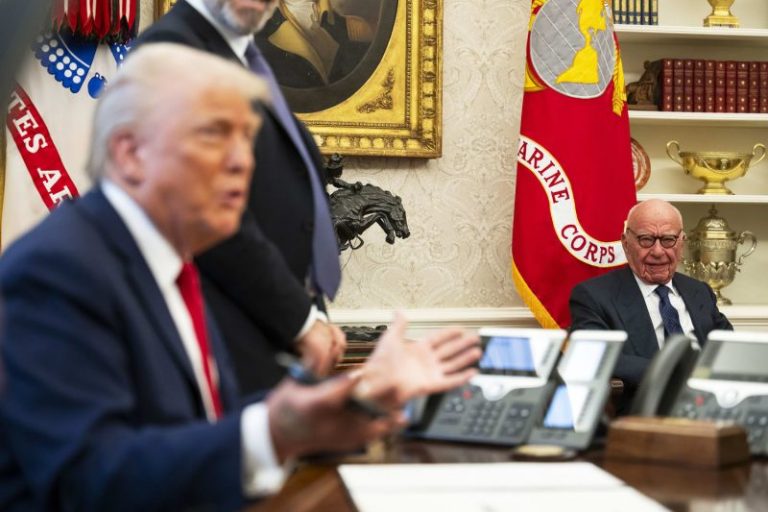
    Conservative media baron Rupert Murdoch will give President Donald Trump regular updates on his health as part of an agreement to postpone Murdoch’s deposition in Trump’s $10 billion defamation lawsuit against him over a Wall Street Journal article about late sex offender Jeffrey Epstein.

    The unusual stipulation comes a week after Trump’s lawyers sought a quick deposition in the case. Their filing in Miami federal court implied that Murdoch might be either dead or too sick to testify in person by the time the case went to trial.

    “Murdoch is 94 years old, has suffered from multiple health issues throughout his life, is believed to have suffered recent significant health scares, and is presumed to live in New York, New York,” Trump’s lawyers said in their filing last week.

    Murdoch’ agreement to divulge highly personal information about his health to Trump and his lawyers contrasts sharply with the cozy relationship Murdoch’s Fox News has had with the president over the years.

    Fox News for more than a decade has acted as a cheerleader for Trump and his policies. The president is an avid watcher of the conservative network, and several of his key administration officials have worked for Fox. Trump’s daughter-in-law, Lara Trump, currently has a show on Fox News.

    The new deal, outlined in a court filing jointly filed by Trump’s and Murdoch’s lawyers late Monday night, postpones Murdoch’s deposition in the case until after a judge rules on his and other defendants’ motions to dismiss Trump’s lawsuit.

    If the judge denies that dismissal motion, Murdoch would have to sit for questioning under oath from Trump’s lawyers within 30 days.

    The deal has to be approved by the judge, but it is likely to be approved given that both sides have agreed to it.

    When the judge signs off on it, Murdoch will be required within three calendar days to give Trump’s’ lawyers “a sworn declaration describing his current health condition,” according to the stipulation filed Monday.

    “Defendant Murdoch has further agreed to provide regularly scheduled updates to Plaintiff regarding his health, including a mechanism for him to alert the Plaintiff if there is a material change to his health,” the filing says.

    That mechanism is described in a separately signed agreement, which was not publicly filed with the court.

    If Murdoch fails to provide the updates as agreed to in the abatement agreement, he will have to sit for an “expedited” deposition, the filing says.

    A spokesman for Trump declined to comment on the filing.

    CNBC has requested comment from Dow Jones & Co., the publisher of the Journal, which is owned by Murdoch’s News Corp.

    Trump’s suit alleges defamation for a Wall Street Journal article in July which said he had sent Epstein a “bawdy” birthday card in 2003 for Epstein’s 50th birthday.

    Trump, who denies writing the note, sued Murdoch; News Corp and its CEO Robert Thomson; Dow Jones & Co.; and the two reporters who wrote the article.

    For weeks, the president and the Justice Department have faced criticism for a decision not to release investigative files about Epstein, a former friend of Trump’s, who died by suicide in jail in 2019, after being arrested on child sex trafficking charges.

    This post appeared first on NBC NEWS

    WASHINGTON — The Agriculture Department allowed six additional states Monday to bar participants in the Supplemental Nutrition Assistance Program from using their benefits to buy certain processed foods, such as sodas and candy.

    The SNAP waivers for West Virginia, Florida, Colorado, Louisiana, Oklahoma and Texas amend the statutory definition of food for purchase and put an end to the subsidization of popular types of junk food beginning in 2026.

    The administration of President Donald Trump has encouraged all states to take such measures as part of its “Make America Healthy Again” initiative, named for the social movement led by Health Secretary Robert F. Kennedy Jr.

    The USDA had so far signed waivers to allow six states — Arkansas, Idaho, Utah, Iowa, Indiana and Nebraska — to place similar purchasing restrictions on SNAP recipients.

    “I hope to see all 50 states join this bold commonsense approach. For too long, the root causes of our chronic disease epidemic have been addressed with lip service only,” said the U.S. Food and Drug Commissioner Marty Makary.

    Agriculture Secretary Brooke Rollins announced the additional waivers at an event at the USDA headquarters in Washington.

    “These state waivers promote healthier options for families in need,” said Secretary Rollins.

    More than 42 million people receive SNAP benefits, sometimes called food stamps, as part of the nation’s largest anti-hunger program.

    The massive tax cut and spending bill signed by President Trump in July makes significant changes to the SNAP program, including expanding work requirements and shifting more spending for the program to states.

    This post appeared first on NBC NEWS

    Amazon is laying off roughly 110 employees in its Wondery podcast division and the head of the group is leaving as part of a broader reshuffling of the company’s audio unit.

    In a Monday note to staffers, Steve Boom, Amazon’s vice president of audio, Twitch and games, said the company is consolidating some Wondery units under its Audible audiobook and podcasting division. Wondery CEO Jen Sargent is also stepping down from her role, Boom said.

    “These changes will not only better align our teams as they work to take advantage of the strategic opportunities ahead but, even more crucially, will ensure we have the right structure in place to deliver the very best experience to creators, customers and advertisers,” Boom wrote in the memo, which was viewed by CNBC. “Unfortunately, these changes also include some role reductions, and we have notified those employees this morning.”

    Bloomberg was first to report on the job cuts.

    The move comes nearly five years after Amazon acquired Wondery as part of a push to expand its catalog of original audio content. The podcasting company made a name for itself with hit shows like “Dirty John” and “Dr. Death.”

    More recently, Wondery signed several lucrative licensing deals with Jason and Travis Kelce’s “New Heights” podcast, along with Dax Shepard’s “Armchair Expert.”

    Amazon is streamlining “how Wondery further integrates” into the company by separating the teams that oversee its narrative podcasts from those developing “creator-led shows,” Boom wrote.

    The narrative podcasting unit will consolidate under Audible, and creator-led content will move to a new unit within Boom’s organization in Amazon called “creator services,” he wrote.

    Amazon’s audio pursuits face a heightened challenge from the growing popularity of video podcasts on Alphabet’s YouTube, which now hosts an increasing number of shows.

    Video shows require different discovery, growth and monetization strategies than “audio-first, narrative series,” Boom wrote in the memo to Amazon staffers.

    “The podcast landscape has evolved significantly over the past few years,” Boom said.

    This post appeared first on NBC NEWS