
Author

admin

Browsing

Biotech is a dynamic industry that is driving scientific advances and innovation in healthcare. In Canada, the biotech sector is home to companies pursuing cutting-edge therapies and medical technologies.

According to Grandview Research, the global biotech market is expected to grow at a compound annual growth rate of 13.96 percent between 2024 and 2030 to reach a value of US$3.08 trillion.

Read on to learn what’s been driving these Canadian biotech firms.

1. Bright Minds Biosciences (CSE:DRUG)

Year-on-year gain: 2,290 percent
Market cap: C$243.73 million
Share price: C$34.41

Bright Minds Biosciences is focused on developing novel treatments for neuropsychiatric disorders and pain.

Its portfolio consists of serotonin agonists designed to target neurocircuit abnormalities that make disorders like epilepsy, post-traumatic stress disorder and depression difficult to treat. The company’s drugs have been designed to potentially retain the powerful therapeutic aspects of psychedelic and other serotonergic compounds, while minimizing their side effects, thereby creating superior drugs to first-generation compounds such as psilocybin.

Bright Minds’ BMB-101, an agonist targeting the 5-HT2C receptor, will target classic absence epilepsy and developmental epileptic encephalopathy. An evaluation of Phase II trials done in collaboration with Firefly Neuroscience (NASDAQ:AIFF) determined that BMB-101 stopped seizures in a mouse model of epilepsy, suggesting it could be a vital new treatment.

In October 2024, Bright Mind’s share price surged nearly 1,500 percent in a single session after global pharmaceutical company H. Lundbeck announced its intention to acquire Longboard Pharmaceuticals, another firm with a 5-HT2C agonist in its pipeline.

In March of this year, Bright Minds added five world-renowned leaders in epilepsy research to its scientific advisory board.

2. Hemostemix (TSXV:HEM)

Year-on-year gain: 170 percent
Market cap: C$20.44 million
Share price: C$0.14

Hemostemix is a clinical-stage biotech company focused on developing autologous stem cell therapies, an approach that uses a patient’s own cells to theoretically enhance safety and efficacy. Its main product, ACP-01, is a cell therapy derived from a patient’s blood to promote tissue repair and regeneration in areas affected by disease.

The company announced its first advanced sales orders for ACP-01 on January 29 and has been working to expand internationally and attract new investment.

In July 2025, Hemostemix reported that the unanimous passing of Senate Bill 1768 in Florida, US, means it can begin commercial ACP-01 treatments for ischemic pain in the state in Q4. The bill creates a framework in which healthcare providers can administer stem cell therapies that had not been approved by the US Food and Drug Administration (FDA) but meet the bill’s guidelines.

The company projected 2026 sales of C$22.5 million following the news.

Additionally, Hemostemix is currently collaborating with Firefly Neuroscience on a Phase 1 clinical trial of ACP-01 for vascular dementia.

3. Eupraxia Pharmaceuticals (TSX:EPRX)

Year-on-year gain: 109.3 percent
Market cap: C$266.36 million
Share price: C$7.20

Eupraxia Pharmaceuticals focuses on developing locally delivered therapeutics for patients with unmet medical needs. Its primary focus has been orthopedics and oncology. Eupraxia acquired EpiPharma Therapeutics in late 2023, absorbing the company’s lead candidate EP-104GI.

In February, the company released positive data from the sixth cohort of its Phase 1b/2a trial for EP-104GI in eosinophilic esophagitis. In July, the company advanced its investigation into the Phase 2b portion after selecting an initial dose based on encouraging safety and efficacy data from the earlier Phase 2a cohorts, with top-line results from the Phase 2b study anticipated in Q3 2026.

4. ME Therapeutics Holdings (CSE:METX)

Year-on-year gain: 33.33 percent
Market cap: C$147.95 million
Share price: C$5.00

ME Therapeutics is a biotechnology company focused on developing cancer-fighting drug candidates that can increase the efficacy of current immuno-oncology drugs by targeting suppressive myeloid cells, which have been found to hinder the effectiveness of existing immuno-oncology treatments. Immuno-oncology is a relatively new area of cancer drug research and has shown promising results when used to treat cancer with low survival rates.

ME Therapeutics’ antibody h1B11-12 is designed to inhibit the cytokine G-SCF. Research performed by ME in collaboration with Dr. Kenneth Harder at the University of British Columbia demonstrated that G-CSF appeared to increase tumor growth in breast and colon cancer, as well as a correlation between survival in patients with colorectal cancer and low expression of G-CSF.

The work suggests that inhibition of tumor-secreted G-CSF using h1B11-12 could support the existing treatments. Trial planning efforts are ongoing, and the company expects development of a cell line for future production of the drug to be finished in the latter half of 2025.

The company is also part of an ongoing collaborative effort to develop therapeutic mRNA delivery methods to myeloid cells with NanoVation Therapeutics, a privately owned biotech company that develops customized nucleic acid and lipid nanoparticle technologies to empower genetic medicine. The collaboration has already resulted in two new mRNA formulations, for which testing began on October 4, and has demonstrated encouraging anti-cancer activity in a preclinical model of colorectal cancer.

In May 2025, the company said it would receive up to C$140,000 in funding from the National Research Council of Canada Industrial Research Assistance Program to advance its mRNA therapeutic program.

ME Therapeutics is also exploring a listing on the Nasdaq or the New York Stock Exchange.

5. NervGen (TSXV:NGEN)

Year-on-year gain: 28.42 percent
Market cap: C$276.78 million
Share price: C$3.75

NervGen is a clinical-stage Canadian biotechnology company that focuses on developing innovative treatments to enable the nervous system to repair itself following damage from injury or disease.

The company’s core technology targets a mechanism that hinders nervous system repair. When the nervous system is damaged, chondroitin sulfate proteoglycans form a “scar.” Initially, CSPGs help contain damage, but their long-term interaction with the PTPσ receptor inhibits repair.

NervGen’s lead drug candidate, NVG-291, is designed to relieve these inhibitory effects, promoting nervous system repair. NervGen is advancing NVG-291 in a Phase 1b/2a clinical trial for spinal cord injury (SCI), reporting positive data from the chronic cohort in June. It received fast track designation from the US FDA.

NVG-300, a newer preclinical candidate, is being evaluated for ischemic stroke and SCI.

Securities Disclosure: I, Meagen Seatter, hold no direct investment interest in any company mentioned in this article.

This post appeared first on investingnews.com

As the global economy shifts toward electrification and clean energy, lithium has emerged as a cornerstone of the energy transition, and the US is racing to secure its place in the supply chain.

Lithium-ion batteries are no longer just critical to electric vehicles (EVs); they’re becoming vital across sectors to stabilize power systems, particularly amid growing reliance on intermittent renewables.

According to Fastmarkets, demand for battery energy storage systems (BESS) is accelerating, driven by data centers, which have seen electricity consumption grow 12 percent annually since 2017.

In the US, where data infrastructure is heavily clustered, BESS demand from data centers alone could make up a third of the market by 2030, with a projected compound annual growth rate of 35 percent.

As the US works to expand domestic production and reduce import dependence, policy uncertainty, including potential rollbacks of EV tax credits and clean energy incentives, clouds the investment outlook.

1. Sociedad Química y Minera (NYSE:SQM)

Year-to-date gain: 10.43 percent
Market cap: US$10.82 billion
Share price: US$40.64

SQM is a major global lithium producer, with operations centered in Chile’s Salar de Atacama. The company extracts lithium from brine and produces lithium carbonate and hydroxide for use in batteries.

SQM is expanding production and holds interests in projects in Australia and China.

Shares of SQM reached a year-to-date high of US$45.61 on March 17, 2025. The spike occurred a few weeks after the company released its 2024 earnings report, which highlighted record sales volumes in the lithium and iodine segments. However, low lithium prices weighed on revenue from the segment, and the company’s reported net profit was pulled down significantly due to a large accounting adjustment related to income tax.

In late April, Chile’s competition watchdog approved the partnership agreement between SQM and state-owned copper giant Codelco aimed at boosting output at the Atacama salt flat. The deal, first announced in 2024, reached another milestone when it secured approval for an additional lithium quota from Chile’s nuclear energy regulator CChEN.

Weak lithium prices continued to weigh on profits, with the company reporting a 4 percent year-over-year decrease in total revenues for Q1 2025.

2. Lithium Americas (NYSE:LAC)

Year-to-date gain: 9.67 percent
Market cap: US$719.1 million
Share price: US$3.29

Lithium Americas is developing its flagship Thacker Pass project in Northern Nevada, US. The project is a joint venture between Lithium Americas at 62 percent and General Motors (NYSE:GM) at 38 percent.

According to the firm, Thacker Pass is the “largest known measured lithium resource and reserve in the world.”

Early in the year, Lithium Americas saw its share rally to a year-to-date high of US$3.49 on January 16, coinciding with a brief rally in lithium carbonate prices.

In March, Lithium Americas secured US$250 million from Orion Resource Partners to advance Phase 1 construction of Thacker Pass. The funding is expected to fully cover development costs through the construction phase. On April 1, the joint venture partners made a final investment decision for the project, with completion targeted for late 2027.

Other notable announcements this year included a new at-the-market equity program, allowing the company to sell up to US$100 million in common shares.

3. Lithium Argentina (NYSE:LAR)

Year-to-date gain: 8.46 percent
Market cap: US$467.28 million
Share price: US$2.90

Lithium Argentina produces lithium carbonate from its Caucharí-Olaroz brine project in Argentina, developed with Ganfeng Lithium (OTC Pink:GNENF,HKEX:1772).

The company is also advancing additional regional lithium assets to support EV and battery demand.

Previously named Lithium Americas (Argentina), the company was spun out from Lithium Americas in October 2023.

While shares of Lithium Argentina spiked in early January to a year-to-date high of US$3.10, the share price has been trending higher since June 19 to its current US$2.90 value.

Notable news from the company this year includes its name and ticker change and corporate migration to Switzerland in late January and the release of the full-year 2024 results in March.

In mid-April, Lithium Argentina executed a letter of intent with Ganfeng Lithium to jointly advance development across the Pozuelos-Pastos Grandes basins in Argentina. The plan includes a project fully owned by Ganfeng as well as two jointly held assets majority-owned by Lithium Argentina.

The company released its Q1 results on May 15, reporting a 15 percent quarter-over-quarter production reduction, which it attributed to planned shutdowns aimed at increasing recoveries and reducing costs.

Overall, the production guidance for 2025 is forecasted at 30,000 to 35,000 metric tons of lithium carbonate, reflecting higher expected production volumes in the second half of the year.

Securities Disclosure: I, Georgia Williams, currently hold no direct investment interest in any company mentioned in this article.
This post appeared first on investingnews.com

Investor Insights

Rapidly emerging as Southeast Asia’s premier base and battery metals developer, Blackstone Minerals now holds two globally significant projects: the Ta Khoa nickel-cobalt project in Vietnam and the Mankayan copper-gold porphyry project in the Philippines. Both projects are critical to the company’s strategy to become a vertically integrated, low-cost, low-carbon producer of critical battery and base metals.

Overview

As the global economy accelerates toward net-zero emissions, the demand for critical minerals continues to rise, with nickel and copper positioned at the forefront of the energy transition. Historically used in stainless steel, nickel is now a core component in lithium-ion batteries; while copper, vital for electrification infrastructure, is similarly facing a looming supply crunch.

Blackstone Minerals (ASX:BSX,OTC:BLSTF,FRA:B9S) recognizes this strategic imperative and has positioned itself as a diversified, vertically integrated producer of low-cost, low-carbon battery and base metals.

Following its transformational merger with IDM International, Blackstone now controls two globally significant assets: the Ta Khoa nickel project in Vietnam and the Mankayan copper-gold project in the Philippines. Together, they represent a rare combination of scale, grade and strategic location in Southeast Asia, an increasingly vital region in the global clean energy supply chain.

The Mankayan copper-gold project is located in Northern Luzon, Philippines

The recently acquired Mankayan project adds substantial scale and diversification to Blackstone’s portfolio. One of the largest undeveloped copper-gold porphyry systems in Asia, Mankayan features over 56,000 meters of historical drilling and a resource of 793 million tonnes (Mt) at 0.756 percent copper equivalent (CuEq), including a high-grade core of 170 Mt at 1.049 percent CuEq. The project benefits from proximity to existing infrastructure and its location just 2.5 km from the operating Lepanto gold mine, owned and operated by Lepanto Consolidated Mining Company, and Far Southeast Gold Resources’ Far Southeast project.

The Ta Khoa project, meanwhile, includes both a past-producing underground nickel sulphide mine (Ban Phuc) and an advanced-stage refinery designed to produce battery-grade precursor cathode active material (pCAM). Vietnam’s low labor and energy costs, coupled with regulated power pricing and surging foreign direct investment, make it an ideal base for Blackstone’s vertically integrated strategy.

Blackstone is uniquely positioned to benefit from geopolitical tailwinds. Vietnam’s Free Trade Agreement with the European Union and the US Inflation Reduction Act are drawing significant interest from global partners and battery manufacturers. Meanwhile, the Philippines is undergoing a mining renaissance, with the government promoting foreign investment in responsible resource development. Mankayan has already been identified as a priority project by the Philippines’ Mines and Geosciences Bureau.

The company’s development strategy is underpinned by a commitment to ESG leadership. Blackstone is advancing renewable energy solutions for Ta Khoa via a direct power purchase agreement with Limes Renewables and is collaborating with Arca Climate Technologies to explore carbon capture through mineralization. At Mankayan, the company is focused on sustainable development in partnership with local communities.

Financially, Blackstone is well-capitalized to deliver on its dual-track growth plan. Following the merger with IDM, the company raised AU$22.6 million and holds AU$24.36 million in cash as of June 2025. The company’s experienced leadership team and strong partnerships provide a clear path to near-term value creation, as both projects progress toward definitive feasibility studies and long-term production.

Blackstone Minerals is now one of Southeast Asia’s leading battery and base metals developers, with a clear vision to supply responsibly sourced nickel and copper for the global energy transition.

Company Highlights

  • Diversified Portfolio: With Ta Khoa in Vietnam and Mankayan in the Philippines, Blackstone offers exposure to two critical and high-demand metal classes: nickel and copper-gold.
  • Strategic Southeast Asia Presence: Vietnam and the Philippines are emerging hubs for EV and mineral resource development, with robust government support and increasing foreign direct investment.
  • Infrastructure Advantage: Both projects benefit from existing infrastructure, including hydroelectric power, trained workforces, and government collaboration.
  • Sustainability Leadership: Blackstone is pursuing low-emission mining solutions through partnerships in renewable energy and carbon capture technologies.
  • Financially Strong: Blackstone raised AU$22.6 million post-merger, supporting an aggressive exploration and development strategy across both assets.

Key Project

Mankayan Copper-Gold Project – Philippines

Following its merger with IDM International, Blackstone now owns a 64 percent effective interest in the world-class Mankayan copper-gold project through Crescent Mining Development. Located in the prolific mineral belt of Northern Luzon, Philippines, Mankayan is one of Asia’s largest undeveloped copper-gold porphyry systems. It lies approximately 340 km from Manila by road, and just 2.5 kilometers from the operating Lepanto gold mine, which includes a 900 ktpa underutilized milling facility.

The Mankayan deposit spans roughly 1,100 meters of strike and 600 meters in width, with mineralization open to the north, south and at depth. Over 56,000 meters of diamond drilling has been completed to date, and the deposit hosts a JORC 2012-compliant mineral resource estimate of 793 Mt at 0.37 percent copper and 0.40 grams per ton (g/t) gold, equating to 0.756 percent CuEq. This includes a high-grade core of 170 Mt at 0.48 percent copper and 0.59 g/t gold (1.049 percent CuEq), offering valuable optionality.

Drilling results support Mankayan’s classification as a globally significant resource. Notable historic intercepts include:

  • 911 meters at 1 percent CuEq, including 253 meters at 1.43 percent CuEq
  • 543 meters at 1.08 percent CuEq, including 277 meters at 1.43 percent CuEq
  • 1,119 meters at 0.86 percent CuEq, including 352 meters at 1.15 percent CuEq
  • 754 meters at 1.03 percent CuEq, including 430 meters at 1.21 percent CuEq

In July 2025, Blackstone confirmed significant new surface mineralization through historical rock chip samples returning grades up to 6 g/t gold and 1.9 percent copper, and a standout recent drill hole – 432 meters at 1.25 percent CuEq (including 210 meters at 1.60 percent) – further underscoring the project’s scale and growth potential.

A key strategic advantage of Mankayan is its dual development pathway. The high-grade core supports a low-capex startup via selective mining methods, while the bulk of the deposit can be exploited through larger-scale mining scenarios that benefit from lower operating costs and economies of scale. This tiered approach allows Blackstone to balance capital efficiency with long-term growth.

Regulatory and community engagement milestones have also been achieved. The project’s 25-year mineral production sharing agreement was renewed in 2022, and a memorandum of agreement with local Indigenous Peoples was signed in 2024, making Blackstone the first mining company to obtain IP consent in the area. The Mines and Geosciences Bureau of the Philippines has since designated Mankayan as a priority development project.

Mankayan stands out globally when benchmarked against peer porphyry systems. A comparative analysis of undeveloped copper-gold projects ranks it near the top in terms of grade and copper equivalent tonnage, reaffirming its strategic and economic potential on the world stage.

In 2025 and beyond, Blackstone will continue metallurgical testwork, geophysics (including magnetics, IP and electromagnetics), environmental baseline studies, and further drilling to refine and expand the resource. These efforts will support upcoming mining studies and a targeted prefeasibility study.

Ta Khoa

Ta Khoa nickel project in Vietnam

Blackstone Minerals holds a 90 percent interest in the Ta Khoa nickel project, located in the Son La Province of northern Vietnam, about 160 km west of Hanoi. The project comprises the Ban Phuc underground nickel sulphide mine – a modern operation built to Australian standards that operated between 2013 and 2016 – and the adjacent Ta Khoa refinery, currently being developed to produce battery-grade precursor cathode active material (pCAM).

The Ban Phuc mine is currently under care and maintenance but is poised for recommissioning alongside the construction of a concentrator and refinery. The broader Ta Khoa asset base contains probable reserves of 48.7 million tonnes (Mt) at 0.43 percent nickel, equivalent to 210 kilotonnes (kt) of contained nickel. The mining inventory totals 64.5 Mt at 0.41 percent nickel, containing 265 kt of nickel. This figure excludes additional developing prospects such as Ban Khoa.

Over the planned 10-year mine life, Ta Khoa is expected to produce an average of 18 kt of nickel concentrate annually, with the potential to extend well beyond this horizon through integrated refining. The existing infrastructure onsite, including a 450 ktpa mill and a mining camp, provides significant capital efficiency and accelerates time to production.

A recent 12-month pilot program, conducted in partnership with ALS and Wood, successfully demonstrated that Ta Khoa’s hydrometallurgical flowsheet can convert concentrate into nickel sulphate at 99.95 percent purity and 97 percent recovery. This success positions the refinery as a credible supplier to the Asia-Pacific battery supply chain.

The project is further distinguished by its low emissions profile. Independent assessments by Digbee, Minviro, Circulor and an audit by the Nickel Institute have confirmed Ta Khoa as the lowest-emitting pCAM flowsheet in the industry, with carbon intensity of just 9.8 kg CO₂ per kg of pCAM, with opportunities for further reduction.

Blackstone’s development strategy includes flexible feedstock acceptance – from nickel concentrate to black mass – and is strengthened by partnerships with Cavico Laos for third-party supply, Arca Climate Technologies for carbon capture via mineralization, and Limes Renewables to supply clean wind energy. Additionally, the company has secured byproduct offtake arrangements for manganese sulphate and sodium sulphate with VinaChem, PVChem and Nam Phong Green, reinforcing its commitment to full-cycle resource utilization and ESG leadership.

Management Team

Hamish Halliday – Non-executive Chairman

Hamish Halliday is a geologist with over 20 years of corporate and technical experience. He is also the founder of Adamus Resources Limited, an AU$3 million float that became a multimillion-ounce emerging gold producer.

Scott Williamson – Managing Director

Scott Williamson is a mining engineer with a commerce degree from the West Australian School of Mines and Curtin University. He has over 10 years of experience in technical and corporate roles in the mining and finance sectors.

Geoff Gilmour – Non-executive Director

Appointed following Blackstone’s merger with IDM, Geoff Gilmour brings deep experience in Southeast Asian mining ventures. He has held senior roles in exploration and development across copper and gold projects in the Philippines and broader Asia-Pacific.

Tessa Kutscher – Executive

Tessa Kutscher is an executive with more than 20 years of experience in working with C-Level executive teams in the fields of business strategy, business planning/optimisation and change management. After starting her career in Germany, she has worked internationally across different industries, such as mining, finance, tourism and tertiary education.

Lon Taranaki – Executive

Lon Taranaki is an international mining professional with over 25 years of extensive experience in all aspects of resources and mining, feasibility, development and operations. Taranaki is a qualified process engineer from the University of Queensland Australia. He holds a Master of Business Administration, and is a fellow of the Australian Institute of Company Directors. Taranaki has established his career in Asia where he has successfully worked (and lived) across multiple jurisdictions and commodities ranging from technical, mine management and executive management roles.

This post appeared first on investingnews.com

UnitedHealth Group revealed Thursday it is facing a Justice Department investigation over its Medicare billing practices.

It comes after the Wall Street Journal reported in May that the Department of Justice is conducting a criminal investigation into the health-care giant over possible Medicare fraud. In response at the time, the company said it stands “by the integrity of our Medicare Advantage program.”

In July, the Journal also reported that the DOJ interviewed several doctors about UnitedHealth’s practices and whether they felt pressured to submit claims for certain conditions that bolstered payments from the Medicare Advantage program to the company.

That marked the second time this year that the insurer’s Medicare Advantage business has come under federal scrutiny. The Journal also reported in February that the DOJ is conducting a civil investigation into whether the company inflated diagnoses to trigger extra payments to its Medicare Advantage plans.

But in March, UnitedHealth moved a step closer to ending a yearslong legal battle with the DOJ that began with a whistleblower who alleged the company illegally withheld at least $2 billion through the Medicare Advantage program. A special master assigned to the case by the judge issued a recommendation in favor of UnitedHealth, saying the DOJ lacked evidence.

UnitedHealthcare’s Medicare and retirement segment, which includes the Medicare Advantage business, is UnitedHealth Group’s largest revenue driver, raking in $139 billion in sales last year.

The update in the probe comes after a tumultuous last year for UnitedHealthcare, the nation’s largest and most powerful private health insurer. Shares of UnitedHealthcare’s parent company, UnitedHealth Group, are down more than 42% for the year after it suspended its 2025 forecast amid skyrocketing medical costs, announced the surprise exit of former CEO Andrew Witty and grappled with the reported probe into its Medicare Advantage business.

The company’s 2024 wasn’t any easier, marked by a historic cyberattack and the torrent of public blowback after the murder of UnitedHealthcare’s CEO, Brian Thompson.

This post appeared first on NBC NEWS

Uber announced a new feature Wednesday that pairs women drivers and riders, in its latest move to address safety on the ride-hailing platform.

The new tool, which the platform will begin piloting next month in the U.S., allows women passengers to match with women drivers when booking or pre-booking rides, and create a preference in their app settings. Women drivers can also choose to drive women.

“It’s about giving women more choice, more control, and more comfort when they ride and drive,” Camiel Irving, Uber’s vice president of U.S. and Canada operations, said in a release.

The company said the rider’s preference isn’t guaranteed but the feature increases the chances women will be paired in the app.

Uber will pilot the program in Los Angeles, San Francisco and Detroit. The company also said it tested the feature in countries such as France, Germany and Argentina.

This isn’t Uber’s first foray into gender preferences on its platform.

In 2019, Uber rolled out a women rider preference feature for female drivers in Saudi Arabia after women won the right to drive in 2018. That offering later expanded to about 40 countries. A survey from the company in 2015 found that about a fifth of its U.S. drivers were women.

Over the years, ride-hailing companies such as Uber and Lyft have faced safety concerns and questions over the roles these platforms have played in various sexual assault and harassment incidents.

Uber has rolled out several features in recent years to improve safety on the platform, including teen accounts and rider and pin verification.

Competitor Lyft launched an option in late 2023 that pairs women and nonbinary drivers and riders.

This post appeared first on NBC NEWS

Alphabet reported second-quarter results on Wednesday that beat on revenue and earnings, but the company said it would raise its capital investments by $10 billion in 2025.

Here’s how the company did, compared with estimates from analysts polled by LSEG:

Wall Street is also watching several other numbers in the report:

The company’s overall revenue grew 14% year over year, higher than the 10.9% Wall Street expected, but Alphabet is going to spend more on artificial intelligence in 2025 than it anticipated.

In February, the company said it expected to invest $75 billion in capital expenditures in 2025 as it continues to expand on its AI strategy. That was already above the $58.84 billion Wall Street expected at the time.

The company increased that figure on Wednesday to $85 billion, saying it was raising it due to “strong and growing demand for our Cloud products and services.” The company expects to further increase capital expenditures in 2026, Alphabet finance chief Anat Ashkenazi said on an earnings call.

The company reported revenue of $13.62 billion for its cloud computing business, which is a 32% increase from a year ago. Last week, OpenAI announced that it expected to use Google’s cloud infrastructure for its popular ChatGPT service. Alphabet CEO Sundar Pichai said “we are very excited to be partnering with them.”

Alphabet’s net income increased to $28.20 billion, up nearly 20% from the previous year.

The company’s search and advertising units still showed growth in the second quarter despite AI competition heating up. The company’s search unit brought in $54.19 billion during the quarter, and its advertising revenue grew to $71.34 billion — up about 10.4% from $64.61 billion the year prior.

YouTube advertising revenue came in at $9.8 billion, higher than Wall Street expected.

The company said its “Other Bets” segment, which includes its self-driving car unit Waymo and life sciences unit Verily, brought in $373 million — up from $365 million a year ago. Other Bets reported a loss of $1.25 billion, up from the $1.13 billion a year ago.

AI Overviews, Google’s AI search product that summarizes search results, now has upward of two billion monthly users across more than 200 countries and territories, Pichai said during Wednesday’s earnings call. That’s up from 1.5 billion monthly users last quarter.

The Gemini app, which has the company’s AI chatbot, now has more than 450 million monthly active users, Pichai said.

When asked about large spending on AI talent, Ashkenazi said Alphabet makes “sure that we invest appropriately to have the best and brightest minds in the industry.”

Google made a splash in the AI talent wars, announcing earlier in July that it would bring in Windsurf CEO Varun Mohan and other top researchers at the AI coding startup as part of a $2.4 billion deal that also includes licensing the company’s technology.

Total operating expenses increased 20% to $26.1 billion, Ashkenazi said on Wednesday. The biggest driver of growth was expenses for legal and other matters due in part to a $1.4 billion charge related to a settlement, she said on Wednesday’s earnings call. Texas Attorney General Ken Paxton in May announced a $1.37 billion settlement with Google related to a data privacy rights lawsuit it made against the company in 2022.

Ashkenazi said Alphabet’s third-quarter revenue “could see a tailwind” due to several reasons. That includes a negative impact for advertising, which benefited from “strong spend on U.S. elections” in late 2024, particularly on YouTube, she said.

This post appeared first on NBC NEWS

UnitedHealth Group revealed Thursday it is facing a Justice Department investigation over its Medicare billing practices.

It comes after the Wall Street Journal reported in May that the Department of Justice is conducting a criminal investigation into the health-care giant over possible Medicare fraud. In response at the time, the company said it stands “by the integrity of our Medicare Advantage program.”

In July, the Journal also reported that the DOJ interviewed several doctors about UnitedHealth’s practices and whether they felt pressured to submit claims for certain conditions that bolstered payments from the Medicare Advantage program to the company.

That marked the second time this year that the insurer’s Medicare Advantage business has come under federal scrutiny. The Journal also reported in February that the DOJ is conducting a civil investigation into whether the company inflated diagnoses to trigger extra payments to its Medicare Advantage plans.

But in March, UnitedHealth moved a step closer to ending a yearslong legal battle with the DOJ that began with a whistleblower who alleged the company illegally withheld at least $2 billion through the Medicare Advantage program. A special master assigned to the case by the judge issued a recommendation in favor of UnitedHealth, saying the DOJ lacked evidence.

UnitedHealthcare’s Medicare and retirement segment, which includes the Medicare Advantage business, is UnitedHealth Group’s largest revenue driver, raking in $139 billion in sales last year.

The update in the probe comes after a tumultuous last year for UnitedHealthcare, the nation’s largest and most powerful private health insurer. Shares of UnitedHealthcare’s parent company, UnitedHealth Group, are down more than 42% for the year after it suspended its 2025 forecast amid skyrocketing medical costs, announced the surprise exit of former CEO Andrew Witty and grappled with the reported probe into its Medicare Advantage business.

The company’s 2024 wasn’t any easier, marked by a historic cyberattack and the torrent of public blowback after the murder of UnitedHealthcare’s CEO Brian Thompson.

This post appeared first on NBC NEWS

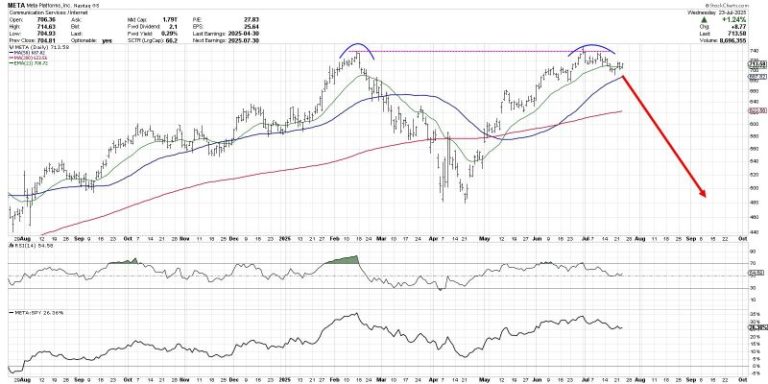
The chart of Meta Platforms, Inc. (META) has completed a roundtrip from the February high around $740 to the April low at $480 and all the way back again.  Over the last couple weeks, META has now pulled back from its retest of all-time highs, leaving investors to wonder what may come next.

Is this the beginning of a new downtrend phase for META?  Or just a brief pullback before a new uptrend phase propels META to new all-time highs?

Today we’ll look at two potential scenarios, including the double top pattern and the cup and handle pattern, and share which technical indicators and approaches could help us determine which path plays out into August.

The double top scenario basically means that the late July retest of the previous all-time high was the end of the recent uptrend phase.  The double top pattern is literally when a major resistance level is set and then retested.  The implication is that a lack of willing buyers means the uptrend is exhausted, and there is nowhere to go but down.

While the 21-day exponential moving average is currently in play for META, I would say that a break below the 50-day moving average could confirm this as the correct scenario.  If that smoothing mechanism does not hold, then the price action would imply less of a pullback and more like the beginning of a real distribution phase.

What is META pulls back but then resumes an uptrend phase, leading META to another new all-time high?  That would result in a confirmed cup and handle pattern, created by a large rounded bottoming pattern followed by a brief pullback.  The key to this pattern is the “rim” of the cup, which sits right at $740 for META.

Given the pullback META has demonstrated so far in July, I would say that a break above the $740 level would basically confirm a bullish cup and handle pattern.  That would suggest much more upside potential for META, as the stock would literally go into previously uncharted territory.

So how can we determine which scenario is more likely to play out?  This is where we need to incorporate more technical indicators into the discussion, as a way to further validate and confirm our investment thesis.

Just to review, I think a break above $740 would confirm a bullish cup and handle pattern.  I would also say that a break below the $680 level, which would represent a move below the 50-day moving average as well as the June swing lows, would basically confirm a bearish double top pattern.

We can also use the Relative Strength Index (RSI) to help determine whether META remains in a bullish trend phase.  During bull phases, the RSI rarely gets below 40, because buyers usually step in to “buy the dips” and keep the momentum fairly constructive.  So if the price would break down, and the RSI would not hold that crucial 40 level, that could mean a bearish outlook is warranted.

Finally, we can use volume-based indicators to assess whether moves in the price are supported by stronger volume readings.  Here I’ve included the Accumulation/Distribution Line, which tracks the trend in daily volume readings over time.  We can see that the high in July resulted in a divergence, as the A/D line was trending lower.  If the A/D line would break below its June and July lows, marked by a dashed red line, that would represent a bearish volume reading for META.

Technical analysis is less about predicting the future, and more about determining the most probable scenarios based on our analysis of trend, momentum, and volume.  I hope this discussion shows how the outlook for META can be easily determined and tracked using the best practices of technical analysis!

RR#6,

Dave

PS- Ready to upgrade your investment process?  Check out my free behavioral investing course!

David Keller, CMT

President and Chief Strategist

Sierra Alpha Research LLC

marketmisbehavior.com

https://www.youtube.com/c/MarketMisbehavior

Disclaimer: This blog is for educational purposes only and should not be construed as financial advice.  The ideas and strategies should never be used without first assessing your own personal and financial situation, or without consulting a financial professional.  

The author does not have a position in mentioned securities at the time of publication.    Any opinions expressed herein are solely those of the author and do not in any way represent the views or opinions of any other person or entity.

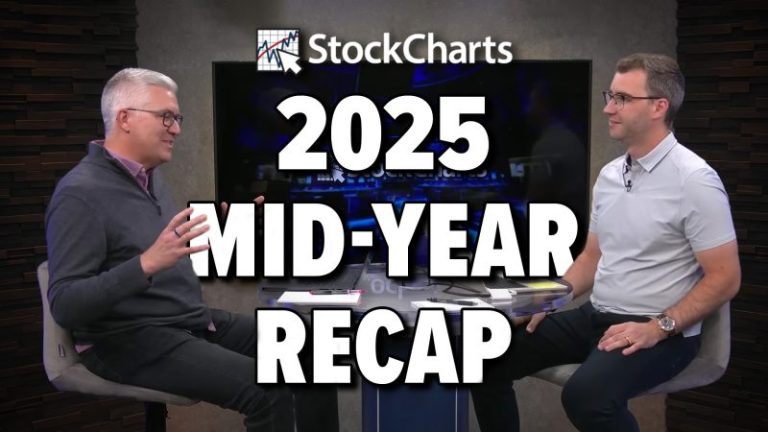
Markets don’t usually hit record highs, risk falling into bearish territory, and spring back to new highs within six months. But that’s what happened in 2025.

In this special mid-year recap, Grayson Roze sits down with David Keller, CMT, to show how disciplined routines, price-based signals, and a calm process helped them ride the whipsaw instead of getting tossed by it. You’ll see what really happened under the surface, how investor psychology drove the swings, and the exact StockCharts tools they leaned on to stay objective. 

If you’re focused on protecting capital, generating income, and sleeping well at night while still capturing the upside, this is a must-watch. Discover which charts deserve your attention now, what to ignore, and how to prep for the back half of 2025. 

This video premiered on July 23, 2025. Click on the above image to watch on our dedicated Grayson Roze page on StockCharts TV.

You can view previously recorded videos from Grayson at this link.