
Author

admin

Browsing

Strong demand in the face of looming supply shortages has pushed copper to new heights in recent years.

With a wide range of applications in nearly every sector, copper is by far the most industrious of the base metals. In fact, for decades, the copper price has been a key indicator of global economic health, earning the red metal the moniker “Dr. Copper.” Rising prices tend to signal a strong global economy, while a significant longer-term drop in the price of copper is often a symptom of economic instability.

After bottoming out at US$2.17 per pound, or US$5,203.58 per metric ton (MT), in mid-March 2020, copper has largely been on an upward trajectory.

Why is copper so expensive in 2025? Higher copper prices over the past few years have largely been attributed to a widening supply/demand gap. The already tenuous copper supply picture was made worse by COVID-19 lockdowns, and as the world’s largest economies seemingly began to emerge from the pandemic, demand for the metal picked up once again. Copper mining and refining activities simply haven’t kept up with the rebound in economic activity.

In this article

    What key factors drive the price of copper?

    Robust demand has long been one of the strongest factors driving copper prices. The ever-growing number of copper uses in everyday life — from building construction and electrical grids to electronic products and home appliances — make it the world’s third most-consumed metal.

    Copper’s anti-corrosive and highly conductive properties are why it’s the go-to metal for the construction industry, and it’s used in products such as copper pipes and copper wiring. In fact, construction is responsible for nearly half of global copper consumption. Rising demand for new homes and home renovations in both Asian and Western economies is expected to support copper prices in the long term.

    In recent decades, copper price spikes have been strongly tied to rising demand from China as the economic powerhouse injects government-backed funding into new housing and infrastructure. Industrial production and construction activity in the Asian nation have been like rocket fuel for copper prices.

    Additionally, copper’s conductive properties are increasingly being sought after for use in renewable energy applications, including thermal, hydro, wind and solar energy.

    However, the biggest driver of copper consumption in the renewable energy sector is rising global demand for electric vehicles (EVs), EV charging infrastructure and energy storage applications. As governments push forward with transportation network electrification and energy storage initiatives as a means to combat climate change, copper demand from this segment is expected to surge.

    New energy vehicles use significantly more copper than internal combustion engine vehicles, which only contain about 22 kilograms of copper. In comparison, hybrid EVs use an average of 40 kilograms, plug-in hybrid EVs use 55 kilograms, battery EVs use 80 kilograms and battery electric buses use 253 kilograms.

    In 2024, EV sales worldwide increased by 25 percent over 2023 to come in at about 17.1 million units, and analysts at Rho Motion expect that trend to continue in the coming years despite some headwinds in the near-term. Already in the first five months of 2025, EV sales were up 28 percent over the same period in the previous year.

    On the supply side of the copper market, the world’s largest copper mines are facing depleting high-grade copper resources, while over the last decade or more new copper discoveries have become few and far between.

    The pandemic made the situation worse as mining activities in several top copper-producing countries faced work stoppages and copper companies delayed investments in further exploration and development — a challenging problem considering it can take as many as 10 to 20 years to move a project from discovery to production. In addition, delayed investments amid the pandemic will also have long-term repercussions for copper supply.

    There have also been ongoing production issues at major copper mines, most notably the shutdown in late 2023 of First Quantum Minerals’ (TSX:FM,OTC Pink:FQVLF) Cobre Panama mine, which accounted for about 350,000 MT of the world’s annual copper production.

    The International Energy Agency (IEA) is forecasting a 30 percent shortfall in the amount of copper needed to meet demand by 2035. “This will be a major challenge. It’s time to sound the alarm,” IEA Executive Director Fatih Birol said.

    The supply shortage has increased the need for end users to turn to the copper scrap market to make up for the supply shortage. Sometimes referred to as “the world’s largest copper mine,” recycled copper scrap contributes significantly to supplying and balancing the copper market.

    “We are seeing signs this could change. Much of the growth over the last five years has come from brownfield expansions rather than greenfield/new discoveries,’ she said. ‘Technology will likely help increase the chance of discovery, and broadly I would say that policymakers are now more supportive of mineral exploration as the push to secure critical raw materials supply has moved up the agenda.’

    Joannides offered some examples of greenfield projects in the pipeline: Capstone Copper’s (TSX:CS,OTC Pink:CSCCF) Santo Domingo in Chile, Southern Copper’s (NYSE:SCCO) Tia Maria in Peru and Teck Resources’ (TSX:TECK.A,TECK.B,NYSE:TECK) Zafranal in Peru.

    How has the copper price moved historically?

    Taking a look back at historical price action, the copper price has had a wild ride for more than two decades.

    Sitting at US$1.38 per pound in late January 2005, the copper price followed global economic growth up to a high of US$3.91 in April 2008. Of course, the global economic crisis of 2008 soon led to a copper crash that left the metal at only US$1.29 by the end of year.

    Once the global economy began to recover in 2011, copper prices posted a new record high of US$4.58 per pound at the start of the year. However, this high was short-lived as the copper price began a five year downward trend, bottoming out at around US$1.95 in early 2016.

    Copper prices stayed fairly flat over the next four years, moving in a range of US$2.50 to US$3 per pound.

    20 year copper price performance.

    Chart via Macrotrends.

    The pandemic’s impact on mine supply and refined copper in 2020 pushed prices higher despite the economic slowdown. The copper price climbed from a low of US$2.17 in March to close out the year at US$3.52.

    In 2021, signs of economic recovery and supercharged interest in EVs and renewable energy pushed the price of copper to rally higher and higher. Copper topped US$4.90 per pound for the first time ever on May 10, 2021, before falling back to close at US$4.76.

    Also affecting the copper price at that time was expectations for higher copper demand amid supply concerns out of two of the world’s major copper producers: Chile and Peru. In late April 2021, port workers in Chile called for a strike, while in Peru presidential candidate Pedro Castillo proposed nationalizing mining and redrafting the country’s constitution.

    In early May 2021, news broke that copper inventories were at their lowest point in 15 years. Expert market watchers such as Bank of America commodity strategist Michael Widmer warned that further inventory declines into 2022 could lead to a copper market deficit.

    After climbing to start 2022 at US$4.52, the copper price continued to spike on economic recovery expectations and supply shortages to reach US$5.02 per pound on March 6. Throughout the first quarter, fears of supply chain disruptions and historically low stockpiles amid rising copper demand drove prices higher.

    However, copper prices pulled back in mid-2022 on worries that further COVID-19 lockdowns in China, as well as a growing mortgage crisis, would slow down construction and infrastructure activity in the Asian nation. Rising inflation and interest hikes by the Fed also placed downward pressure on a wide basket of commodities, including copper. By late July 2022, copper prices were trading down at nearly a two year low of around US$3.30.

    In the early months of 2023 the copper price was trading over the US$4 per pound level after receiving a helpful boost from continuing concerns about low copper inventories, signs of rebounding demand from China, and news about the closure of Peru’s Las Bambas mine, which accounts for 2 percent of global copper production.

    However, that boost turned to a bust in the second half of 2023 as China continued to experience real estate sector issues, alongside the economic woes of the rest of the world. The price of copper dropped to a low for the year of US$3.56 per pound in mid October.

    Elevated supply levels kept copper trading in the US$3.50 to US$3.80 range for much of Q1 2024 before experiencing strong gains that pushed the price of the red metal to US$4.12 on March 18.

    Those gains were attributed to in part to tighter copper concentrate supply following the closure of First Quantum Minerals’ Cobre Panama mine, guidance cuts from Anglo American (LSE:AAL,OTCQX:AAUKF) and declining production at Chile’s Chuquicamata mine. In addition, China’s top copper smelters announced production cuts after limited supply led to lower profits from treatment and refining charges.

    BHP’s (ASX:BHP,NYSE:BHP,LSE:BHP) attempted takeover of Anglo American also stoked fears of even tighter global copper mine supply. These supply-side challenges continued to juice copper prices in Q2 2024, causing a jump of nearly 29 percent from US$4.04 per pound on April 1 to a then all-time high of US$5.20 by May 20, 2024.

    What was the highest price for copper ever?

    The price of copper reached its highest recorded price of US$5.72 per pound, or US$12,610 per metric ton, on July 8, 2025. The red metal’s price surged more than 13 percent from July 7 to its new all time high. Read on to found out how the copper price reached those heights.

    Why did the copper price hit an all-time high in 2025?

    After starting 2025 at US$3.99 per pound, copper prices were lifted in Q1 by increasing demand from China’s economic stimulus measures, renewable energy and artificial intelligence (AI) technologies and stockpiling brought on by fear of US President Trump’s tariff threats.

    At the time, Trump had said the US was considering placing tariffs of up to 25 percent on all copper imports in a bid to spark increased domestic production of the base metal.

    In late February, he signed an executive order instructing the US Commerce Department to investigate whether imported copper poses a national security risk under Section 232 of the Trade Expansion Act of 1962. The price of copper reached a new high price of US$5.24 per pound on March 26 as tariff tensions escalated.

    Trump’s tariff talk sparked yet another copper price rally to set its new record high price in early July when he announced he plans to impose a 50 percent tariff on all imports of the red metal.

    Looking at the bigger picture, copper’s rally in recent years has encouraged bullish sentiment on prices looking ahead. In the longer term, the fundamentals for copper are expected to get tighter as demand increases from sectors such as EVs and energy storage. A May 2024 report from the International Energy Forum (IEF) projects that as many as 194 new copper mines may need to come online by 2050 to support massive demand from the global energy transition.

    Looking over to renewable energy, according to the Copper Development Association, solar installations require about 5.5 MT of copper for every megawatt, while onshore wind turbines require 3.52 MT of copper and offshore wind turbines require 9.56 MT of copper.

    The rise of AI technology is also bolstering the demand outlook for copper. Commodities trader Trafigura has said AI-driven data centers could add one million MT to copper demand by 2030, reports Reuters.

    Where can investors look for copper opportunities?

    Copper market fundamentals suggest a return to a bull market cycle for the red metal in the medium-term. The copper supply/demand imbalance also presents an investment opportunity for those interested in copper-mining stocks.

    Securities Disclosure: I, Melissa Pistilli, hold no direct investment interest in any company mentioned in this article.

    This post appeared first on investingnews.com

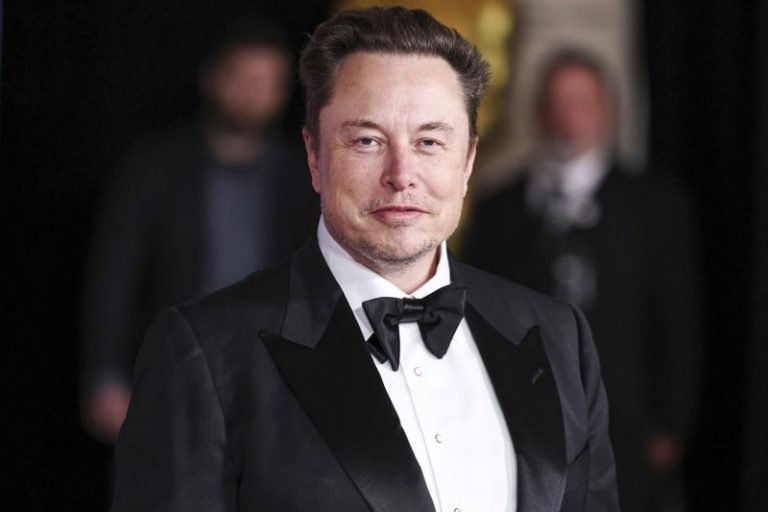
    Elon Musk’s health tech company Neuralink labeled itself a “small disadvantaged business” in a federal filing with the U.S. Small Business Administration, shortly before a financing round valued the company at $9 billion.

    Neuralink is developing a brain-computer interface (BCI) system, with an initial aim to help people with severe paralysis regain some independence. BCI technology broadly can translate a person’s brain signals into commands that allow them to manipulate external technologies just by thinking.

    Neuralink’s filing, dated April 24, would have reached the SBA at a time when Musk was leading the Trump administration’s Department of Government Efficiency. At DOGE, Musk worked to slash the size of federal agencies.

    MuskWatch first reported on the details of Neuralink’s April filing.

    According to the SBA’s website, a designation of SDB means a company is at least 51% owned and controlled by one or more “disadvantaged” persons who must be “socially disadvantaged and economically disadvantaged.” An SDB designation can also help a business “gain preferential access to federal procurement opportunities,” the SBA website says.

    The Department of Justice has previously fined companies for making false claims about their SDB status.

    Musk, the world’s wealthiest person, is CEO of Tesla and SpaceX, in addition to his other businesses like artificial intelligence startup xAI and tunneling venture The Boring Company. In 2022, Musk led the $44 billion purchase of Twitter, which he later named X before merging it with xAI.

    Jared Birchall, a Neuralink executive, was listed as the contact person on the filing from April. Birchall, who also manages Musk’s money as head of his family office, didn’t immediately respond to a request for comment.

    Neuralink, which incorporated in Nevada, closed a $650 million funding round in early June at a $9 billion valuation. ARK Invest, Peter Thiel’s Founders Fund, Sequoia Capital and Thrive Capital were among the investors. Neuralink said the fresh capital would help the company bring its technology to more patients and develop new devices that “deepen the connection between biological and artificial intelligence.”

    Under Musk’s leadership at DOGE, the initiative took aim at government agencies that emphasized diversity, equity and inclusion (DEI). In February, for example, DOGE and Musk boasted of nixing hundreds of millions of dollars worth of funding for the Department of Education that would have gone towards DEI-related training grants.

    This post appeared first on NBC NEWS

    One great habit to develop as an investor is regularly scanning the stock market. Whether you’re checking for stocks that are outperforming a benchmark, gapping up, reversing, or breaking out of a trading range, scanning keeps you in the loop and, importantly, helps you stay sharp and spot potential opportunities early on. 

    During one of our routine scans, one stock stood out: Rigetti Computing, Inc. (RGTI), a company in a fast-moving quantum computing space. On Wednesday, RGTI closed the day up 30%, which turned some heads. What’s behind the move? Rigetti announced significant improvements in its platform, better performance metrics, and the 36-qubit system, a technical milestone in the quantum world.  

    Should You Invest in RGTI?

    If you ran any of the bullish predefined scans on StockCharts, you may have noticed RGTI popping up. That alone is a good reason to take a closer look at RGTI stock’s price action.

    Looking at the daily chart of RGTI, the stock had a nice ride in late 2024. However, things cooled off in early January 2025 and, since then, the stock has been trading sideways until this week. On Wednesday, RGTI gapped up with strong volume, breaking out of that sideways range.

    FIGURE 1. DAILY CHART OF RGTI STOCK. Since its rise in late 2024, the stock has been trading sideways until Wednesday, when it broke out of that range. Chart source: StockCharts.com. For educational purposes.

    Back in June, RGTI bounced off its 50-day simple moving average (SMA), which is starting to slope upward—a healthy technical signal. With Wednesday’s price move, RGTI is above its May 27 and July 8 highs.

    RGTI’s price isn’t too far from its all-time high, set in January. If the stock breaks above that level and has strong momentum, we could see it push to new highs. The Relative Strength Index (RSI) and Percentage Price Oscillator (PPO) are showing early signs of positive momentum.

    On the other hand, if the stock pulls back and Wednesday’s gap up doesn’t get filled, RGTI could reverse either at the May 27 or July 8 high. A reversal with a rise in momentum would confirm an upside continuation. If RGTI falls below these levels, fills Wednesday’s gap up, and finds support at the 50-day SMA, it could go back to trading sideways, waiting for the next catalyst. A decline below the 50-day SMA would invalidate the uptrend.

    A Rising Tide in Quantum Stocks?

    Other stocks in the Quantum Computing space, like IonQ, Inc. (IONQ) and D-Wave Quantum, Inc. (QBTS), also saw gains on Wednesday.

    Quantum computing stocks can be a bit of a roller coaster; they rallied at the end of 2024, dipped earlier this year, and are now gaining ground, thanks to encouraging news on quantum computing developments. The technology is in its early stages and could take years before it’s truly mainstream. So while these stocks are gaining attention now, the momentum may not be consistent.

    If you’re a long-term investor with patience and curiosity, it may be worth adding RGTI, QBTS, ION, and others to your ChartLists. Track them regularly and watch for continued technical strength or signs of trend reversals. 


    Disclaimer: This blog is for educational purposes only and should not be construed as financial advice. The ideas and strategies should never be used without first assessing your own personal and financial situation, or without consulting a financial professional.

    Join Tom as he covers key inflation data, earnings season highlights, and sector rotation trends. He breaks down recent price action in major indexes like the S&P 500 and Nasdaq, with a close look at the 20-day moving average as a support gauge. Tom spotlights standout industry groups such as gambling, semiconductors, software, and aerospace, and shares charts of top-performing stocks like Goldman Sachs, Johnson & Johnson, and PNC. Tom highlights under-performing areas like insurance brokers and home improvement, then reviews several strong earnings reactions, including Monarch Casino’s 15% after-hours gain.

    This video was published on July 17, 2025. Click this link to watch on Tom’s dedicated page.

    Missed a session? Archived videos from Tom are available at this link

    There is no denying that the broad markets remain in a resilient uptrend off the April 2025 low.  But if there’s one thing I’ve learned from many years of analyzing charts, it’s to remain vigilant during bullish phases.  Even though I’ll assume the uptrend is still intact, that doesn’t mean I can stop looking for signs of potential weakness!

    With that in mind, here are three bearish candle patterns that often pop up during bullish market phases.  By looking for these patterns in the stocks and ETFs that you own, you can hopefully get ahead of any corrective moves and take profits before it’s too late!

    The Shooting Star Pattern

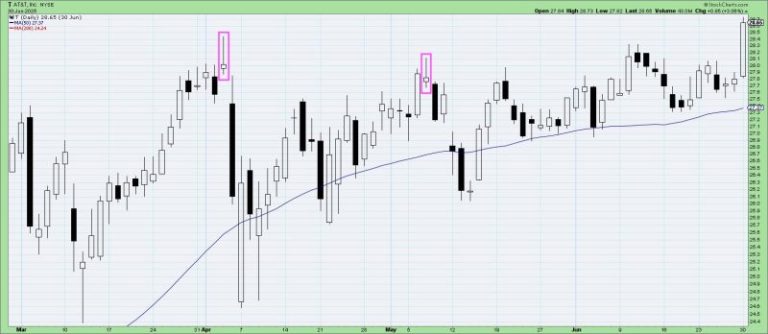
    If you see a long upper shadow, little to no lower shadow, and the open and close are close together near the bottom of the day’s range, then you have identified a shooting star candle pattern.  If you’re familiar with the hammer candle pattern, then you can think of this as a hammer candle but basically everything is upside down!

    The chart of AT&T (T) has featured a number of shooting star candles so far in 2025.  Just before the selloff in early April, there was a clear shooting star candle after the March rally.  Then during the rally off the April low, a shooting star pattern in early May suggested that the uptrend phase was nearing an exhaustion point.

    The Bearish Engulfing Pattern

    One of the most recognizable patterns in the candlestick library, the bearish engulfing pattern represents a short-term rotation from accumulation to distribution.  Basically, a large up candle is followed by a large down candle, and the second day’s “real body” (the open-to-close range) engulfs the range of the first day’s real body.  

    Look at the strength in the uptrend for Paramount Global (PARA) going into early June.  Then just before the 4th of July weekend, a bearish engulfing pattern suggests a change of character as the bears take control.  It’s worth noting that these candle patterns are not long-term signals, but rather indicate short-term dynamics.  So a bearish engulfing pattern suggests weakness for the next one to three bars.

    The Evening Star Pattern

    If you took the bearish engulfing pattern, and then added another small candle in the middle of those two days, then you’d have an evening star pattern.  Now most candlestick textbooks will tell you that the “star” day in the middle should include a gap, so there’s no overlap between that day’s range and the other two candles.  In practice, I’ve found most people ignore this detail and rather look for patterns with enough similarities to this basic structure.

    Going back to the AT&T chart we used earlier, we can see an evening star pattern at the end of June.  A big day is followed soon after by a big down day, with a small candle in the middle.  This is a great example of where additional weakness led the price below the 50-day moving average, serving to confirm the bearish outlook as represented by the evening star pattern.

    It’s so easy to become complacent during an extended bull market rally.  Investors that regularly scan for bearish candle patterns have an edge, as they can anticipate potential turning points before the uptrend changes in dramatic fashion to a new downtrend phase!

    RR#6,

    Dave

    PS- Ready to upgrade your investment process?  Check out my free behavioral investing course!

    David Keller, CMT

    President and Chief Strategist

    Sierra Alpha Research LLC

    marketmisbehavior.com

    https://www.youtube.com/c/MarketMisbehavior

    Disclaimer: This blog is for educational purposes only and should not be construed as financial advice.  The ideas and strategies should never be used without first assessing your own personal and financial situation, or without consulting a financial professional.  

    The author does not have a position in mentioned securities at the time of publication.    Any opinions expressed herein are solely those of the author and do not in any way represent the views or opinions of any other person or entity.

    State Department spokesperson Tammy Bruce said the United States does not support recent Israeli airstrikes on Syria and called for ‘dialogue’ between the two Middle East powers.

    ‘The United States unequivocally condemns the violence. All parties must step back and engage in meaningful dialogue that leads to a lasting ceasefire,’ Bruce announced at a State Department press briefing Thursday afternoon. 

    On Wednesday, Israeli airstrikes in the Syrian capital of Damascus struck the country’s Defense Ministry headquarters and an area near the presidential palace, killing three and injuring dozens of others, according to reports. 

    The Israeli military said it was intervening to defend the minority Druze population in southern Syria, a community that shares a border with Israel, amid armed skirmishes between local Bedouin Sunni tribes and the recently installed Syrian government.

    ‘We are acting decisively to prevent the entrenchment of hostile elements beyond the border, protect Israeli citizens and prevent harm to Druze civilians,’ Eyal Zamir, chief of the Israeli Defense Forces’ general staff, said during a situational assessment at the Syrian border.

    Secretary of State Marco Rubio announced Wednesday afternoon that an agreement had been reached between Israel and Syria to end the ‘troubling and horrifying situation.’

    ‘This will require all parties to deliver on the commitments they have made, and this is what we fully expect them to do,’ he added.

    ‘Thankful to all sides for their break from chaos and confusion as we attempt to navigate all parties to a more durable and peaceful solution in Syria,’ U.S. Special Envoy to Syria Tom Barrack added.

    When asked Thursday what prompted the Israeli strikes and whether the U.S. suspected any foreign fighters, like ISIS, of being involved in the conflict in Syria between the Bedouins and the Druze, Bruce said there will need to be continued investigation to figure out exactly why this Israeli airstrike occurred.

    Rubio said Wednesday he believed Israel’s strike on the Syrian capital of Damascus was ‘likely’ due to ‘a misunderstanding.’

    Bruce on Thursday responded to reporters’ questions about what U.S. officials meant when they said ‘confusion’ and ‘misunderstanding’ from Israel were what led to their involvement. 

    ‘This is an ancient rivalry between the Druze and the Bedouins and violence ensued, the Syrians moving to that area to quell and stop that violence. And the Israelis, who see that occurring to the Druze community and their concerns, then entered what they assessed was something larger than what, or even not what it was at all,’ Bruce said at Thursday’s briefing. 

    ‘The good news is, the story is, it stopped, as within the management of that larger conflict. Again, there’s still skirmishes and other issues. … The Syrian government is going to have to lead — obviously, there will be other involvement — but lead in to this de-escalation and to the stability.’

    Fox News Digital’s Caitlin McFall contributed to this report.

    This post appeared first on FOX NEWS

    People for the Ethical Treatment of Animals (PETA) is applauding a letter sent Thursday by Republican lawmakers to National Institutes of Health (NIH) Director Dr. Jay Bhattacharya, urging the agency to stop using taxpayer dollars for experiments on animals conducted in foreign laboratories. 

    The letter, signed by Rep. Troy Nehls, R-Texas, and Sen. Rick Scott, R-Fla., highlights concerns about the lack of oversight and inadequate standards in certain foreign facilities. 

    The bipartisan Cease Animal Research Grants Overseas (CARGO) Act—led by the Republicans along with Rep. Dina Titus, D-Nev., and Sen. Cory Booker, D-N.J.—seeks to end NIH funding for animal experiments outside the U.S. and ensure taxpayer dollars are not misused for the unnecessary suffering of animals.

    Between 2011 and 2021, the NIH issued more than $2.2 billion in grants for controversial research in 45 countries.

    According to the letter, the ‘research’ included genetically altering cats to be born with deformed legs, infecting bats with diseases that were transmissible and fatal to humans, and force-feeding mice human feces.

    Nehls and Scott noted there are little to no inspections at the facilities where research is conducted or where the animals are housed, and there is inadequate auditing of foreign NIH-funded animal studies, resulting in significant gaps in oversight and accountability of how taxpayer dollars are being used. 

    ‘It is deeply concerning that American taxpayer dollars have been used to fund harmful and abusive animal experiments overseas that lack the same oversight and accountability as labs here in the United States,’ Nehls and Scott wrote in the letter. ‘…It is a waste of resources that should be allocated to more ethical and effective research practices that do not involve animals.’

    PETA Senior Vice President Kathy Guillermo said the organization is grateful to Nehls, Scott, Titus and Booker for serving as the lead sponsors of the CARGO Act.

    ‘This effort represents a significant step in halting cruel and wasteful animal experimentation abroad, and it aligns with the Trump Administration’s broader shift toward more relevant, non-animal research methods,’ Guillermo wrote in a statement to Fox News Digital. ‘We are excited to continue working alongside these dedicated lawmakers to pass the CARGO Act and ensure that taxpayer money is no longer used to support pointless and unethical research.’

    The CARGO Act was introduced following a PETA investigation into Caucaseco Scientific Research Center, a discredited Colombian laboratory with a history of violating animal care standards. 

    Caucaseco Scientific Research Center received more than $17 million in U.S. funding, and the Biden administration’s NIH encouraged additional funding, even after it was caught confining monkeys in filthy conditions, leaving them to die from infected wounds, and starving mice to the point of cannibalism, according to PETA.

    The PETA investigation reportedly led to multiple investigations by local authorities, the rescues of 108 monkeys and 180 mice, and the retraction of a research publication.

    ‘The letter’s request for NIH to immediately cease funding animal experiments in foreign labs is a crucial step toward protecting animals and ensuring taxpayer dollars are used responsibly,’ Guillermo wrote. ‘PETA remains committed to advocating for legislative and policy changes that prioritize ethical, practical, and non-animal research.’

    This post appeared first on FOX NEWS

    Former Biden administration staffer Annie Tomasini is expected to appear before congressional investigators on Friday after being subpoenaed by House Oversight Committee Chairman James Comer, R-Ky.

    Tomasini, former Assistant to the President and Deputy Chief of Staff for ex-President Joe Biden, was previously scheduled to appear for a voluntary transcribed interview on Friday.

    A committee aide told Fox News Digital earlier this week that Tomasini’s counsel requested the subpoena, but did not say why. 

    When she arrives for the 10 a.m. closed-door deposition on Friday, she will be the third ex-Biden administration aide to come under subpoena in Comer’s probe in recent weeks.

    Comer is investigating allegations that Former President Joe Biden’s former top White House aides covered up signs of his mental and physical decline while in office, and whether any executive actions were commissioned via autopen without the president’s full knowledge. Biden allies have pushed back against those claims.

    In an interview with The New York Times on Thursday, Biden affirmed he ‘made every decision’ on his own.

    Just before Tomasini, House investigators heard from Anthony Bernal, a longtime aide to ex-first lady Jill Biden. 

    Bernal pleaded the Fifth Amendment on all questions about Biden and was out of the committee room less than an hour after going in.

    Lawmakers are largely not expected to attend the closed-door deposition, which is traditionally staff-led.

    Comer has been to several so far, and progressive firebrand Rep. Jasmine Crockett, D-Texas, has made surprise appearances as well.

    CNN anchor Jake Tapper and Axios political correspondent Alex Thompson revealed in their book, ‘Original Sin,’ that Tomasini and Bernal ‘loaded a written Q&A into a prompter ahead of a local interview – a document that the campaign had used in prep with Biden.’

    Tomasini and Bernal brought out the teleprompter as his aides were trying to soften his blunders as Biden struggled to stay on message, according to the book. But the teleprompter fiasco became an easy attack line throughout Biden’s re-election campaign, as President Donald Trump ‘weaved’ through his myriad unscripted moments.

    The book described how Tomasini and Bernal grew closer to Biden during the pandemic, eventually becoming Joe and Jill Biden’s most trusted aides. 

    Tapper and Thompson describe the ‘intensely loyal’ duo – Tomasini and Bernal – as taking on an ‘older-brother-and-little-sister vibe’ among Biden’s inner circle.  

    Bernal and Tomasini later took on some of the residence staffers’ roles in the White House. Tapper and Thompson said the aides ‘had all-time access to the living quarters, with their White House badges reading ‘Res’ – uncommon for such aides.’

    ‘The significance of Bernal and Tomasini is the degree to which their rise in the Biden White House signaled the success of people whose allegiance was to the Biden family – not to the presidency, not to the American people, not to the country, but to the Biden theology,’ the authors wrote. 

    A source familiar with the Biden team’s thinking called House Republicans’ probe ‘dangerous’ and ‘an attempt to smear and embarrass.’

    ‘And their hope is for just one tiny inconsistency between witnesses to appear so that Trump’s DOJ prosecute his political opponents and continue his campaign of revenge,’ the source said.

    This post appeared first on FOX NEWS

    Congress is officially sending a package detailing $9 billion in spending cuts to President Donald Trump’s desk, minutes after midnight on Friday.

    The bill, called a ‘rescissions package,’ was approved by the House of Representatives in a late-night 216 to 213 vote after intense debate between Republicans and Democrats. Just two Republicans, Reps. Brian Fitzpatrick, R-Pa., and Mike Turner, R-Ohio, voted in opposition.

    Friday was also the deadline for passing the legislation, otherwise the White House would be forced to re-obligate those funds as planned.

    It’s a victory for House Speaker Mike Johnson, R-La., but a mostly symbolic one – the spending cuts bill was largely seen by Trump allies as a test run of a fiscal claw-back process not used in more than two decades.

    ‘This bill tonight is part of continuing that trend of getting spending under control. Does it answer all the problems? No. $9 billion, I would say is a good start,’ House Majority Leader Steve Scalise, R-La., said during debate on the bill.

    When signed by Trump, it will block $8 billion in funding to the U.S. Agency for International Development (USAID) and $1 billion to the Corporation for Public Broadcasting for the remainder of the fiscal year. The dollars had been allocated by Congress for the duration of fiscal year 2025.

    Republicans celebrated it as a victory for cutting off the flow of U.S. taxpayer dollars to what they called ‘woke’ initiatives abroad, while Democrats accused the right of gutting critical foreign aid.

    Rescissions packages are a way for the president to have input in Congress’ yearly appropriations process. The White House sends a proposal to block some congressionally obligated funds, which lawmakers have 45 days to get through the House and Senate.

    Republicans have also been able to sideline Democrats so far, with the rescissions process lowering the Senate’s threshold for passage from 60 votes to 51.

    The last time a rescissions package was signed into law was 1999.

    Consideration of the bill began with a House Rules Committee hearing at 6 p.m. on Thursday evening.

    Democrats attempted multiple times throughout the process to weaponize the ongoing inter-GOP fallout over the Jeffrey Epstein case, both in the House Rules Committee and on the chamber floor during debate on the bill. 

    Multiple calls were made for votes to force the release of the so-called Epstein ‘files.’

    ‘If every Republican votes to block our attempt to release the records, they are telling Epstein’s victims, you don’t matter as much as our political convenience. And that should disgust every single one of us,’ said Rep. Jim McGovern, D-Mass.

    Far-right GOP figures are demanding accountability, while Trump has called on his base to move on after the Department of Justice (DOJ) signaled the case was closed.

    Initial plans to begin advancing the bill earlier in the day were quickly scuttled, with Republicans on the committee being concerned about being put into a difficult position with potential Epstein votes.

    In the end, a compromise led to the House Rules Committee advancing a separate nonbinding measure dealing with Epstein transparency, on a parallel track to the rescissions bill.

    ‘All the credible evidence should come out. I’ve been very clear with members of the House Rules Committee. Republicans have been taking the incoming criticism because they voted to stop the Democrats’ politicization of this, and they’re trying to stick to their job and move their procedural rules to the floor so we can do our work and get the rescissions done for the American people,’ Johnson told reporters during negotiations earlier in the day.

    Democrats nevertheless pressed on, mentioning Epstein multiple times on the House floor. McGovern even briefly led a chant of ‘release the files’ when closing debate on the bill.

    Republicans, in turn, accused Democrats of hypocrisy.

    ‘Interesting how they talk about Jeffrey Epstein, because for four years, Mr. Speaker, President Joe Biden had those files, and not a single Democrat that you’re hearing tonight tried to get those files released,’ House Majority Leader Steve Scalise, R-La., said at one point during the House floor debate.

    The House initially voted to advance a $9.4 billion rescissions package, but it was trimmed somewhat in the Senate after some senators had concerns about cutting funding for HIV/AIDS prevention research in Africa.

    Trump is expected to sign the bill on Friday.

    This post appeared first on FOX NEWS

    What can you get for $9.4 billion?

    3G Capital recently purchased footwear giant Skechers for $9.4 billion. 

    $9.4 billion could cover your rent for a pretty nice apartment in New York City for more than 40,000 years. 

    Yes, it will just be you and the cockroaches by then. 

    Or, you could pay the cost of every major disaster in the past four decades – ranging from Chernobyl to Fukushima to Hurricane Sandy. 

    But $9.4 billion isn’t a lot when cast against nearly $7 trillion in annual spending by the federal government. 

    And it’s really not much money when you consider that the U.S. is about slip into the red to the tune of $37 trillion. 

    Which brings us to the Congressional plan to cancel spending. That is, a measure from Republicans and the Trump Administration to rescind spending lawmakers already appropriated in March. The House and Senate are now clawing back money lawmakers shoved out the door for the Corporation for Public Broadcasting and foreign aid programs under USAID. The original proposal cut $9.4 billion. But that figure dwindled to $9 billion – after the Senate restored money for ‘PEPFAR,’ a President George W. Bush era program to combat AIDS worldwide. 

    In other words, you may have a couple thousand years lopped off from your rent-controlled apartment in New York City. Of course that hinges on what Democratic mayoral nominee Zorhan Mamdani decides to do, should he win election this fall. 

    Anyway, back to Congressional spending. Or ‘un-spending.’ 

    The House passed the original version of the bill in June, 216-214. Flip one vote and the bill would have failed on a 215-215 tie. Then it was on to the Senate. Republicans had to summon Vice President Vance to Capitol Hill to break a logjam on two procedural votes to send the spending cancellation bill to the floor and actually launch debate. Republicans have a 53-47 advantage in the Senate. But former Senate Majority Leader Mitch McConnell, R-Ky., along with Sens. Lisa Murkowski, R-Alaska and Susan Collins, R-Maine, voted nay – producing a 50-50 tie.

    Fox is told some Senate Republicans are tiring of McConnell opposing the GOP – and President Trump – on various issues. That includes the nay votes to start debate on the spending cancellation bill as well as his vote against the confirmation of Defense Secretary Pete Hegseth in January.

    ‘He used to be the Leader. He was always telling us we need to stick together,’ said one GOP senator who requested anonymity. ‘Now he’s off voting however he wants? How time flies.’

    Note that McConnell led Senate Republicans as recently as early January.

    But McConnell ultimately voted for the legislation when the Senate approved it 51-48 at 2:28 am ET Thursday morning. 

    Murkowski and Collins were the only noes. The services of Vice President Vance weren’t needed due to McConnell’s aye vote and the absence of Sen. Tina Smith, D-Minn. She fell ill and was admitted to George Washington Hospital for exhaustion. 

    As for the senior senator from Alaska, one GOP senator characterized it as ‘Murkowski fatigue.’

    ‘She always asking. She’s always wanting more,’ groused a Senate Republican.

    Murkowski secured an agreement on rural hospitals in exchange for her vote in favor of the Big, Beautiful Bill earlier this month. However, Murkowski did not secure more specificity on the DOGE cuts or help with rural, public radio stations in Alaska on the spending cut plan.

    ‘My vote is guided by the imperative of coming from Alaskans. I have a vote that I am free to cast, with or without the support of the President. My obligation is to my constituents and to the Constitution,’ said Murkowski. ‘I don’t disagree that NPR over the years has tilted more partisan. That can be addressed. But you don’t need to gut the entire Corporation for Public Broadcasting.’ 

    In a statement, Collins blasted the Trump administration for a lack of specificity about the precision of the rescissions request. Collins, who chairs the Senate Appropriations Committee in charge of the federal purse strings, also criticized the administration a few months ago for a paucity of detail in the President’s budget. 

    ‘The rescissions package has a big problem – nobody really knows what program reductions are in it.  That isn’t because we haven’t had time to review the bill,’ said Collins in a statement. ‘Instead, the problem is that OMB (the Office of Management and Budget) has never provided the details that would normally be part of this process.’

    Collins wasn’t the only Republican senator who worried about how the administration presented the spending cut package to Congress. Senate Armed Services Committee Chairman Roger Wicker, R-Miss.,  fretted about Congress ceding the power of the purse to the administration. But unlike Collins, Wicker supported the package.

    ‘If we do this again, please give us specific information about where the cuts will come. Let’s not make a habit of this,’ said Wicker. ‘If you come back to us again from the executive branch, give us the specific amounts in the specific programs that will be cut.’

    DOGE recommended the cuts. In fact, most of the spending reductions targeted by DOGE don’t go into effect unless Congress acts. But even the $9.4 billion proved challenging to cut. 

    ‘We should be able to do that in our sleep. But there is looking like there’s enough opposition,’ said Sen. Rand Paul, R-Ky., on Fox Business.

    So to court votes, GOP leaders salvaged $400 million for PEPFAR.

    ‘There was a lot of interest among our members in doing something on the PEPFAR issue,’ said Senate Majority Leader John Thune, R-S.D. ‘You’re still talking about a $9 billion rescissions package – even with that small modification.’

    The aim to silence public broadcasting buoyed some Republicans.

    ‘North Dakota Public Radio – about 26% of their budget is federal funding. To me, that’s more of an indictment than it is a need,’ said Sen. Kevin Cramer, R-N.D. 

    But back to the $9 billion. It’s a fraction of one-tenth of one percent of all federal funding. And DOGE recommended more than a trillion dollars in cuts.

    ‘What does this say for the party if it can’t even pass this bill, this piddling amount of money?’ yours truly asked Sen. John Kennedy, R-La.

    ‘I think we’re going to lose a lot of credibility. And we should,’ replied Kennedy.

    But the House needed to sync up with the Senate since it changed the bill – stripping the cut for AIDS funding. House conservatives weren’t pleased that the Senate was jamming them again – just two weeks after major renovations to the House version of the Big, Beautiful Bill. But they accepted their fate.

    ‘It’s disappointing that we’re $37 trillion in debt. This to me was low-hanging fruit,’ said Rep. Eric Burlison, R-Mo. ‘At the end of the day, I’ll take a base hit, right? It’s better than nothing.’

    White House Budget Director Russ Vought is expected to send other spending cancellation requests to Congress in the coming months. The aim is to target deeper spending reductions recommended by DOGE. 

    But it doesn’t auger well for future rescissions bills if it’s this much of a battle to trim $9 trillion.

    What can you get for that much money? For Republicans, it’s not much. 

    Republicans were swinging for the fences with spending cuts.

    But in the political box score, this is recorded as just a base hit.

    This post appeared first on FOX NEWS