
Author

admin

Browsing

Questcorp Mining Inc. (CSE: QQQ) (OTCQB: QQCMF) (FSE: D910) (the ‘Company’ or ‘Questcorp’) is pleased to update shareholders on the on-going surface exploration in preparation for drilling at the La Union Gold-Silver Project in Sonora, Mexico. Questcorp has an Option earn a 100% interest from Riverside Resources Inc. in the 2,520 ha (25 km sq) property by making a series of cash payments and share issuance and completing a series of exploration expenditures.

Questcorp President & CEO, Saf Dhillon, stated: ‘We are pleased with the progress Riverside has made as we complete the preliminary exploration steps, in finalizing our drill targets for the upcoming maiden drill program at La Union. The decades of in country exploration experience that John-Mark and his Riverside team diligently bring to focus at the La Union project is very evident as they continue to further de-risk the up-coming 1,500 metre drill program.’

Figure 1: Cross section IP with interpreted structures and targets from Union new Induced Polarity geophysics survey.

To view an enhanced version of this graphic, please visit:
https://images.newsfilecorp.com/files/10197/257897_4d60e7d2c4556af9_001full.jpg

La Union operator Riverside Resources has successfully completed two IP lines over the La Union and La Union Norte mines respectively, highlighting chargeability and resistivity features at depth which will guide the placement of the first ever drill holes on the property, as well as correlating with mapped mineralized zones and former workings.

A drone magnetic survey was flown over the property to provide structural context, follow up potential intrusive feeders and provide information about potential faults beneath the pediments and post-mineral young cover units.

Ongoing surface geochemistry and mapping continues to strengthen the targeting pipeline, particularly across exposed gold-rich manto zones and along the margins of shallow post-mineral gravel pediment cover. These efforts are focused on delineating the transition zones from covered to exposed mineralization and establishing structural controls that may influence ore continuity at depth.

The La Union Project

The La Union Project is a carbonate replacement deposit (‘CRD’) project hosted by Neoproterozoic sedimentary rocks (limestones, dolomites, and siliciclastic sediments) overlying crystalline Paleoproterozoic rocks of the Caborca Terrane. The structural setting features high-angle normal faults and low-to-medium-angle thrust faults that sometimes served as mineralization conduits. Mineralization occurs as polymetallic veins, replacement zones (mantos, chimneys), and shear zones with high-grade metal content, as shown in highlight grades of 59.4 grams per metric tonne (g/t) gold, 833 g/t silver, 11% zinc, 5.5% lead, 2.2% copper, along with significant hematite and manganese oxides, consistent with a CRD model (see the technical report entitled ‘NI 43-101 Technical Report on the Union Project, State of Sonora, Mexico’ dated effective May 6, 2025 available under Questcorp’s SEDAR+ profile). These targets also demonstrate intriguing potential for large gold discoveries potentially above an even larger porphyry Cu district potential as the Company’s target concept at this time.

Questcorp cautions investors grab samples are selective by nature and not necessarily indicative of similar mineralization on the property.

Riverside, the operator of the La Union Project, is currently lining up the various geophysical contractors to immediately undertake orientation surveys and follow up detailed survey to confirm and enhance the drill targets.

The technical and scientific information in this news release has been reviewed and approved by R. Tim Henneberry, P. Geo (BC), a director of the Company and a ‘qualified person’ under National Instrument 43-101 – Standards of Disclosure for Mineral Projects.

About Questcorp Mining Inc.

Questcorp Mining Inc. is engaged in the business of the acquisition and exploration of mineral properties in North America, with the objective of locating and developing economic precious and base metals properties of merit. The Company holds an option to acquire an undivided 100% interest in and to mineral claims totaling 1,168.09 hectares comprising the North Island Copper Property, on Vancouver Island, British Columbia, subject to a royalty obligation. The Company also holds an option to acquire an undivided 100% interest in and to mineral claims totaling 2,520.2 hectares comprising the La Union Project located in Sonora, Mexico, subject to a royalty obligation.

Contact Information

Questcorp Mining Corp.
Saf Dhillon, President & CEO
Email: saf@questcorpmining.ca
Telephone: (604) 484-3031

This news release includes certain ‘forward-looking statements’ under applicable Canadian securities legislation. Forward-looking statements include, but are not limited to, statements with respect to Riverside’s arrangements with geophysical contractors to undertake orientation surveys and follow up detailed survey to confirm and enhance the drill targets. Forward-looking statements are necessarily based upon a number of estimates and assumptions that, while considered reasonable, are subject to known and unknown risks, uncertainties, and other factors which may cause the actual results and future events to differ materially from those expressed or implied by such forward-looking statements. Such factors include, but are not limited to: the ability of Riverside to secure geophysical contractors to undertake orientation surveys and follow up detailed survey to confirm and enhance the drill targets as contemplated or at all, general business, economic, competitive, political and social uncertainties, uncertain capital markets; and delay or failure to receive board or regulatory approvals. There can be no assurance that the geophysical surveys will be completed as contemplated or at all and that such statements will prove to be accurate, as actual results and future events could differ materially from those anticipated in such statements. Accordingly, readers should not place undue reliance on forward-looking statements. The Company disclaims any intention or obligation to update or revise any forward-looking statements, whether as a result of new information, future events or otherwise, except as required by law.

To view the source version of this press release, please visit https://www.newsfilecorp.com/release/257897

News Provided by Newsfile via QuoteMedia

This post appeared first on investingnews.com

Chinese chain Luckin Coffee opened its first two U.S. locations this week, betting that mobile-only ordering and creative flavors can lure customers away from Starbucks.

Both new Luckin stores are based in Manhattan, and at the midtown location on Wednesday, Sam Liu took a sip of her jasmine cold brew.

“I’ve never tried anything like it,” she said.

I thought I just order at the counter, but I realized everyone was standing around looking at their phone.

Luckin Customer Sam Liu, New York City

Liu said she’d hoped for more seating — the small shop has only three tables — and was initially confused by Luckin’s in-app ordering system, which means customers can’t order directly from a barista.

“I thought I just order at the counter, but I realized everyone was standing around looking at their phone,” Liu said.

Luckin is China’s largest coffee chain, with more than twice as many locations as Starbucks there. Its two New York City stores are its first foray outside Asia, where it has over 24,000 locations across the region. By comparison, there are over 17,000 Starbucks in the United States.

Its CEO, Guo Jinyi, called the U.S. “a strategically important market” for the company’s expansion in a press release heralding the two new locations Wednesday. “We are excited to introduce a diverse and unique coffee experience to American consumers.”

The company, which didn’t respond to a request for comment, has touted its ambitions to expand globally but hasn’t publicly detailed its next moves in the U.S. or other markets.

The chain has gained success overseas through creative drinks like alcohol-infused coffees and fruit lattes, along with its smartphone-centric ordering model. The app-based approach makes it easier to track inventory, send personalized appeals to consumers and serve drinks quickly, said John Zolidis, an analyst who tracks Luckin and Starbucks at the brokerage firm he founded, Quo Vadis Capital.

“Luckin was able to develop an incredible muscle with regard to product innovation, and they have been very creative in China,” he said.

Drink orders ready for pickup or delivery inside one of the Manhattan Luckin shops on Monday.Anthony Behar / Sipa USA via AP

Zolidis said how Luckin fares on Starbucks’ home turf will depend on its ability to differentiate its menu from other major U.S. coffee chains and smaller, independent cafes. Its American lineup already includes distinctive drinks like blood orange cold brew and coconut lattes.

“These orange drinks, or one of their most successful, a coconut cloud latte — that’s how you get trial [customers] from the U.S.,” Zolidis said.

Luckin faced financial troubles during the pandemic. It was delisted from Nasdaq in 2020 after its stock plunged following an internal investigation that found an executive had falsified revenue reports. The company filed for bankruptcy in the U.S. the following year but emerged from proceedings in 2022 and its sales have soared since, reaching $4.7 billion worldwide in fiscal year 2024, a 38.4% increase from 2023.

Luckin was able to develop an incredible muscle with regard to product innovation, and they have been very creative in China.

John Zolidis, Founder, Quo Vadis Capital

Starbucks, by contrast, is struggling in both the U.S. and China. Its same-store sales in the U.S. declined 2% and its sales in China 8% in fiscal year 2024, and it reported in April that its quarterly profit was half of what it pulled in for the same period last year. The Seattle-based chain is reportedly looking to partially sell its business in China while revamping its U.S. strategy to focus on customer experience and human connection, in contrast with Luckin’s model.

“We veered away from, I think, owning the idea of the ‘third place,’ the coffeehouse experience, making sure that the customer was front and center,” Starbucks CEO Brian Niccol told NBC News in June.

A Starbucks spokesperson declined to comment.

Zolidis said that whereas Starbucks aims in both the U.S. and China to appeal to customers looking for higher-end coffee served in an inviting setting, Luckin has successfully positioned itself as the “everyman’s coffee” in China, with low prices and small, grab-and-go storefronts.

After taking the train in from Hoboken, New Jersey, to check out the new one in midtown, Samantha Coy said the trip was worth it. She had enjoyed Luckin in China previously and was eager to order one of its fruit drinks.

“I’m surprised Starbucks hasn’t tried to bring that over to the U.S.,” Coy said. “I hope they stay open.”

Zolidis said he thinks Luckin is well-positioned to gain a foothold in America.

“They’ve been able to operate and grow incredibly quickly in the Chinese market, much faster than I would have thought possible, and they’ve been able to sustain it and develop a strong financial model so they can fund their expansion in the U.S.,” Zolidis said. “They wouldn’t be coming here to try it if they didn’t think they had a shot of owning part of the market.”

This post appeared first on NBC NEWS

Iran is preparing its next step in what one security expert warns remains its chief objective: developing a nuclear weapon.

‘Repair, reconstitute and rebuild is going to be the modus operandi of the Islamic Republic of Iran,’ Behnam Ben Taleblu, Senior Director of the Foundation for Defense of Democracies’ Iran Program told Fox News Digital. ‘It just depends on how are they going to be doing it? While flirting with the international community? Are they going to go dark totally altogether?

‘All of this remains to be seen,’ he added.

Spokesman for the regime, Fatemeh Mohajerani, confirmed this week that the Fordow, Isfahan and Natanz nuclear sites had been ‘seriously damaged’ following the U.S. and Israeli strikes on Iran’s nuclear program last month. 

Questions remain over the extent of damage that was incurred, as well as skepticism over whether Iran was able to move any enriched uranium or centrifuges away from the heavily guarded sites prior to the strikes. 

Though the Trump administration said on Wednesday that it had ‘obliterated’ the three facilities it struck, and has fervently rejected reports suggesting that Iranian officials may have been able to transfer some elements of the regime’s coveted nuclear program, Israeli officials confirmed this week that they are continuing to monitor the situation closely.

Experts in the U.S. and Israel have said they believe Iran is still assessing the extent of the damage from the ‘bunker busting’ bombs, and that the regime will look to recover and repair what it can — meaning it may be looking to buy time.

‘No doubt, the regime will still have a diplomatic strategy designed to rope-a-dope anybody, and to find as much time as possible for this government to do that,’ Ben Taleblu said.

The Iranian regime this week suggested it remained open to negotiations with the U.S. after President Donald Trump signaled that the talks could begin as soon as next week, though multiple Iranian officials said that that timeframe was overly ambitious. 

‘I don’t think negotiations will restart as quickly as that,’ Iranian Foreign Minister Abbas Araghchi said in a CBS News interview. ‘The doors of diplomacy will never slam shut.’ 

But the regime also took steps to further hinder the UN nuclear watchdog — which is tasked with tracking all nation’s nuclear programs — and suspended all interaction with the International Atomic Energy Agency (IAEA) on Wednesday. 

That same day, the State Department condemned the move, and spokesperson Tammy Bruce said it was ‘unacceptable that Iran chose to suspend cooperation with the IAEA at a time when it has a window of opportunity to reverse course and choose a path of peace and prosperity.’

Iran has limited IAEA access in the past and Ben Taleblu argued Tehran will likely look to do this again as it attempts to hold on to any bargaining chip it can.

‘The Islamic Republic of Iran’s next step, and likely most dangerous capability right now, is its diplomatic capability,’ the Iranian security expert argued. ‘This is the capability of the regime to either enter negotiations with a weak hand and leave with a strong hand, or try to prevent a military victory of its adversaries from becoming a political victory. 

‘If negotiations do take place between the U.S. and the Iranians, be they direct or indirect, the Iranians are going to be dangling IAEA access. This is already their most important weapon,’ he added. 

Ben Taleblu explained that using the IAEA as a bargaining chip not only enables Iran to play for time as it looks to re-establish its nuclear program, but to sow division in the U.S. by creating uncertainty. 

‘By diminishing the monitoring and by circumscribing and even cutting IAEA access to these facilities, the regime is trying to make America have to rely on intelligence alone,’ he said. ‘And as you see from the very politicized debates over the battle damage assessment, relying on intelligence alone without sources on the ground inspecting the sites, inspecting the facilities, documenting the fissile material, can lead to drastically different conclusions being taken by similar but not the same intelligence organizations or representatives.’

Ultimately, Iran is not going to give up on its nuclear ambitions, Ben Taleblu warned, noting that Tehran’s security apparatus completely changed during its war with Iraq in the 1980s. 

‘Everything that we face from the regime that is a security threat was started then — the ballistic missile program, the drone program, the maritime aggression, the transnational terrorist apparatus and the nuclear program all have their origins in the 1980s,’ he said.  ‘By resurrecting this nuclear program, the Islamic Republic was not engaging in a science fair experiment. 

‘The Islamic Republic was seeking an ultimate deterrent,’ Ben Taleblu continued. ‘It was seeking an ultimate deterrence because it had a vision for what the region and the world should look like, and it was willing to put foreign policy muscle and the resources of its state behind that vision.’

The expert on the Iranian regime warned that Iran’s 40-year ‘obsession’ with developing its nuclear program to achieve its geopolitical aims is not going to change because of U.S. military intervention. 

This post appeared first on FOX NEWS

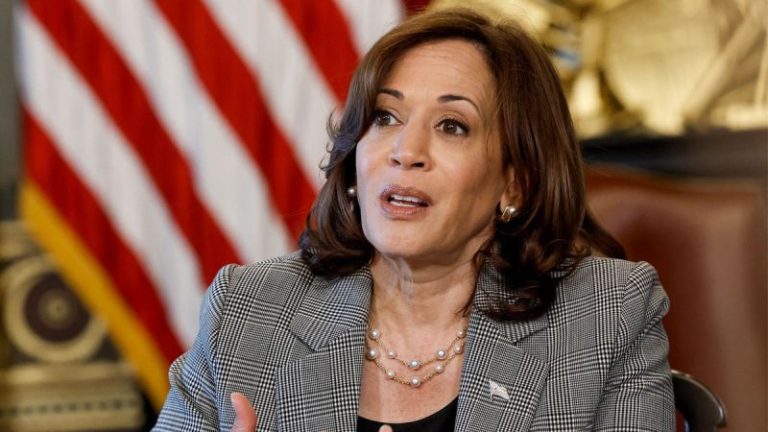
Prominent Democrats sent messages of doom and gloom rather than celebration on July 4, drawing ire from a multitude of critics. Many of the messages included warnings about supposed threats to the country emanating from the Trump administration.

‘This Fourth of July, I am taking a moment to reflect. Things are hard right now. They are probably going to get worse before they get better,’ former Vice President Kamala Harris wrote in a post on X that included a photo of her and former first gentleman Doug Emhoff at the White House. ‘But I love our country — and when you love something, you fight for it. Together, we will continue to fight for the ideals of our nation.’

Many social media users were quick to point out that Harris cropped former President Joe Biden and former first lady Jill Biden out of the photo. Others took one of Harris’ famous phrases to mock her, saying that the country was ‘unburdened by what has been.’

Harris’ old boss, former President Joe Biden, posted a more mild message, while also encouraging Americans to ‘fight to maintain’ democracy.

Meanwhile, former President Barack Obama also chimed in with a warning of his own, saying that ‘core democratic principles seem to be continuously under attack.’ He argued that the word ‘we’ is the ‘single most powerful word in our democracy,’ and used his first presidential campaign slogan as one of his examples.

‘Independence Day is a reminder that America is not the project of any one person. The single most powerful word in our democracy is the word ‘We.’ ‘We The People.’ ‘We Shall Overcome.’ ‘Yes We Can.’ America is owned by no one. It belongs to all citizens. And at this moment in history—when core democratic principles seem to be continuously under attack, when too many people around the world have become cynical and disengaged—now is precisely the time to ask ourselves tough questions about how we can build our democracies and make them work in meaningful and practical ways for ordinary people,’ Obama wrote.

Xi Van Fleet, a survivor of Mao’s Cultural Revolution, responded saying, ‘We the People are taking our country back from those like you who despise America and work tirelessly to dismantle everything it stands for.’

Sen. Bernie Sanders appeared to support the anti-Trump ‘No Kings’ movement in his July 4 post.

‘On July 4, 1776, Americans said: No to Kings, No to Despotism. On July 4, 2025, all across the country, Americans say again: No to Kings, No to Despotism,’ Sanders wrote.

In response, several social media users pointed out that, unlike a king, President Donald Trump was elected.

This post appeared first on FOX NEWS

The stock markets had a dynamic start to the third quarter, pushing indices to new highs after earlier tariff concerns.

On Monday (June 30), markets generally saw strong gains, with the S&P 500 (INDEXSP:INX) and Nasdaq Composite (INDEXNASDAQ:.IXIC) reaching new record highs in the US while the S&P/TSX Composite Index (INDEXTSI:OSPTX) climbed higher after a last-minute policy reversal to rescind a planned digital services tax targeting US tech firms.

Tuesday (July 1), Canadian markets were closed for Canada Day. As for US markets, following two consecutive days of highs, the S&P and Nasdaq declined on Tuesday (July 1) after a renewed feud between Tesla (NASDAQ:TSLA) CEO Elon Musk and US President Donald Trump sent Tesla shares down by over 5 percent.

However, tech stocks boosted the performance of both Canadian and US markets on Wednesday (July 2) and Thursday (July 3) after export restrictions to China were lifted and the US labor market reported better-than-expected unemployment data.

US markets were closed on Friday (July 4) for a holiday, while Canadian markets ended the day slightly positive.

1. Meta announces AI restructure, continues talent acquisition

Last weekend, reports surfaced that Meta Platforms (NASDAQ:META) has hired four additional researchers from OpenAI, bringing the total number of high-profile AI talent poached from other tech labs to 13, according to a tweet from former Scale AI CEO Alexandr Wang, who was recently recruited as Meta’s Chief AI Officer.

Then, in an internal memo to employees on Monday, Meta CEO Mark Zuckerberg unveiled the company was restructuring its AI division under the name Meta Superintelligence Labs. According to the memo, which was reviewed by Bloomberg, the new division will be led by Wang and one of its commitments is ‘developing AI ‘superintelligence’ or systems that can complete tasks as well as or even better than humans.’

Meta has reportedly offered researchers contracts and signing bonuses worth up to US$100 million; however, Chief Technology Officer Andrew Bosworth has pushed back on those reports, claiming the figures are inflated.

Helen Toner, a former OpenAI board member and director of strategy at Georgetown’s Center for Security and Emerging Technology, told Bloomberg TV’s Haslinda Amin on Thursday that Meta’s bid to become an AI leader would be “difficult” considering its track record of internal dysfunction and questions around the return on its massive talent spending.

“Meta has started to get a reputation of having a little bit of a dysfunctional AI team, not really having its organizational structure set up in a way that really lets them succeed and innovate. And what I think we’re seeing here is CEO Mark Zuckerberg really stepping in and saying, well, we have to do something differently. We need a big new push, we need a big new effort,’ she said.

‘I think (Meta is) really trying to start something new, to pour enormous amounts of financial resources into that. So the question (to watch) is six months from now, 12 months from now, is that paying off for them?’

2. Apple considers third-party AI for Siri overhaul

Apple (NASDAQ:AAPL) is reportedly in active discussions with Anthropic and OpenAI to integrate their foundation models into an overhauled version of its voice assistant Siri, a significant pivot from the company’s in-house approach to AI. According to people familiar with the discussions who spoke to Bloomberg, Apple has asked both companies to train versions of their models that could be tested on Apple’s infrastructure, the publication reported Monday.

Apple announced plans to release a new version of its voice assistant at its Worldwide Developers Conference in 2024. The release was slated for 2026, but the company has run into multiple engineering snags and delays, and ultimately replaced John Giannandrea with Mike Rockwell as the new Siri chief executive.

Rockwell and software engineering head Craig Federighi launched an evaluation, instructing staff to assess Siri’s performance using third-party tech, including Anthropic’s Claude, OpenAI’s ChatGPT and Alphabet’s (NASDAQ:GOOGL) Gemini.

According to Bloomberg’s sources, the team found Anthropic’s technology most promising for Siri, leading Apple’s vice president of corporate development to open discussions with Anthropic.

Bloomberg’s sources maintain that the development of an in-house model is still active, and Apple hasn’t made a final decision on using third-party models.

Apple shares closed up 6.24 percent for the week.

Apple’s share price performance, June 30 to July 3, 2025.

3. Oracle and OpenAI ink massive computing deal

OpenAI will rent roughly 4.5 gigawatts of computing power from Oracle (NYSE:ORCL) as part of the Stargate Project, according to sources for Bloomberg. The news follows a US$30 billion single cloud deal announced on Monday with an unnamed customer.

The Stargate energy deal is reportedly a component of that larger contract.

Sources added that Oracle will develop multiple data centers in the US, considering sites in Texas, Michigan, Wisconsin and Wyoming, and that the company will expand its recently built center in Abilene, Texas, to accommodate about two gigawatts of power capacity.

This collaboration underscores the escalating demand for high-performance computing necessary to train and operate advanced AI models. OpenAI, a leader in AI research and development, requires immense computational resources to fuel its projects, including large language models and other sophisticated AI applications.

The Stargate initiative positions Oracle as a crucial enabler of this next generation of AI innovation, solidifying its role in the evolving cloud and AI ecosystem. The long-term implications of this partnership could see a significant shift in how AI companies acquire and manage their computational infrastructure, potentially paving the way for more dedicated and extensive cloud partnerships in the future.

Oracle’s share price performance, July 1 to July 3, 2025.

4. CoreWeave deploys first Nvidia GB300-powered AI server

CoreWeave (NASDAQ:CRWV) said it has received the first AI server system built around NVIDIA’s (NASDAQ:NVDA) ultra-powerful GB300 Grace Blackwell AI chip.

The server is deployed within Dell’s (NYSE:DELL) integrated rack-scale system — a turnkey AI infrastructure platform combining compute, networking and cooling — and features 72 of Nvidia’s GB200 chips.

CoreWeave said it will install the cutting-edge hardware in the US and roll out more servers over time. The company will offer the server as part of its AI cloud platform, allowing clients like OpenAI to train and deploy massive, next-generation AI models with faster speeds and greater efficiency.

In the announcement, CoreWeave claimed the NVIDIA GB300 NVL72 significantly boosts AI reasoning performance, offering a 10 times improvement in user responsiveness and five times better throughput per watt than the Hopper server. This translates to an increase of fifty times in reasoning model inference output, enabling faster, more complex AI models.

5. US lifts EDA software export restrictions to China

License requirements for design software sales in China were lifted this week as part of a trade deal between the US and China.

On July 2, the US Commerce Department told Synopsys (NASDAQ:SNPS), Cadence Design Systems (NASDAQ:CDNS) and Siemens (XETR:SIE), three of the world’s leading design software providers, that they would no longer need to seek government licenses to conduct business in China.

Official announcements from the companies confirmed they would be resuming business with Chinese counterparts, sending each of their stock prices up between 3 and 6 percent.

The US government restricted sales of electronic design automation (EDA) tools to China in late May as a response to China’s decision to limit shipments of essential rare earth minerals. Last week, the two countries reached a trade agreement that would re-allow shipments of EDA software after Beijing speeds up approvals of critical mineral exports to the US.

Securities Disclosure: I, Meagen Seatter, hold no direct investment interest in any company mentioned in this article.

This post appeared first on investingnews.com

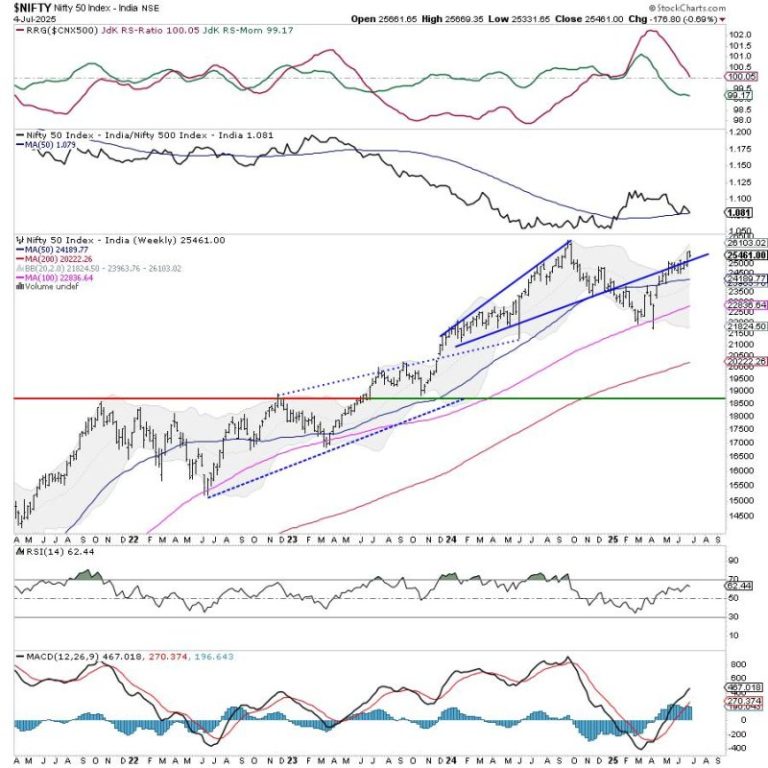
After a strong move in the week before this one, the Nifty spent the last five sessions largely consolidating in a very defined range. The markets traded with a weak underlying bias and lost ground gradually over the past few days; however, the drawdown remained quite measured and within the expected range. As the markets consolidated, the trading range got narrower. The Nifty moved in a 337-point range during the week. While the Index formed a near-similar high, it marked a much higher low. The volatility also retraced; the India VIX came off by 0.59% to 12.31. While showing no intention to trend higher, the headline Index closed with a net weekly loss of 176.80 points (-0.69%).

The Nifty has created an intermediate resistance zone between 25600 and 25650. A trending move on the upside would happen only if the Nifty is able to take out this zone on the upside convincingly. Until that happens, we will see the Nifty continuing to consolidate with 25100 acting as support. This is the prior resistance level, which is expected to act as support in case of any corrective retracement. So long as the Nifty is inside the 25000-25650 zone, it is unlikely to develop any sustainable directional bias on either side.

Friday was a trading holiday in the US. Because of this, we will not have any overnight cues to deal with on Monday. The Indian markets may see a stable and quiet start. The levels of 25650 and 25800 are likely to act as probable resistance points. Support levels come in at 25250 and 25000.

The weekly MACD is bullish and remains above its signal line. The weekly RSI is 62.40; it stays neutral and does not show any divergence against the price. No major formation was noticed on the candles.

The pattern analysis of the weekly chart reveals that after breaking above the rising trendline resistance and moving past the 25000-25150 zone, the Nifty consolidated after trending higher for four consecutive days. Over the past week, it gave up a portion of its gains and consolidated at higher levels. In the process, it has dragged its support level higher to 25000. As long as the Index remains above this point, the breakout and the resumption of the upmove observed in the preceding week remain valid and intact.

Overall, it is expected that the Nifty will remain within the 25000-25650 range over the coming week. The markets are unlikely to develop any directional bias unless they move past the 25650 level or violate the 25000 level. Sector rotation within the market is very much visible; it would be imperative to efficiently rotate sectors and stay invested in those that show improved relative strength and a promising technical setup. We are likely to see improved performance in the Auto, Energy, IT, and broader markets, among other sectors. It is also strongly recommended to protect profits here, where the stocks have run up hard. Any aggressive shorting should be avoided as long as the Nifty stays above the 25000 level. A cautiously positive approach is advised for the coming week.


Sector Analysis for the coming week

In our look at Relative Rotation Graphs®, we compared various sectors against the CNX500 (NIFTY 500 Index), representing over 95% of the free-float market cap of all the listed stocks. 

Relative Rotation Graphs (RRG) show that the Nifty PSU Bank Index and the Midcap 100 Index are the only two groups that are inside the leading quadrant. They are likely to outperform the broader markets relatively.

The Nifty Infrastructure Index is experiencing an improvement in its relative momentum while it remains within the weakening quadrant. Additionally, the PSE, Nifty Bank, and the Financial Services Index are located within the weakening quadrant. While individual stock-specific performance may not be ruled out, the overall relative performance may take a backseat.

The Commodities Index and the Services Sector Index have rolled into the lagging quadrant. The Consumption, Pharma, and the FMCG Indices also continue to languish inside the lagging quadrant. The Metal Index is showing a sharp improvement in its relative momentum against the broader markets, while staying within the lagging quadrant.

The IT, Energy, Media, Realty, and Auto Indices are inside the Improving quadrant. They continue to rotate firmly while improving their relative performance against the broader Nifty 500 Index.


Important Note: RRG charts show the relative strength and momentum of a group of stocks. In the above Chart, they show relative performance against NIFTY500 Index (Broader Markets) and should not be used directly as buy or sell signals.  


Milan Vaishnav, CMT, MSTA

Consulting Technical Analyst

www.EquityResearch.asia | www.ChartWizard.ae

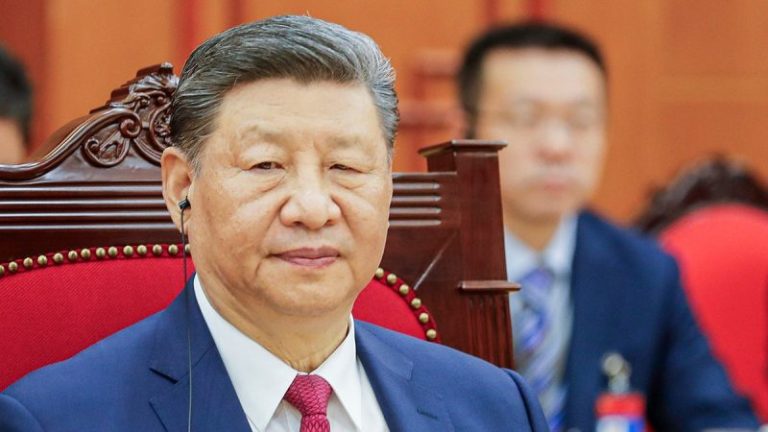
Chinese President Xi Jinping will not attend this week’s BRICS Summit in Brazil, marking the first time the Chinese leader has missed the gathering of major emerging economies. The abrupt decision has triggered widespread speculation about internal political dynamics within China and the fraying cohesion of BRICS itself.

China’s official explanation — a ‘scheduling conflict’ and the fact that Xi already met with Brazilian President Luiz Inácio Lula da Silva earlier this year, according to the South China Morning Post — has been met with skepticism. Premier Li Qiang will attend the summit in Xi’s place, continuing a recent trend of Xi scaling back his appearances on the global stage.

‘That doesn’t make sense,’ said Gordon Chang, an expert on U.S.-China relations. ‘There are many other countries at the BRICS summit, not just Brazil. To me, it’s extremely significant that Xi Jinping is not going. It suggests turbulence at home — there are signs he’s lost control of the military and that civilian rivals are reasserting power. This is a symptom of that.’

Bryan Burack of the Heritage Foundation agrees that Xi’s absence underscores deeper issues: ‘It’s another indication that BRICS is not going to be China’s vassalization of the Global South.’ He noted that countries like Brazil and Indonesia have recently imposed tariffs on China over industrial overcapacity and dumping, moves that suggest widening rifts within the group.

‘China is actively harming all those countries for the most part, maybe with some exceptions, through its malign trade policies and dumping and overcapacity.’

Tensions with India and global trade pressure may also be factors

Some analysts point to rising China-India friction as a contributing factor in Xi’s decision to skip the summit. 

‘China has been at war with India for decades, essentially,’ Burack said. ‘These are fundamentally opposing interests. It’s difficult to see China changing its behavior in the near term, and that will keep tensions high.’

India’s Prime Minister Narendra Modi is expected to take a leading role at the gathering, potentially another deterrent for Xi’s attendance.

Another key leader — Russian President Vladimir Putin — is only expected to address the group by video. 

BRICS: United in name, divided in decades-long tensions 

Formed by Brazil, Russia, India and China and later joined by South Africa, BRICS was envisioned as a non-Western counterweight to G7 dominance. It has expanded to include Egypt, Ethiopia, Iran, the UAE and, most recently, Indonesia, strengthening its economic footprint.

Economist Christian Briggs highlighted BRICS’s massive scale: ‘BRICS now comprises 12 full members and up to 23 when counting partners. Collectively, they account for over 60% of the world’s GDP and around 75% of the global population. They control vast natural resources and a growing share of global trade flows.’

Yet despite its scale, the bloc remains ideologically and strategically fragmented. ‘It’s a group of countries that hate each other,’ Burack said bluntly. ‘China is harming many of them through unfair trade practices. There’s not a lot of incentive for real unity.’

Currency ambitions and strategic divergences

The alliance’s aspirations to challenge the U.S. dollar through alternative payment systems and a potential BRICS currency have gained media traction — but experts caution against overestimating this threat.

‘There’s been a lot of fearmongering about a BRICS currency,’ said Burack. ‘But the interests of these countries are completely divergent. There’s more smoke than fire when it comes to a currency challenge to the dollar.’

Chang echoed this skepticism: ‘The only country that can challenge the dollar is the United States. Weakness in the dollar is due to what we are doing domestically, not what the BRICS are doing.’

Still, Briggs offered a counterpoint, arguing that BRICS members are already reshaping global currency flows.

‘They’re moving away from the dollar into digital yuan, rupees, rubles. China has launched a SWIFT alternative already adopted by the Caribbean banking sector — trillions of dollars are shifting.’

Is BRICS still a threat to U.S. influence?

While its cohesion remains questionable, BRICS poses a long-term challenge to U.S. influence — particularly in regions where Washington has retreated diplomatically and economically.

‘China filled the void left by the U.S. in places like Africa,’ said Briggs. ‘Now it controls about 38% of the world’s minerals. Meanwhile, Russia’s economy has doubled despite sanctions, because they preemptively reduced reliance on the dollar.’

Yet Chang sees India as a brake on any aggressive anti-Western tilt. ‘BRICS has an ‘I’ in it—and that’s India. Modi doesn’t want to be part of an anti-Western bloc. As long as India’s in BRICS, the rest of the world is safe.’

A missed opportunity — or a calculated power move?

To some, Xi’s no-show signals instability in Beijing. To others, the opposite: it demonstrates confidence in China’s dominance over the other BRICS members.

‘He doesn’t have to be there,’ Briggs contended. ‘Xi’s power allows him to delegate. China is trading with nearly 80% of the world now. He’s moving the agenda forward even in absentia.’

What’s clear is that BRICS continues to evolve — its internal contradictions as visible as its geopolitical ambitions. Whether Xi’s absence marks a retreat or a recalibration remains one of the key questions hovering over the summit in Brazil.

This post appeared first on FOX NEWS

CoTec Holdings Corp. (TSXV:CTH)(OTCQB:CTHCF) (the ‘Corporation‘) is pleased to announce that it has completed a second closing (the ‘Second Closing‘) of its previously announced financing pursuant to the listed issuer financing exemption under Part 5A of National Instrument 45-106 – Prospectus Exemptions (the ‘LIFE Offering‘) and concurrent private placement (the ‘Private Placement‘ and together with the LIFE Offering, the ‘Offerings‘) of up to an aggregate of 12,820,512 units (each, a ‘Unit‘) at a price of $0.78 per Unit for aggregate gross proceeds of up to $10,000,000 (comprised of $5,000,000 under the LIFE Offering and $5,000,000 under the Private Placement). Each Unit consists of one common share in the capital of the Corporation (each a ‘Common Share‘) and one Common Share purchase warrant (each a ‘Warrant‘). Each Warrant entitles the holder to purchase one Common Share at an exercise price of $1.20 for a period of 18 months following the issuance of the Units.

CoTec is also pleased to note that the aggregate target of $10,000,000 under the Offerings are now fully subscribed for and that the Corporation will be closing the financing on or around July 9, 2025 to allow for subscription agreements received but not yet finalised to be processed.

Pursuant to the Second Closing, the Corporation issued a total of 2,306,753 Units for aggregate gross proceeds of $1,799,270.36 under the LIFE Offering and 1,080,723 Units for aggregate gross proceeds of $842,964.90 under the Private Placement. Together with the initial closing under the Offerings, the Corporation has issued an aggregate total of 5,039,065 Units for aggregate gross proceeds of $3,930,474.27 under the LIFE Offering and 5,027,854 Units for aggregate gross proceeds of $3,921,728.72 under the Private Placement. The Corporation will use the net proceeds of the Offerings to fund the detailed design and engineering at HyProMag USA LLC, the Corporation’s drilling program at its Lac Jeannine property, further investment obligations and for general corporate purposes.

In connection with the Second Closing, the Corporation paid cash fees and compensation warrants (‘Compensation Warrants‘) to certain agents and finders as follows: $70,540.47 and 90,437 Compensation Warrants to ECM Capital Advisors Ltd.; $6,000.00 and 7,692 Compensation Warrants to Odeon Capital Group LLC; $40,799.91 and 52,308 Compensation Warrants to Integrity Capital Group Inc.; and $12,237.12 and 15,689 Compensation Warrants to INTE Securities LLC.

All securities issued to investors in connection with the Private Placement will be subject to a statutory hold period of four months plus a day from the date of issuance in accordance with applicable securities legislation in Canada.

About CoTec

CoTec is a publicly traded investment issuer listed on the TSXV and the OTCQB and trades under the cymbol CTH and CTHCF respectively. CoTec is a forward-thinking resource extraction company committed to revolutionizing the global metals and minerals industry through innovative, environmentally sustainable technologies and strategic asset acquisitions. With a mission to drive the sector toward a low-carbon future, CoTec employes a dual approach: investing in disruptive mineral extraction technologies that enhance efficiency and sustainability while applying these technologies to undervalued mining assets to unlock their full potential. By focusing on recycling, waste mining, and scalable solutions, the Company accelerates the production of critical minerals, shortens development timelines, and reduces environmental impact. CoTec’s strategic model delivers low capital requirements, rapid revenue generation, and high barriers to entry, positioning it as a leading mid-tier disruptor in the commodities sector.

For more information, please visit www.cotec.ca.

Forward-Looking Information Cautionary Statement

Statements in this press release regarding the Company, its exepctations regarding the final closing of the Offerings, its investments and the Offerings which are not historical facts are ‘forward-looking statements’ that involve risks and uncertainties, including statements relating to management’s expectations with respect to its current and potential future investments and the benefits to the Company which may be implied from such statements. Since forward-looking statements address future events and conditions, by their very nature, they involve inherent risks and uncertainties.

Actual results in each case could differ materially from those currently anticipated in such statements, due to known an unknown risks and uncertainties affecting the Company, including by not limited to: general economic, political and market factors in North America and internationally, interest and foreign exchange rates, changes in costs of goods and services, global equity and capital markets, business competition, technological change, changes in government relations, industry conditions, unexpected judicial or regulatory proceedings and catastrophic events. The Company’s investments are being made in mineral extraction related assets and technologies which are subject to their own inherent risks and the success of such Investments may be adversely impacted by, among other things: environmental risks and costs; labor costs and shortages; uncertain supply and price fluctuations in materials; increases in energy costs; labor disputes and work stoppages; leasing costs and the availability of equipment; heavy equipment demand and availability; contractor and subcontractor performance issues; worksite safety issues; project delays and cost overruns; extreme weather conditions; and social disruptions. As the investments are being made in mineral extraction technology, such investments will also be subject to risks of successful application, scaling and deployment of technology, acceptability of technology within the industry, availability of assets where technology could be applied, protection of intellectual property in relation to such technology, successful promotion of technology and success of competitor technology. Any material adverse change in the Company’s financial position or a failure by the Company to successfully make investments in the manner currently contemplated, could have a corresponding material adverse change on the investments and, by extension, the Company.

For further details regarding risks and uncertainties facing the Company, please refer to ‘Risk Factors’ in the Company’s filing statement dated April 6, 2022 and its other continuous disclosure documents, copies of which may be found under the Company’s SEDAR+ profile at www.sedarplus.com. The Company assumes no responsibility to update forward-looking statements in this press release except as required by law. Readers should not place undue reliance on the forward-looking statements and information contained in this press release and are encouraged to read the Company’s continuous disclosure documents, which are available on SEDAR+ at www.sedarplus.ca.

For further information, please contact:

Braam Jonker – (604) 992-5600

Neither TSX Venture Exchange nor its Regulation Services Provider (as that term is defined in the policies of the TSX Venture Exchange) accepts responsibility for the adequacy or accuracy of this news release.

NOT FOR DISTRIBUTION TO THE U.S. NEWSWIRE SERVICES OR FOR DISSEMINATION IN THE UNITED STATES

Source

Click here to connect with CoTec Holdings Corp. (TSXV:CTH)(OTCQB:CTHCF) to receive an Investor Presentation

This post appeared first on investingnews.com

Here’s a quick recap of the crypto landscape for Friday (July 4) as of 12:00 noon UTC.

Get the latest insights on Bitcoin, Ethereum and altcoins, along with a round-up of key cryptocurrency market news.

Bitcoin and Ethereum price update

Bitcoin (BTC) is priced at US$108,948, down by 1.6 percent in the last 24 hours. The day’s range for the cryptocurrency brought a low of US$107,741 and a high of US$109,997.

Bitcoin price performance, July 4, 2025.

Chart via TradingView

Bitcoin’s rally to US$108,000 followed strong US labor data that boosted risk appetite early on, alongside continued inflows into Bitcoin spot ETFs (nearly US $50 billion), which helped anchor prices despite broader equity market pullbacks.

Market watchers also noted heightened volatility following the reactivation of two long-dormant Bitcoin wallets containing roughly 20,000 BTC (worth over US$2 billion), raising questions about potential future dumping.

Ethereum (ETH) is priced at US$2,549.85, down by 2.7 percent over the past 24 hours. Its lowest valuation on Wednesday was US$2,502.39 and its highest was US$2,600.55.

Altcoin price update

  • Solana (SOL) was priced at US$150.30, up by five percent over 24 hours. Its highest valuation as of Friday was US$153.26, and its lowest was US$146.61.
  • XRP was trading for US$2.24, down by 1.4 percent in 24 hours. The cryptocurrency’s lowest valuation was US$2.21 and its highest was US$2.28.
  • Sui (SUI) is trading at US$2.92, showing a decrease of 3.6 percent over the past 24 hours. Its lowest valuation was US$2.87 and its highest was US$3.07.
  • Cardano (ADA) is priced at US$0.5817, down by 3.1 percent in the last 24 hours. Its lowest valuation as of Wednesday was US$0.5715 and its highest was US$0.6028.

Today’s crypto news to know

Trump’s “big, beautiful bill” passes Congress, sending crypto markets higher

President Donald Trump’s flagship “big, beautiful bill,” featuring sweeping tax cuts, narrowly passed the House of Representatives on July 3 with a 218–214 vote and now awaits his signature.

The legislation has stirred concern over the national debt, with Polymarket traders assigning a 90 percent probability of US debt exceeding US$38 trillion by 2025. Bitcoin traded near US$109,886 after the news, with other leading coins including Ethereum and Solana also posting gains.

Elon Musk criticized the bill for potentially inflating the deficit by trillions, while Trump suggested Musk’s criticism stemmed from policy clashes on EV incentives.

Coinbase CEO Brian Armstrong also raised concerns that a ballooning debt could paradoxically fuel Bitcoin’s status as a reserve asset, despite supporting crypto adoption.

The total crypto market cap climbed to US$3.39 trillion following the vote.

Bitcoin power shift as whales sell 500,000 BTC to institutions

A major redistribution of Bitcoin is underway as long-term whales have sold off around 500,000 BTC over the past year, worth more than US$50 billion at current prices.

According to a Bloomberg report, these sales are being absorbed almost equally by institutional buyers, including spot ETFs and corporate treasuries. That pattern is turning Bitcoin from a high-volatility speculative bet into a steadier institutional portfolio allocation.

Despite steady bullish headlines, the asset has struggled to break through resistance around $110,000, showing a consolidation phase rather than a breakout.

Some of the whales cashing out are early holders dating back to Bitcoin’s earliest cycles, who are swapping BTC for stock-linked deals instead of simply liquidating.

Russian giant Rostec to issue ruble-backed stablecoin

State-owned Russian conglomerate Rostec is moving to launch a ruble-pegged stablecoin called RUBx and a payments network named RT-Pay before year-end, according to TASS.

The stablecoin will be anchored one-to-one with ruble deposits held in treasury accounts, and its code will be independently audited by CertiK. RT-Pay will integrate directly with Russia’s banking system, aiming for instant settlement and smart contract functionality even outside business hours.

Rostec says its platform will follow Russia’s anti-money-laundering and terrorism-financing requirements, in line with the Bank of Russia’s rules.

The stablecoin will run on the Tron blockchain, with its smart contract code to be published on GitHub.

Coinbase’s Base sees US$4 billion in outflows while Ethereum gains US$8.5 billion

Coinbase’s Layer 2 network Base has lost significant traction this year, registering US$4.3 billion in net outflows through cross-chain bridges, data shows.

This downturn is a sharp reversal from the US$3.8 billion of inflows Base attracted in 2024, when it led the sector in bridge activity. Meanwhile, Ethereum has staged a comeback, seeing US$8.5 billion in inflows compared to net outflows last year.

The slowdown in stablecoin supply growth on Base, now holding steady above $4 billion since May, points to a maturing user base and declining trading volumes.

Bridges are key pieces of crypto infrastructure that allow assets to move between chains, supporting interoperability.

Nano Labs starts US$1 billion BNB buying plan with US$50M purchase

Hong Kong-based chipmaker Nano Labs (NASDAQ:NA) has made its first major move in an ambitious plan to hold up to 10 percent of Binance Coin (BNB) in circulation, snapping up US$50 million of BNB this week.

The company disclosed buying around 74,315 BNB at an average price of US$672, funded partly by convertible notes.

Nano Labs ultimately plans to allocate US$1 billion to BNB holdings, signaling a vote of confidence in Binance’s ecosystem.

However, its shares fell nearly 5 percent on Thursday and lost another 2 percent after hours, reflecting investor worries about its exposure to volatile crypto reserves. Nano Labs’ reserves, including Bitcoin, now stand around US$160 million in total.

Securities Disclosure: I, Giann Liguid, hold no direct investment interest in any company mentioned in this article.

Securities Disclosure: I, Meagen Seatter, hold no direct investment interest in any company mentioned in this article.

This post appeared first on investingnews.com

Watch on FOX Business News
Saturday, July 5 at 5:00 PM EST or via the links below

Tune into BTV-Business Television and Discover Investment Opportunities featuring nine standout companies making major moves globally.

North American Iron – With pig iron in short supply, North American Iron is stepping up with a two-million-ton annual solution. The company is transforming Minnesota’s legacy iron ore into a domestic feedstock for U.S. steelmakers-backed by North Dakota’s clean energy support and aiming for production in 2029.

West Red Lake Gold Mines (TSXV: WRLG) (OTCQB: WRLGF) BTV features West Red Lake Gold as it marks its first gold pour at the fully permitted Madsen Mine in Ontario’s Red Lake district. With two million ounces of historical production and robust infrastructure, the company is ramping toward 70,000 ounces per year.

Northisle Copper and Gold (TSXV: NCX) (OTCQX: NTCPF) – BTV spotlights Northisle’s advanced copper-gold project on Vancouver Island. With an estimated long mine life, low capital intensity, and proximity to a deepwater port, the project is backed by experienced leadership and strong local support.

Westport Fuel Systems (NASDAQ: WPRT) With over 30 years of innovation, Westport is delivering fuel-agnostic engine solutions including hydrogen and natural gas. Through its high-pressure joint venture and over 1,400 patents, Westport is helping long-haul transportation transition toward cleaner fuel alternatives.

U.S. Gold Corp. (NASDAQ: USAU) This fully permitted copper-gold project in Wyoming boasts a sub-two-year payback. ESG-friendly plan, low water use, and potential for added revenue through local gravel sales.

Orvana Minerals  (TSX: ORV) (OTCQX: ORVMF) – With operations in Spain and growth projects in Bolivia and Argentina, Orvana Minerals delivers near-term production and exploration upside across gold, copper, and silver.

Avino Silver & Gold (TSX: ASM) (NYSE American: ASM)  A debt-free, cash-flow positive silver, gold, and copper producer, operating in Durango, Mexico. With development underway at a second mine, Avino is scaling production while leveraging existing infrastructure.

Pasofino Gold (TSXV: VEIN) (OTCQB: EFRGF) – is advancing a 3.9-million-ounce gold project in Liberia. Backed by strong economics and a completed feasibility study, the company is preparing for a construction decision and aiming for early production of up to 200,000 ounces per year.

Mayfair Gold (TSXV: MFG) (OTCQX: MFGCF) – Mayfair Gold is developing a low-risk, fast-to-market gold operation in Ontario, with a unique strategy to self-finance expansion using early cash flow. Positioned below federal permitting thresholds, it’s set to capitalize on the current gold cycle.

About BTV – Business Television:

On air for 25+ years, BTV – Business Television, a half-hour investment TV show, delivers up-and-coming companies and investment opportunities. With Hosts, Taylor Thoen and Jessica Katrichak, BTV features stock market analysts, experts and on location interviews with emerging company executives.

TV BROADCAST NETWORKS and TIMES: 

Airing on FOX Business News!

  • Saturday, July 5 @ 5:00pm ET

Suggest a Company to Feature!

Contact: (604) 664-7401 x3 info@b-tv.com. To receive BTV news, subscribe.

To view the source version of this press release, please visit https://www.newsfilecorp.com/release/257791

News Provided by Newsfile via QuoteMedia
This post appeared first on investingnews.com