
Author

admin

Browsing

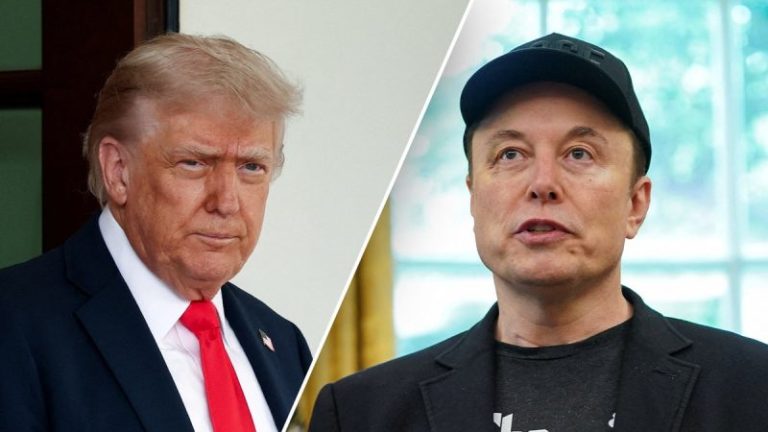
Elon Musk and President Donald Trump are fighting again. Now Musk’s business interests — and the billions in government contracts they enjoy — are once again in the crosshairs.

Investors were already punishing Tesla on Tuesday, sending shares in the electric carmaker more than 4% lower in afternoon trading. The stock has experienced a late-spring rally alongside the broader market but remains down some 20% so far this year. The shares have been pummeled by a global backlash to Musk’s alliance with Trump on the campaign trail and in the White House, where the multibillionaire led a sweeping program of government cuts

Musk acknowledged there had been “some blowback” to the actions taken by his Department of Government Efficiency project that may have affected Tesla sales. Yet investors remain largely bullish on the company and its efforts to pivot away from mass-market EVs and toward self-driving taxis and robotics, pushing its market valuation back toward $1 trillion.

Tesla remains Musk’s best-known business, but its fortunes are less directly tied to the government than SpaceX, his rocket-building company. SpaceX’s $350 billion valuation largely rests on the many government contracts that fuel it. SpaceX’s work for NASA has ramped up in recent years in support of the Artemis mission to return to the moon.

Meanwhile, SpaceX’s Dragon spacecraft is currently the only active vessel capable of carrying astronauts to and from the International Space Station. SpaceX has also become essential to the Department of Defense’s missions taking satellites into orbit and today is responsible for the majority of such missions, according to Ars Technica.

SpaceX is privately held, meaning its shares don’t trade on the open market. It is thus difficult to get a real-time gauge on how worsening relations could affect the company’s fortunes. But the impact could be substantial. Since fiscal year 2000, total revenue for SpaceX and Tesla from federal unclassified contracts sits at $22.5 billion, according to Bloomberg Government data — with most of those going to the former. The Washington Post has put the figure for SpaceX alone at close to $38 billion, with $6.3 billion alone coming in 2024 — the highest annual total to date.

The dispute with Trump has also taken a chunk out of Musk’s personal net worth. After soaring to an all-time high of nearly half a trillion dollars after Trump’s election win, Musk’s publicly available wealth tally now sits at $400 billion, though that still makes him the world’s wealthiest individual by nearly $150 billion ahead of Oracle founder Larry Ellison, another Trump ally.

The Musk-Trump tiff first exploded into public view last month, shortly after Musk formally stepped down from his special government employee role and criticized the massive spending and tax cut bill that Republican senators passed Tuesday. Trump responded at the time by threatening to “terminate Elon’s Governmental Subsidies and Contracts.”

Musk, in turn, said he would begin “decommissioning” the Dragon, only to reverse course hours later after an X user advised him and Trump to “cool off and take a step back for a couple of days.”

Before their initial flare-up subsided, Musk announced he would be reining in his political spending weeks after a candidate he had backed lost a key Wisconsin Supreme Court race. Some analysts believe the current relapse in tensions between the two men will be short-lived given Musk’s reliance on the government, and vice-versa.

Still, Musk is now discussing launching his own political party to address the U.S.’s fiscal imbalances, which he believes Trump’s bill will exacerbate — a contention supported by the nonpartisan Congressional Budget Office. While the South Africa-born executive is ineligible to run for office, any candidate he backed for national office would likely face immediate conflict-of-interest questions.


This post appeared first on NBC NEWS

The last day of trading for the first half of 2025 ended with a bang. The S&P 500 ($SPX) and Nasdaq Composite ($COMPQ) closed at record highs — an impressive finish, given the year has seen significant swings.

We saw signs of investors rotating into technology stocks last week when the Nasdaq 100 ($NDX) hit a record high. Looking at the one-week timeframe in the US Indexes tab in the Equities panel in the StockCharts Market Summary page, the $NDX has seen the largest percentage gain (+3.76%) and is trading 9.94% above its 200-day simple moving average (SMA). The Nasdaq Composite is a close second, with the same percentage gain and trading 8.92% above its 200-day SMA.

FIGURE 1. EQUITIES PANEL OF THE MARKET SUMMARY PAGE. Here, you see a snapshot of the one-week performance of the major US indexes and how far they are from key moving averages. Image source: StockCharts.com. For educational purposes.

Is the Technology Rally Stable?

With technology stocks taking the lead again, it’s worth checking to see if market breadth supports the move.

  • Bullish Percent Index. The %Bullish Percent Indexes panel shows the Nasdaq 100 at 74%, which is in favor of the bullish move in technology stocks.
  • New Highs vs. New Lows. On Monday, approximately 10% of stocks in the Nasdaq 100 hit all-time highs, while 0% of stocks hit a 52-week low. The semiconductor industry is the top-performing bellwether industry.

Armed with this data, let’s break down the Technology sector.  Looking at the MarketCarpets format, we can see that software and semiconductors occupy a significant portion of the sector. The largest cap-weighted stocks are all in the green — Microsoft Corp. (MSFT), NVIDIA Corp. (NVDA), Broadcom, Inc. (AVGO), Taiwan Semiconductor Mfg. (TSM), and Oracle Corp. (ORCL).

FIGURE 2. MARKETCARPET OF THE ONE-WEEK PERFORMANCE OF THE TECHNOLOGY SECTOR. Mega-cap stocks such as MSFT, NVDA, AVGO, TSM, and ORCL were strong performers. Image source: StockCharts.com. For educational purposes.

Three semiconductor stocks — NVDA, AVGO, and TSM — make up most of the move in the entire sector, which makes it worth looking at a chart of the semiconductor stocks.

Semis Stay Strong

The six-month daily chart of the VanEck Vectors Semiconductor ETF (SMH) below shows a clear uptrend, with the 21-day exponential moving average (EMA) sloping up and the 50-day SMA about to cross above its 200-day counterpart.

FIGURE 3. SIX-MONTH DAILY CHART OF THE VANECK VECTORS SEMICONDUCTOR ETF (SMH). The ETF has been in a steady uptrend and is close to its all-time high. The RSI is above 70, and the PPO histogram is hovering above zero. Both support the bullish move in SMH, but it’s worth keeping an eye on momentum. Chart source: StockCharts.com. For educational purposes.

The relative strength index (RSI) is above 70 while the percentage price oscillator (PPO) histogram is just above zero. Despite Monday’s relatively flat day, all the above data support a bullish trend. A slowing momentum would be the first alarm bell for a pullback, with the first support being the 21-day EMA. That would be an opportune time to monitor the industry and, if you’ve considered adding either individual semiconductor stocks or ETFs to your portfolio, it’s worth monitoring the price action. Price could either reverse after hitting a key support level or continue falling.

As we head into the second half of 2025, the performance of semiconductors and technology stocks will dictate the direction of the market.

The Bottom Line

In a market that flip-flops from one day to the next, you might need a helping hand to prevent you from getting emotionally sidetracked. The Market Summary page is your compass, if you will, that helps you make sense of the market’s twists and turns. Visiting the page should be a part of every investor’s routine.


Disclaimer: This blog is for educational purposes only and should not be construed as financial advice. The ideas and strategies should never be used without first assessing your own personal and financial situation, or without consulting a financial professional.

Join Grayson for a solo show as he reveals his top 10 stock charts to watch this month. From breakout strategies to moving average setups, he walks through technical analysis techniques using relative strength, momentum, and trend-following indicators. As a viewer, you’ll also gain insight into key market trends and chart patterns that could directly impact your trading strategy. Whether you’re a short-term trader or a long-term investor, this breakdown will help you stay one step ahead.

This video originally premiered on July 1, 2025. Click on the above image to watch on our dedicated Grayson Roze page on StockCharts TV.

You can view previously recorded videos from Grayson at this link.

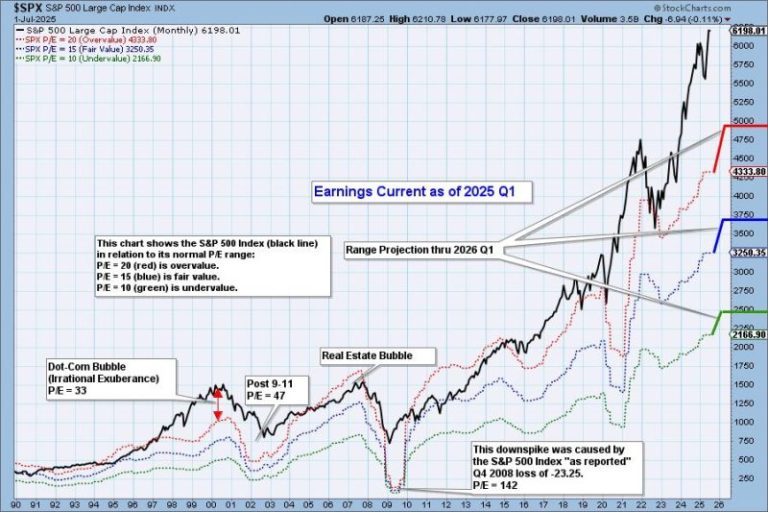
S&P 500 earnings are in for 2025 Q1, and here is our valuation analysis.

The following chart shows the normal value range of the S&P 500 Index, indicating where the S&P 500 would have to be in order to have an overvalued P/E of 20 (red line), a fairly valued P/E of 15 (blue line), or an undervalued P/E of 10 (green line). Annotations on the right side of the chart show where the range is projected to be, based upon earnings estimates through 2026 Q1.


Historically, price has usually remained below the top of the normal value range (red line); however, since about 1998, it has not been uncommon for price to exceed normal overvalue levels, sometimes by a lot. The market has been mostly overvalued since 1992, and it has not been undervalued since 1984. We could say that this is the “new normal,” except that it isn’t normal by GAAP (Generally Accepted Accounting Principles) standards.

We use GAAP earnings as the basis for our analysis. The table below shows earnings projections through March 2026. Keep in mind that the P/E estimates are calculated based upon the S&P 500 close as of June 30, 2025. They will change daily depending on where the market goes from here. It is notable that the P/E remains outside the normal range.

The following table shows where the bands are projected be, based upon earnings estimates through 2026 Q1.

This DecisionPoint chart keeps track of S&P 500 fundamentals, P/E and yield, and it is updated daily — not that you need to watch it that closely, but it is up-to-date when you need it.

CONCLUSION: The market is still very overvalued and the P/E is still well above the normal range. Earnings have ticked up and are projected to trend higher for the next four quarters. High valuation applies negative pressure on the market, but other more positive factors can keep the market in overvalued territory.


(c) Copyright 2025 DecisionPoint.com


Technical Analysis is a windsock, not a crystal ball.


Disclaimer: This blog is for educational purposes only and should not be construed as financial advice. The ideas and strategies should never be used without first assessing your own personal and financial situation, or without consulting a financial professional. Any opinions expressed herein are solely those of the author, and do not in any way represent the views or opinions of any other person or entity.

DecisionPoint is not a registered investment advisor. Investment and trading decisions are solely your responsibility. DecisionPoint newsletters, blogs or website materials should NOT be interpreted as a recommendation or solicitation to buy or sell any security or to take any specific action.

The chairman of the House Budget Committee pushed back on Elon Musk’s claim that President Donald Trump’s $3.3 trillion ‘big, beautiful bill’ is full of ‘pork.’

It’s a claim the tech billionaire made when the House was considering the legislation the first time around, and he re-vamped those attacks again this week as the Senate wrestled with the bill.

Chairman Jodey Arrington, R-Texas, told Fox News Digital in early June that it was not possible for ‘pork barrel spending’ to be included in the legislation, called a budget reconciliation bill, because the reconciliation process was simply not the mechanism for such federal funds.

‘Reconciliation does not have anything to do with discretionary spending — earmarks, and all of that,’ Arrington said. ‘And quite frankly, the [Department of Government Efficiency] findings were, I think, almost entirely an issue for… annual appropriations.’

‘Discretionary spending’ refers to the annual dollars allocated by Congress each year through the appropriations process, also known as ‘spending bills.’ 

It’s a process that’s historically known to be rife with ‘pork barrel spending’ from both Republicans and Democrats — funding for pet projects or other specific initiatives benefiting a certain member of Congress’ district.

But reconciliation deals with the government’s ‘mandatory spending’ — largely government welfare programs that can only be amended by changing the law.

‘We’re dealing with mandatory spending programs — entitlements, health care, welfare and the tax code,’ Arrington said. 

‘We did a responsible bill. There’s no pork in it. The question, I think, for some folks and the objective of mine and my budget committee members was, whatever we’re doing on tax or security to unleash growth and to buy greater security for the American people, we wanted it to be done in a fiscally responsible way.’

Senior White House advisor Stephen Miller echoed that sentiment on X last month: ‘The reconciliation bill cuts taxes, seals the border and reforms welfare. It is not a spending bill. There is no ‘pork.’ It is the campaign agenda codified.’

Musk posted on X Monday night., ‘It is obvious with the insane spending of this bill, which increases the debt ceiling by a record FIVE TRILLION DOLLARS that we live in a one-party country – the PORKY PIG PARTY!! Time for a new political party that actually cares about the people.’

The vast majority of the trillions of dollars in the bill are aimed at Trump’s tax policies — extending his 2017 Tax Cuts and Jobs Act (TCJA) while implementing new priorities like eliminating taxes on tips and overtime wages.

There’s also $5 trillion in the latest version of the bill aimed at raising the debt limit.

The legislation is also aimed at amending current laws to enable new funding for border security and Immigrations and Customs Enforcement (ICE) — projected to boost those priorities by billions of dollars.

To offset those costs, House GOP leaders are seeking stricter work requirements for Medicaid and food stamps, while shifting more of the cost burden for both programs to the states.

Republicans are also looking to roll back green energy tax subsidies in former President Joe Biden’s Inflation Reduction Act (IRA).

But Musk and other fiscal hawks’ main concern has been that the legislation does not go far enough with those spending cuts.

They have also raised concerns about the overall bill adding to the national debt, which is currently nearing $37 trillion.

As part of his social media campaign against the bill, Musk in June called for both eliminating the tax cuts and removing the debt limit increase from the final legislation.

Musk reposted another X user who wrote, ‘Drop the tax cuts, cut some pork, get the bill through.’

He’s also previously shown support on X for Sen. Rand Paul, R-Ky., and his call to strip the debt limit provision out of the bill.

Paul was one of three Republican senators to vote against the bill on Tuesday morning, alongside Sens. Thom Tillis, R-N.C., and Susan Collins, R-Maine.

It’s now set to be considered in the House on Wednesday, with a goal of sending it to Trump’s desk by Fourth of July.

This post appeared first on FOX NEWS

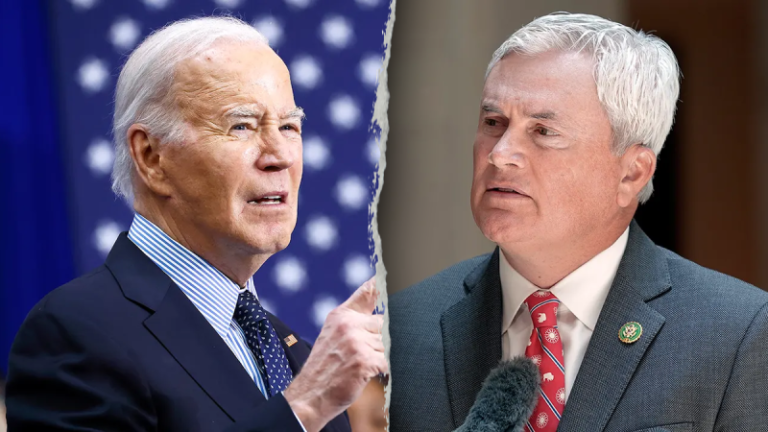
The House Oversight Committee is expanding its investigation into an alleged cover-up of former President Joe Biden’s mental decline and possible unauthorized executive actions, and nine former senior White House officials will testify in the coming weeks.

An Oversight Committee aide familiar with the interview schedule told Fox News Digital five more former senior White House staff members have agreed to appear voluntarily for transcribed interviews.

Ronald Klain, former chief of staff under Biden; Steve Ricchetti, former counselor to the president; Mike Donilon, former senior advisor to the president; Bruce Reed, former deputy chief of staff for policy; and Anita Dunn, former senior advisor to the president for communications will appear for transcribed interviews July 24 through Aug. 7.

According to the aide, two other former high-ranking Biden White House officials, Ashley Williams, former special assistant to the president, and Annie Tomasini, former deputy director of Oval Office operations, former assistant to the president and deputy chief of staff, are voluntarily appearing for transcribed interviews on July 11 and July 18, respectively.

Not all former Biden officials, however, have agreed to testify voluntarily.

Oversight Chairman James Comer, R-Ky., has issued subpoenas compelling Dr. Kevin O’Connor, Biden’s physician, and Anthony Bernal, a former assistant to the president and senior advisor to the first lady, to appear for depositions.

The aide said O’Connor’s deposition is scheduled for July 9, while Bernal’s is schedule for July 16.

These interviews are part of the committee’s ongoing investigation into the alleged attempted cover-up of Biden’s decline and the potentially unauthorized issuance of sweeping pardons and other executive actions by senior White House officials usurping Biden’s presidential authority.

Comer has been on the hunt for who was making decisions in Biden’s inner circle during the president’s apparent mental decline.

Last Friday, he sent letters to former Biden White House press secretary Karine Jean-Pierre, former White House chief of staff Jeff Zients, former senior deputy press secretary Andrew Bates and former special assistant to the president Ian Sams, demanding they present themselves for transcribed interviews with the oversight committee.

In his letters, Comer says the committee believes that the four top Biden staffers have ‘critical’ information on ‘who made key decisions and exercised the powers of the executive branch during the previous administration, possibly without former President Biden’s consent.’

He said that ‘if White House staff carried out a strategy lasting months or even years to hide the chief executive’s condition — or to perform his duties — Congress may need to consider a legislative response.’

Comer set interview dates for late August and early September and gave the four senior officials until July 4 to confirm they would comply with the demands voluntarily or if they will ‘require a subpoena to compel your attendance for a deposition.’

In a statement to Fox News Digital last week, Comer said that ‘as part of our aggressive investigation into the cover-up of his cognitive decline and potentially unauthorized executive actions, we must hear from those who aided and abetted this farce.’

This post appeared first on FOX NEWS

Israel has agreed to a proposal led by the Trump administration for a 60-day ceasefire, during which time President Donald Trump said all parties will work to end the war in the Middle East.

‘My Representatives had a long and productive meeting with the Israelis today on Gaza,’ Trump said in a post on Truth Social on Tuesday. ‘Israel has agreed to the necessary conditions to finalize the 60 Day CEASEFIRE, during which time we will work with all parties to end the War. 

‘The Qataris and Egyptians, who have worked very hard to help bring Peace, will deliver this final proposal,’ Trump added. ‘I hope, for the good of the Middle East, that Hamas takes this Deal, because it will not get better — IT WILL ONLY GET WORSE. Thank you for your attention to this matter!’

Israeli Minister of Foreign Affairs Gideon Sa’ar said Monday, ‘Israel is serious in its will to reach a hostage deal and ceasefire in Gaza.’

He pointed to Jerusalem’s acceptance of a recent proposal presented by Special Envoy Steve Witkoff, but which Hamas rejected as it did not include a solution to a permanent ceasefire and a plan to withdraw Israeli forces from Gaza.

Witkoff is expected to head to Cairo in the coming days to begin hashing out new negotiations.

The president has been pushing for Israel to end its conflict in Gaza and to secure a hostage deal.

Ending Israel’s military operations in Gaza will prove a crucial step in expanding Trump’s ambitions to bring new nations into the Abraham Accords. 

‘We have opportunities in front of us,’ Sa’ar said, echoing Jerusalem’s ambitions to reach a deal. ‘We paid for the new reality in the Middle East with the blood of our soldiers and citizens.’

‘Israel is interested in expanding the Abraham Accords circle of peace and normalization. We have an interest in adding countries, such as Syria and Lebanon, our neighbors, to the circle of peace and normalization – while safeguarding Israel’s essential and security interests,’ he added. 

Prior to today, Trump had not detailed which nations are interested in normalizing diplomatic relations with Israel, though nations like Saudi Arabia have made clear that so long as Palestinians continue to suffer in the Israel-Hamas conflict, normalization is off the table.

Fox News Digital’s Caitlin McFall contributed to this report.

This post appeared first on FOX NEWS

A conservative legal group is trying to uncover whether the former Biden administration’s focus on diversity, equity and inclusion (DEI) initiatives seeped into the nation’s organ transplant system and led to prioritizing patients based on race. 

MAGA law group America First Legal is suing a number of federal health agencies to obtain documents related to the nation’s organ transplant system. 

Specifically, they’re targeting the Department of Health and Human Services, the Centers for Medicare and Medicaid Services and the Health Resources Services Administration, in an attempt to compel them to turn over documents related to the Organ Procurement and Transplantation Network (OPTN).

In April 2023, AFL filed a Freedom of Information Act (FOIA) request seeking documents relevant to the Biden administration’s efforts to infuse DEI into the organ transplant system. However, to date, AFL says it has not received any of the requested information and, as a result, decided to sue in an effort to compel the release of it.

‘The Biden Administration infected the federal government with ‘equity,’ replacing traditional principles of fairness and need with race-conscious criteria,’ said America First Legal Counsel Will Scolinos. ‘AFL is determined to uncover the complete scope of Biden-era DEI policies and will continue to take decisive action to restore colorblind healthcare.’ 

Just days after taking office in 2021, former President Joe Biden signed Executive Order 13985, directing all federal agencies to conduct ‘Equity Assessments’ to determine whether ‘underserved communities and their members’ faced systemic barriers to accessing federal programs. The order also required each agency to develop an action plan to address those barriers.

As part of this effort, in December 2021, CMS issued a request to the public for comments on how the agency could ‘Advance Equity and Reduce Disparities in Organ Transplantation.’

‘CMS is focused on identifying potential system-wide improvements that would increase organ donations, improve transplants, enhance the quality of care in dialysis facilities, increase access to dialysis services, and advance equity in organ donation and transplantation,’ the agency said at the time. 

‘Communities of color have much higher rates of high blood pressure, diabetes, obesity, and heart disease, all of which increase the risk for kidney disease. Black Americans are almost four times more likely, and Latinos are 1.3 times more likely, to have kidney failure compared to White Americans. Despite the higher risk, data shows that Black and Latino patients on dialysis are less likely to be placed on the transplant waitlist and have a lower likelihood of transplantation. Because of these stark inequities, CMS’ [Request For Information] asks the public for specific ideas on advancing equity within the organ transplantation system.’

Meanwhile, several weeks later, the HRSA announced that the ‘labeling of race and ethnicity information for organ donors’ would ‘change on a number of data reports available on the Organ Procurement and Transplantation Network (OPTN) website.’ According to the HRSA, the move made the data ‘clearer, more consistent and easier for users to interpret,’ and did not impact the manner in which data is collected. OPTN collects and manages data pertaining to the patient waiting list, organ donation, matching and transplantation in the U.S.

HRSA also announced a ‘modernization initiative’ for OPTN around the same time, which included plans to strengthen ‘equity, and performance in the organ donation and transplantation system.’

In its lawsuit, AFL chronicled a series of delays, non-responses and incomplete communications following its April 2023 FOIA request. AFL is hoping to obtain a judge’s order requiring the release of the records it is seeking, as well as an index of any withheld material and explanations for why it could not be provided. 

‘The last administration’s pervasive directives requiring consideration of immutable characteristics like race, color, and ethnicity — to make healthcare more ‘equitable’ — should concern all Americans,’ Scolinos said Tuesday. ‘AFL is determined to uncover the complete scope of Biden-era DEI policies and will continue to take decisive action to restore colorblind healthcare.’

HHS declined to comment on AFL’s lawsuit.

This post appeared first on FOX NEWS

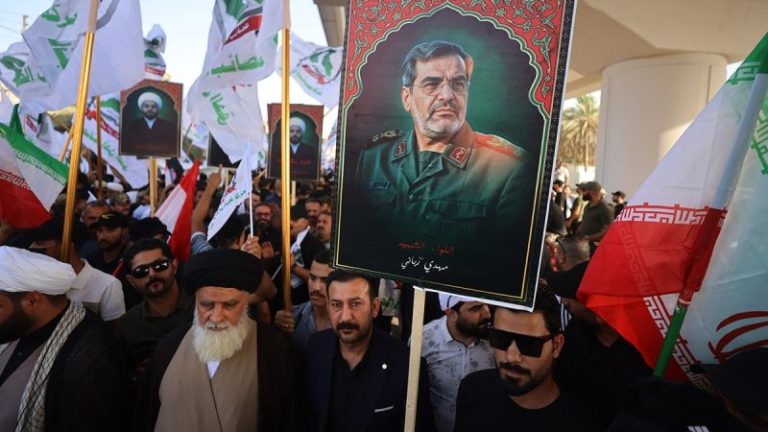
Once a revolutionary militia, Iran’s Islamic Revolutionary Guard Corps built power through ideology and fear. Now, after devastating losses, its future is uncertain.

After major military setbacks, Iran’s IRGC faces a turning point. Experts explain its roots, power, and whether its reign of repression and terror can endure.

Once a fringe militia born of revolution, Iran’s Islamic Revolutionary Guard Corps (IRGC) has grown into the regime’s most feared and powerful force. But according to Dr. Afshon Ostovar, a leading expert on Iran and author of ‘Vanguard of the Imam: Religion, Politics, and Iran’s Revolutionary Guards,’ said the recent U.S. and Israeli strikes in Iran may have permanently altered its trajectory.

‘What the IRGC tried to achieve over the last 25 years is basically toast,’ Ostovar told Fox News Digital, ‘Their campaign to build a military deterrent at home through missiles and nuclear enrichment, and to expand regionally through proxies, has essentially collapsed.’

Founded in the wake of the 1979 revolution, the IRGC was created to safeguard and spread the Islamic Republic’s values — often through violence. Ostovar describes how its legitimacy evolved over time, initially drawn from the overthrow of the Shah, then the Iran-Iraq War, and later through the manufactured narrative of an eternal struggle with the U.S. and Israel.

Behnam Ben Taleblu, Senior Director of FDD’s Iran Program Behnam Ben Taleblu, told Fox News Digital the IRGC’s origin reflects a deep mistrust of Iran’s traditional military, which had remained loyal to the Shah. 

‘The IRGC were created through efforts to collect pro-regime armed gangs called Komitehs. They enforced revolutionary edicts and developed a parallel and ideological military force due to clerical skepticism in the national army,’ he explained.

‘The IRGC are tasked with preserving and defending the revolution in Iran,’ Taleblu said. ‘That’s one reason why the 1979 Islamic Revolution has not been tamed, nor has the regime’s extremism lost any luster. If anything, terrorism and hostage-taking have continued.’

‘They created a boogeyman in the U.S. and Israel,’ Ostovar added. ‘But today, that ideology no longer resonates with most Iranians. The majority want better relations with the West and are tired of the regime’s isolationist stance.’

Today, the IRGC is deeply intertwined with the clerical elite. ‘The IRGC and the clerical elite are partners in power, treating Iran as a springboard to export their revolution,’ Taleblu noted.

Over the past year, Iran has suffered a series of strategic defeats: Hezbollah has been degraded in Lebanon, Hamas crippled in Gaza, Syria effectively lost, and Iranian military infrastructure — including nuclear and missile sites — destroyed in many cases by U.S. and Israeli strikes. Ostovar says these losses have decimated the IRGC’s regional footprint and forced the regime to reevaluate its strategy.

‘They can try to rebuild everything — but that would take too long and be too difficult,’ he said. ‘More likely, we’ll see them repress harder at home and lean on China and Russia to rebuild conventional military capabilities like air defense and advanced jets.’

Internally, the IRGC’s economic empire is also under growing strain. Sanctions, cyberattacks, and battlefield losses have made operations far more difficult. Ostovar said that foreign banks avoid any connection with Iran out of fear they may inadvertently deal with IRGC-linked entities, forcing the group to operate through front companies abroad. ‘They’ve lost a lot, and now they’ll have to redirect their limited resources to rebuild. That’s going to stretch them even thinner.’

Despite these pressures, both Ostovar and Taleblu agree that the IRGC is unlikely to turn against the regime. ‘Much like the regime elite, the IRGC is at a crossroads,’ Taleblu said. ‘They have lost much of their strategic brain trust, but are likely to remain loyal for a combination of ideological and material reasons — so long as the status quo doesn’t change.’

Looking ahead, Iran may shift focus inward, relying more on domestic repression than on external terror. ‘They can’t get weapons into Gaza. They’ve lost access to Lebanon. They may still attempt terrorism, but they’ve failed repeatedly — especially against Israeli targets,’ Ostovar said. ‘In contrast, repressing their own people is something they can do easily.’

He warns that Iran could become ‘more insular, more autocratic — more like North Korea than what it is today.’ While regime collapse is always a possibility, Ostovar believes autocracies are often resilient. ‘Look at Venezuela or Cuba — they’ve run their countries into the ground but still hold on to power.’

Ostovar thinks change — and not for the better — could come via generational shift. ‘The IRGC’s younger cadre is less religious but no less hardline,’ he said. ‘They may not care about hijabs, but they’ve spent the last two decades fighting the U.S. and Israel in Iraq, Syria, and Lebanon. That’s the war they know.’

Some reformist elements within the regime envision a different path — one focused on normalization and growth. ‘They want to preserve the regime not by fighting the world, but by opening up to it,’ Ostovar said. ‘They look more to Vietnam or China as models.’

Taleblu warned that despite recent setbacks, the IRGC’s grip remains strong. ‘Right now, the Guards have power without accountability, wielding political, economic, and military influence in Iranian policy. How this influence is channeled by the next generation of Guardsmen remains to be seen.’

This post appeared first on FOX NEWS

The federal website created to host the U.S. national climate assessments, congressionally-mandated and peer-reviewed reports that cover the effects of climate change in the U.S. has been inaccessible so far this week.

A Fox News Digital review found that the websites for the U.S. Global Change Research Program and the pages for the national assessments were down on Tuesday without any links or referrals to other websites. 

The White House said the climate-related reports will be located within the National Aeronautics and Space Administration (NASA) going forward. However, searches for the assessments did not bring anything up on the NASA website, according to The Associated Press.

The U.S. national climate assessments, of which five have been created to date, are published every four years. Some scientists argue the reports save money and lives, AP reported.

‘It’s critical for decision-makers across the country to know what the science in the National Climate Assessment is,’ University of Arizona climate scientist Kathy Jacobs said in a statement. ‘That is the most reliable and well-reviewed source of information about climate that exists for the United States.’

In March, President Donald Trump’s energy chief vowed a reversal of ‘politically polarizing’ Biden-era climate policies as the new administration approaches climate change as ‘a global physical phenomenon.’

‘I am a climate realist,’ Energy Secretary Chris Wright said at S&P Global’s CERAWeek conference in Houston in March. ‘The Trump administration will treat climate change for what it is, a global physical phenomenon that is a side effect of building the modern world.’

In February, the Trump administration similarly revamped agency websites to be rid of climate change-filled content, amid a widespread rebranding of federal departments from content deemed as not aligning with Trump’s agenda.

The White House and NASA did not immediately respond to Fox News Digital’s request for comment.

This post appeared first on FOX NEWS