Author

admin

Browsing

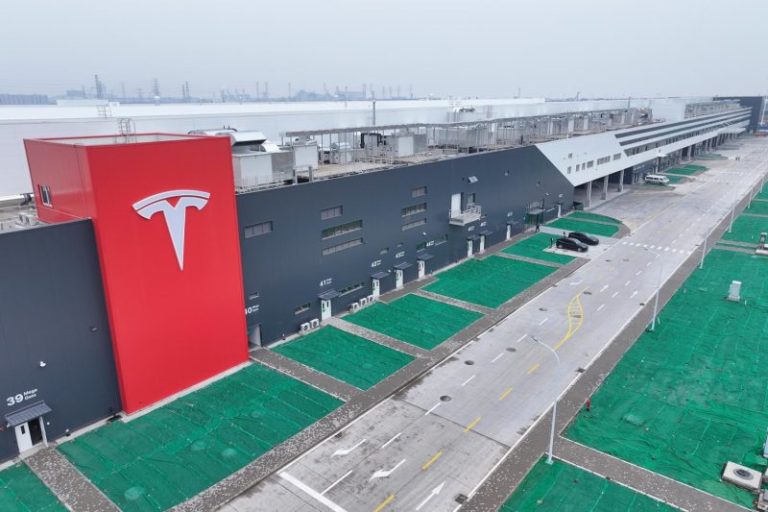
Tesla has inked its first deal to build a grid-scale battery power plant in China amid a strained trading relationship between Beijing and Washington.

The U.S. company posted on the Chinese social media service Weibo that the project would be the largest of its kind in China when completed.

Utility-scale battery energy storage systems help electricity grids keep supply and demand in balance. They are increasingly needed to bridge the supply-demand mismatch caused by intermittent energy sources such as solar and wind.

Chinese media outlet Yicai first reported that the deal, worth 4 billion yuan ($556 million), had been signed by Tesla, the local government of Shanghai and financing firm China Kangfu International Leasing, according to the Reuters news agency.

Tesla said its battery factory in Shanghai had produced more than 100 Megapacks — the battery designed for utility-scale deployment — in the first quarter of this year. One Megapack can provide up to 1 megawatt of power for four hours.

“The grid-side energy storage power station is a ‘smart regulator’ for urban electricity, which can flexibly adjust grid resources,” Tesla said on Weibo, according to a Google translation.

This would “effectively solve the pressure of urban power supply and ensure the safe, stable and efficient electricity demand of the city,” it added. “After completion, this project is expected to become the largest grid-side energy storage project in China.”

According to the company’s website, each Megapack retails for just under $1 million in the U.S. Pricing for China was unavailable.

The deal is significant for Tesla, as China’s CATL and carmaker BYD compete with similar products. The two Chinese companies have made significant inroads in battery development and manufacturing, with the former holding about 40% of the global market share.

CATL was also expected to supply battery cells and packs that are used in Tesla’s Megapacks, according to a Reuters news source.

Tesla’s deal with a Chinese local authority is also significant as it comes after U.S. President Donald Trump slapped tariffs on imports from China, straining the geopolitical relationship between the world’s two largest economies.

Tesla Chief Executive Elon Musk was also a close ally of President Trump during the initial stages of the trade war, further complicating the business outlook for U.S. automakers in China.

The demand for grid-scale battery installation, however, is significant in China. In May last year, Beijing set a new target to add nearly 5 gigawatts of battery-powered electricity supply by the end of 2025, bringing the total capacity to 40 gigawatts.

Tesla has also been exporting its Megapacks to Europe and Asia from its Shanghai plant to meet global demand.

Capacity for global battery energy storage systems rose 42 gigawatts in 2023, nearly doubling the total increase in capacity observed in the previous year, according to the International Energy Agency.

— CNBC’s Arjun Kharpal contributed reporting.

This post appeared first on NBC NEWS

President Donald Trump came back into office promising no new wars. So far, he’s kept that promise. But he’s also left much of Washington — and many of America’s allies — confused by a series of rapid, unexpected moves across the Middle East. 

In just a few months, Trump has reopened backchannels with Iran, then turned around and threatened its regime with collapse. He’s kept Israel at arm’s length — skipping it on his regional tour — before signaling support once again. He lifted U.S. sanctions on Syria’s Islamist leader, a figure long treated as untouchable in Washington. And he made headlines by hosting Pakistan’s top general at the White House, even as India publicly objected. 

For those watching closely, it’s been hard to pin down a clear doctrine. Critics see improvisation — sometimes even contradiction. But step back, and a pattern begins to emerge. It’s not about ideology, democracy promotion, or traditional alliances. It’s about access. Geography. Trade. 

More specifically, it may be about restarting a long-stalled infrastructure project meant to bypass China — and put the United States back at the center of a strategic economic corridor stretching from India to Europe. 

The project is called the India–Middle East–Europe Corridor, or IMEC. Most Americans have never heard of it. It was launched in 2023 at the G20 summit in New Delhi, as a joint initiative among the U.S., India, Saudi Arabia, the UAE and the European Union. Its goal? To build a modern infrastructure link connecting South Asia to Europe — without passing through Chinese territory or relying on Chinese capital. 

IMEC’s vision is bold but simple: Indian goods would travel west via rail and ports through the Gulf, across Israel, and on to European markets. Along the way, the corridor would connect not just trade routes, but energy pipelines, digital cables, and logistics hubs. It would be the first serious alternative to China’s Belt and Road Initiative — a way for the U.S. and its partners to build influence without boots on the ground. 

But before construction could begin, war broke out in Gaza. 

The October 2023 Hamas attacks and Israel’s military response sent the region into crisis. Normalization talks between Saudi Arabia and Israel fell apart. The Red Sea became a warzone for shipping. And Gulf capital flows paused. The corridor — and the broader idea of using infrastructure to tie the region together — was quietly shelved.

That’s the backdrop for Trump’s current moves. Taken individually, they seem scattered. Taken together, they align with the logic of clearing obstacles to infrastructure. Trump may not be drawing maps in the Situation Room. But his instincts — for leverage, dealmaking and unpredictability — are removing the very roadblocks that halted IMEC in the first place. 

His approach to Iran is a prime example. In April, backchannels were reopened on the nuclear front. In May, a Yemen truce was brokered — reducing attacks on Gulf shipping. In June, after Israeli strikes inside Iran, Trump escalated rhetorically, calling for Iran’s ‘unconditional surrender.’ That combination of engagement and pressure may sound erratic. But it mirrors the approach that cleared a diplomatic path with North Korea: soften the edges, then apply public pressure. 

Meanwhile, Trump’s temporary distancing from Israel is harder to miss. He skipped it on his regional tour and avoided aligning with Prime Minister Netanyahu’s continued hard-line approach to Gaza. Instead, he praised Qatar — a U.S. military partner and quiet mediator in the Gaza talks — and signaled support for Gulf-led reconstruction plans. The message: if Israel refuses to engage in regional stabilization, it won’t control the map. 

Trump also made the unexpected decision to lift U.S. sanctions on Syria’s new leader, President Ahmad al-Sharaa — a figure with a past in Islamist groups, now leading a transitional government backed by the UAE. Critics saw the move as legitimizing extremism. But in practice, it unlocked regional financing and access to transit corridors once blocked by U.S. policy. 

Even the outreach to Pakistan — which angered India — fits a broader infrastructure lens. Pakistan borders Iran, influences Taliban-controlled Afghanistan, and maintains ties with Gulf militaries. Welcoming Pakistan’s military chief was less about loyalty, and more about leverage. In corridor politics, geography often trumps alliances. 

None of this means Trump has a master plan. There’s no confirmed strategy memo that links these moves to IMEC. And the region remains volatile. Iran’s internal stability is far from guaranteed. The Gaza conflict could reignite. Saudi and Qatari interests don’t always align. But there’s a growing logic underneath the diplomacy: de-escalate just enough conflict to make capital flow again — and make corridors investable. 

That logic may not be ideologically pure. It certainly isn’t about spreading democracy. But it reflects a real shift in U.S. foreign policy. Call it infrastructure-first geopolitics — where trade routes, ports and pipelines matter more than treaties and summits. 

To be clear, the United States isn’t the only player thinking this way. China’s Belt and Road Initiative has been advancing the same model for over a decade. Turkey, Iran and Russia are also exploring new logistics and energy corridors. But what sets IMEC apart — and what makes Trump’s recent moves notable — is that it offers an opening for the U.S. to compete without large-scale military deployments or decades-long aid packages. 

Even the outreach to Pakistan — which angered India — fits a broader infrastructure lens. Pakistan borders Iran, influences Taliban-controlled Afghanistan, and maintains ties with Gulf militaries.

For all his unpredictability, Trump has always had a sense for economic leverage. That may be what we’re seeing here: less a doctrine than a direction. Less about grand visions, and more about unlocking chokepoints. 

There’s no guarantee it will work. The region could turn on a dime. And the corridor could remain, as it is now, a partially built concept waiting on political will. But Trump’s moves suggest he’s trying to build the conditions for it to restart — not by talking about peace, but by making peace a condition for investment. 

In a region long shaped by wars over ideology and territory, that may be its own kind of strategy. 

This post appeared first on FOX NEWS

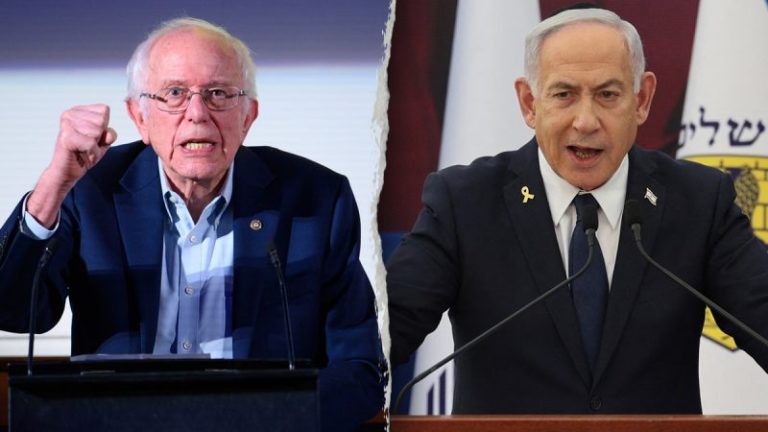
Sen. Bernie Sanders, I-Vt., issued a press release on Thursday in which he declared that Israeli Prime Minister Benjamin Netanyahu was ‘wrong’ in the past and is again now.

In the statement, Sanders pointed to comments Netanyahu made while speaking about Saddam Hussein at a U.S. congressional hearing in 2002. 

Netanyahu said at the time that ‘if you take out … Saddam’s regime,’ the move ‘will have enormous positive reverberations on the region.’ He said that there was ‘no question whatsoever’ that the Iraqi leader was pursuing the ‘development of nuclear weapons.’

‘Netanyahu was wrong. Very wrong. The war in Iraq resulted in 4,492 U.S. military deaths, over 32,000 wounded, and a cost of roughly three trillion dollars. Hundreds of thousands of Iraqis also died as a result of that tragic war. Netanyahu was wrong regarding the war in Iraq. He is wrong now. We must not get involved in Netanyahu’s war against Iran,’ Sanders asserted in his statement.

President Donald Trump has not ruled out the prospect of U.S. military intervention as Israel targets Iran in a bid to stop the rogue regime from achieving its nuclear weapons ambitions.

‘Based on the fact that there’s a substantial chance of negotiations that may or may not take place with Iran in the near future, I will make my decision whether or not to go within the next two weeks,’ President Trump said, according to White House press secretary Karoline Leavitt, who read out the president’s comment during a press briefing on Thursday.

Trump has been clear that he opposes the prospect of Iran acquiring nuclear weapons.

‘AMERICA FIRST means many GREAT things, including the fact that, IRAN CAN NOT HAVE A NUCLEAR WEAPON. MAKE AMERICA GREAT AGAIN!!!’ he declared in a Truth Social post on Monday.

This post appeared first on FOX NEWS

As President Donald Trump weighs joining Israel’s war to destroy Iran’s nuclear capabilities, the world’s chief nuclear official tells Fox News that he sees no evidence Iran’s leaders are racing to build a nuclear bomb.

International Atomic Energy Agency (IAEA) Director General Rafael Grossi said, ‘We have confirmed that Iran does have, even now, enough material for several warheads.

‘But this should not be equated with a nuclear weapon,’ Grossi continued, adding, ‘We do not have at this point, if you ask me, at this time, any tangible proof that there is a program, or a plan, to fabricate, to manufacture a nuclear weapon.’

Inspectors from Grossi’s agency, which is the United Nations’ nuclear watchdog, are tasked with monitoring Iran’s nuclear activities. The IAEA has not been able to carry out inspections since Israel began attacking sites earlier this month but has been making extensive use of satellite imagery.

When asked by Fox News whether Iran’s nuclear program had been set back dramatically by Israel’s attacks to date, Grossi said, ‘No, I wouldn’t say so.

‘I think there have been a number of important military attacks and impacts,’ he said. ‘But it is very clear, and everybody agrees on this, that not everything has been taken out.’

He also argued that military action alone would not be enough to undo what Iran has learned in several decades of nuclear research.

‘One thing is the physical damage,’ Grossi said. ‘But then there is the knowledge factor, and the fact that it is very difficult to roll back the knowledge that a country has acquired.’

Iran has blamed Israel for the killings of multiple Iranian nuclear scientists over many years, including several in recent days. The IAEA censured Iran on June 12, just hours before Israel launched its wave of attacks, for failing to comply with commitments meant to prevent it from developing a nuclear weapon.

However, despite the IAEA reprimand, and the current fighting, Grossi insists a diplomatic solution remains a viable option.

‘I believe that there is a way to take this danger — or this concern — out of the table in a negotiated way.

‘I’ve been in conversations, very good conversations, with [President Trump’s envoy] Steve Witkoff and with the Iranians as well,’ Grossi said.

‘I believe there are ways in which we can make sure that Iran does not get a nuclear weapon. I think this is ultimately what Israel wants and what the United States has declared.

‘We are the international corps of inspectors, and we know what you would need to check in order to prevent this from happening.

‘We believe that the opportunity should be seized, as President Trump said, but of course the space for that is narrowing.’

This post appeared first on FOX NEWS

President Donald Trump came back into office promising no new wars. So far, he’s kept that promise. But he’s also left much of Washington — and many of America’s allies — confused by a series of rapid, unexpected moves across the Middle East. 

In just a few months, Trump has reopened backchannels with Iran, then turned around and threatened its regime with collapse. He’s kept Israel at arm’s length — skipping it on his regional tour — before signaling support once again. He lifted U.S. sanctions on Syria’s Islamist leader, a figure long treated as untouchable in Washington. And he made headlines by hosting Pakistan’s top general at the White House, even as India publicly objected. 

For those watching closely, it’s been hard to pin down a clear doctrine. Critics see improvisation — sometimes even contradiction. But step back, and a pattern begins to emerge. It’s not about ideology, democracy promotion, or traditional alliances. It’s about access. Geography. Trade. 

More specifically, it may be about restarting a long-stalled infrastructure project meant to bypass China — and put the United States back at the center of a strategic economic corridor stretching from India to Europe. 

The project is called the India–Middle East–Europe Corridor, or IMEC. Most Americans have never heard of it. It was launched in 2023 at the G20 summit in New Delhi, as a joint initiative among the U.S., India, Saudi Arabia, the UAE and the European Union. Its goal? To build a modern infrastructure link connecting South Asia to Europe — without passing through Chinese territory or relying on Chinese capital. 

IMEC’s vision is bold but simple: Indian goods would travel west via rail and ports through the Gulf, across Israel, and on to European markets. Along the way, the corridor would connect not just trade routes, but energy pipelines, digital cables, and logistics hubs. It would be the first serious alternative to China’s Belt and Road Initiative — a way for the U.S. and its partners to build influence without boots on the ground. 

But before construction could begin, war broke out in Gaza. 

The October 2023 Hamas attacks and Israel’s military response sent the region into crisis. Normalization talks between Saudi Arabia and Israel fell apart. The Red Sea became a warzone for shipping. And Gulf capital flows paused. The corridor — and the broader idea of using infrastructure to tie the region together — was quietly shelved.

That’s the backdrop for Trump’s current moves. Taken individually, they seem scattered. Taken together, they align with the logic of clearing obstacles to infrastructure. Trump may not be drawing maps in the Situation Room. But his instincts — for leverage, dealmaking and unpredictability — are removing the very roadblocks that halted IMEC in the first place. 

His approach to Iran is a prime example. In April, backchannels were reopened on the nuclear front. In May, a Yemen truce was brokered — reducing attacks on Gulf shipping. In June, after Israeli strikes inside Iran, Trump escalated rhetorically, calling for Iran’s ‘unconditional surrender.’ That combination of engagement and pressure may sound erratic. But it mirrors the approach that cleared a diplomatic path with North Korea: soften the edges, then apply public pressure. 

Meanwhile, Trump’s temporary distancing from Israel is harder to miss. He skipped it on his regional tour and avoided aligning with Prime Minister Netanyahu’s continued hard-line approach to Gaza. Instead, he praised Qatar — a U.S. military partner and quiet mediator in the Gaza talks — and signaled support for Gulf-led reconstruction plans. The message: if Israel refuses to engage in regional stabilization, it won’t control the map. 

Trump also made the unexpected decision to lift U.S. sanctions on Syria’s new leader, President Ahmad al-Sharaa — a figure with a past in Islamist groups, now leading a transitional government backed by the UAE. Critics saw the move as legitimizing extremism. But in practice, it unlocked regional financing and access to transit corridors once blocked by U.S. policy. 

Even the outreach to Pakistan — which angered India — fits a broader infrastructure lens. Pakistan borders Iran, influences Taliban-controlled Afghanistan, and maintains ties with Gulf militaries. Welcoming Pakistan’s military chief was less about loyalty, and more about leverage. In corridor politics, geography often trumps alliances. 

None of this means Trump has a master plan. There’s no confirmed strategy memo that links these moves to IMEC. And the region remains volatile. Iran’s internal stability is far from guaranteed. The Gaza conflict could reignite. Saudi and Qatari interests don’t always align. But there’s a growing logic underneath the diplomacy: de-escalate just enough conflict to make capital flow again — and make corridors investable. 

That logic may not be ideologically pure. It certainly isn’t about spreading democracy. But it reflects a real shift in U.S. foreign policy. Call it infrastructure-first geopolitics — where trade routes, ports and pipelines matter more than treaties and summits. 

To be clear, the United States isn’t the only player thinking this way. China’s Belt and Road Initiative has been advancing the same model for over a decade. Turkey, Iran and Russia are also exploring new logistics and energy corridors. But what sets IMEC apart — and what makes Trump’s recent moves notable — is that it offers an opening for the U.S. to compete without large-scale military deployments or decades-long aid packages. 

Even the outreach to Pakistan — which angered India — fits a broader infrastructure lens. Pakistan borders Iran, influences Taliban-controlled Afghanistan, and maintains ties with Gulf militaries.

For all his unpredictability, Trump has always had a sense for economic leverage. That may be what we’re seeing here: less a doctrine than a direction. Less about grand visions, and more about unlocking chokepoints. 

There’s no guarantee it will work. The region could turn on a dime. And the corridor could remain, as it is now, a partially built concept waiting on political will. But Trump’s moves suggest he’s trying to build the conditions for it to restart — not by talking about peace, but by making peace a condition for investment. 

In a region long shaped by wars over ideology and territory, that may be its own kind of strategy. 

This post appeared first on FOX NEWS

Democrats in Washington, D.C., are misrepresenting major criticisms of President Trump’s ‘big beautiful bill’ with incorrect facts, according to an expert who spoke to Fox News Digital this week as Trump’s budget reconciliation package is debated in Congress. 

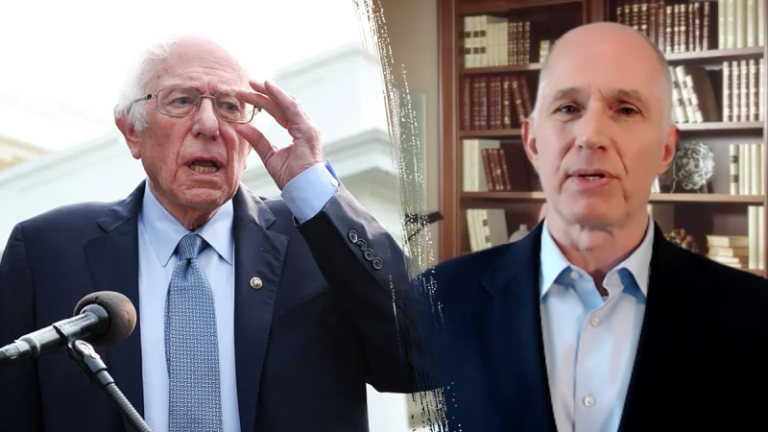
‘The bill doesn’t cut benefits for anyone who has income below the poverty line, anyone who is working at least 20 hours a week and not caring for a child, and people who are Americans,’ Jim Agresti, president and cofounder of Just Facts, told Fox News Digital in response to criticisms from Democrats and a handful of Republicans, including Sen. Josh Hawley, that Trump’s bill will cut Medicaid and disproportionately hurt the poor. 

‘In other words, it cuts out illegal immigrants who are not Americans and fraudsters. So that narrative has no basis in reality. See, what’s been going on since the Medicaid program was started? Is that it’s been expanded and expanded and extended. You know, it got its start in 1966. And since that time, the poverty rate has stayed roughly level around 11% to 15%. While the portion of people in the United States on Medicaid has skyrocketed from 3% to 29%. Right now, 2.5 times more people are on Medicaid than are in poverty.’

Medicaid cuts and reform have been a major sticking point with Democrats, who have merged data from two new reports from the nonpartisan Congressional Budget Office (CBO) to back up claims that nearly 14 million would lose coverage. The White House and Republicans have objected, as not all the policy proposals evaluated were actually included in Republicans’ legislation, and far fewer people would actually face insurance loss. 

Instead, Republicans argue that their proposed reforms to implement work requirements, strengthen eligibility checks and crack down on Medicaid for illegal immigrants preserve the program for those who really need it. 

‘I agree,’ Dem. Rep. Jasmine Crockett said in response to a claim on CNN that Republicans ‘want poor people to die’ with Medicaid cuts. 

Agresti told Fox News Digital that the Medicaid cuts are aimed at bringing people out of poverty and waste. 

‘It’s putting some criteria down to say, ‘Hey, if you want this, and you’re not in poverty, you need to work,” Agresti said. ‘You need to do something to better your situation, which is what these programs are supposed to be, lifting people out of poverty, not sticking them there for eternity. So the whole idea is to get people working, give them an incentive. Hey, if you want to do better in life, and you want this Medicaid coverage, then you have to earn it.’

Independent Sen. Bernie Sanders has claimed the bill is a ‘death sentence for the working class,’ because it raises health insurance ‘copayments for poor people.’

Agresti called that claim ‘outlandish.’

‘First of all, the Big Beautiful Bill does not raise copayments on anyone who’s below the poverty line,’ he explained. ‘Now, for people who are above the poverty line, it requires states to at least charge some sort of copayment, and it also reduces, actually, the max copayment from $100 per visit to $35 per visit.’

Agresti went on to explain that under the current system, ‘people have basically free rein to just go to a doctor or an emergency room or any other place without any co-payment, and they’re not in poverty.’

‘What ends up happening is they waste a ton of money,’ Agresti said. ‘This has been proven through randomized control trials, which are the gold standard for social science analysis, where you have people in a lottery system, some people get the benefit, and some people don’t, and what you end up seeing is that people who don’t have to have skin in the game, abuse emergency rooms, they go there for a stuffy nose, rack up all this money, and it does nothing to improve their health. It’s just wasteful.’

In a statement to Fox News Digital, Sanders Communications Director Anna Bahr said, ‘Mr. Agresti’s facts here are simply incorrect.’

Sanders’ office added that ‘nearly half of all enrollees on the ACA exchanges are Republicans’ and pointed to the House-passed reconciliation bill that Sanders’ office argues ‘says that if a worker can’t navigate the maze of paperwork that the bill creates for Medicaid enrollees, they are barred from receiving ACA tax credits as well.’

‘But workers must earn at least $15,650 per year to qualify for tax credits on the ACA marketplaces – approximately equal to the annual income for a full-time worker earning the federal minimum wage.’

Sanders’ office also pointed to ‘CBO estimates that 16 million people will lose insurance as a result of the House-passed bill and the Republicans ending the ACA’s enhanced premium tax credits.’

Sanders’ office also reiterated that the House-passed bill makes a ‘fundamental change’ to copay for Medicaid beneficiaries, shifting from optional to mandatory.

‘While claiming that I’m ‘incorrect,’ Sanders’ staff fails to provide a single fact that shows the BBB cuts health care for poor working Americans,’ Agresti responded. 

‘It’s especially laughable that they cite expanded Obamacare subsidies in this context, because people in poverty aren’t even eligible for them,’ Agresti continued. ‘After this ‘temporary’ Covid-era handout expires, people with incomes up to 400% of the federal poverty level — or $150,600 for a family of five — will still be eligible for this welfare program, although they will receive less.’

Agresti argued that the claim a ‘max $35 copay (for people who are not poor) ‘hurts working families’’ is not supported by research ‘which makes generalizations and merely cites ‘associations.”

‘As commonly taught in high school math, association doesn’t prove causation,’ Agresti said. 

Sanders’ office told Fox News Digital, ‘Mr. Agresti seems to believe that a working family of four earning only $32,150 per year doesn’t deserve help affording their health care. Health care in the United States is more expensive than anywhere in the world. Terminating health care coverage for 16 million Americans and increasing health care costs for millions will make it harder for working people to afford the health care they need, even if Mr. Agresti doesn’t agree.’

Agresti also took issue with the narrative that cuts cannot be made to Medicaid without cutting benefits to people who are entitled to them.

‘The Government Accountability Office has put out figures that are astonishing, hundreds of billions of dollars a year are going to waste,’ Agresti said. ‘So, yeah, some criteria to make sure that doesn’t happen is a wise idea. Unfortunately, there is a ton of white-collar crime in this country, and this kind of crime is a white-collar crime. It’s not committed with a gun, or by robbing or punching someone, it’s committed by fraud, and there’s an enormous amount of it. 

‘And the big, beautiful bill, again, seeks to rein that in by putting a criteria to make sure we’re checking people’s income, we’re checking their assets. A lot of these federal programs, government health care programs, they’ve stopped checking assets. So you could be a lottery winner sitting on $3 million in cash and have very little income. And still get children’s health insurance program benefits for your kids.’

Hawley said on Monday that he did not have a problem with some of the marquee changes to Medicaid that his House Republican counterparts wanted, including stricter work requirements, booting illegal immigrants from benefit rolls and rooting out waste, fraud and abuse in the program that serves tens of millions of Americans.

However, he noted that about 1.3 million Missourians rely on Medicaid and the Children’s Health Insurance Program (CHIP), and contended that most were working.

‘These are not people who are sitting around, these are people who are working,’ he said. ‘They’re on Medicaid because they cannot afford private health insurance, and they don’t get it on the job.’

‘And I just think it’s wrong to go to those people and say, ‘Well, you know, we know you’re doing the best, we know that you’re working hard, but we’re going to take away your health care access,’’ he continued. 

Fox News Digital’s Diana Stancy and Alex Miller contributed to this report.

This post appeared first on FOX NEWS

Trading resumes in:

Company: Cygnus Metals Limited

TSX-Venture Symbol: CYG

All Issues: Yes

Resumption (ET): 8:15 AM

CIRO can make a decision to impose a temporary suspension (halt) of trading in a security of a publicly-listed company. Trading halts are implemented to ensure a fair and orderly market. CIRO is the national self-regulatory organization which oversees all investment dealers and trading activity on debt and equity marketplaces in Canada .

SOURCE Canadian Investment Regulatory Organization (CIRO) – Halts/Resumptions

News Provided by PR Newswire via QuoteMedia

This post appeared first on investingnews.com

Galan Lithium Limited (ASX:GLN) ( Galan or the Company ) is pleased to announce it has secured a binding commitment for a A$20 million placement ( Placement ) at A$0.11 per share, a 21% premium to the last closing price of A$0.091 as at 19 June 2025 from an existing shareholder, The Clean Elements Fund ( Clean Elements ). Additionally, Clean Elements will receive one unlisted option for every two shares issued under the Placement, with an exercise price of A$0.15 per option and an expiry date that is three years from the date of issue.

The Placement is subject to Clean Elements’ satisfactory completion of due diligence over a period not longer than 77 days. Full completion of the Placement will require shareholder approval which will be sought at a Galan general meeting, expected to be held in early September 2025 .

The Placement provides the final construction funding solution for Phase 1 (at 4ktpa LCE), of the Company’s world class Hombre Muerto West project ( HMW ) in Argentina , which will see production of lithium chloride concentrate in H1 2026.

Managing Director, Juan Pablo (JP) Vargas de la Vega, commented:

We are extremely pleased to receive further support from Clean Elements. HMW is a world-class lithium project, offering exceptional scale and grade. This commitment from Clean Elements, priced at a significant premium to our last closing share price, reflects the value proposition provided by Galan.

To have executed this funding agreement whilst facing strong macro headwinds for the lithium industry is a huge achievement for Galan and further validates the unique attributes of HMW. With a clear pathway to first concentrate production, this support positions Galan to focus on execution. The next 12 months promise to be a transformational period for Galan and the team remains fully focussed on the creation of significant value for all shareholders.’

Clean Element’s Chairman, Ofer Amir, stated:

‘We are incredibly excited to partner with Galan Lithium on what we believe is one of the most compelling lithium opportunities in Argentina today. After extensive evaluation of the Argentinian lithium landscape, HMW stands out as an exceptional world-class asset with the rare combination of scale, grade, and execution capability that positions it to be a major force in the global lithium market. This investment represents Clean Elements’ confidence in Galan’s transformative potential and our shared vision of powering the clean energy revolution.

Our investment in Galan reflects our disciplined approach to identifying high-quality lithium assets with strong fundamentals and experienced management teams. Galan’s impressive resource base of 9.5 Mt LCE, combined with its low-cost position in the first quartile globally and proven operational track record in the Hombre Muerto Salar, aligns perfectly with our investment criteria. We were particularly impressed by Galan’s strategic partnership with Authium, which enhances project economics through innovative processing technology while securing offtake agreements that de-risk the path to production. We look forward to supporting Galan beyond Phase 1 as they execute their long term production growth plan towards 60 ktpa LCE.’

Details of the Placement

The Company has received binding commitments for a total of 181,818,182 shares at an issue price of A$0.11 per share. 90,909,091 options (exercisable at A$0.15 with a 3 year expiry from issue date) will also be issued.

The Placement is expected to settle in two tranches:

  • Tranche Two – A$10 million , 90,909,091 shares and 45,454,545 options (exercisable at A$0.15 with a 3 year expiry from issue date), subject to shareholder approval and completion of due diligence. Expected settlement on or around 28 November 2025 .

The proceeds of the Placement will be utilised to complete Phase 1 construction activities in H2 2025 required to realise first lithium chloride production in H1 2026. The Company notes that a US$ 6 million prepayment facility will be available to the Company under the terms of the offtake and prepayment agreement with Authium Limited ( Authium ) (see announcement https://shorturl.at/GaU0r) .

In light of the current market conditions, the Company decided to pursue the Placement, which was structured at a 21% premium to Galan’s last closing price. Despite efforts to secure debt funding, the prevailing economic environment has resulted in unfavourable terms and higher costs associated with debt. By opting for equity raising Galan will strengthen its balance sheet and minimise financing risk, whilst carrying no debt, as the Company brings HMW into production.

About Hombre Muerto West

HMW is a multi-decade, lithium brine project in Argentina with compelling economics. Phase 1 provides for a 4ktpa LCE operation, producing a 6% LiCl concentrate product over a projected 40-year life. Finalisation of Phase 1 and commencement of production is the key focus Galan. Beyond Phase 1, the Company will undertake a phased scaling approach, eventually ramping up to 60ktpa at the conclusion of Phase 4. This approach mitigates funding and execution risk and will allow for continuous process improvement.

With a world class resource and a cost profile within the first quartile globally, HMW is a clear demonstration of the benefits of a high-quality lithium brine asset. These benefits are allowing Galan to progress through development and into production with a lower capital intensity and lower risk profile when compared to hard rock lithium (spodumene) projects.

As importantly, lithium chloride is a key component for lithium iron phosphate (LFP) batteries, which have become the dominant battery product globally. With the ability to be cost effectively converted into a lithium dihydrogen phosphate or lithium carbonate, lithium chloride, as will be produced at HMW, is an ideal source for LFP batteries.

Please refer to Mineral Resource Statement for Galan’s Total Resources of 9.5Mt LCE.

The Galan Board has authorised this release.

For further information contact:

COMPANY

MEDIA

Juan Pablo (‘JP’) Vargas

de la Vega

Matt Worner

Managing Director

VECTOR Advisors

jp@galanlithium.com.au

mworner@vectoradvisors.au

+ 61 8 9214 2150

+61 429 522 924

About Galan

Galan Lithium Limited (ASX:GLN) is an ASX-listed lithium exploration and development business. Galan’s flagship assets comprise two world-class lithium brine projects, HMW and Candelas, located on the Hombre Muerto Salar in Argentina , within South America’s ‘lithium triangle’. Hombre Muerto is proven to host lithium brine deposition of the highest grade and lowest impurity levels within Argentina . It is home to the established El Fenix lithium operation, Sal de Vida (both projects are operated by Arcadium Lithium) and Sal de Oro (POSCO) lithium projects. Rio Tinto is now in the process of acquiring Arcadium Lithium plc. Galan also has exploration licences at Greenbushes South in Western Australia , just south of the Tier 1 Greenbushes Lithium Mine.

About Clean Elements

Clean Elements is a private holding company specifically founded to pursue the development of high performing lithium assets in Argentina and globally. Clean Elements has a successful track record in investing in lithium brine assets, notably completing a financing transaction with NOA Lithium in 2024. Clean Elements is partnered with Swiss financial expert firm ISP Securities Ltd., part of the ISP Group, who is a leading Swiss financial service provider specializing in wealth management, asset management, securitisation and trading services. ISP Group has companies in Switzerland ( Zurich and Geneva ), Dubai , Hong Kong , and Israel .

Contact:

Ofer Amir
ofer@thecleanelements.com
+97254492777

View original content: https://www.prnewswire.com/news-releases/galan-lithium-limited-a20-million-placement-to-strategic-partner-302486923.html

SOURCE Galan Lithium Limited

News Provided by PR Newswire via QuoteMedia

This post appeared first on investingnews.com

This Time Technology Beats Financials

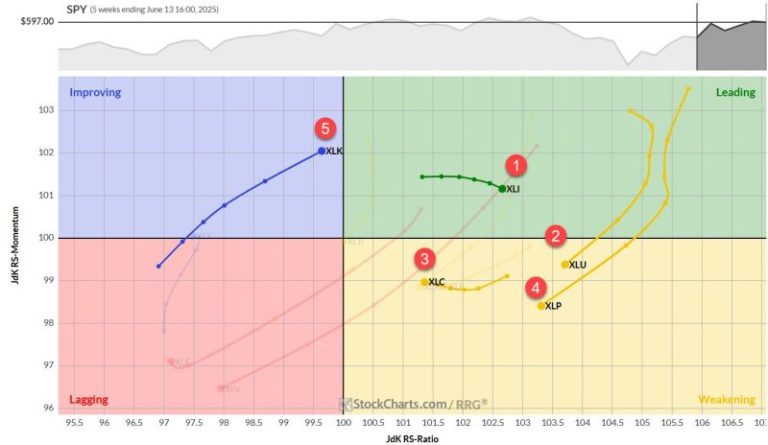
After a week of no changes, we’re back with renewed sector movements, and it’s another round of leapfrogging.

This week, technology has muscled its way back into the top five sectors at the expense of financials, highlighting the ongoing volatility in the market.

Communication Services and Consumer Staples have swapped places since last week, while Technology has entered at number five, pushing Financials down to sixth. The remaining sectors from seven to eleven remain unchanged.

This constant shuffling is a clear indicator of the market’s indecision. Imho, such volatility usually doesn’t accompany a sustainable trend, and that’s precisely what’s hurting trend-following models right now.

  1. (1) Industrials – (XLI)
  2. (2) Utilities – (XLU)
  3. (4) Communication Services – (XLC)*
  4. (3) Consumer Staples – (XLP)*
  5. (6) Technology – (XLK)*
  6. (5) Financials – (XLF)*
  7. (7) Real-Estate – (XLRE)
  8. (8) Materials – (XLB)
  9. (9) Consumer Discretionary – (XLY)
  10. (10) Healthcare – (XLV)
  11. (11) Energy – (XLE)

Weekly RRG Analysis

On the weekly Relative Rotation Graph, the Technology sector is showing impressive strength. Its tail is well-positioned in the improving quadrant, nearly entering the leading quadrant with a strong RRG heading. This movement explains Technology’s climb back into the top ranks.

Industrials remains the only top-five sector still inside the leading quadrant on the weekly RRG. It continues to gain relative strength, moving higher on the JdK RS-Ratio axis, while slightly losing relative momentum. All in all, this tail is still in good shape.

Utilities, Communication Services, and Consumer Staples are all currently in the weakening quadrant. Utilities and Staples show negative headings but maintain high RS-Ratio readings, giving them room to potentially curl back up. Communication Services is losing ground on the RS-Ratio scale but starting to pick up relative momentum.

Daily RRG: A Different Picture

Switching our focus to the daily RRG reveals a somewhat different story:

  • Industrials has moved into the lagging quadrant, losing ground on the RS-Ratio scale
  • Utilities and Staples are rolling back into the lagging quadrant with negative headings — not a great sign
  • Communication Services remains close to the benchmark
  • Technology shows the strongest tail, nearly completing a leading-weakening-leading rotation

This daily view underscores the strength we’re seeing in the Technology sector on the weekly timeframe.

Industrials: Facing Resistance

XLI dropped back below its previous high after a strong showing the week prior. There’s significant resistance between $142.50 and $145.

In a worst-case scenario, I think XLI could even retreat to the gap area between $137.50 and $139.

The uptrend remains intact, but more buying power is needed for a convincing break to new highs.

Utilities: Range-Bound

XLU is now trading in a range between roughly $80 on the downside and $83 on the upside.

It needs to break above the former high to continue building relative strength.

The raw RS line has returned to its trading range, dragging both RRG lines lower — not the strongest outlook for this defensive sector.

Communication Services: Testing Resistance

The sector peaked almost exactly at resistance offered by its previous high around $105, then closed at the lower end of the bar.

The raw RS line is managing to stay within its rising channel, albeit horizontally.

A sustained upward price movement is crucial for maintaining relative strength here.

Consumer Staples: Struggling to Break Higher

XLP continues to face heavy overhead resistance between $82 and $83.

Its inability to break higher is starting to hurt relative strength.

The raw RS line has moved down from a recent high, dragging the RRG lines lower.

The RS-Momentum line has already crossed below 100, positioning the weekly tail inside the weakening quadrant.

Technology: The Comeback Kid

XLK, the new kid on the block (again), tested its overhead resistance level around $244, peaking slightly above it last week before closing lower.

Recent strength has pushed the raw RS line convincingly higher, taking out its previous peak from mid-December.

Both RRG lines are pointing strongly upward, with RS-Momentum already above 100 and RS-Ratio rapidly approaching 100.

Portfolio Performance

With all this sector leapfrogging, especially involving the heavyweight Technology sector, the gap between the top five sectors’ performance and SPY has widened to around 7%.

The drawdown continues, but I’m sticking with this experiment and trusting the model to come back and start beating SPY again.

Yes, a 7% lag sounds significant (and it is), but it can change rapidly in such a concentrated portfolio. One or two strong weeks could easily turn this performance around, particularly if big sectors like Technology and potentially Consumer Discretionary become part of the top five.

#StayAlert and have a great week. –Julius


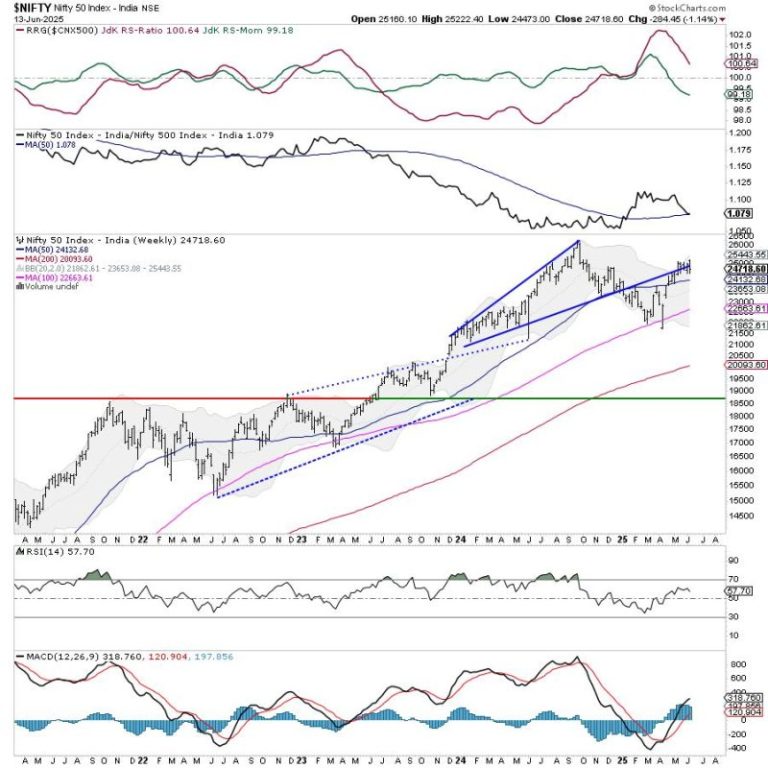
An attempt to break out of a month-long consolidation fizzled out as the Nifty declined and returned inside the trading zone it had created for itself. Over the past five sessions, the markets consolidated just above the upper edge of the trading zone; however, this failed to result in a breakout as the markets suffered a corrective retracement. The trading range stayed wider on anticipated lines; the Index oscillated in a 749-point range over the past week. The volatility rose; the India Vix climbed 3.08% to 15.08 on a weekly basis. The headline Index closed with a net weekly loss of 284.45 points (-1.14%).

We have a fresh set of geopolitical tensions to deal with Israel attacking Iran. The global equity markets are likely to remain affected, and India will be no exception to this. Having said this, the Indian markets are relatively stronger than their peers and are likely to stay that way. Despite the negative reaction to the global uncertainties, Nifty has shown great resilience and has remained in the 24500-25100 trading zone, in which it has been trading for over a month now. There are high possibilities that over the coming week, the Nifty may stay volatile and oscillate in a wide range, but it is unlikely to create any directional bias. A sustainable trend would emerge only after Nifty takes out 25100 on the upside or violates the 24500 level.

The levels of 25100 and 25300 are likely to act as resistance points in the coming week. The supports are likely to come in at 24500 and 24380.

The weekly RSI stands at 57.67; it stays neutral and does not show any divergence against the price. The weekly MACD is bullish and remains above its signal line.

The pattern analysis of the weekly chart shows that the Nifty has failed to break above the rising trendline resistance. This trendline begins from 21150 and joins the subsequent higher bottoms. Besides this, it reinforces the 25100 level as a strong resistance point. For any trending upmove to emerge, it would be crucial for the Index to move past this level convincingly.

Overall, it is unlikely that the Nifty will violate the 24500 levels. The options data shows very negligible call writing below 24500 strikes, increasing the possibility of this level staying defended over the coming days. Unless there is a situation with more gravity to be dealt with, the markets may stay largely in a defined trading range. The sector rotation stays visible in favor of traditionally defensive pockets and low-beta stocks. We continue to recommend a cautious stance as long as the Index does not move past the 25100 level and stays above that point. Until then, a highly stock-specific approach is recommended while guarding profits at higher levels.


Sector Analysis for the coming week

In our look at Relative Rotation Graphs®, we compared various sectors against the CNX500 (NIFTY 500 Index), representing over 95% of the free-float market cap of all the listed stocks. 

Relative Rotation Graphs (RRG) show that the Nifty Midcap 100 has rolled inside the leading quadrant and is set to outperform the broader markets relatively. The Nifty PSU Bank and PSE Indices are also inside the leading quadrant; however, they are giving up on their relative momentum.

The Nifty Infrastructure Index has rolled into the weakening quadrant. The Banknifty, Services Sector Index, Consumption, Financial Services, and Commodities Sector Indices are also inside the weakening quadrant. While stock-specific performance may be seen, the collective relative outperformance may diminish.

The Nifty FMCG Index languishes in the lagging quadrant. The Metal and Pharma Indices are also in the lagging quadrant, but they are improving their relative momentum against the broader Nifty 500 Index.

The Nifty Realty, Media, Auto, and Energy Sector Indices are inside the improving quadrant; they may continue improving their relative performance against the broader markets.


Important Note: RRG charts show the relative strength and momentum of a group of stocks. In the above Chart, they show relative performance against NIFTY500 Index (Broader Markets) and should not be used directly as buy or sell signals.  


Milan Vaishnav, CMT, MSTA

Consulting Technical Analyst

www.EquityResearch.asia | www.ChartWizard.ae