
Author

admin

Browsing

The resource investing community descended on Boca Raton, Florida, during the first full week of July for another edition of the Rule Symposium, hosted by veteran investor and speculator Rick Rule.

The five day event featured an illustrious array of speakers, panelists and companies sharing a wealth of investor knowledge. As in years past, gold remained a top focus, with many presenters stressing the value it offers investors.

Opening the conference, Rule provided a sobering overview of the current economic trajectory. He urged investors to set aside political narratives and instead focus on the raw arithmetic of America’s financial condition.

“It’s not about politics, it’s about math,” said Rule.

He pointed to three figures that define the US financial landscape: US$141 trillion in aggregate private net worth, a US$27.71 trillion GDP and a personal savings rate of just 4 percent. That’s set against mounting obligations — US$36.6 trillion in federal debt held by bondholders and over US$100 trillion in unfunded federal entitlements.

Rule cautioned that the imbalance between assets and liabilities points to a looming reckoning, potentially echoing the inflationary erosion of the 1970s, when the US dollar lost 75 percent of its purchasing power.

“There’s no way out of this without reducing the value of the dollar,” he told the audience. “(The) increase in gold (prices) will mirror the decrease in purchasing power of the US dollar.’

To hedge against this risk, Rule encouraged attendees to adopt a more self-reliant approach.

He advised listeners to question government guarantees, focus on building personal financial resilience and consider investing in inflation-sensitive assets such as gold and silver. “The math doesn’t lie — it’s time to prepare, not just react,” said Rule. ”I need you not to panic when the time is right, but rather to pounce.”

Watch a recap of key Rule Symposium takeaways.

Tailwinds turning to headwinds

In addition to strategically allocating to gold, geopolitical uncertainty was as a key theme at the Rule Symposium.

During his presentation “Back to the Old Drawing Board: First Principles and the Lost Art of Investing Through Crisis,” author and publisher Grant Williams made the case that longstanding tailwinds — globalization, demographic expansion and low interest rates — have reversed, giving way to persistent uncertainty.


Williams provides an overview of shifting market dynamics.

He traced the last four decades of wealth creation to a rare alignment of forces that pushed asset prices, particularly US equities, sharply higher. However, since 2020, a new macro regime has emerged, defined by tighter monetary policy, rising geopolitical risk and fading confidence in the US dollar.

Like many speakers at the Rule Symposium, Williams also underscored the massive gold purchases central banks are making. During Q1 of this year, central banks added 244 metric tons of gold to their official reserves, a 24 percent increase above the five year quarterly average, according to World Gold Council data.

For Williams, this shift signals growing concern within the financial system — a trend investors shouldn’t overlook.

“When central banks are exchanging their reserves for gold in record amounts, if they feel the sudden urgent need to own more gold, you better believe that we should feel that too,” he noted.

The expert went on to illustrate how major economic and societal cycles are converging, suggesting more volatility ahead. A live poll of the audience taken during his session revealed growing unease among attendees, with many already adjusting their portfolios and long-term goals. In response, Williams called for a return to key principles: scarcity, durability, resilience, trust, patience and a clear-eyed acceptance of uncertainty.

These, he said, should now anchor any sound investment approach. He urged Rule Symposium attendees to shift their mindset from chasing returns to preserving capital by reducing overexposure to US equities, diversifying by geography and asset class and focusing on businesses with real staying power.

The investment playbook of the past no longer fits the world we’re entering, he stressed.

Navigating what Williams calls an “age of headwinds” will require humility, discipline and a willingness to rethink what truly creates and protects wealth.

Hard assets set to shine

Economist, author and former Wall Street executive Dr. Nomi Prins laid out a case for what she calls the “real asset uprising,” a global shift in value and power driven by hard assets like gold, silver, copper, uranium and rare earths.

Drawing on her experience in high-level banking and her current work in the mining sector, Prins argued that rising geopolitical friction, shifting trade dynamics and financial system strain are fueling a renewed focus on tangible resources. She pointed to surging institutional interest in commodities, noting that Wall Street deal flow tied to real assets is up 24 percent year-on-year, while hiring in commodity finance roles has increased by 15 percent.

Gold, once dismissed on trading desks, is now seen as a strategic monetary tool.

According to Prins, the yellow metal will not replace the US dollar as the reserve currency, but it will play a central role in bilateral trade and power negotiations. Gold’s jurisdiction — where it is stored and mined — is now more important than ever, she explained, as nations seek to shield assets from sanctions and instability.

Silver, copper, uranium and rare earths are all finding support through similar structural tailwinds, Prins pointed out.

Silver demand is rising due to its industrial applications, and limited aboveground supply is driving long-term contracts.

For its part, copper has become so strategically important that the US is conducting a Section 232 national security investigation into its supply chain, a move historically reserved for defense resources. Major buyers like China and India are stockpiling copper in anticipation of supply constraints.

Uranium is also surging back into focus, driven by bipartisan support for nuclear energy. Legislation and executive orders are fast tracking uranium permitting and enrichment, with utility demand expected to outstrip supply.

Rare earths = real assets

Prins highlighted rare earths as a critical new front in the ongoing global shift in value and power.

‘Rare earths are intrinsic to the nation,’ she said, pointing to their essential role in defense, electronics and energy technologies. With 85 percent of processing controlled by China, the US has launched Section 232 investigations to assess domestic vulnerabilities — reports on copper and rare earths are expected this fall.

Prins described her decision to join the board of a rare earths company as a natural extension of her belief in physical assets: “It’s not just about the asset — it’s about controlling the asset, the processing and the movement.”

That theme underpins the investment case: security of supply, efficient processing and strategic jurisdiction are key to value creation. She also noted a dramatic capital rotation, saying that US$330 billion has exited bonds over the past year, while US$230 billion has flowed into commodities.

“Wall Street is following the real asset story,” Prins emphasized.


Rule sits down with Porter Stansberry to discuss his investment strategy.

Prins then said real upside now lies not just in owning resources, but in having processing capability.

New technologies, like advanced rare earths separation methods, are increasing economic viability and attracting private capital. “Where private money and public power combine, that’s where the investment opportunity is,” she said.

With key policy announcements and trade shifts looming in the fall, she warned investors this is a “very critical time” in the real asset uprising. For Prins, the message is clear: investors, policymakers and mining leaders must position accordingly, because, in today’s world, “whoever controls the ground controls the game.’

Securities Disclosure: I, Georgia Williams, hold no direct investment interest in any company mentioned in this article.


This post appeared first on investingnews.com

Defense manufacturer Lockheed Martin (NYSE:LMT) is in early talks with undersea mining companies to open access to two dormant seabed exploration licenses it has held since the 1980s

The move signals a renewed US push to tap the ocean floor for critical minerals.

The licenses, which cover swaths of the eastern Pacific seabed in international waters, were awarded to Lockheed by US regulators decades ago during a previous wave of interest in deep-sea mining.

Though the projects never progressed to extraction, they are now gaining fresh attention as nations and corporations seek alternative sources of key minerals used in electric vehicles, defense technologies, and clean energy systems.

“We are in early stages of conversations with several companies about giving them access to our licences and allowing them to process those materials,” Frank St. John, Lockheed’s chief operating officer, told the Financial Times.

While St. John declined to quantify the potential value of the deposits, he added that interested parties have “done the homework and determined there is value there.”

Lockheed’s seabed licenses could represent a strategic foothold in a mineral-rich region, containing polymetallic nodules that can hold commercially viable concentrations of key metals.

The timing also coincides with recent executive action from the White House.

USPresident Donald Trump, who returned to office in January, signed an executive order in April asserting US rights to issue mining licenses in international waters and encouraging the stockpiling of seabed metals as strategic resources.

The order bypasses ongoing negotiations at the International Seabed Authority (ISA), the UN agency tasked with regulating deep-sea mining, and instead relies on the 1980 US Deep Seabed Hard Mineral Resources Act as the legal foundation.

It emphasizes the need to “establish the US as a global leader in seabed mineral exploration and development both within and beyond national jurisdiction.” While the US has not ratified the UN Convention on the Law of the Sea — the treaty from which the ISA derives its authority — it has signed a 1994 agreement recognizing the treaty’s seabed provisions and operates its own permitting system through the National Oceanic and Atmospheric Administration.

Lockheed said it welcomes the renewed policy attention. “We believe the US has the opportunity to develop a gold standard for commercial recovery of nodules in an environmentally responsible manner.”

Court upholds TMC disclosures on deep-dea mining risks

Lockheed is not alone in navigating the legal uncertainties surrounding seabed mining.

The Metals Company (TMC) (NASDAQ:TMC), a deep-sea mining startup, recently survived a shareholder lawsuit alleging it had misled investors about the environmental impacts and financial backing of its operations.

US District Judge Eric Komitee dismissed the claims, ruling that the company’s comparisons to conventional mining methods were not misleading, even if deep-sea mining still carries environmental risks.

“It is eminently possible that (1) deep-sea mining causes meaningful environmental harm, and yet (2) such harm is significantly less than the harm caused by existing methods,” the judge wrote.

TMC had disclosed in filings that deep-sea mining could result in damage and that the regulatory path remained uncertain. Its legal win may encourage others — like Lockheed — to proceed more openly with their seabed plans, albeit cautiously.

Deep-sea mining industry cautiously awakens

The growing pursuit of potentially extracting resources from the world’s oceans comes at a critical juncture for the seabed-mining industry. For decades, a de facto moratorium on mining in international waters has been in place due to regulatory uncertainty and environmental concerns.

The ISA has issued more than 30 exploratory permits, but has yet to finalize commercial extraction rules. That delay has prompted frustration from some parties, while drawing calls from others for a pause or outright ban.

Currently, the ISA is holding key assemblies in Jamaica to hash out the long-awaited mining code to regulate commercial activity on the ocean floor with provisions for environmental safeguards, royalties, and tax obligations.

But a growing number of countries — 37 at last count — have pushed for a precautionary pause, citing risks to deep-sea ecosystems that remain largely uncharted. Scientists warn that mining these habitats could cause irreversible damage.

In 2023, Lockheed appeared to step back from the sector by selling two UK-sponsored exploration licenses in the Pacific, a move interpreted by analysts as signaling reduced confidence in deep-sea mining.

However, its retained US licenses suggest it never fully exited the space.

The Trump administration’s executive order marks the most assertive US step yet to undermine the ISA’s multilateral approach, raising fears among diplomats that the agency may lose legitimacy.

China, which has also invested heavily in seabed mining, responded sharply to the move.

“The US authorization violates international law and harms the overall interests of the international community,” Chinese foreign ministry spokesman Guo Jiakun said earlier this year.

Securities Disclosure: I, Giann Liguid, hold no direct investment interest in any company mentioned in this article.

This post appeared first on investingnews.com

Geopolitical tensions are rising in several regions of the world, and governments are expected to increase their defense spending in the years ahead. This has investors looking to aerospace and defense stocks.

The entrenched Russia-Ukraine war, widespread conflict in the Middle East, military posturing in the ongoing US-China trade conflict and the spread of cybersecurity attacks on critical infrastructure — all of these developments and more are driving demand in the global defense market.

In 2024, the five countries spending the most on their militaries were the United States, China, Russia, Germany and India, according to data from the Stockholm International Peace Research Institute.

For the most part, the aerospace and defense industry provides equipment, technologies and services to national governments through contracts. The players in this space are typically defense contractors that design and manufacture aircraft, satellites, electronic systems, software, missiles, drones, autonomous vehicles, tanks and marine vessels.

Global aerospace and defense revenue reached record highs in 2024, according to PwC in its latest annual sector report, totaling US$922 billion across the top 100 companies. However, the firm reports that increased demand is outpacing supply and capacity from defense companies.

5 Biggest US Defense Stocks

Today, the US accounts for the largest share of global defense spending, representing about 37 percent of worldwide military outlays. In fact, military spending represents about 12 percent of the US federal budget for fiscal year 2025. Worsening geopolitical tensions are expected to increase the US government’s spending on defense technology.

1. RTX (NYSE:RTX)

Market cap: US$189.46 billion

One of the most well-known American defense companies, RTX operates in the defense, aviation, space, electronics and cybersecurity sectors. The company captured more than US$80.7 billion in revenue for 2024, up 17.15 percent from the previous year.

The company’s defense solutions arm Raytheon was awarded a US$250 million contract in June 2025 from Japan’s Mitsubishi Electric (TSE:6503) for licensed production of ESSM Block 2 short to medium-range guided missiles.

‘Under the Direct Commercial Sale contract, Raytheon will provide missile kits, parts, and components as well as technical support for missile production at (Mitsubishi Electric) in Japan,’ the press release stated.

2. The Boeing Company (NYSE:BA)

Market cap: US$151.52 billion

Another heavyweight in the aerospace and defense industry, Boeing designs and manufactures airplanes, rotorcraft, rockets, satellites, telecommunications equipment and missiles.

Revenue for the company declined by 14.5 percent in 2024 over the previous year to come in at US$66.5 billion. The majority of that loss was driven by its airplane segment; its defense segment revenue dropped 4 percent over the same period. The company’s aviation sector has faced heavy scrutiny in recent years after several disastrous incidents linked to the Boeing 737.

As for its defense business, in March 2025, Boeing reported that production of its air defense systems, Patriot Advanced Capability-3 seekers, reached an all-time high in 2024. According to the release, the company produces the seekers as a subcontractor for Lockheed Martin and has sold them to 17 countries, including the US and Ukraine.

3. Honeywell International (NASDAQ:HON)

Market cap: US$144.57 billion

Engineering and technology company Honeywell International develops and manufactures technological solutions for a variety of sectors. The company’s four business divisions are aerospace technologies, building automation, energy and sustainability solutions, and industrial automation. Honeywell’s sales came in at US$38.5 billion in 2024, up 5 percent from the previous year.

Honeywell has numerous defense contracts with government agencies around the world, including right at home with the US Department of Defense (DoD) and US Armed Forces. In May 2025, the company’s JetWave X satellite communication system was selected for use in the advanced US Army aircraft ARES.

4. Lockheed Martin (NYSE:LMT)

Market cap: US$107.57 billion

Lockheed Martin’s business is concentrated on aerospace products and advanced defense technology systems. The F-16 Fighting Falcon fighter jet is among its most notable products, but Lockheed is also well known for its space launchers, ballistic missiles and satellites. The company’s 2024 net sales increased by 5.15 percent from the previous year to just over US$71 billion.

Unsurprisingly, about half of Lockheed Martin’s annual sales are made to the US DoD. However, governments around the world have purchasing contracts with the company to supply their militaries with defense products such as F-16 and F-35 fighter jets. In April 2025, the Royal Norwegian Air Force received the last two F-35 fighter jets of the 52 ordered in its most recent supply contract.

5. General Dynamics (NYSE:GD)

Market cap: US$76.57 billion

Although best known for its Gulfstream business jets, General Dynamics designs and manufactures wheeled and tracked combat vehicles, submarines, weapons and communications systems, as well as munitions. The company garnered more than US$47.72 billion in revenue for 2024, up 12.88 percent from the previous year.

General Dynamics is a major defense contractor for the US military as well as allied nations abroad. In April 2025, the company was awarded US$12 billion in contract modifications for the construction of two Virginia-class submarines for the US Navy, bringing the potential value of the contract to US$17.2 billion. This type of sub is designed for anti-submarine and surface ship warfare and special operations support.

5 Biggest US Defense ETFs

Investors looking to mitigate the risk of investing in individual stocks can diversify their portfolio with defense ETFs. While ETFs aren’t without risk, they are often considered a more stable investment compared to stocks as they allocate funds across a variety of stocks that are rebalanced by an asset manager to meet the return goals of the fund.

The biggest US Defense ETFs by assets under management are listed below according to data from ETF Database.

1. iShares U.S. Aerospace & Defense ETF (BATS:ITA)

Assets under management: US$7.83 billion

The iShares U.S. Aerospace & Defense ETF launched in May 2006. This fund invests in large, generally stable companies in the aerospace and defense sector, particularly those with the majority of their revenues based on long-term government contracts.

The ETF has 40 holdings and an expense ratio of 0.4 percent. IShares U.S. Aerospace & Defense ETF’s top holdings include RTX, Boeing, Lockheed Martin and General Dynamics as well as another important name in the industry, L3Harris Technologies (NYSE:LHX).

2. Invesco Aerospace & Defense ETF (NYSEARCA:PPA)

Assets under management: US$5.41 billion

Invesco Aerospace & Defense ETF launched in October 2005. Like ITA, it also tracks large, stable aerospace and defense stocks with steady revenue streams from long-term government contracts.

While it has more holdings than ITA at 57, it also has a higher expense ratio at 0.58 percent. Unlike ITA, Honeywell is listed among Invesco Aerospace & Defense ETF’s top holdings in addition to the other biggest US defense stocks.

3. SPDR S&P Aerospace & Defense ETF (NYSEARCA:XAR)

Assets under management: US$3.76 billion

SPDR S&P Aerospace & Defense ETF, which launched in September 2011, offers exposure to large cap stocks in this sector. It has the lowest expense ratio on this list at 0.35 percent.

Of the 40 holdings XAR tracks, the most heavily weighted US defense stocks include RTX, Boeing, Lockheed Martin and General Dynamics as well as Rocket Lab (NASDAQ:RKLB) and AeroVironment (NASDAQ:AVAV).

4. Global X Defense Tech ETF (NYSEARCA:SHLD)

Assets under management: US$2.69 billion

Launched in September 2023, Global X Defense Tech ETF is the newest defense ETF on the market. While it does offer a geographic diversity of exposure to the overall defense sector, its holdings are just over 50 percent based in the United States. This ETF has an expense ratio of 0.50 percent.

SHLD has 43 holdings, including the biggest US defense stocks such as Lockheed Martin and General Dynamics, but is also heavily weighted in Palantir Technologies (NASDAQ:PLTR) and L3Harris Technologies.

5. Direxion Daily Aerospace & Defense Bull 3X Shares (NYSEARCA:DFEN)

Assets under management: US$249.19 million

Direxion Daily Aerospace & Defense Bull 3X Shares launched in May 2017 with the goal of tripling the daily return of an index of major defense industry stocks.

DFEN has the highest expense ratio on this list at 0.95 percent. Some of the most heavily weighted stocks of its 39 holdings are Boeing, Lockheed Martin and RTX.

Securities Disclosure: I, Melissa Pistilli, hold no direct investment interest in any company mentioned in this article.

This post appeared first on investingnews.com


‘Not for distribution to United States newswire services or for dissemination in the United States.’


Forte Minerals Corp . (‘ Forte ‘ or the ‘ Company ‘) ( CSE: CUAU ) ( OTCQB: FOMNF ) ( Frankfurt: 2OA ) is pleased to announce a non-brokered private placement with a strategic investor (the ‘ Investor ‘), who will acquire 6,326,066 common shares at a price of C$0.90 per share for gross proceeds of approximately C$5,693,459 (the ‘ Strategic Placement ‘). Upon closing of the Strategic Placement, the Investor will own 9.99% of Forte’s issued and outstanding common shares on a non-diluted basis, establishing a meaningful long-term position in Forte’s growth and exploration strategy.


The C$0.90 offering price reflects a premium to Forte’s current market value, underscoring the Investor’s conviction in the Company’s long-term potential.


Patrick Elliott, President and CEO of Forte, commented: ‘This strategic investment marks a significant milestone for the company. It reflects strong conviction in the long-term value of our portfolio and validates the quality of our exploration pipeline. We’re excited to begin what we see as a long-term, collaborative relationship that supports our vision to unlock meaningful copper and gold discoveries in Perú.


The proceeds from the Strategic Placement will be primarily used to advance Forte’s Alto Ruri high-sulfidation epithermal gold project in Perú (‘ Alto Ruri ‘), with at least 80% of the funds dedicated to exploration activities at Alto Ruri. The remaining funds will support general working capital and corporate purposes.


In connection with the Strategic Placement, Forte and the Investor will enter into an Investor Rights Agreement whereby the Investor is entitled to certain rights, subject to the Investor maintaining certain ownership thresholds in the Company, including technical information sharing rights and the right to participate in future equity financings and top-up its holdings in relation to dilutive issuances in order to maintain its percentage ownership interest in the Company. The Investor has also agreed to voting support and standstill covenants.


In addition, under the Investor Rights Agreement the Investor and Forte will:


  • form a joint technical advisory committee; and
  •  

  • collaborate on community engagement and long-term access strategies.
  •  

The closing of the Strategic Placement is expected to occur on or around July 23, 2025, subject to regulatory approvals. All shares issued pursuant to the Strategic Placement will be subject to a statutory hold period of four months and one day from the closing date.


This investment signals a firm belief in Forte’s vision, technical leadership and the significant long-term value potential of Alto Ruri. This collaboration marks a major step in executing the strategy Forte has been actively advancing; to deliver pipeline projects that fuel the major developers and producers.


  ABOUT Forte Minerals CORP.  


 Forte Minerals Corp. is an exploration company with a strong portfolio of high-quality copper (Cu) and gold assets (Au) in Perú. Through a strategic partnership with GlobeTrotters Resources Perú S.A.C. , the Company gains access to a rich pipeline of historically drilled, high-impact targets across key mineral belts.


Forte is committed to responsible resource development, creating long-term value, and fostering lasting partnerships with stakeholders and communities.


  On behalf of   Forte Minerals CORP.  


(signed) ‘ Patrick Elliott’  
Chief Executive Officer


  For further information, please contact:  
Forte Minerals Corp.
office: (604) 983-8847
info@forteminerals.com  
www.forteminerals.com  


   Follow Us On Social Media   : LinkedIn | Instagram | X | Meta | The Drill Down; Newsletter  


  Certain statements included in this press release constitute forward-looking information or statements (collectively, ‘forward-looking statements’), including those identified by the expressions ‘anticipate’, ‘believe’, ‘plan’, ‘estimate’, ‘expect’, ‘intend’, ‘may’, ‘should’ and similar expressions to the extent they relate to the Company or its management. The forward-looking statements are not historical facts but reflect current expectations regarding future results or events. This press release contains forward looking statements relating to the terms of the Strategic Placement, the timing for completion of the Strategic Placement and the intended use of proceeds of the Strategic Placement. These forward-looking statements and information reflect management’s current beliefs and are based on assumptions made by and information currently available to the Company with respect to the matter described in this press release. Forward-looking statements involve risks and uncertainties, which are based on current expectations as of the date of this release and subject to known and unknown risks and uncertainties that could cause actual results to differ materially from those expressed or implied by such statements. Additional information about these assumptions and risks and uncertainties is contained under ‘Risk Factors and Uncertainties’ in the Company’s latest management’s discussion and analysis, which is available under the Company’s SEDAR+ profile at www.sedarplus.ca, and in other filings that the Company has made and may make with applicable securities authorities in the future.  


  Forward-looking statements are not a guarantee of future performance and involve risks, uncertainties and assumptions which are difficult to predict. Factors that could cause the actual results to differ materially from those in forward-looking statements include the continued availability of capital and financing, and general economic, market or business conditions. Forward-looking statements contained in this press release are expressly qualified by this cautionary statement. These statements should not be read as guarantees of future performance or results. Such statements involve known and unknown risks, uncertainties and other factors that may cause actual results, performance or achievements to be materially different from those implied by such statements. Although such statements are based on management’s reasonable assumptions, there can be no assurance that the statements will prove to be accurate or that management’s expectations or estimates of future developments, circumstances or results will materialize. The Company assumes no responsibility to update or revise forward-looking information or statements to reflect new events or circumstances unless required by law. Readers should not place undue reliance on the Company’s forward-looking statements.  


  Neither the Canadian Securities Exchange (the ‘CSE’) nor its Regulation Services Provider (as that term is defined in the policies of the CSE) accepts responsibility for the adequacy or accuracy of this release.  


News Provided by GlobeNewswire via QuoteMedia

This post appeared first on investingnews.com

Join Dave as he reviews three common candle patterns traders can use to identify potential turning points. From bullish engulfing patterns to evening star patterns, Dave gives insights on how to leverage these powerful candle signals to anticipate market shifts. He also shows combining candle patterns with conventional technical analysis tools can help improve success rates.

This video originally premiered on July 14, 2025. Watch on StockCharts’ dedicated David Keller page!

Previously recorded videos from Dave are available at this link.

Bitcoin ($BTCUSD) is riding a wave of surging optimism, smashing past $112k as retail and institutional capital pour into the cryptocurrency. Some say the market has grown euphoric, and that a sharp pullback may be lurking around the corner. Others believe this is just the beginning of another leg higher.

A few key questions to guide your analysis: What does $BTCUSD’s history tell us about breakouts above major resistance after a prolonged period of sideways movement? If it’s the start of another move higher, how can you project an upside target? And, if it reverses, where could support levels come into play?

What $BTCUSD’s History Reveals About Breakouts and Big Rallies

Let’s begin by taking a look at a 3-year weekly chart.

FIGURE 1. WEEKLY CHART OF $BTCUSD. Note the crypto’s impressive rallies after clearing resistance following a prolonged period of sideways trading.

In 2023, $BTCUSD traded sideways for six months, repeatedly failing to break above resistance around $31k. But once it did, the crypto soared more than 126% before a major pullback.

A similar pattern unfolded in 2024: seven months in a wide range, unable to clear resistance between $71k and $73k. When $BTCUSD finally broke out in November, it staged a parabolic move, rallying nearly 47% before pulling back again, setting another key resistance zone that brings it to overhead resistance range between $110k–$112k.

So this answers the question posed about $BTCUSD’s historical tendencies after breaking above a prolonged range. Historically, the crypto tends to stage an outsized run once it clears critical resistance. But will it happen this time around? If so, how can you estimate a potential upside target? And if the breakout fails, where might $BTCUSD find support?

Seasonality Trends: $BTCUSD’s Strongest Months

Before looking at a daily chart, let’s look at $BTCUSD’s seasonality chart going back 10 years. If you’re curious as to how the crypto has performed during the summer months, maybe this can help.

FIGURE 2. 10-YEAR SEASONALITY CHART OF $BTCUSD. Most months on average have been quite strong for the asset, but October’s performance has been strong, with an average seasonal return of 21%.

According to its seasonality performance, July is arguably strong with a favorable positive close rate (70%) and return (9.6%). However, October is the crypto’s strongest month, with an 89% positive close rate and an average return of 21%. Over the last 10 years, $BTCUSD’s performance has been volatile, which accounts for the outsize returns on this chart. While seasonal tendencies don’t guarantee a repeat, knowing the general bullish/bearish seasonality context can help inform your analysis and trading decisions.

Now, let’s look at a daily chart to find entry points or estimate an upside target while identifying support, should its breakout fail to follow through.

$BTCUSD Breaks Critical $112K Resistance

FIGURE 3. DAILY CHART OF $BTCUSD. The asset just broke above critical resistance. If you have a position, now’s the time to estimate potential price targets.

$BTCUSD just broke the critical resistance level of $112k. The Relative Strength Index (RSI) is indicating strong momentum, easing into an overbought reading. While there’s no way to fundamentally determine the crypto’s upside target, one technical method is to use a measured move by taking the height of the prior range and adding it to the top of the range (or the breakout level; this varies by trader).

Calculating an Upside Target Using a Measured Move Approach

Measuring the range from the support area around $98k up to $110–112k (we’ll settle for $110k), you can project that distance of $12k above the top level of the breakout range, which implies a potential target near $124k, more or less.

$110k breakout + $12k range height = $122k–$124k target, depending on entry.

However, note that some traders don’t wait for a 100% measured move before taking profits. Some will exit positions as soon as a 60% move has occurred, but that really depends on the trader.

Key Support Levels to Watch if the Breakout Fails

Now, if $BTCUSD fails to follow through and reverses, you can reasonably expect support at roughly these three levels:

  • The breakout level near $112k.
  • A strong historical support level at around $110k.
  • Another support level within the previous trading range (shaded red) near $100k, which coincides with concentrated levels of trading activity, according to the Volume-by-Price (the horizontal volume bars on the left side of the chart).

If $BTCUSD falls below the previous trading range, that is, below $98k, then the current rally is likely over.

What to Do Now

Ideally, a trader’s entry point would have been at $112k. Considering that some platforms allow fractional lots of $BTCUSD, some people may choose to enter smaller positions, as a fractional position would minimize risk and reward.

If you already have a position in $BTCUSD, put it in your ChartLists, and set a price alert at $124k or any measured move percentage below that 100% target level (like 60% of the measured move would be at $119k).

If the breakout fails, expect a near-term bounce between $110k and $112k. However, a move lower toward $100k or $98k would likely signal an end to the bullish thesis. Traders might even consider placing a stop a few points below $98k to avoid the likelihood of further downside.

At the Close

$BTCUSD has a history of explosive moves after clearing major resistance, but it can just as easily blindside you with a sudden reversal. That’s why it’s crucial to keep upside and downside levels in mind. Seasonality also favors the bulls, with most months delivering favorable returns. Add the crypto to your ChartLists and set price alerts to track whether your upside target is hit, or whether downside levels signal either an early bounce or a failed rally.


Disclaimer: This blog is for educational purposes only and should not be construed as financial advice. The ideas and strategies should never be used without first assessing your own personal and financial situation, or without consulting a financial professional.

After a relatively quiet week for the S&P 500, we’re seeing some interesting shifts in sector dynamics. Let’s dive into the latest rankings, RRG analysis, and what it means for our portfolio strategy.

Sector Shifts and RRG Insights: Materials on the Move

The big news this week is the ascent of the Materials sector, which has muscled its way into the top five at the expense of the Utilities sector.

The rest of the top five remained steady, but we’re seeing some movement in the lower ranks as well. Consumer Discretionary made a notable jump from #9 to #7, pushing Consumer Staples and Real Estate down a notch each. Energy and Health Care continue to bring up the rear at #10 and #11, respectively.

  1. (1) Technology – (XLK)
  2. (2) Industrials – (XLI)
  3. (3) Communication Services – (XLC)
  4. (4) Financials – (XLF)
  5. (6) Materials – (XLB)*
  6. (5) Utilities – (XLU)*
  7. (9) Consumer Discretionary – (XLY)*
  8. (7) Consumer Staples – (XLP)*
  9. (8) Real-Estate – (XLRE)*
  10. (10) Energy – (XLE)
  11. (11) Healthcare – (XLV)

Weekly RRG

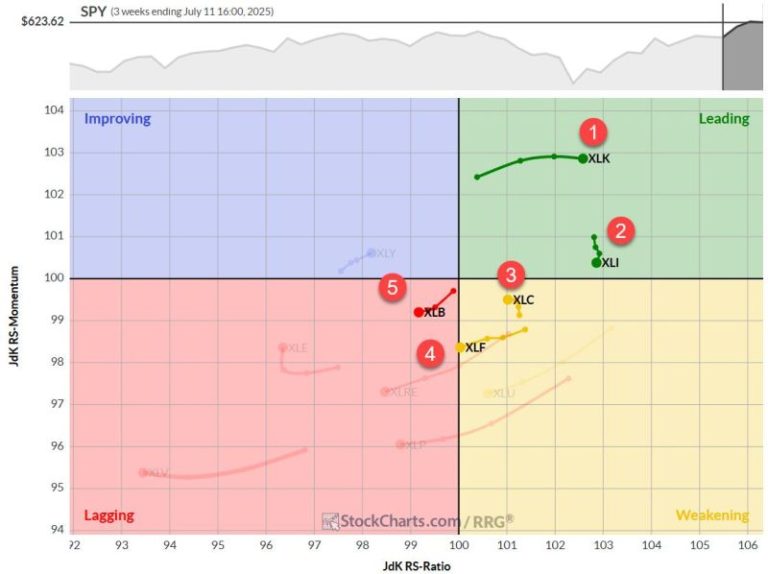
The weekly Relative Rotation Graph (RRG) gives us a broader perspective on sector trends. Technology continues to dominate, firmly entrenched in the leading quadrant, no surprises there. Industrials is showing stability with a short tail in the leading quadrant, indicating a consistent relative uptrend.

Communication Services, however, is raising some eyebrows. It’s lurking in the weakening quadrant with a short tail, suggesting a stable relative uptrend but with negative momentum. Financials are teetering on the edge of the lagging quadrant, a move that demands attention. Materials, despite its rise in the rankings, is actually in the lagging quadrant on the weekly RRG. You will see why it made its way into the top 5 on the daily RRG.

Daily RRG

On the daily RRG, we get a more nuanced picture of short-term sector movements:

  • Materials (XLB) is the star of the show, crossing into the leading quadrant and standing alone in that coveted space.
  • Financials (XLF) is showing weakness, rolling over and heading back towards the lagging quadrant — confirming what we saw on the weekly chart.
  • Communication Services is on the verge of crossing into the lagging quadrant, a sign that is not great for its current #3 ranking.
  • Industrials is flexing its muscles, approaching the leading quadrant with a positive heading.
  • Technology, while rotating into the weakening quadrant, still has ample room to bounce back into leading territory.

Technology

The tech train continues to roll, breaking through resistance around 240 and maintaining its upward trajectory in both price and relative strength. The RS line is pushing higher after a clean breakout from its falling trend, a bullish sign for the sector leader.

Industrials

XLI is following through nicely on both price and relative strength charts. The raw RS line has established a new higher low, dragging the RS ratio higher. In my opinion, this sector looks rock-solid.

Communication Services

Here’s where things get dicey. XLC is clinging to its breakout above 105, but last week’s decline is testing that former resistance as new support. The raw RS line breaking below rising support is a warning sign that this sector could be in for a bumpy ride.

Financials

Similar to Communications Services, Financials has retreated to test old resistance as support. The raw RS line looks even worse here, having broken out of its rising channel weeks ago. Both RRG lines are flirting with the 100 level; a further push into the lagging quadrant seems likely.

Materials

XLB is showing some muscle, breaking out of its falling channel and taking out recent highs. The raw RS line is pushing against falling resistance — if it can break through, we could see a significant turnaround in the RRG lines, confirming the sector’s newfound strength.

Portfolio Performance

Now, for the part that might sting a bit, the portfolio drawdown is ongoing. It’s something trend followers need to learn to live with. Currently, the portfolio is down about 2% for the year, while the S&P 500 is up over 6%. That puts us roughly 8% behind the benchmark YTD.

It’s not a comfortable position, but it’s part of the game. Trend-following strategies often lag in choppy or rapidly changing markets. The key is to stay disciplined and trust in the long-term efficacy of our approach.

#StayAlert and have a great week, Julius


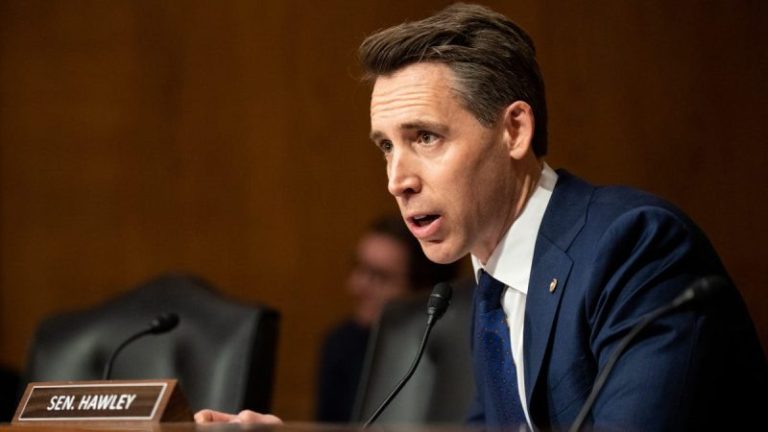
Sen. Josh Hawley, R-Mo., is urging Department of Homeland Security (DHS) Secretary Kristi Noem to declassify all documents related to the assassination attempt on then-presidential candidate Donald Trump in Butler, Pennsylvania, on July 13, 2024.

Hawley’s request comes a year after 20-year-old Thomas Matthew Crooks fired off several shots at Trump from a rooftop near the presidential rally grounds. The gunman had a clear shot and grazed the president’s ear.

Even after a year, though, questions still remain about how Crooks was able to get a clear shot.

In his letter to Noem, Hawley mentions the one-year anniversary of the first assassination attempt on Trump.

‘This occasion marks a deeply troubling chapter in our nation’s history and serves as a reminder of the importance of transparency in preserving public trust during moments of national crisis,’ he wrote. ‘To that end, I urge you to take the necessary steps to declassify all documents within the Department of Homeland Security (DHS) related to the events of July 13, 2024.

‘As you know, assassination attempts against current and former presidents are rare but profoundly consequential events in American life,’ Hawley continued. ‘And the American people rightly expect full transparency from their government.’

The senator pointed to investigation stonewalling tactics from the Biden administration’s Secret Service and DHS, which he said ultimately denied basic facts to the American people.

‘The public learned far more from whistleblowers than they did from public officials, and I released a report documenting these disclosures, many of which have been corroborated to date,’ Hawley wrote. ‘In October of last year, in a unanimous vote, the Homeland Security Committee passed my legislation requiring the Secret Service release to the public all pertinent documents.

‘Now, I am requesting that you immediately declassify and release all documents relating to the first assassination attempt on President Trump within the full extent of your authority, subject only to the narrowest possible redactions necessary to protect ongoing operations or individual safety,’ he said. ‘The public deserves a full and accurate account of this event, the circumstances that allowed it to happen, and the steps the government has taken since to strengthen protective measures.’

Hawley requested a complete inventory of all classified or non-public materials related to the first assassination attempt on Trump, including reports, internal communications, threat assessments, after-action reviews and coordinated records with other agencies.

He also requested a formal explanation for the continued classification of materials Noem believes must remain restricted, as well as a proposed plan and timeline for the immediate declassification and public release of all remaining documents, all by July 30, 2025.

Fox News Digital has reached out to DHS for comment on the matter.

Hawley released a report in September, detailing the failures of the Secret Service in connection with the attempted assassination of Trump in July, which included whistleblower allegations that are ‘highly damaging to the credibility’ of the agency.

The report uncovered a ‘compounding pattern of negligence, sloppiness, and gross incompetence that goes back years, all of which culminated in an assassination attempt that came inches from succeeding.’

Hawley accused the Secret Service, FBI and DHS of all trying ‘to evade real accountability.’

‘These agencies and their leaders have slow-walked congressional investigations, misled the American people, and shirked responsibility,’ the report states. 

After the first of two assassination attempts against Trump in just over two months, Hawley visited the Butler rally site to interview whistleblowers and opened up a whistleblower tip line, encouraging those with relevant information to share with officials. 

Documents subpoenaed by the Senate Committee on Homeland Security and Government Affairs also show major failures among the six U.S. Secret Service (USSS) agents who were suspended without pay in response to the assassination attempt.

The documents were based on interviews with the agents and their colleagues and revealed that several agents admitted the existence of major security concerns at the Butler rally, but none of them elevated the concerns or helped produce a plan to properly cover the roof that provided Crooks a clear shot of Trump.

The documents show that some agents in charge never even conducted walk-throughs of the site. For example, the lead advance agent, documents show, never did a final security walk-through of the rally site because she was in the hospital for heat exhaustion, the special agent in charge said when questioned.

Some of the agents were suspended without pay for various terms, though none of the agents were fired.

This post appeared first on FOX NEWS

Sen. Rand Paul, R-Ky., on Monday announced that he would revive his criminal referral against Dr. Anthony Fauci, adding yet another wrinkle to the ongoing Biden White House autopen saga.

‘Today I will reissue my criminal referral of Anthony Fauci to Trump DOJ,’ Paul said on X.

It’s not the first time that Paul has issued a criminal referral against Fauci, who is the former director of the National Institute of Allergy and Infectious Diseases (NIAID) and medical adviser to former President Joe Biden.

The first came in 2021, when Paul accused Fauci of lying to Congress about funding gain-of-function research for the COVID-19 virus at the Wuhan Institute of Virology. The next came in 2023, again as part of Paul’s efforts to investigate the origins of the virus.

‘Perjury is a crime,’ Paul said. ‘And Fauci must be held accountable.’

Fox News Digital reached out to Paul’s office for comment.

This time, Paul’s reupping of his criminal referral comes after a new report added another chapter to the ongoing autopen saga, in which President Donald Trump and congressional Republicans have accused Biden of shrugging off his authority to aides and top officials in the White House to authorize his signature on a slew of pardons and documents.

The New York Times reported that emails showed that Biden’s Chief of Staff Jeff Zients gave final approval for the use of the autopen for preemptive pardons for Fauci and former Joint Chiefs of Staff Gen. Mark Milley, two of Trump’s top critics.  

Biden signed the bulk of his over 4,000 clemency documents in the waning months of his presidency, a point that Trump and congressional Republicans have pounced to hammer in the claims that the former president’s cognitive ability was declining and his staff were running the White House.

Trump has gone so far as to request Attorney General Pam Bondi open an investigation into Biden’s usage of the autopen, while Republicans in the Senate and House have all held their own committee hearings on the matter.

And earlier Monday, Trump told reporters that Biden’s alleged use of the autopen amounted to possibly ‘one of the biggest scandals that we’ve had in 50 to 100 years.’

‘I guarantee you he knew nothing about what he was signing, I guarantee you,’ Trump said. 

Diana Stancy contributed to this report. 

This post appeared first on FOX NEWS