
Author

admin

Browsing

As we navigate the evolving stock market landscape, understanding key sectors and their trends is important, especially during earnings season. This week, the spotlight shines on the Financial sector, with several of the largest banks reporting. Five of the top 10 holdings within the Financial Select Sector SPDR ETF (XLF) are on deck: J.P. Morgan (JPM), Goldman Sachs (GS), Bank of America (BAC), Wells Fargo (WFC), and Morgan Stanley (MS). 

This week we will focus on the Financial sector via XLF and zoom in on one of its top components, Goldman Sachs.

The Financial Sector: A Technical Look at XLF

XLF has been outperforming the S&P 500 ($SPX), experiencing new all-time highs, and has been a leading sector in the most recent market rebound.

Now that all banks that were susceptible to the Fed’s stress test have passed with flying colors, questions loom about whether less stringent regulations will lead to more growth. The sector has not experienced much M&A activity, and the IPO market has yet to come back to a healthy level of activity. However, there is hope that a banking renaissance is on the horizon, and maybe this quarter will give a rosier outlook than more recent forecasts.

Technically, XLF looks promising. Shares broke out to new all-time highs ahead of earnings and are now set up with good risk/reward potential for investors. 

The pattern from which it broke out is a bit of a wonky head-and-shoulders pattern. I’d call this a stretch as it isn’t picture perfect, but the price image presented is close enough to set parameters to trade. 

The breakout on a gap to new highs is extremely bullish, and that gap level could be used as a stop-loss to the downside, worst case should be the rising 50-day moving average. Buyers should come back into the sector there on a dip.

Goldman Sachs (GS): A Bellwether

Goldman Sachs, the largest component in the price-weighted Dow Jones Industrial Average, reports results on Wednesday morning just days after hitting all-time highs. Investors will be looking for any commentary focused on tariffs and margins. 

Has there been any impact on their results, or have concerns about inflation been overblown? Any earnings pressure on their bottom line could cause ripple effects throughout other sectors like industrials, materials, and technology. 

Shares declined 33% then rallied 65% from their April 7 lows. Shares may need a breather as they are overbought, but that’s where opportunity may lie. Wouldn’t chase it just yet. I would own for the long term, but price action could be very interesting when they report next week. 

One bold prediction — look for a possible stock split announcement. Since their debut in 1999, shares have never split. Seeing the recent price surge and its size in the Dow, that option should be on the table. 

Technically, shares have been on a tremendous run as they’ve rallied 65% from their April 7 lows. Shares may need a breather as they are overbought, but that may be where the opportunity lies when they report next week. 

The stock has rallied with a series of gaps along the way. Those gaps tell a story, and it’s worth watching the most recent gap from $690 to $700. Each jump higher has not experienced a full retracement — a gap fill, if you will.

The gaps higher have been very bullish. The first large gap — a breakaway gap — started the main part of this rally. We have seen a series of smaller gaps that helped extend the rally. Now, we may be tiring. Watch the $690 level to see if that gap can hold. If it can’t, then there may be more selling pressure over the near term. 

A healthy pullback given the strong bull run is likely, but buyable. A break below $690 could see a swift move lower to the $665 level. If things turn negative, then the rising 50-day moving average, which coincides with a key Fibonacci retracement level just below $620 would be an ideal entry point from a risk/reward perspective. 

The good news is that any weakness in the stock looks like it should be met with great opportunities to enter the name. The long-term trend is up, and the momentum is there not only in the stock but within the sector. The long-term trader shouldn’t fret earnings; the swing trader may get an opportunity to buy a dip from an overbought condition. The bad news would be that the stock gaps higher again and continues its upward trajectory. 

Beyond Financials: Johnson & Johnson (JNJ)

While financials take center stage, we want to touch upon another significant company reporting this week: Johnson & Johnson (JNJ).

JNJ shares have remained relatively flat for the better part of five years. Much of the earnings focus will be on plans to navigate patent expirations. 

Merck acquired Verona last week. The patent cliff will continue to be a hot topic for the entire pharma industry. As for JNJ, it’s confronting the expiration of exclusivity on Stelara, its $10B+ immunology blockbuster drug. The exclusivity expires first in Europe this year and then in the U.S. in 2026.

As for reaction to earnings, don’t expect too much activity. The average move post-results has been +/- 2.05%. Shares have traded lower after five of the last seven times. Shares of the Dow stock are up 8% year-to-date and -9% off their highs.

Technically, there isn’t much to see here. We backed it out to look at price in a five-year weekly range to illustrate that point.

Shares have been in a wide range between roughly $138 to $168 over this lengthy span. Yes, I yawned when I typed this out — it’s that boring. We don’t expect much to change, but there are small setups for a shorter-term swing trader.

The stock, while breaking above the midpoint of this longer-term range, is forming a bullish ascending triangle and has, albeit tight, risk/reward parameters for those looking to trade. 

To the downside, look for the continued near-term uptrend to hold and find support right at the 200-day moving average just below $153. A good entry point in which one could manage risk. 

To the upside, a break above $158 could take shares to their recent highs and slowly and steadily towards the $168 level. The set-up is far from ideal when looking at the longer-term action, but near term, there could be a quick play and maybe, just maybe, shares can finally escape the longer-term neutral range. 
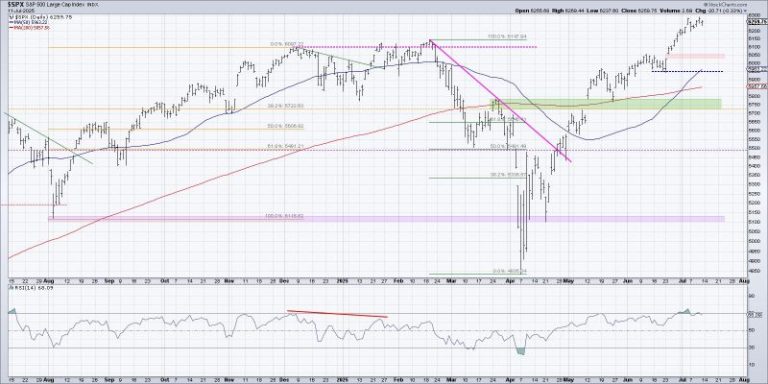

The S&P continues to push higher, with the equity benchmark almost reaching 6300 this week for the first time in history. With so many potential macro headwinds still surrounding us, how can the market continue to reflect so much optimism? On the other hand, when will bulls wake up and realize that this market is obviously overextended and rotate significantly lower?

With the S&P 500 once again achieving new all-time highs, and with Q2 earnings just around the corner, I thought it would be a perfect time to revisit an exercise in probabilistic analysis. Basically, I’ll lay out four different scenarios for the S&P 500 index between now and late August. Which path do you see as the most likely and why? Watch the video, check out the first scenarios, and then cast your vote!

By the way, we last ran this analytical process on the S&P 500 back in May, and check out which scenario actually played out!

And remember, the point of this exercise is threefold:

  1. Consider all four potential future paths for the index, think about what would cause each scenario to unfold in terms of the macro drivers, and review what signals/patterns/indicators would confirm the scenario.
  2. Decide which scenario you feel is most likely, and why you think that’s the case. Don’t forget to drop me a comment and let me know your vote!
  3. Think about how each of the four scenarios would impact your current portfolio. How would you manage risk in each case? How and when would you take action to adapt to this new reality?

Let’s start with the most optimistic scenario, with the S&P 500 index continuing the recent uptrend phase to retest all-time highs by June.

Option 1: The Super Bullish Scenario

The most bullish scenario would involve the S&P 500 continuing a similar trajectory that we’ve seen off the April low. Growth continues to dominate, tariffs remain essentially a non-issue, volatility remains lower, and the market moves onward and ever upward!

Dave’s Vote: 10%

Option 2: The Mildly Bullish Scenario

What if the uptrend continues, but at a much slower rate? The “mildly bullish scenario” would mean the S&P 500 probably tops out around 6300-6400 but doesn’t get any further. Perhaps a leadership rotation emerges, and technology stocks start to pull back as investors rotate to other sectors and themes. Lack of upside momentum from the largest growth names slows the uptrend in a big way.

Dave’s vote: 30%

Option 3: The Mildly Bearish Scenario

Maybe “the top” is already in, and even though July is traditionally a strong month, we see a corrective move into August that brings the S&P 500 down to the 200-day moving average. Bulls and bears would probably feel quite vindicated here, as bulls would see this as a healthy pullback, and bears would see this as a serious wake up call for investors.

Dave’s vote: 45%

Option 4: The Very Bearish Scenario

We always need a doomsday scenario, and here we’ll describe how the S&P 500 could go back down to retest the May price gap. If Q2 earnings season becomes all about companies reflecting on a significantly negative impact from potential tariffs, and investors begin to not just complain about overvalued stocks but actually start selling as a result, we could certainly see a downside move to retrace about 38.2% of the April to July uptrend phase.

Dave’s vote: 15%

What probabilities would you assign to each of these four scenarios? Check out the video below, and then drop a comment on which scenario you select and why!

RR#6,

Dave

PS- Ready to upgrade your investment process?  Check out my free behavioral investing course!

David Keller, CMT

Chief Market Strategist

StockCharts.com

Disclaimer: This blog is for educational purposes only and should not be construed as financial advice.  The ideas and strategies should never be used without first assessing your own personal and financial situation, or without consulting a financial professional.  

The author does not have a position in mentioned securities at the time of publication.    Any opinions expressed herein are solely those of the author and do not in any way represent the views or opinions of any other person or entity.

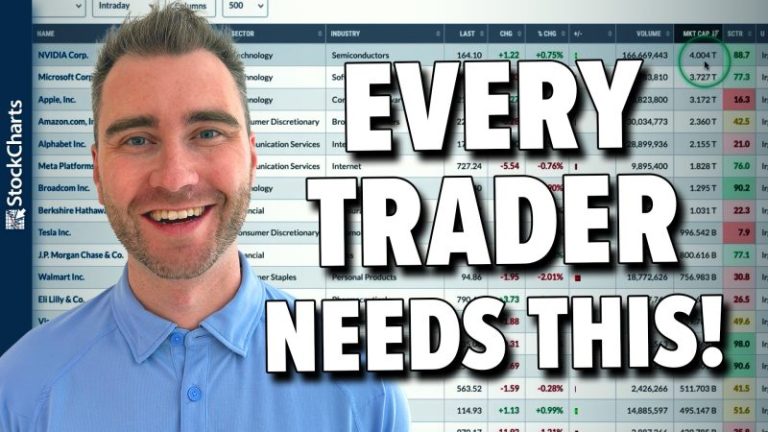
If you’re serious about trading or investing, establishing a weekly market routine is a must. But where do you begin?  

In this eye-opening video, Grayson Roze, Chief Strategist at StockCharts, shares the method he uses every week to stay aligned with the market’s biggest drivers — the top 25 stocks by market cap

Learn how to build a customized ChartList of these stocks, sort the stocks by market cap, and different ways to review them to spot long-term trends or reversals.

Whether you’re new to charting or a seasoned technician, this routine could transform how you view the market. 

This video originally premiered on July 11, 2025. Click on the above image to watch on our dedicated Grayson Roze page on StockCharts TV.

You can view previously recorded videos from Grayson at this link.

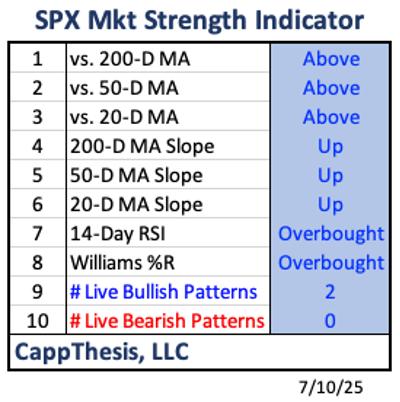
Up to this point, the S&P 500 ($SPX) has now stayed above the 6,200-mark for eight straight days. The upside follow-through has been limited, but the drawdown has also been shallow. The onus continues to be on the bears to do something with the stretched state. We discuss this in terms of the CappThesis Market Strength Indicator below.

What Is the Market Strength Indicator (MSI)?

When the market makes strong moves, like they have recently, I like to review our Market Strength Indicator (MSI).  This isn’t some secret, proprietary formula. It’s a simple blend of trend, oscillator indicators, and patterns, factors that we base our market stance upon.

And surprise, surprise, the MSI is as bullish as can be with the SPX at new highs and up 30% in three months.

  1. The S&P 500 is trading above each moving average, and each moving average is sloping higher.
  2. The 14-day Relative Strength Index (RSI) and Williams %R are both overbought. We use both of these since it takes a considerable up move to get the RSI to overbought territory. And while the Williams %R swings to extremes much more easily, it can only stay overbought if the market continues to tick higher with minimal drawdowns. Clearly, all of this has been happening.
  3. And, of course, two big pattern breakouts remain in play. Two weeks ago, the MSI was even more extreme when we had four patterns in play at the same time.

Here are each of those indicators together on one chart. (We don’t show the patterns here since it would be way too much to display all at once – and that would be an offensive chart crime.)

The clear next question:

Now what?

Market Strength Indicator Now vs. April 7, 2025

First, the obvious. The MSI was completely depressed on April 7 after two months of intense selling and extreme volatility.

Interestingly, though, after that last massive downside gap on April 7, the final bearish pattern target was hit. That set the stage for a bottoming process to potentially begin.

With the pendulum now having completely swung from historically oversold to now extended, does a very bullish MSI suggest the upswing is unsustainable?  

Bulls and bears agree on one thing these days: The pace of the last three months can’t continue, and at any time, a pullback greater than the 3.5% drop from mid-May is going to happen. It’s just a matter of when. 

Now let’s look at the recent times when the MSI got to extreme levels like now.

Market Strength Indicator Now vs. 2023–24

The results are crystal clear. “Extreme” MSI readings are the result of strong technicals, which occur in uptrends. And uptrends tend to last longer than many think is possible or probable.

From this perspective, only once did a correction begin right after a high MSI reading – in July’24. At the time, though, only one bullish pattern was in play (the one with the long-term 6,100 target that was triggered way back in Jan’24). 

Now, of course, we have two live bullish formations, and for the uptrend to persist without a major market disturbance, we’ll need to see the next bout of profit-taking morph into the next set of short-term bullish formations.

Live Patterns

Our two live patterns remain – targets of 6,555 and 6,745, which could be with us for a while going forward. For those to eventually be achieved, though, new, smaller versions will need to be constructed.

Live Patterns

Our two live patterns remain – targets of 6,555 and 6,745, which could be with us for a while going forward. For those to eventually be achieved, though, new, smaller versions will need to be constructed.

The stock market continued to push higher with the S&P 500 ($SPX) and Nasdaq Composite ($COMPQ) closing at record highs on Thursday. The Dow Jones Industrial Average ($INDU) tacked on a solid 192 points (+0.43%). There was a pullback on Friday, but July is a seasonally strong month, the economy remains healthy, and volatility is low, fueling a clear risk-on vibe. 

But even in a healthy market, investors face a dilemma. The question lingers: “Should I buy now or wait for a pullback?” One often-ignored clue can help you decide: small-cap price action. 

Small Cap Stocks: The Silent Signal

Small caps have been struggling in the recent past. Every time they break above a key resistance level, they’re not able to hold their position for too long. They’re breaking out again, and this time, you’ll want them on your radar.

Since early April, small-caps have been rising along with other asset groups. The S&P 600 Small Cap Index ($SML) has broken above the 1380 level, an area that, in the past, has served as a key support level (see chart below). 

FIGURE 1. DAILY CHART OF THE S&P 600 SMALL CAP INDEX ($SML). The index broke above the 1380 level on Thursday but pulled back on Friday. If the upside move continues, it would support a higher move in the large-cap indexes. Chart source: StockCharts.com. For educational purposes.

The percentage of S&P 600 stocks trading above the 200-day moving average was above 50 on Thursday, and advances were greater than declines. The expanding breadth in small caps supports a move higher. For as long as this breadth holds, the broader market has room to keep climbing. 

In the five-year weekly chart of $SML, you can see that $SML has broken above its 40-week simple moving average (SMA). A continued move higher would support a rise in the overall market. When small caps participate in the upside move, it’s an indication that the health of the overall market is strong. We saw this happen at the end of 2023 when $SML broke above its 40-week SMA. It stayed above that moving average until the end of March 2025. During that time, the S&P 500 gained almost 50% (see figure 3). 

FIGURE 2. WEEKLY CHART OF $SML AND S&P 500. $SML broke above its 40-week SMA, supporting the S&P 500’s move higher. Chart source: StockCharts.com. For educational purposes.

In the weekly chart of the S&P 500, it’s evident that the large-cap index led the move higher. 

FIGURE 3. FIVE-YEAR WEEKLY CHART OF S&P 500. The large-cap index led the move higher, but small caps led the move lower. Chart source: StockCharts.com. For educational purposes.

But here’s where it gets interesting. If you compare the chart of $SML and $SPX, it’s clear that the small-cap index started its decline well ahead of its large-cap cousin. $SML pulled back to its 40-week SMA in early January 2025 and bounced off it. The high was lower than the previous high, the first sign of a confirmed downtrend. 

The S&P started its downtrend in early February, which was confirmed in late February when it hit resistance at its 40-week SMA and declined. The small caps rolled over first, and if you had noticed it, it would have been your first alert that large-cap stocks would soon follow. 

Will Small Caps Outrun Large Caps?

In an environment where capital is rotating into growth stocks, it’s unlikely small caps will outperform large-cap stocks. In the chart of the SPDR Portfolio S&P 600 Small Cap ETF (SPSM) vs. the S&P 500 ETF (SPY), between 2023 and 2025, small caps underperformed the large caps. (Note: This chart can be accessed from the Market Summary page.)

FIGURE 4. PERFORMANCE OF SMALL CAPS. VS. LARGE CAPS. Between 2023 and 2025, small caps underperformed large caps. Chart source: StockCharts.com. For educational purposes.

The takeaway: Since small caps lead the broader market lower, investors should make it a point to monitor their price action, especially when the stock market continues to rise. 

Add $SML or a small-cap proxy such as the iShares Russell 2000 ETF (IWM) or the SPDR Portfolio S&P 600 Small Cap ETF (SPSM) to your ChartLists. When you see a confirmed downtrend in small caps, expect a pullback in large caps. It may not happen immediately, but at least you’ll be better prepared for the next significant pullback or correction.  

Closing Position

Small-cap stocks may not take the place of the large-cap growth stocks in your portfolio, but they silently signal the market’s next move. By monitoring $SML and small-cap proxies on StockCharts, you’ll get an early heads-up, which will allow you to act with confidence — whether that means trimming your winners, adding hedges, or jumping into new setups.

Are you ready to follow the price action in the charts? Log in to your StockCharts.com account, click on the charts in this article, and save them to your ChartLists.


Disclaimer: This blog is for educational purposes only and should not be construed as financial advice. The ideas and strategies should never be used without first assessing your own personal and financial situation, or without consulting a financial professional.

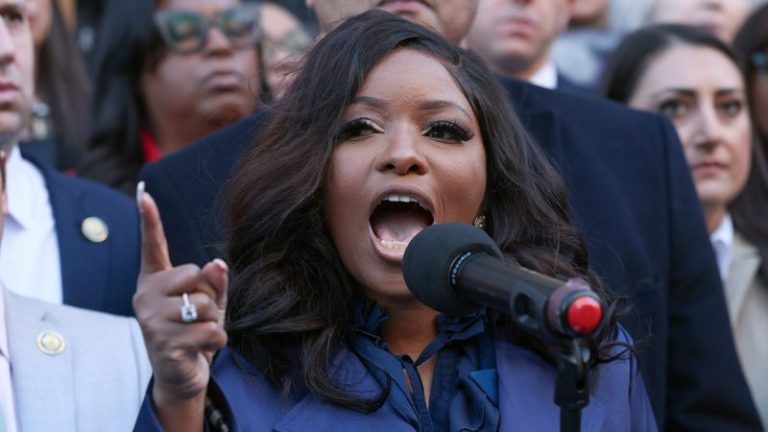
Progressive firebrand Rep. Jasmine Crockett, D-Texas, made a second surprise appearance at the House Oversight Committee’s closed-door discussions with former Biden administration aides this week, once again criticizing President Donald Trump on the way out.

Crockett surprised reporters when she arrived roughly 15 minutes after House investigators’ transcribed interview with former White House advisor Ashley Williams began, declining to speak on the way in.

The Texas Democrat emerged just over 30 minutes later, saying little about what went on inside but telling reporters she still had ‘absolutely’ no concerns about Biden’s mental fitness while in office.

She said it was important to ‘be there physically’ for Biden allies being interviewed in the GOP probe – even going as far as suggesting the Trump administration created a threatening environment for members of Congress and its own political opponents.

‘It is important…in my mind, to be there for these witnesses. Unfortunately, we know what happens when this regime gets going. We know about the threats that come upon them, that come upon us as members of Congress,’ Crockett said.

‘I think it is important to stand there in solidarity and to at least be there physically so that they don’t feel like they’re alone as they are enduring egregious attacks consistently from this administration.’

Crockett was the only lawmaker seen going in or out of Williams’ meeting with investigators on Friday. The transcribed interview was expected to be staff-led, and lawmakers were not required to attend.

‘Right now, the Republicans continue to act as if this is a main priority. Yet none of them are showing up,’ she said.

‘I do think that it is important that I show up because if they are going to make allegations about the former commander-in-chief, egregious allegations they continue to wage. I want to make sure that I’m in the room to correct the record, because a lot of times they like to mischaracterize things.’

When asked by Fox News Digital if the interview was still ongoing as she exited, however, Crockett answered, ‘It’s still going. I’m leaving early. I’ve got to get to another thing.’

A source familiar with the ongoing proceeding told Fox News Digital that Crockett came in during Republican investigators’ round of questioning and so was unable to make inquiries herself. Fox News Digital reached out to Crockett for a response.

Williams was the former Director of Strategic Outreach under the Biden administration. She did not speak to reporters on the way into her transcribed interview.

Crockett initially caught reporters and potentially even staff off guard when she arrived for the closed-door deposition of Biden’s former White House physician, Dr. Kevin O’Connor.

House Oversight Committee Chairman James Comer, R-Ky., was there as well, as is the norm for sworn depositions.

Williams, unlike O’Connor, is not on Capitol Hill under subpoena.

During her Wednesday appearance, Crockett declared she never had any concerns about Biden’s mental state while he was president, though she did raise similar claims about Trump.

White House spokesman Harrison Fields told Fox News Digital in response to Crockett questioning Trump’s mental acuity: ‘The Democrats’ rising star has done more to cement the party’s demise than the President she breathlessly supported, the decrepit and feeble Joe Biden. Jasmine continues to prove she’d be better suited as a reality TV star on VH1 than an elected official on Capitol Hill.’

Comer is investigating accusations that Biden’s former top White House aides covered up signs of his mental and physical decline while in office, and whether any executive actions were commissioned via autopen without the president’s full knowledge. Biden allies have pushed back on those claims.

This post appeared first on FOX NEWS

President Trump once famously quipped that he could shoot a man on 5th Avenue and his strongest supporters would stay with him. For nearly a decade this has seemed true, but today, the president may have stumbled on the exception, in the sickening form of the Jeffrey Epstein case.

It turns out that Epstein is a major test for Trump in the eyes of his MAGA warriors. They want real answers from this administration, not fumbled document dumps and dismissive comments from the president himself, as we saw this week.

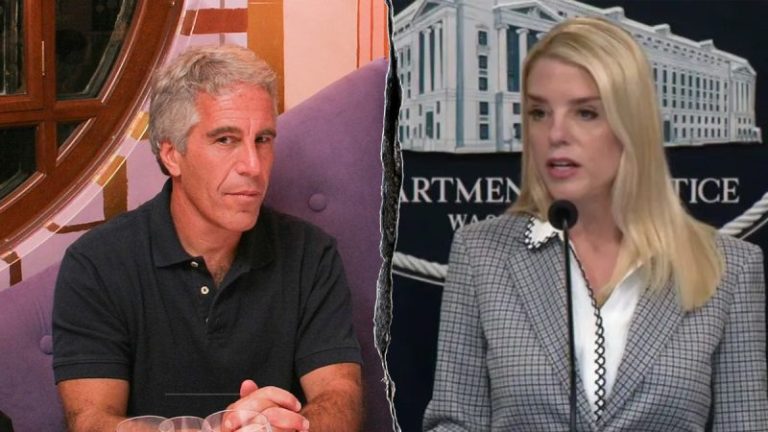
Now, we have FBI Deputy Director Dan Bongino who is apparently threatening to resign over the debacle, if Attorney General Pam Bondi doesn’t go first and a bewildered MAGA base that feels it is being insulted and lied to by its government, again. 

To be sure, Epstein was an awful human being who preyed on poor underage girls for decades, according to testimony from the Ghislane Maxwell trial (which I covered in the courthouse), as well as a wealth of other evidence. But for most Americans, his crimes and suspicious death are a mere curiosity at this point.

It is much, much more for hard-core MAGA. For them, it is nothing less than a test to determine whether or not the Swamp that has lied to our faces for decades is still in control.

This week, Steve Bannon said the only way the Epstein story goes away is if ‘the 5 to 10 to 15 percent of the Trump movement, the Pepes and hardcores,’ finally just say, ‘I’ve had enough of it.’ He added that the basic question is, ‘who is running the country?’

Likewise, at the TPUSA convention in Florida this weekend, which is led by Trump ally Charlie Kirk and is as pure a distillation of the core MAGA movement as exists, my sources tell me that Epstein is very much the top topic of concern.

But why did this curious case of this infamous creep and his private island become a synecdoche for all government lies in the mind of MAGA? In other words, how did Epstein become the symbol of deep government corruption?

For one thing, the notion Epstein was allowed to kill himself inside a federal prison has always strained credulity. From missing video to conflicting medical exams, there have been legitimate questions about how a man rumored to have damaging information on powerful people and ties to the intelligence community could turn up dead in federal custody. While officials assured the nation there was nothing to see, MAGA seethed. ‘Epstein didn’t kill himself’ became not just a meme and a mantra, but a declaration that we’ve been gaslit by our government.

There is also the matter of Bondi seeming to indicate that there was an Epstein client list in a Fox News Channel interview, only to now say it doesn’t exist. She says she was talking about the file writ large, but it didn’t sound that way at the time.

Bongino, in recent weeks, along with FBI Director Kash Patel, told us that a video from the prison is proof positive that this was suicide, but it turns out there was a missing minute of footage, and the video may have been doctored.

This was after Bondi all but hijacked a group of influencers in the spring at the White House, handing out binders purporting to share new bombshell information that turned out to be as exciting as a list of grandma’s baking recipes. 

On top of all of this, we have President Trump himself, visibly annoyed in the White House, this week when asked about Epstein, ‘Are you still talking about this guy…this creep?’ Trump asked. Well, yes, Mr. President, they are.

All in all, the administration’s handling of the Epstein case has been about as transparent as a brick wall, one that appears to be crumbling.

Trump has expressed concern in the past about innocent people being listed in Epstein documents, as happened to attorney Alan Dershowitz and others, and according to Elon Musk, both Trump and Bannon appear in this evidence, though Musk offers no proof of this.

This may be a reasonable concern, but after decades of blatant lies and stalled prosecutions of Epstein, Trump’s hardcore supporters want more than assurances. They want to see the documents. They want to see everything.

And this is a central part of Trump’s appeal, his promise to open up the hood and expose the broken-down, deep-state engine of government. But promises are not enough. Where are the results? When are we going to Fort Knox as promised, for example?

A breathtaking hallmark of the second Trump term has been extreme transparency. The president takes questions almost daily, and answers with candor. Except, it seems, when it comes to Jeffrey Epstein.

For a quarter-century now, the Epstein case has been a combustible cocktail of power, greed, private islands and sexual abuse. It has ushered in both careful examination and wild conspiracy theories, and the only way to separate the two is with complete sunlight onto the evidence.

For President Trump, this may be the first time he is risking the loyalty of his longest, strongest supporters, and for a populist political movement that is pure poison. 

The time to release everything is now, the future of MAGA may depend on it.

This post appeared first on FOX NEWS

Ashley Williams, a longtime ally of former President Joe Biden, met with House investigators behind closed doors for nearly six hours Friday as Republicans probe allegations the Democrat’s top aides hid his mental decline.

A source familiar with the transcribed interview told Fox News Digital Williams said she did not ‘recall’ various things ‘an untold number of times.’

‘Examples include she could not recall if she spoke with President Biden in the last week, if teleprompters were used for Cabinet meetings, if there were discussions about President Biden using a wheelchair, if there were discussions about a cognitive test, if she discussed a mental or physical decline of President Biden, if she ever had to wake President Biden up and how she got involved with his 2020 campaign,’ the source said.

Williams told House investigators Biden is fit to be president today, the source said. 

In addition to whether senior aides covered up Biden’s alleged decline, House Oversight Committee Chairman James Comer, R-Ky., is looking into whether any presidential orders were signed via autopen without the former commander in chief’s knowledge.

Any allegations of wrongdoing so far have been denied by the ex-president’s allies.

But Republican investigators have pointed to Biden’s disastrous June 2024 debate and subsequent revelations in the media that there were more concerns from Biden’s inner circle about his fitness for office than previously known.

Williams, however, argued he was in command of himself during that debate, the source said.

The former White House aide said nothing to reporters when entering or leaving the committee meeting room for her voluntary interview.

Fox News Digital reached out to Williams’ lawyers for their account of events inside the room.

It was a staff-led meeting, but Rep. Jasmine Crockett, D-Texas, briefly stopped in for just under 30 minutes to show ‘solidarity’ with the witness, the progressive told reporters afterward.

‘I do think that it is important that I show up because if they are going to make allegations about the former commander in chief, egregious allegations they continue to wage, I want to make sure that I’m in the room to correct the record because a lot of times they like to mischaracterize things,’ she said.

When asked by Fox News Digital if the interview was still ongoing as she exited, Crockett answered, ‘It’s still going. I’m leaving early. I’ve got to get to another thing.’ 

The source who spoke with Fox News Digital said Crockett had come in during the GOP’s questioning session and did not ask any questions herself. Fox News Digital reached out to her office for a response.

Williams is a longtime Biden ally whose time with the Democrat goes back to assisting second lady Jill Biden during the Obama administration, according to a 2019 profile of Biden staffers.

Williams later worked for Biden’s 2020 campaign and presidential transition team. She served as his trip director before being hired by the White House as deputy director of Oval Office operations and a special assistant to the president.

Williams ended her White House tenure as deputy assistant to the president, senior advisor to the president and director of strategic outreach, according to her LinkedIn page.

Notably, the social media page also says Williams still works for the ex-leader as senior advisor in the Office of Former President Joe Biden.

She was subpoenaed by the House Oversight Committee last year during Republicans’ investigation into Biden’s cognitive health, but GOP investigators say the former White House blocked her from giving any information.

The Democratic staffer is the third person to appear before committee investigators in recent weeks.

Former Biden White House physician Kevin O’Connor appeared for a sworn deposition Wednesday after being subpoenaed by Comer.

This post appeared first on FOX NEWS

David Gergen, who worked for four presidents, including Richard Nixon, Gerald Ford, Ronald Reagan and Bill Clinton, before becoming an academic and political TV pundit, has died. He was 83. 

Gergen died in a retirement home in Massachusetts on July 10, his son said, according to several outlets. 

The Washington, D.C., veteran had been suffering from Lewy body dementia, his son said. 

Those who knew and admired Gergen took to X to express their condolences. 

Former California first lady Maria Shriver wrote on X: ‘David Gergen was total professional and a really kind man. My thoughts are with his family. He loved politics and he loved being in service to this country.’

‘RIP, Mr. Gergen,’ CBS reporter Robert Costa wrote. 

Former Democratic Tennessee Congressman Harold Ford, Jr. wrote: ‘We lost a good one, a really good one – RIP, my friend David Gergen

Gergen came up with the line that then-candidate Reagan said in the 1980 election: ‘Are you better off than you were four years ago?’ according to The New York Times. 

He later said of the line: ‘Rhetorical questions have great power.’ 

Of his time with the Nixon administration, Gergen told the Washington Post in 1981, ‘I was young, and I was too naive. It hardened me up a lot. It was an extremely difficult experience emotionally, in terms of belief in people.’ 

After leaving public office, Gergen worked as an editor and columnist, as well as for the conservative American Enterprise Institute and the liberal Kennedy School of Government at Harvard University. He was also a commentator for PBS, CNN and NPR. 

‘To say that I rely on him is an understatement,’ Reagan’s White House Chief of Staff, James A. Baker III, told The Washington Post in 1981. ‘He’s the best conceptualizer, in terms of communications strategy, that we have.’

This post appeared first on FOX NEWS

Former White House aide Ashley Williams is the latest ex-Biden administration official to appear in the House Oversight Committee’s probe.

Oversight Committee Chair James Comer, R-Ky., is investigating allegations that Biden’s former top White House aides covered up signs of his mental and physical decline while in office, and whether any executive actions were commissioned via autopen without the president’s full knowledge. Biden allies have pushed back on those claims.

Williams is the third member of Biden’s White House inner circle to show up, though she said nothing to reporters on her way into the room late Friday morning nor during a brief lunch break in the afternoon.

She’s a longtime Biden ally whose time with the Democrat goes back to assisting then-second lady Jill Biden during the Obama administration, according to a 2019 profile of Biden staffers.

Williams later worked for both Biden’s 2020 campaign and presidential transition team. She served as his trip director before being hired to the White House as deputy director of Oval Office Operations and a special assistant to the president.

Williams ended her White House tenure as deputy assistant to the president, senior advisor to the president, and director of Strategic Outreach, according to her LinkedIn page.

Notably, the social media page also says Williams still works for the ex-leader as senior advisor in the Office of Former President Joe Biden.

Williams is a graduate of Georgetown University, and received a doctorate of Law from the University of Pennsylvania. She also got a Master’s degree in political management from George Washington University.

She was subpoenaed by the House Oversight Committee last year in Republicans’ investigation into Biden’s cognitive health, but GOP investigators say the White House blocked her from giving any information.

‘The Biden White House obstructed the Committee’s investigation and refused to make the aides available for depositions or interviews,’ the committee said in a press release this year.

Williams’ Friday appearance was not forced under subpoena, however. She appeared voluntarily for her closed-door transcribed interview.

The Trump White House waived executive privilege for Williams along with several other former Biden aides last month.

This post appeared first on FOX NEWS