
Author

admin

Browsing

Investor Insight

Quimbaya Gold’s strategic focus on Colombia offers a compelling opportunity for gold exploration in a prolific, yet underexplored region supported by a favorable permitting environment. The upside potential is worthy of examination by any savvy investor.

Overview

Quimbaya Gold (CSE:QIM) is a junior gold exploration company focused on its high-grade gold projects in Colombia. The company’s portfolio spans 59,057 hectares across three highly prospective regions in the Antioquia mining district. This region is responsible for approximately 50 percent of Colombia’s total gold production, equivalent to around 1 million ounces (Moz) annually.

Positioned right next to Aris Mining’s (TSX:ARIS) Segovia mine, Quimbaya leverages its proximity to established infrastructure and gold-rich geological formations. With Colombia being one of the most underexplored yet top mining jurisdictions in South America, Quimbaya’s projects are uniquely poised for significant discoveries.

Quimbaya’s projects benefit from Colombia’s favorable permitting environment, enabling faster transitions from discovery to production, compared to its global peers. Quimbaya’s strategy focuses on value creation through new discoveries and monetizing them via strategic transactions, including joint ventures and operational contracts.

Quimbaya has established a significant partnership with Independence Drilling, Colombia’s largest drilling company with over 40 years of experience. The agreement secures 100,000 meters of drilling over five years, with Independence Drilling accepting part of its payment in Quimbaya shares. This innovative structure demonstrates strong confidence in Quimbaya’s projects, ensuring cost-effective and efficient drilling operations.

The company’s management team brings extensive and deep expertise in exploration in Colombia, corporate finance and project development. Quimbaya trades on multiple exchanges: CSE (QIM), OTCQB (QIMGF), and FSE (K05).

Company Highlights

  • Quimbaya Gold controls 59,057 hectares across three distinct projects in Antioquia, Colombia — renowned as the country’s top mining department, accounting for over half of Colombia’s gold production.
  • The flagship Tahami project is adjacent and on trend to Aris Mining’s Segovia mine, one of the highest-grade gold mines globally. Tahami benefits from its strategic proximity to Segovia and its potential for discovery of high-grade vein gold systems.
  • Tight share structure (60 percent insider/family offices/institutions ownership) with a market cap of approximately C$11.45 million, ensuring alignment with shareholder interests.
  • Quimbaya has entered into a partnership with Independence Drilling, Colombia’s largest drilling company, which secures an extremely cost-effective 100,000 meters of drilling over five years.
  • Quimbaya utilizes software that allows for rapid and cost-effective acquisition of mining claims, giving the company a competitive edge in securing high-value assets.
  • The technical team’s proven track record of major discoveries in Colombia positions Quimbaya as a standout explorer in the region.
  • Fully funded into 2026 for multi-project advancement in Colombia after closing $4 million financing

Key Projects

Tahami Project (Flagship)

The Tahami project is located in Segovia, Antioquia, adjacent to Aris Mining’s Segovia mine, one of the highest-grade gold mines in the world. Spanning 17,087 hectares, Tahami’s geology features mesothermal veins with multiple mineralization events underlain by Precambrian metamorphic rocks consolidated within the San Lucas Gneiss unit.

Several vein systems from Aris Mining’s Segovia project, including the Sandra K and El Silencio veins, extend towards Quimbaya’s tenements. Both the Sandra K and El Silencio veins align with structural orientations of known high-grade deposits. The project also boasts more than 25 historical artisanal mines, underscoring its prospectively.

Quimbaya’s exploration plan for Tahami involves leveraging advanced geochemical and geophysical surveys to generate drill targets. These efforts will be complemented by modern 3D geological modelling and an initial drilling campaign to test high-grade zones. The integration of historical data and cutting-edge technology positions Tahami as a prime asset for discovery. The initial drilling campaign is anticipated to commence by late Q2 of 2025 and will prioritize the high-grade targets identified in preliminary exploration work.

Maitamac Project

Located in Abejorral, Antioquia, 80 kilometers south of Medellín, the Maitamac project spans 33,223 hectares and offers excellent road access. This emerging gold metallogenic district features mesothermal veins and potential porphyry gold-copper systems.

Initial surface rock samples have reported gold grades of up to 3.2 g/t, with stream sediments revealing over 1 g/t gold. Identified as a promising district by the Colombian Geological Services, Maitamac is positioned alongside the past producing ABE project and structural corridor which has produced mined shoots averaging 26 g/t gold.

Team

Alexandre P. Boivin – CEO and Director

Alexandre Boivin is an entrepreneur with more than 10 years of experience in corporate finance and Colombian mining. Through his extensive experience in the mining industry, corporate finance, capital markets and business development, Boivin has been instrumental in managing and funding early-stage companies through a network of partners and investors immersed in the capital markets. Under his leadership, Quimbaya Gold has secured significant investments to advance its exploration projects. His commitment to the company’s growth is further demonstrated by his substantial shareholding in Quimbaya Gold.

Olivier Berthiaume – CFO and Director

Olivier Berthiaume is an accountant with over 12 years of experience working with early-stage companies in the Canadian markets. He holds a Bachelor of Business Administration from HEC Montreal and specializes in private-to-public market transactions, compliance, corporate governance, and corporate growth strategies. Berthiaume has held various director and officer positions in junior mining companies.

Sebastian Wahl – Vice-president, Business Development

Sebastian Wahl brings over 15 years of experience in the mining industry, with a strong focus on precious metals trading, capital markets, and corporate development. Wahl has played a pivotal role in shaping Quimbaya Gold’s strategic direction and elevating its external positioning during a critical growth phase.

Ricardo Sierra – Exploration Manager

Ricardo Sierra is a professional economic Geologist with over 18 years of exploration experience in Colombia-Chile-Cuba-Brazil in orogenic, mesothermal, porphyry type deposits, epithermal systems, and stratabound. Sierra started his career with ANGLO AMERICAN as an exploration geologist in greenfield and brownfield exploration, supervising diamond drilling on their Colombian properties. His knowledge in vein systems, critical in understanding mineralization processes, was honed while exploration superintendent with Continental Gold (now Zijin Mining Group) on their Buritica (Antioquia) deposit, also in their regional exploration (Choco, Nariño, Cauca, Antioquia). Sierra graduated in 2007 as a geologist from Universidad de Caldas (Colombia). He is a member of the Australian Institute of Mining and Metallurgy (MAusIMM) and is a qualified person (QP) as defined by National Instrument 43-101, also he is a Competent Person (CP) of Comision Colombiana de Recursos y Reservas Mineras (CCRR).

Dr. Stewart Redwood – Senior Technical Advisor

Stewart Redwood is a distinguished geological consultant with more than 40 years of experience in mineral exploration and economic geology, specializing in epithermal, porphyry and skarn deposits, particularly in Latin America and the Caribbean. His notable achievements include significant discoveries, including the San Cristobal silver-zinc deposit in Bolivia, the Romero gold-copper deposit in the Dominican Republic, and the Antamina copper-zinc project in Peru, recognized as the world’s largest copper skarn deposit. Throughout his career, Redwood has held key positions in prominent mining and exploration companies, including as chief geologist Latin America for AngloGold Ashanti, founder president and CEO of GoldQuest Mining, and VP exploration of Colombia Goldfields (which merged with Gran Colombia Gold). He has been instrumental in the success of Gran Colombia Gold’s Marmato project (now owned by Aris Mining), currently an 8.8 Moz deposit in the construction stage.

Nicolas Lopez Villegas – Technical Advisor

A Colombian native, with over 28 years of experience focused in the mining district of Antioquia, currently the CEO of MINING BRAIN SAS, Nicolas Lopez, leads this consulting company advising on the implementation, development of sustainable mining projects all over Colombia. Prior to the establishment of his consultancy practice, Lopez spent 12 years as Colombia & Nicaragua’s country manager for IAMGOLD, having devoted the previous 10 years with MINEROS SA as head of exploration & geology. Villegas played a pivotal role in major discoveries, including the first porphyry copper-gold deposit in the Colombian middle Cauca belt, known as Titiribi. a significantly rich gold-copper geological region. As a seasoned executive in gold exploration, Villegas holds a geology degree from Universidad de Caldas (Colombia), a Governance in Oil & Mining degree from Oxford University (UK) and he is a Qualified Person (QP).

Terence Ortslan – Advisor

Terence Ortslan is a seasoned resource executive with over 40 years of experience, having served in advisory capacities across the mining, metals, and fertilizer sectors. He provides guidance on investment and technical aspects of the industry, as well as strategic and policy advice tailored to mining companies. Additionally, Ortslan advises financial institutions on investment decisions, offers direction to international industry organizations, and consults with governments on fiscal and industrial regulations. He also supports universities in enhancing their educational standards and assists corporations with decision-making, boardroom leadership, shareholder value enhancement, and strengthening ES parameters. Ortslan holds a Bachelor of Engineering & Applied Geophysics and an MBA from McGill University.

This post appeared first on investingnews.com

The conversation touches on triumph gold’s rationale for expanding into the United States, highlighting the project’s access to year-round work, low dilution, and proximity to major producers such as Rio Tinto and Osisko Development.

‘We’ve added a highly compelling silver project in one of North America’s most mining-friendly jurisdictions,’ Anderson said. ‘Utah allows us to operate year-round, and the acquisition gives us exposure to high-grade silver and regional-scale discovery potential with minimal dilution to our shareholders.’

Other highlights from the interview include:

  • Details on the Coyote Knoll acquisition structure, including share issuance and milestone payments
  • Ongoing strategic value of the company’s flagship Freegold Mountain project in Yukon
  • Exploration potential at Andalusite Peak, Triumph’s underexplored copper-gold property in Northern British Columbia
  • Comments on the permitting environment in Canada and the potential impact of fast-tracking federal legislation

Watch the full interview here:

About triumph gold

triumph gold is a junior exploration company focused on advancing gold, silver and copper assets across North America. The company’s holdings include the Freegold Mountain project in Yukon, Andalusite Peak in British Columbia and the newly acquired Coyote Knoll project in Utah.

For more information: https://triumphgoldcorp.com/

Media Contact

To view the source version of this press release, please visit https://www.newsfilecorp.com/release/258113

News Provided by Newsfile via QuoteMedia

This post appeared first on investingnews.com


Brunswick Exploration Inc. (TSX-V: BRW, OTCQB: BRWXF; ‘ BRW ‘ or the ‘ Company ‘) is pleased to report the final set of results obtained as part of the 2025 Winter drill campaign conducted on its Mirage Project. The Mirage Project is located in the Eeyou Istchee–James Bay region of Quebec, approximately 40 kilometers south of the Trans-Taiga Road. This press release primarily focuses on the drilling work carried out in the eastern extension of the MR-6 dyke and the ‘Stacked Dyke’ zone.


  Highlights include:  


  • The discovery of a further three new major dykes located between 200 and 500 meters northeast of MR-6, which returned 33.2 meters at 1.1% Li    O in drill hole MR-25-110, 20 meters at 1.3% Li    O and 11 meters at 1.2% Li    O in drill hole MR-25-112.
  •  

  • The ‘Stacked Dyke’ zone was extended 150 meters to the north, with hole MR-25-106 intersecting 17.4 meters at 1.01% Li    O .
  •  

  • Over the course of the Winter 2025 program, BRW has discovered a total of 4 new major dykes measuring between 10 meters and 35 meters, all located near surface and in the core of the project all of which remain open in all directions.
  •  

  • Elevated tantalum concentrations continue to be strongly associated with lithium mineralization with values consistently ranging from 150 to 350ppm. Further metallurgical work will be completed to determine the viability of producing a tantalum byproduct.
  •  

Mr. Killian Charles, President and CEO of BRW, commented: ‘Brunswick Exploration remains one of the most compelling stories in the mining sector as we leverage the atypical combination of advanced exploration work at Mirage alongside an aggressive global lithium grassroot program which has no comparable peers. As the lithium market regains strength over the coming quarters and years, we are uniquely positioned to benefit from new discoveries and the continued development of Mirage.


‘Today’s results serve once more to highlight the exploration potential of Mirage. Even after more than 20,000 meters of drilling over the last 18 months, we have repeatedly and continue to intercept new dykes of appreciable width and grade. As we move toward a maiden resource estimate in late 2025, I am extremely proud of the work the BRW exploration team has achieved across its still growing pipeline of projects.’


  Mirage Project Drilling Overview  


The Mirage Project comprises 427 claims located roughly 40 kilometers south of the Trans-Taiga Highway in Quebec’s James Bay region and 34 kilometers northeast of Winsome Resources’ Adina Project.


The drilling campaign was primarily aimed at extending the mineralized ‘Stacked Dyke’ zone to the northeast. The highlights presented in this press release are shown in Table 1 and Figures 1 and 2. Collar locations are provided in Table 2.


  Figure 1 : Zone Location at Mirage Project


  Figure 2 : Central Zone of the Mirage Project


Drill hole MR-25-110 led to the discovery of a new spodumene-bearing pegmatite dyke, grading 1.1% Li₂O over 33.2 meters from 217 to 251 meters (vertical depth of 180 meters), while drill hole MR-25-112 returned 1.3% Li₂O over 20 meters from 367.9 to 387 meters (vertical depth of 290 meters). These two new dykes are interpreted to be sub-parallel, oriented approximately N130/30. Drill hole MR-25-112 also intersected another dyke grading 1.2% Li₂O over 11 meters from 328 to 339 meters (vertical depth of 250 meters), which is believed to be also parallel to the others. These new intersections highlight the stacking of sub-horizontal mineralized dykes in this area. The dykes remain open in all directions.


  Figure 3 : Section A-A’


Drill hole MR-25-117 also intersected a 27-meter-wide pegmatite from 329 to 356 meters. This pegmatite is interpreted to be the same one intersected in drill hole MR-25-112 (which returned 1.3% Li₂O over 20 meters from 367.9 to 387 meters). However, due to the proximity of the Lac Orion fault, in MR-25-117, the pegmatite shows significant alteration and the spodumene has been largely replaced by cookeite. As a result, lower values of lithium were reported and only a smaller subinterval returned significant lithium with 1.8% Li₂O over 3.2 meters. Nonetheless, the presence of the dyke over sizeable widths is extremely encouraging and remains an excellent follow-up target for further drilling campaign.


Drill hole MR-25-109 extended the ‘Stacked Dyke’ zone by more than 100 meters to the North, with several spodumene-bearing pegmatite intersections. The widest interval returned 1.3% Li₂O over 13.3 meters, from 21.4 to 34.7 meters. The dykes in this hole are sub-horizontal and demonstrate a change in orientation compared to the central zone, where dykes typically dip 60 to 70 degrees to the southeast.


Drill hole MR-25-116 intersected over forty moderately mineralized pegmatite dykes, generally of limited thickness. While the lithium grades were modest, this hole highlights the strong potential for the mineralized system to continue toward the Northeast. The intersected dykes remain open in all directions.


Drill hole MR-25-113, located approximately 4.5 km northeast of the central zone, was completed as a reconnaissance exploration hole. Unfortunately, no spodumene-bearing pegmatite was intersected in this hole.


  Table 1: 2025 Winter Drilling Program Discussed in this Release


  Hole ID     From (m)     To (m)     Length (m)     Li2O (%)     Ta2O5 (ppm)  
  MR-25-109     21.4     34.7     13.3     1.3     351  
MR-25-109 64.5 69.2 4.7 1.2 266
MR-25-109 106.6 111.8 5.2 1.3 222
MR-25-110 42.6 47.6 5.0 1.0 245
  MR-25-110     217.8     251.0     33.2     1.1     128  
MR-25-112 113.9 116.3 2.3 1.4 183
MR-25-112 251.5 253.7 2.2 0.8 172
MR-25-112 316.0 321.4 5.4 1.2 193
  MR-25-112     328.0     339.0     11.0     1.2     160  
  MR-25-112     367.9     387.8     20.0     1.3     231  
MR-25-116 52.6 55.8 3.2 0.9 172
MR-25-116 74.5 76.8 2.3 0.5 140
MR-25-116 152.0 164.9 13.0 0.3 123
MR-25-116 200.7 203.6 2.9 1.1 141
MR-25-117 210.9 212.9 2.0 1.2 281
MR-25-117 341.5 344.6 3.2 1.8 309


  True thickness is estimated to vary between 80% and 90% across all reported holes in the 2025 Winter campaign.  


  Table 2 : Drill Hole Collars


  Hole ID     Azimut     Dip     Length (m)     UTM NAD83 z18 – East     UTM NAD83 z18 – North  
MR-25-109 300 -55 279 683432 5941447
MR-25-110 300 -55 267 683227 5941533
MR-25-112 300 -55 399 683324 5941492
MR-25-113 300 -55 169.7 686828 5943668
MR-25-116 340 -45 300 683577 5941438
MR-25-117 300 -50 363 683463 5941701


  3D model update  


Following the completion of the 2025 Winter drill campaign, Brunswick Exploration, in collaboration with PLR Resources (https://www.plr-resources.com/), updated its 3D model in preparation for a first resource estimate planned for late 2025. Figure 3 shows the location of the sections presented in Figures 5 and 6.


  Figure 4: Location of Section B-B’ and C-C’


  Figure 5 : Section B-B”


  Figure 6 : Section C-C’


Observations from field work and drilling indicate that the geometry of the pegmatite dykes in the core of the project (covering North, Central and South Zone) is closely linked to a regional antiformal folding pattern. Although the dykes locally appear to be folded, evidence strongly supports that their emplacement was primarily controlled by the hinges of these antiformal folds, rather than the dykes being simply passively deformed post-emplacement.


The emplacement of the pegmatites is interpreted as syn- to post-tectonic, likely occurring towards the final stages of the second deformation event in the region. This timing corresponds with a decrease in regional stress conditions, allowing pegmatitic melts to be focused and emplaced in structurally favorable zones such as fold hinges and lithological contacts.


Hydrothermal alteration observed in specific segments of certain pegmatite dykes, notably at MR-3 and MR-6, indicates post-emplacement metasomatic fluid activity. These fluids are believed to be associated with reactivation along nearby structures, particularly the Orion Lake Fault, which likely acted as a fluid conduit during late-stage tectonism.


Of note, the role of gabbroic units in the area remains to be fully determined; however, their consistent spatial association with pegmatite dykes suggests they may also have influenced pegmatite emplacement. Some pegmatite dykes could be guided by contacts between metagabbro and metavolcanic rocks, potentially acting as rheological boundaries favorable to dyke propagation.


  QAQC  


All drill core samples were collected under the supervision of BRW employees and contractors. The drill core was transported by helicopter and by truck from the drill platform to the core logging facility in Val-d’Or. Each core was then logged, photographed, tagged, and split by diamond saw before being sampled. All pegmatite intervals were sampled at approximately 1-meter intervals to ensure representativity. Samples were bagged; duplicated on reject, blanks and certified reference materials for lithium were inserted every 20 samples. Samples were bagged and groups of samples were placed in larger bags, sealed with numbered tags, in order to maintain a chain of custody. The sample bags were transported from the BRW contractor facility to the AGAT laboratory in Val-d’Or. All sample preparation and analytical work was performed by AGAT by sodium peroxide fusion with ICP-OES and ICP-MS finish. All results passed the QA/QC screening at the lab and all inserted standard and blanks returned results that were within acceptable limits. All reported drill intersections are calculated based on a lower cutoff grade of 0.3% Li2O, with maximum internal dilution of 5 meters. Host basalts adjacent to the dykes may grade up to 0.3% Li2O but were excluded from the reported intersections.


  Qualified Person  


The scientific and technical information contained in this press release has been reviewed and approved by Mr. Simon T. Hébert, VP Development. He is a Professional Geologist registered in Quebec and is a Qualified Person as defined by National Instrument 43-101.


  About Brunswick Exploration  


 Brunswick Exploration is a Montreal-based mineral exploration company listed on the TSX-V under symbol BRW. The Company is focused on grassroots exploration for lithium in Canada, a critical metal necessary to global decarbonization and energy transition. The company is rapidly advancing the most extensive grassroots lithium property portfolio in Canada and Greenland.


  Investor Relations/information  


Mr. Killian Charles, President and CEO ( info@brwexplo.ca )


  Cautionary Statement on Forward-Looking Information  


  This news release contains ‘forward-looking information’ within the meaning of applicable Canadian securities legislation based on expectations, estimates and projections as at the date of this news release. Forward-looking information involves risks, uncertainties and other factors that could cause actual events, results, performance, prospects and opportunities to differ materially from those expressed or implied by such forward-looking information. Factors that could cause actual results to differ materially from such forward-looking information include, but are not limited to, delays in obtaining or failures to obtain required governmental, environmental or other project approvals; uncertainties relating to the availability and costs of financing needed in the future; changes in equity markets; inflation; fluctuations in commodity prices; delays in the development of projects; the other risks involved in the mineral exploration and development industry; and those risks set out in the Corporation’s public documents filed on SEDAR at www.sedar.com. Although the Corporation believes that the assumptions and factors used in preparing the forward-looking information in this news release are reasonable, undue reliance should not be placed on such information, which only applies as of the date of this news release, and no assurance can be given that such events will occur in the disclosed time frames or at all. The Corporation disclaims any intention or obligation to update or revise any forward-looking information, whether as a result of new information, future events or otherwise, other than as required by law. Neither the TSX Venture Exchange nor its Regulation Services Provider (as that term is defined in the policies of the TSX Venture Exchange) accepts responsibility for the adequacy or accuracy of this news release.  


Photos accompanying this announcement are available at


  https://www.globenewswire.com/NewsRoom/AttachmentNg/d95734af-c249-4da4-a9c2-bb5fbe0aab0f  


  https://www.globenewswire.com/NewsRoom/AttachmentNg/41eac253-f61c-43b4-9753-2cd3d0d6d55d  


  https://www.globenewswire.com/NewsRoom/AttachmentNg/550313e2-f6ad-4966-987c-6d023678ec1f  


  https://www.globenewswire.com/NewsRoom/AttachmentNg/e588a1b4-6128-41e3-944c-5b1097b8ab98  


  https://www.globenewswire.com/NewsRoom/AttachmentNg/58151d57-78ac-4465-adbf-aaf2e0b9ff43  


  https://www.globenewswire.com/NewsRoom/AttachmentNg/2f47949b-b03c-4a78-b3f1-a3c289f8b234  


News Provided by GlobeNewswire via QuoteMedia

This post appeared first on investingnews.com

Boeing delivered 60 airplanes last month, the most since December 2023, as the plane maker seeks to raise production of its bestselling 737 Max jets after a series of manufacturing and safety problems.

The tally was the highest since before a door plug from one of its new 737 Max 9 planes blew out midair in January 2024, sparking a new crisis for the company and slowing production and deliveries of aircraft. Of the monthly total, 42 were 737 Maxes, going to customers including Southwest Airlines, Alaska Airlines and United Airlines.

CEO Kelly Ortberg, who took the top job at Boeing last August, has said the company has made progress in improving production rates and quality on its factory lines.

For the three months ended June 30, Boeing handed over 150 airplanes, its best second quarter since 2018, before two crashes of Max planes five months apart grounded the jets and sparked a multiyear crisis at the top U.S. exporter. That was also the last year Boeing posted an annual profit. Its problems also gave rival Airbus a bigger lead over Boeing.

Boeing this spring had been producing about 38 Max aircraft a month and will need Federal Aviation Administration approval to go above that limit, which the agency set after the door plug accident. Ortberg said at a Bernstein investor conference in late May that he’s confident that the company could increase production to 42 of the jets a month.

The company booked 116 gross orders in June, or 70 net orders when including cancellations and accounting adjustments. Boeing often removes or adds orders to its backlog for a variety of reasons including customers’ financial health.

Boeing’s backlog stood at 5,953 as of June 30.

The manufacturer is set to report second-quarter financial results on July 29, when investors will be focused on Ortberg’s plan to increase production and aircraft deliveries.

This post appeared first on NBC NEWS

Waymo announced Tuesday that it is offering accounts for teens ages 14 to 17, starting in Phoenix.

The Alphabet-owned company said that, beginning Tuesday, parents in Phoenix can use their Waymo accounts “to invite their teen into the program, pairing them together.” Once their account is activated, teens can hail fully autonomous rides.

Previously, users were required to be at least 18 years old to sign up for a Waymo account, but the age range expansion comes as the company seeks to increase ridership amid a broader expansion of its ride-hailing service across U.S. cities. Alphabet has also been under pressure to monetize AI products amid increased competition and economic headwinds.

Waymo said it will offer “specially-trained Rider Support agents” during rides hailed by teens and loop in parents if needed. Teens can also share their trip status with their parents for real-time updates on their progress, and parents receive all ride receipts.

Teen accounts are initially only being offered to riders in the metro Phoenix area. Teen accounts will expand to more markets outside California where the Waymo app is available in the future, a spokesperson said.

Waymo’s expansion to teens follows a similar move by Uber, which launched teen accounts in 2023. Waymo, which has partnerships with Uber in multiple markets, said it “may consider enabling access for teens through our network partners in the future.”

Already, Waymo provides more than 250,000 paid trips each week across Phoenix, the San Francisco Bay Area, Los Angeles, Atlanta, and Austin, Texas, and the company is preparing to bring autonomous rides to Miami and Washington, D.C., in 2026.

In June, Waymo announced that it plans to manually drive vehicles in New York, marking the first step toward potentially cracking the largest U.S. city. Waymo said it applied for a permit with the New York City Department of Transportation to operate autonomously with a trained specialist behind the wheel in Manhattan.

This post appeared first on NBC NEWS

The Trump administration revoked the terrorist designation for Hay’at Tahrir al-Sham, the militant group who overthrew President Bashar al’Assad and assumed control of the Syrian government. 

The group was formed as Syria’s al-Qaeda branch. In an astounding turnaround, the group’s interim leader Ahmed al-Sharaa went from a $10 million U.S. bounty on his head to the de facto leader of Syria who scored a meeting with President Donald Trump in June. 

Al-Sharaa had been campaigning hard for a relationship with Washington and sanctions relief: He offered to build a Trump Tower in Damascus, ease hostilities with Israel, and give U.S. access to Syria’s oil and gas. He worked to soften the image of Hay’at Tahrir al-Sham and promised an inclusive governing structure. 

‘In consultation with the Attorney General and the Secretary of the Treasury, I hereby revoke the designation of al-Nusrah Front, also known as Hay’at Tahrir al-Sham (and other aliases) as a Foreign Terrorist Organization,’ Secretary of State Marco Rubio wrote in a memo made public Monday. 

The move comes a week after Trump signed an executive order ending sanctions imposed on Syria. Trump said he’d lift the sanctions on Syria to give the nation, ravaged by decades of civil war, a chance at economic development. 

Treasury Secretary Scott Bessent said that lifting sanctions would help Syria ‘reestablish ties to global commerce and build international confidence,’ while continuing to prevent ‘Assad, his cronies, terrorists, and other illicit actors from attempting to destabilize Syria and the region.’ 

HTS, a Sunni Islamist group, emerged out of Jabhat al-Nusra, Syria’s former al-Qaeda affiliate. The State Department under Trump in 2018 added HTS to the existing al-Nusra foreign terrorist designation.

Some sanctions still will need to be lifted by Congress. In a bipartisan pairing from opposite sides of the political spectrum, Reps. Ilhan Omar, D-Minn., and Anna Paulina Luna, R-Fla., recently introduced legislation to lift sanctions on Syria. 

U.S. sanctions have included financial penalties on any foreign individual or company that provided material support to the Syrian government and prohibited anyone in the U.S. from dealing in any Syrian entity, including oil and gas. Syrian banks also were effectively cut off from global financial systems. 

This post appeared first on FOX NEWS

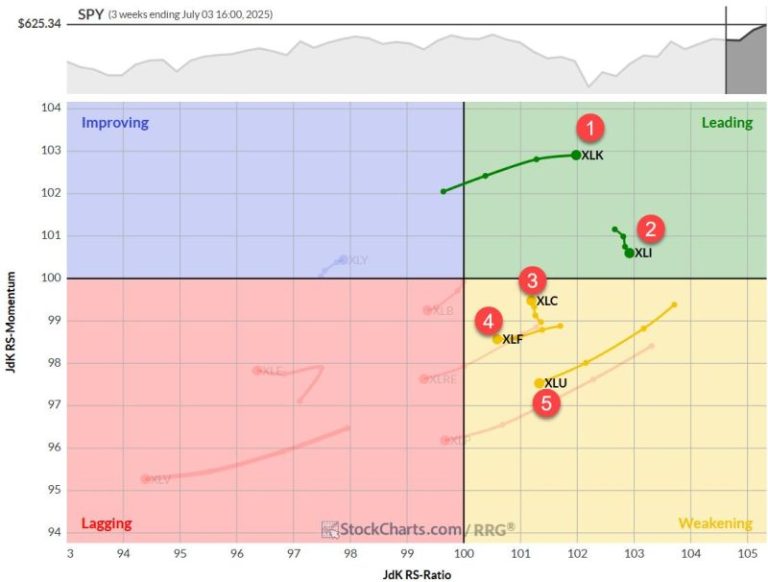
The past week has been relatively stable in terms of sector rankings, with no new entrants or exits from the top five. However, we’re seeing some interesting shifts within the rankings that warrant closer examination. Let’s dive into the details and see what the Relative Rotation Graphs (RRGs) are telling us about the current market dynamics.

Sector Rankings Shuffle

The top three sectors, technology, industrials, and communication services, remain firmly entrenched in their positions. But the real action is happening just below them. Financials climbed to the number four spot, consequently pushing utilities down to fifth place. This shift is significant, as it indicates a move towards more cyclical sectors in the top rankings.

These changes suggest a potential shift towards more economically sensitive and offensive sectors, which supports a bullish scenario or at least a move away from defensive positioning.

  1. (1) Technology – (XLK)
  2. (2) Industrials – (XLI)
  3. (3) Communication Services – (XLC)
  4. (5) Financials – (XLF)*
  5. (4) Utilities – (XLU)*
  6. (8) Materials – (XLB)*
  7. (7) Consumer Staples – (XLP)
  8. (6) Real-Estate – (XLRE)*
  9. (10) Consumer Discretionary – (XLY)*
  10. (9) Energy – (XLE)*
  11. (11) Healthcare – (XLV)

Weekly RRG

The weekly Relative Rotation Graph continues to show strength in the technology sector within the leading quadrant. Industrials is also maintaining its position in the leading quadrant, with a very short tail, indicating a consistent relative uptrend.

Communication services, financials, and utilities are currently in the weakening quadrant. However, communication services have rebounded and appear to be making their way back towards the leading quadrant again.

Financials and utilities, on the other hand, are showing negative headings, with utilities displaying the weakest momentum (longest tail).

Daily RRG

Switching to the daily RRG, we get a more granular view of recent sector movements:

  • Technology remains the strongest sector, with a high RS ratio and a short tail
  • Communication services are rotating at a slightly negative heading but still within the leading quadrant
  • Financials and industrials are showing promise in the improving quadrant
  • Utilities continues to rotate within the lagging quadrant, confirming its weakness

The positioning of these sectors, particularly the strength of technology and improvements in financials and industrials, suggests a shift towards more cyclical and less defensive sectors in the market.

Technology

Tech continues its rally after breaking above the $240 resistance area. The raw RS line is also climbing, having broken out of its falling channel. This sector remains the market leader and shows no signs of slowing down.

Industrials

The industrial sector has cleared its overhead resistance and is pushing higher. Its RS line is putting in new highs, reflecting strong relative performance. The RRG lines remain in the leading quadrant and may be turning up again, a bullish sign.

Communication Services

Comms have broken above their resistance around 105. While still at the lower boundary of its rising RS channel, it’s starting to pick up steam. Both RRG lines are climbing, with RS momentum approaching the 100 level. A cross above that level would put it back in the leading quadrant.

Financials

Financials broke through overhead resistance last week, which is a significant positive development. It’s now above both horizontal resistance and its former support line. The relative strength line needs some work, but with the current price breakout, improvement seems likely in the near future.

Utilities

The weak link in the top five, utilities, remains range-bound. It’s still above support, but not by much. With the broader market rising, utilities’ sideways movement is causing its RS line to drop. The RRG lines are rolling over, and we may soon see this sector rotate into the lagging quadrant on the weekly RRG.

Portfolio Performance Update

I must admit, our portfolio is still underperforming. The current drawdown is a little over 8%, which isn’t ideal. However, this is the nature of trend-following strategies. We’re sticking with our approach through this period of underperformance, confident that historical results support our patience.

If market trends continue as they are, we should see more offensive sectors rotate into the top five. This shift, in turn, should help us overcome the current drawdown and eventually bring us ahead of the S&P again.

Remember, investing is a marathon, not a sprint. Periods of underperformance are normal and to be expected. The key is to stay disciplined and trust in your strategy.

#StayAlert and have a great week. –Julius