Author

admin

Browsing

Investor Insight

With a proven management team and a high-impact flagship asset, Asara Resources is spearheading a new era of gold discovery in West Africa, leveraging the same team that established Robex’s 3.5 Moz Kiniero project. The company holds 923,000 oz of gold in Mineral Resources with significant upside, delivering a compelling investment opportunity for savvy investors.

Overview

Asara Resources (ASX:AS1,FSE:ALM) is spearheading the next West African gold rush from a strategic foothold in Guinea’s underexplored Siguiri Basin, an emerging gold district with over 30 million ounces (Moz) of historical and current gold production.

The company’s flagship Kada gold project hosts a 923,000 oz, oxide-dominant gold resource located just 35 km south of AngloGold Ashanti’s 6.2 Moz Siguiri mine. Asara is methodically applying the proven “string-of-pits” development model that has driven success across the region, supported by an experienced team responsible for establishing the Kiniero project, now a cornerstone asset for Robex (TSX:RBX). Guinea offers a favorable jurisdiction for mining investment, with more than US$15 billion in resource-sector inflows since 2020 and a planned return to civilian governance, positioning it as one of the more stable West African jurisdictions relative to its neighbours in the Sahel region.

Asara’s near-term strategy includes: rapidly growing its resource base through 33,600 meters of RC and diamond drilling planned for 2025; advancing a low-CAPEX, oxide-first development strategy leveraging free-dig saprolite, high gold recoveries and conventional carbon-in-leach (CIL) flowsheet; and maintaining upside exposure to copper and silver-zinc through its Loreto JV with Teck and the optional Paguanta asset in Chile.

With strong in-country infrastructure, a focused and proven leadership team, and robust gold pricing tailwinds, Asara is advancing the Kada project toward a construction-ready decision on a compressed and capital-efficient timeline.

Company Highlights

  • Flagship Kada gold project – 923,000 oz gold and counting: 30.3 Mt @ 0.95 g/t gold with 59 percent oxide-transition ounces that show over 90 percent CIL recoveries and <3.5:1 strip ratio; resource remains open in every direction along a 15 km corridor.
  • Aggressive growth runway: Three contiguous licence applications (Talico, Banan and Syli) would lift the land package to 348 sq km and extend strike control to 35 km, only ~6 percent of which is drilled.
  • Experienced team who took the Kiniero project from an exploration resource to construction: Senior executives previously turned Robex’s Kiniero from 1 Moz to ~3.5 Moz and into a C$750 million market cap company, bringing an identical on-ground team, in-country relationships and proven workflows to Asara.
  • Strategic Land Package: Kada is in the heart of the prolific Siguiri Basin (>30 Moz gold endowment), just 35 km south of AngloGold Ashanti’s Siguiri Mine.
  • Strong Institutional Support: Top 20 shareholders control 70+ percent of the company.

Key Projects

Kada Gold Project

The Kada gold project, located in the heart of Guinea’s prolific Siguiri Basin, is Asara’s flagship asset and the primary focus of its development strategy. The project currently hosts a JORC 2012-compliant mineral resource estimate of 30.3 million tons (Mt) grading at 0.95 grams per ton (g/t) gold for 923,000 oz of contained gold, comprising 391,000 oz oxide, 145,000 oz transitional, and 387,000 oz fresh mineralization. Approximately 59 percent of the resource lies within the oxide-transitional profile, with 24 percent of the total resource already classified as indicated.

The resource is hosted within the Massan and Bereko deposits, both of which remain open along strike and at depth and sit along a regional-scale 15 km gold-bearing corridor. The Massan deposit alone accounts for 906,000 oz of the total resource and is characterized by shallow, broad zones of saprolitic mineralization ideal for low-strip, open-pit mining. Gold mineralization is associated with quartz-sulphide-tourmaline stockworks hosted in metasediments with deep saprolite (>100 m) and is amenable to simple processing.

The mineralized zones are free-milling, with metallurgical testwork confirming cyanide leach recoveries of 95 to 97 percent for oxide and 88 percent for transition/fresh ore. Conventional CIL processing is suitable, with rapid leach kinetics (less than 24 hours for oxide) and no need for gravity recovery or oxygen injection. The ore has medium hardness, with a grind size optimized at 80 percent passing 75 microns. Geotechnically, the project exhibits a low strip ratio (<3.5:1), and the saprolite is potentially free digging, minimizing mining costs.

The project is within 60 km of the mining centre of Siguiri and benefits from existing infrastructure, including paved roads and ready access to water. Asara plans to carry out 33,600 metres of drilling in 2025, including 24,000 m RC and 9,600 m diamond drilling, to upgrade confidence in the core of the resource and test extensions at depth and along strike. These campaigns will target mineralization north, south and west of Massan. Auger drilling will be used to define and explore kilometre-scale gold-in-soil anomalies on the Talico, Banan and Syli license application. If granted, these licenses will expand Asara’s landholding to 348 sq km and provide a 35 km contiguous footprint along the Siguiri gold trend, where artisanal workings have already been mapped along key lithologic contacts.

The Bereko deposit, situated 10 km north of Massan, currently hosts an inferred resource of 18,000 oz gold grading at 0.94 g/t from shallow oxide, transitional and fresh material.

Importantly, this MRE only covers 400 metres of a >5.5 km strike length with confirmed bedrock gold anomalies. Historical drilling at Bereko includes notable intercepts such as 1.2 g/t gold over 27 m, 3.3 g/t gold over 9.3 m, and 8.8 g/t gold over 3.3 m. Mineralization remains open in all directions, providing significant upside potential with further drilling.

Asara envisions a low-CAPEX, staged development, anchored by starter pits at Massan and Bereko, followed by centralized processing infrastructure capable of supporting future satellite deposits. This approach mirrors the multi-pit strategy successfully deployed at Kiniero and Siguiri.

Loreto Copper Project

The 100 percent owned Loreto project is a large-scale porphyry copper exploration project in northern Chile, located between tenements held by mining majors BHP and Codelco. Under a joint venture with Teck Resources, Teck can earn a 75 percent interest in the project by making US$0.6 million in staged payments and spending US$17 million on exploration. The project hosts a 2.3 km x 1.0 km alteration footprint with evidence of a deeper porphyry system, supported by mapping, geochemistry and ZTEM geophysics. Teck is currently advancing social license and environmental studies to enable drilling. Asara is fully carried under the JV structure and maintains strategic exposure to a world-class copper opportunity with no capital obligations.

Paguanta Project

Asara holds a 75 percent interest in the Paguanta project in Chile. The asset is an advanced silver-zinc-lead-gold project with a defined JORC 2012 mineral resource totaling 2.4 Mt grading at 5 percent zinc, 1.4 percent lead, 88 g/t silver, and 0.3 g/t gold. The Patricia deposit contains a silver-equivalent resource of 18.2 Moz (236 g/t silver equivalent) and a zinc-equivalent resource of 514 Mlb (9.7 percent zinc equivalent). Mineralization is hosted within epithermal veins with potential for porphyry copper at depth, including the newly identified La Rosa porphyry target. More than 46,700 metres of drilling has been completed at the site, and a partial feasibility study was previously conducted by Golder Associates. Asara is actively evaluating strategic options to realize value from this asset.

Leadership Team

Matthew Sharples – Chief Executive Officer

Formerly with Robex, Matthew Sharples was instrumental in growing Kiniero into a multi-million-ounce project. He brings deep expertise in capital markets, stakeholder engagement, and West African permitting.

Tim Strong – Executive Director

Tim Strong is a seasoned exploration geologist and JORC Competent Person with significant experience across West Africa. Strong leads Asara’s technical strategy and resource development.

Brett Montgomery – Non-executive Chairman

Brett Montgomery is a respected corporate leader with a history of guiding early-stage exploration companies through critical growth phases.

Dr. Doug Jones – Non-executive Director

A geologist with decades of African exploration experience, Dr. Doug Jones provides technical oversight and strategic direction.

Dan Tucker – Technical Advisor

A key architect behind the Kiniero development strategy, Dan Tucker contributes deeply to geological targeting and land consolidation strategy.


This post appeared first on investingnews.com

The gold price continued to surge to new record highs in the second quarter of the year, reaching an all-time high of C$4,663.85 per ounce, or US$3,433.47, on June 13.

The gains were primarily fueled by safe-haven investment as Israel and the United States launched attacks on Iranian nuclear sites and Iran retaliated against targets in Israel and a US base in Qatar. Although a ceasefire was announced, tensions in the region remain high.

Additional tailwinds come from the continuing uncertainty in global financial markets, stemming from shifting US trade policy and Donald Trump’s ongoing, on-again-off-again tariff plans.

There is also additional uncertainty going into the second half of the year as the US government passed its “Big Beautiful Bill” on July 3. The bill has been criticized from both sides, including the former head of the Department of Government Efficiency, Elon Musk, for increasing deficit spending and exacerbating an already ballooning debt, which some investors believe is driving the US toward a debt crisis.

What does this mean for junior gold companies? While there was delay in translating high gold prices into share price gains for gold explorers, many are now up significantly this year. Below, we profile the five TSXV gold companies that are the best performers of 2025 by year-to-date share price gains.

Data for this article was retrieved on July 3, 2025, using TradingView’s stock screener, and only companies with market capitalizations greater than C$10 million are included.

1. Onyx Gold (TSXV:ONYX)

Year-to-date gain: 846.34 percent
Market cap: C$122.48 million
Share price: C$1.94

Onyx Gold is an exploration company advancing its Munro-Croesus project, located near Timmins in Ontario, Canada. The company has increased the size of the land package by 200 percent between 2020 and 2025, and the project now covers an area of 109 square kilometers.

Munro-Croesus hosts the historic Croesus mine, which produced 14,859 ounces of gold between 1915 and 1936 with an average grade of 95.3 grams per metric ton (g/t). Onyx is the first company to explore the property since the mine closed.

Shares in Onyx have had significant gains in the second quarter of 2025. The momentum came as the company announced option agreements to enlarge its land package at Munro-Croesus.

The first announcement came on April 10, when it stated that it had agreed with private vendors to acquire a 21 hectare patented claim near the Argus North zone. Under the terms of the agreement, Onyx has the option to acquire a 100 percent interest in the property, which has never been drilled, in exchange for cash consideration of C$1.5 million and 3.3 million Onyx shares over a three-year period.

The second acquisition was announced on June 24, when Onyx reported that it signed a mineral property purchase and sale agreement to acquire a 100 percent interest in the Munro and Hewitt properties, both located near the existing Munro-Croesus project. The acquisition will expand the company’s land package from 95 to 109 square kilometers.

Alongside its land consolidations, Onyx has also spent the second quarter advancing exploration at the property.

Most recently, on June 26, the company reported the first drill results from its 10,000 meter spring drill program at the Argus North zone at Munro-Croesus. One highlighted assay contained 1.8 grams per metric ton (g/t) gold over 91 meters, including 4 g/t over 32 meters and 5.3 g/t over 17 meters.

The company said the results demonstrate the continuity of broad zones of high-grade gold mineralization.

Shares in Onyx reached a year-to-date high of C$2.09 on June 27.

2. Goldgroup Mining (TSXV:GGA)

Year-to-date gain: 500 percent
Market cap: C$217.34 million
Share price: C$0.99

Goldgroup Mining is a gold production, development and exploration company working to advance its Cerro Prieto heap-leach gold mine. The 4,335 hectare property, located in Sonora, Mexico, produces an annual average of 11,500 ounces of gold and has produced more than 120,000 ounces since its beginning in March 2013.

Goldgroup is currently working to double the capacity of the mine to more than 25,000 ounces per year. The last update on progress came in October 2024, when it announced that it had installed the primary crusher with a 2,200 metric ton per day throughput. It also said it had expanded pumping and irrigation capacity.

The most recent update on Cerro Prieto came on March 26, when Goldgroup announced high-impact exploration near the mine. The program will include 6,000 meters of diamond drilling focused on the Nuevo Esperanza and Reyna zones, which are next to the main Esperanza production zone.

The company also announced plans for an induced polarization geophysical survey and surface trenching 1 kilometer south of the mine to further investigate newly discovered mineralized zones.

In addition to activities at Cerro Prieto, the company announced on March 7 that it had entered an agreement to acquire Minera Apolo and its Pinos gold project from Candeleria Mining in exchange for settling a US$2.7 million loan facility. Goldgroup previously secured rights to the facility with Candeleria from a creditor group in a maneuver to acquire the project.

Pinos is a fully permitted gold project situated in the Zacatecas mining belt of Northern Mexico and comprises 29 concessions over 3,816 hectares. A 2018 PEA revealed an after-tax net present value of US$12 million, with a 25 percent internal rate of return at a gold price of US$1,250 per ounce.

Shares in Goldgroup reached a year-to-date high of C$1.08 on May 9.

3. Trident Resources (TSXV:ROCK)

Year-to-date gain: 400 percent
Market cap: C$19.62 million
Share price: C$0.75

Trident Resources, formerly Eros Resources, is a gold and copper exploration company focused on projects in Saskatchewan, Canada.

A three-way merger in early 2025 between Eros Resources, MAS Gold and Rockridge Resources, allowed the companies to consolidate a portfolio of assets in Saskatchewan, including the Contact Lake and Greywacke gold projects in the La Ronge gold belt as well as the Knife Lake copper project.

Before this year, Eros was focused on the Bell Mountain gold-silver project in Nevada, US, but on January 6, the company announced it had sold the property to Lincoln Gold Mining (TSXV:LMG) in exchange for up to 4.5 million common shares and a net profits interest of 7.5 percent of net returns from gold and silver produced at the project to a maximum of US$2 million.

The company announced its rebranding from Eros to Trident on April 23, with its new name chosen in part to represent the three companies joining together. In the release, the company stated that the rebrand marked the beginning of a new chapter for the company, underscoring its focus on the gold and copper markets.

On May 6, Trident announced it received drill permits for the Contact Lake project, marking the first project news following the rebrand.

Trident stated the drill program would be conducted over the summer and consist of approximately 5,000 meters, with 3,800 meters to be carried out at the Contact Lake deposit and 1,200 meters at the Preview SW deposit.

Shares in Trident reached a year-to-date high of C$0.75 on July 3.

4. Solstice Gold (TSXV:SGC)

Year-to-date gain: 333 percent
Market cap: C$15.28 million
Share price: C$0.065

Solstice Gold is an exploration company focused on advancing its flagship Strathy gold project in Ontario, which it acquired in June 2024.

The project consists of 45 claims covering an area of 45 square kilometers in the Temagami Greenstone belt. Historical documents report six gold showings in the central portion of the project areas, with documented mineralization at the Leckie prospect.

On January 15, Solstice announced results from an induced polarization survey of the property. It identified 50 new targets, with the highest priority targets being along strike on the Leckie Fault. The company stated that the results support the existence of an extensive, largely unexplored system, with potential for multiple discoveries.

Solstice said it had also been selected to receive a grant under the Ontario Junior Exploration Program from the provincial government. The grant will provide 50 percent of the exploration funding, up to a maximum of C$194,000.

Shares in Solstice gained early in the year following its January 20 announcement that Michael Gentile had increased his stake in Solstice to 16.76 percent, making him the single largest shareholder.

In its latest project update on July 2, Solstice announced it had wrapped up its spring drill program, which focused on four target areas. In total, the company completed 3,125 meters of drilling across 14 holes, and results are expected in July.

The company reported that it had entered into an agreement to acquire 17 additional claims, which would increase the project area by 50 percent. It added that targets identified from its IP program may extend along strike into these claims.

Shares in Solstice reached a year-to-date high of C$0.065 on June 27.

5. Lahontan Gold (TSXV:LG)

Year-to-date gain: 300 percent
Market cap: C$28.49 million
Share price: C$0.10

Lahontan Gold is a development and exploration company dedicated to advancing a portfolio of properties in Nevada, United States.

Its primary focus is on its flagship Santa Fe gold-silver project in Walker Lane. The property consists of 291 unpatented lode mining claims, 67 unpatented mill site claims, and 24 patented lode mining claims, covering a land package of 26.4 square kilometers.

On January 24, the company released a PEA for the project that demonstrated an after-tax net present value of US$56.5 million with an internal rate of return of 17.4 percent over a payback period of 4.24 years based on a gold price of US$2,025 per ounce.

The included MRE for the site reports an indicated resource of 1.44 million ounces of gold and 11.2 million ounces of silver from 48.39 million metric tons of ore at an average grade of 0.92 g/t gold and 7.18 g/t silver. It also hosts an inferred resource of 401,000 ounces of gold and 1.75 million ounces of silver from 16.76 million metric tons at a grade of 0.74 g/t gold and 3.25 g/t silver.

The most recent news from Lahontan was on March 18, when it provided an update on its Exploration Plan of Operation submitted to the Bureau of Land Management in November 2024. In the release, the company stated it expects the Bureau to approve the plan, allowing permitting to proceed to the National Environmental Policy Act phase. According to Lahontan, final approval is on track for late 2025.

In the meantime, Lahontan stated that it would be able to continue exploration drilling at its patented mining claims under a Notice of Intent (NOI). On May 6, the company filed a new NOI for additional drilling at the site that would target extensions in the Slab and York areas of the project, and the BLM approved it on June 9.

Additionally, the company announced on June 24 that it had started metallurgical test work at Santa Fe with the goal of substantially improving CN leach gold recoveries for transition materials compared to the 49 percent recovery in the PEA.

Shares in Lahontan reached a year-to-date high of C$0.105 on June 25.

Securities Disclosure: I, Dean Belder, hold no direct investment interest in any company mentioned in this article.

This post appeared first on investingnews.com

Here’s a quick recap of the crypto landscape for Monday (July 7) as of 9:00 p.m. UTC.

Get the latest insights on Bitcoin, Ethereum and altcoins, along with a round-up of key cryptocurrency market news.

Bitcoin and Ethereum price update

Bitcoin (BTC) is priced at US$108,159, a 0.3 percent decline in the last 24 hours. The day’s range for the cryptocurrency brought a low of US$107,591 and a high of US$108,551.

Bitcoin price performance, July 7, 2025.

Chart via TradingView.

Bitcoin hovered near US$109,000 at the start of the day as investors shifted from equities to crypto in response to tariff-related uncertainty under US President Donald Trump.

Meanwhile, MicroStrategy’s (NASDAQ:MSTR) paused its weekly Bitcoin purchases for the first time since March, signaling a strategic reassessment amid recent volatility. Together, macro pressures and institutional moves helped support Bitcoin’s price.

Ethereum (ETH) is priced at US$2,546.07, up by 0.2 percent over the past 24 hours. Its lowest valuation as of Monday was US$2,521, and its highest was US$2,553.

Altcoin price update

  • Solana (SOL) was priced at US$149.11, down by 1.3 percent over 24 hours. Its lowest valuation as of Monday was US$149.21, and its highest was US$153.06.
  • XRP was trading for US$2.30, up 1.6 percent in the past 24 hours. The cryptocurrency’s lowest valuation was US$2.28, and its highest was US$2.30.
  • Sui (SUI) is trading at US$2.87, down by 0.7 percent over the past 24 hours. Its lowest valuation was US$2.84 and its highest was US$2.92.
  • Cardano (ADA) is priced at US$0.5847, down by 0.4 percent in the last 24 hours. Its lowest valuation as of Monday was US$0.5764, and its highest was US$0.589.

Today’s crypto news to know

CoreWeave to acquire Core Scientific for US$9 billion

CoreWeave (NASDAQ:CRWV) signed a definitive agreement to acquire Core Scientific (NASDAQ:CORZ) in an all-stock deal valued at US$9 billion, the company announced today. Core Scientific’s shareholders will receive 0.1235 shares of CoreWeave Class A common stock for each share of Core Scientific, representing a 66 percent premium over Core Scientific’s June 25 closing price of US$12.30.

The deal had been in the works for over a year. A US$1 billion bid made by CoreWeave in 2024 was initially rejected as too low, but the Wall Street Journal reported in June 2025 that discussions between the two companies had resumed.

“This acquisition accelerates our strategy to deploy AI and (high-performance computing) workloads at scale,” said Michael Intrator, CoreWeave’s CEO, Chair and co-founder. “Verticalizing the ownership of Core Scientific’s high-performance data center infrastructure enables CoreWeave to significantly enhance operating efficiency and de-risk our future expansion.”

Bit Digital shifts corporate treasury from Bitcoin to Ether

Digital asset firm Bit Digital (NASDAQ:BTBT) has shifted its corporate treasury from Bitcoin to Ether, according to an announcement made by the company on Monday.

The change was punctuated by a purchase of more than 75,000 ETH tokens, funded by the sale of 280 Bitcoin and proceeds raised during a recent public offering that brought in US$172 million.

According to the announcement, Bit Digital held 24,434 ETH prior to the offering, and the additional ETH acquisition has brought the company’s total to approximately 100,603 ETH. This move establishes Bit Digital as the second-largest corporate holder of ETH after Coinbase Global, according to CoinGecko data.

Following this news, Bit Digital’s stock closed over 18 percent higher, and its market capitalization temporarily rose above US$1 billion.

The Blockchain Group and Smarter Web Company expand Bitcoin holdings

On the other hand, France’s The Blockchain Group (EPA:ALTBG) and the United Kingdom’s Smarter Web Company (AQSE:SWE) expanded their Bitcoin holdings today.

In a Monday announcement, The Blockchain Group said it acquired 116 BTC for about 10.7 million euros, bringing its total holdings to 1,904 BTC.

The Smarter Web Company announced its purchase of 226.42 BTC for 17.9 million pounds, bringing the company’s total to 1,000 BTC.

SEC’s crypto ETF guidance signals mainstream shift

The US Securities and Exchange Commission took a major step toward regulating crypto exchange-traded products with its first formal guidance on crypto ETP disclosures, according to a Reuters analysis.

Issued last week, the 12 page document issues new guidance, stating firms should describe risks and custody arrangements in “plain English.” The document could speed up approval of dozens of new crypto ETFs tied to a variety of coins, including Solana, XRP and even Trump’s meme coin, Reuters states.

Anonymous insiders told Reuters the SEC is also developing a more standardized listing rule to replace the case-by-case exemptions that currently delay launches. That change could shrink approval timelines from 240 days to as little as 75.

Musk’s America Party goes all-in on Bitcoin, calls fiat ‘hopeless’

Elon Musk confirmed that his newly formed America Party will officially embrace Bitcoin after declaring that “fiat is hopeless” in a post on X.

The move follows Musk’s earlier hints at increasing his own Bitcoin exposure and praising Bitcoin as a hedge against traditional currency.

Musk was a significant figure in Trump’s reelection campaign and even headed the Department of Government Efficiency before splitting with Trump over his budget bill and creating the America Party.

The shift could inject more digital asset discussions into US politics as Musk tries to build a third-party movement.

Despite hype from Dogecoin supporters, no plans for DOGE adoption were announced.

Metaplanet boosts Bitcoin stash past 15,500 BTC

Japan’s Metaplanet (OTCQX:MTPLF,TSE:3350) disclosed this week that it purchased another 2,205 BTC at an average price of 15.64 million yen per coin, spending around US$213 million.

This purchase brings the firm’s total bitcoin holdings to 15,555 BTC, making Metaplanet one of the world’s largest corporate holders of the asset.

The company tracks a proprietary metric called BTC Yield, measuring the effect of share dilution on per-share bitcoin value.

For the second quarter, Metaplanet reported a BTC yield of 95.6 percent, down from 309.8 percent the previous quarter, but still strong enough to highlight aggressive growth.

Metaplanet’s total BTC investment now tops US$1.38 billion.

Securities Disclosure: I, Giann Liguid, hold no direct investment interest in any company mentioned in this article.

Securities Disclosure: I, Meagen Seatter, hold no direct investment interest in any company mentioned in this article.

This post appeared first on investingnews.com


  About finlay minerals ltd.  


Finlay is a TSXV company focused on exploration for base and precious metal deposits with five 100% owned properties in northern British Columbia : the PIL and ATTY properties in the Toodoggone (13,374 hectares (‘ha’)), the Silver Hope Cu-Ag Property (21,322 ha) and the SAY Cu-Ag & the JJB Cu Properties (41,655 ha) in the Bear Lake Corridor. Each property is located in areas of recent development and porphyry discoveries with the advantage of hosting the potential for new discoveries.


The PIL and ATTY Properties are fully and sole funded by Freeport-McMoRan through 6-year Earn-In Agreements; the JJB, SAY and Silver Hope 2025 exploration programs are fully funded by Finlay.


Finlay trades under the symbol ‘FYL’ on the TSXV and under the symbol ‘FYMNF’ on the OTCQB. For further information and details, please visit the Company’s website at www.finlayminerals.com  


  On behalf of the Board of Directors,  


  Robert F. Brown , P. Eng.
President, Executive Chairman of the Board & Director


  Neither the TSXV nor its Regulation Services Provider (as that term is defined in the policies of the TSXV) accepts responsibility for the adequacy or accuracy of this release.  


   Forward-Looking Information:    This news release includes certain ‘forward-looking information’ and ‘forward-looking statements’ (collectively, ‘forward-looking statements’) within the meaning of applicable Canadian securities legislation. All statements in this news release that address events or developments that we expect to occur in the future are forward-looking statements. Forward-looking statements are statements that are not historical facts and are generally, although not always, identified by words such as ‘expect’, ‘plan’, ‘anticipate’, ‘project’, ‘target’, ‘potential’, ‘schedule’, ‘forecast’, ‘budget’, ‘estimate’, ‘intend’ or ‘believe’ and similar expressions or their negative connotations, or that events or conditions ‘will’, ‘would’, ‘may’, ‘could’, ‘should’ or ‘might’ occur. All such forward-looking statements are based on the opinions and estimates of management as of the date such statements are made. Forward-looking statements in this news release include statements regarding, among others, corporate plans. Although Finlay believes the expectations expressed in such forward-looking statements are based on reasonable assumptions, such statements are not guarantees of future performance and actual results or developments may differ materially from those forward-looking statements. Factors that could cause actual results to differ materially from those in forward-looking statements include market prices, exploration successes, and continued availability of capital and financing, and general economic, market or business conditions. These forward-looking statements are based on a number of assumptions including, among other things, assumptions regarding general business and economic conditions, the timing and receipt of regulatory and governmental approvals, the ability of Finlay and other parties to satisfy stock exchange and other regulatory requirements in a timely manner, the availability of financing for Finlay’s proposed transactions and programs on reasonable terms, and the ability of third-party service providers to deliver services in a timely manner. Investors are cautioned that any such statements are not guarantees of future performance and actual results or developments may differ materially from those projected in the forward-looking statements. Finlay does not assume any obligation to update or revise its forward-looking statements, whether as a result of new information, future or otherwise, except as required by applicable law.  


SOURCE finlay minerals ltd. 


  View original content to download multimedia: http://www.newswire.ca/en/releases/archive/July2025/07/c0723.html  


News Provided by Canada Newswire via QuoteMedia

This post appeared first on investingnews.com


 Kobo Resources Inc. (TSX.V: KRI):


This press release features multimedia. View the full release here: https://www.businesswire.com/news/home/20250708360290/en/  


  KOBO CUP SUPPORTER JERSEY  


Building on the success of the inaugural Kobo Cup in 2024, Kobo Resources has proudly expanded this initiative in 2025 into a full multi-village tournament. This year also featured a dynamic art workshop where young artists from Kossou, Bocabo, and Angossé designed the official jerseys their teams will wear.


We are excited to take this celebration of local talent and meaningful community partnerships even further with the launch of the exclusive ‘2025 Kobo Cup Supporter Jersey’ . This limited-edition jersey symbolizes more than just a game; it represents Kobo’s ongoing commitment to social responsibility and direct support for the villages where they operate.


A JERSEY WITH PURPOSE


Designed with deep cultural significance, the ‘Supporter Jersey’ proudly showcases six traditional Adinkra symbols, iconic motifs from West African heritage known for their powerful meanings and values. These symbols are thoughtfully repeated across the fabric, each representing qualities that inspire and reflect the spirit of the villages Kobo Resources supports.


Together, these symbols represent leadership, perseverance, adaptability, strength, wisdom, and community abundance. They embody the core values and spirit of the villages Kobo Resources supports, weaving a narrative of resilience, unity, and hope that investors can proudly wear as a symbol of their commitment to sustainable community development.


  DIRECT IMPACT FOR VILLAGE NEEDS  


All profits from the sale of the ‘2025 Kobo Cup Supporter Jersey’ will be channeled directly into addressing urgent needs within the villages, including providing school supplies, everyday goods, and essential resources that help improve daily life. This initiative marks a direct, transparent way for investors to contribute to sustainable community development beyond traditional infrastructure projects.


  KOBO’S COMMITMENT TO COMMUNITY  


The Kobo Cup has evolved from a single football match into an annual multi-village tournament celebrating local talent, culture, and youth empowerment. With in-country partners like African Boyz Club and Coast to Coast Entertainment, Kobo Resources continues to foster inclusion and cultural pride while ensuring fair play and equal opportunity on the field.


‘As we deepen our community engagement through the Kobo Cup and beyond, the Supporter Jersey is a unique opportunity for investors to wear their commitment to social responsibility and to help fuel meaningful change for the villages we serve,’ said Edward Gosselin, CEO of Kobo Resources.


  How to Get Your Jersey  


The limited-edition ‘2025 Kobo Cup Supporter Jersey’ is available exclusively on the Kobo Resources website.


About Kobo Resources Inc. 


 Kobo Resources is a growth-focused gold exploration company with a compelling new gold discovery in Côte d’Ivoire, one of West Africa’s most prolific and developing gold districts, hosting several multi-million-ounce gold mines. The Company’s 100%-owned Kossou Gold Project is located approximately 20 km northwest of the capital city of Yamoussoukro and is directly adjacent to one of the region’s largest gold mines with established processing facilities.


  View source version on businesswire.com:    https://www.businesswire.com/news/home/20250708360290/en/   


For further information, please contact:
Edward Gosselin
Chief Executive Officer and Director
1-418-609-3587
ir@kobores.com  
X: @KoboResources | LinkedIn: Kobo Resources Inc. 


News Provided by Business Wire via QuoteMedia

This post appeared first on investingnews.com


Stallion Uranium Corp. (the ‘ Company ‘ or ‘ Stallion ‘ ) ( TSX-V: STUD ; OTCQB: STLNF ; FSE: FE0 ) is pleased to announce that, it has entered into a technology data acquisition agreement (the ‘ Agreement ‘) dated April 24 th 2025, amongst the Company and Matthew J. Mason (the ‘ Lessor ‘) to enhance exploration efforts across its expansive uranium land package in the Athabasca Basin, Saskatchewan. The Lessor holds the exclusive license to certain proprietary technology and know how that can be used to assist in area prioritization selection for the purposes of exploration for minerals (the ‘ Technology ‘ or ‘ Haystack ‘).


  Highlights About the Technology:  


  • Haystack holds the exclusive rights to an intelligent Geological Target Identification platform called Matchstick TI which offers an innovative leap in mineral exploration technology.
  •  

  • Haystack’s predictive technology is revolutionizing the mineral exploration industry with its AI-powered deposit discovery software and proprietary drilling technology. Specializing in predictive exploration and drilling for energy metals, the company accelerates the exploration process while reducing costs. Headquartered in Vancouver, BC, Canada, the company is at the forefront of innovation in sustainable resource discovery.
  •  

  • At the heart of Haystack sits a proprietary algorithm that models geological features in space and time, delivering a remarkable 77% accuracy rate in predicting target locations.
  •  

  • This cutting-edge technology reduces financial risk and accelerates discovery in Greenfield and Frontier Exploration using readily available public data.
  •  

  • Developed over a decade in Cambridge, UK, Haystack fuses Theoretical Physics, Data Science, and Pattern Recognition to accurately pinpoint mineral targets, transforming the way exploration is conducted.
  •  

  • Stallion intends to utilize this technology to confirm current targets, and outline any additional targets on the current land position of 1,700 sq/km.
  •   

  ‘The application of machine learning in mineral exploration is transforming the industry, and we are excited to integrate this powerful tool into our exploration strategy,’ said Matthew Schwab, CEO of Stallion Uranium. ‘By deploying advanced analytics, we aim to enhance our ability to identify high-priority targets, reduce exploration risk, and maximize the potential of our uranium assets.’  


   Figure 1    : Haystack Study Area


  Agreement Terms:
Pursuant to the terms of the Agreement, the Lessor will grant the Company a non-exclusive, non-transferable right to access the Technology for a 12-month term (the ‘ Technology Lease ‘). The Company’s use of the Technology pursuant to the Technology Lease shall be limited to such mineral tenures owned or legally occupied by the Company covering an area of approximately 1,400 square kilometers in the Athabasca Basin, Saskatchewan and Alberta (the ‘ Subject Property ‘).


Pursuant to the terms of the Agreement and in consideration for the grant of the Technology Lease, on the fifth business day following the TSX Venture Exchange’s conditional acceptance of the Agreement (the ‘ Closing Date ‘), the Company will issue an aggregate of 5,000,000 common shares in the capital of the Company (each a ‘ Payment Share ‘) to the Licensor and the Lessee, as follows: (i) 3,750,000 Payment Shares to the Lessor; and (ii)1,250,000 Payment Shares to the Licensor. The Payment Shares shall be subject to a hold period ending on the date that is four months plus one day following the date of issuance under applicable Canadian securities laws.


Pursuant to the terms of the Agreement, the Licensor shall provide certain services in connection with the application of the Technology to the Subject Property for a minimum of any three consecutive months during the term of the Agreement (the ‘ Services ‘). In consideration for such Services, the Company has agreed to pay the Licensor a fee of £70,000 per month for each month in which the Services are performed.


The Lessor is an insider to the Company by virtue of holding 10% or more Company’s issued and outstanding common shares on a partially diluted basis. The issuance of any securities to an insider will be considered a ‘related party transaction’ within the meaning of Multilateral Instrument 61-101 – Protection of Minority Security Holders in Special Transactions (‘ MI 61-101 ‘). The Company is relying on exemptions from the formal valuation requirements of MI 61-101 pursuant to section 5.5(a) and the minority shareholder approval requirements of MI 61-101 pursuant to section 5.7(1)(a) in respect of such insider participation as the fair market value of the transaction, insofar as it involves interested parties, does not exceed 25% of the Company’s market capitalization.


  About Stallion Uranium Corp.:
 Stallion Uranium is working to ‘Fuel the Future with Uranium’ through the exploration of roughly 1,700 sq/km in the Athabasca Basin, home to the largest high-grade uranium deposits in the world. The company, with JV partner Atha Energy holds the largest contiguous project in the Western Athabasca Basin adjacent to multiple high-grade discovery zones.


Our leadership and advisory teams are comprised of uranium and precious metals exploration experts with the capital markets experience and the technical talent for acquiring and exploring early-stage properties. For more information visit stallionuranium.com .


  On Behalf of the Board of Stallion Uranium Corp.:  


Matthew Schwab
CEO and Director


  Corporate Office:  
700 – 838 West Hastings Street,
Vancouver, British Columbia,
V6C 0A6


T: 604-551-2360
info@stallionuranium.com  


  Neither the TSX Venture Exchange nor its Regulation Services Provider (as that term is defined in the policies of the TSX Venture Exchange) accepts responsibility for the adequacy or accuracy of this release.  


  This news release contains forward-looking statements and forward-looking information within the meaning of Canadian securities legislation (collectively, ‘forward-looking statements’) that relate to the Company’s current expectations and views of future events. Any statements that express, or involve discussions as to, expectations, beliefs, plans, objectives, assumptions or future events or performance (often, but not always, through the use of words or phrases such as ‘will likely result’, ‘are expected to’, ‘expects’, ‘will continue’, ‘is anticipated’, ‘anticipates’, ‘believes’, ‘estimated’, ‘intends’, ‘plans’, ‘forecast’, ‘projection’, ‘strategy’, ‘objective’ and ‘outlook’) are not historical facts and may be forward-looking statements and may involve estimates, assumptions and uncertainties which could cause actual results or outcomes to differ materially from those expressed in such forward-looking statements. No assurance can be given that these expectations will prove to be correct and such forward-looking statements included in this material change report should not be unduly relied upon. These statements speak only as of the date they are made.  


  Forward-looking statements are based on a number of assumptions and are subject to a number of risks and uncertainties, many of which are beyond the Company’s control, which could cause actual results and events to differ materially from those that are disclosed in or implied by such forward-looking statements. The Company undertakes no obligation to update or revise any forward-looking statements, whether as a result of new information, future events or otherwise, except as may be required by law. New factors emerge from time to time, and it is not possible for the Company to predict all of them or assess the impact of each such factor or the extent to which any factor, or combination of factors, may cause results to differ materially from those contained in any forward-looking statement. Any forward-looking statements contained in this presentation are expressly qualified in their entirety by this cautionary statement .


A photo accompanying this announcement is available at https://www.globenewswire.com/NewsRoom/AttachmentNg/028d9b66-ef57-4c79-b33c-72bd316d6d05  


News Provided by GlobeNewswire via QuoteMedia

This post appeared first on investingnews.com

US President Donald Trump’s massive One Big Beautiful Bill is poised to reshape America’s entire industrial and energy future, dramatically reorienting policies and incentives for various industries.

Passed by the Senate by a 51 to 50 margin, with Vice President JD Vance breaking the tie, the legislation now heads to conference negotiations that will finalize its far-reaching impacts on energy investment, critical minerals and the digital economy.

Framed by the White House as a blueprint for restoring American industrial strength, the bill combines major fossil fuel incentives, nuclear supports, and deep tax cuts with steep rollbacks of renewable energy subsidies and critical minerals credits.

Here are some of the bill’s most significant provisions.

Mining incentives on the chopping block

Perhaps the most consequential piece of the “One Big Beautiful Bill” for the mining industry is its planned phaseout of the Section 45X advanced manufacturing production credit.

This 10 percent tax incentive was created under the 2022 Inflation Reduction Act to encourage domestic extraction, processing and recycling of critical minerals — such as lithium, nickel, cobalt and rare earth elements — that power batteries and other industrial technologies.

Under the new bill, the 45X credit would begin to wind down in 2031 and be eliminated entirely by 2034.

That reversal has drawn fierce criticism from mining advocates, who warn that scaling back the credit undermines efforts to build a resilient domestic supply chain.

Meanwhile, the National Mining Association, which has long called for expanded mining incentives, expressed their support for the bill’s passage and praised other funding provisions in the bill that support the industry.

“We urge the House to quickly pass this bill,” said Rich Nolan, National Mining Association president and CEO, in a statement after the Senate vote. “It increases the competitiveness of the American mining industry and provides vital incentives, including funding to counter China’s mineral dominance.”

The overall direction of the bill, though, makes clear that domestic producers will face a more challenging environment after a brief window of continued support up until 2034.

The bill’s tougher guardrails on critical mineral sourcing add to this challenge. Alongside the phaseout of 45X, lawmakers included new restrictions to curb reliance on “prohibited foreign entities” — primarily adversarial nations like China and Russia — in the supply chain.

Under the legislation, companies seeking the advanced manufacturing credit will have to pass a ‘material assistance cost ratio test’ to prove they are not overly dependent on inputs or components from these foreign entities.

Fossil fuels win big

The legislation delivers a sweeping victory to oil, gas and coal interests.

First, it mandates an ambitious leasing program for fossil fuel production, opening 30 lease sales in the Gulf of Mexico over 15 years and more than 30 lease sales annually on federal lands across nine states. It also cuts the royalties oil and gas producers pay to the government, aiming to encourage higher output.

“This bill will be the most transformational legislation that we’ve seen in decades in terms of access to both federal lands and federal waters,” Mike Sommers, president of the American Petroleum Institute, told CNBC.

“It includes almost all of our priorities.”

Coal producers, too, receive a major boost. The bill designates at least 4 million additional acres of federal land for coal mining and slashes the royalties paid by coal companies.

In a further sweetener for metallurgical coal producers, the bill permits them to use advanced manufacturing tax credits to support coal used in steelmaking.

In a controversial move, the bill also extends a carbon capture tax credit designed to trap carbon emissions from industrial facilities. However, under the new language, oil companies can claim a higher tax benefit for using captured CO2 to push more oil out of aging wells.

Hydrogen fuel investments get a partial reprieve: the hydrogen production tax credit will now end in 2028 instead of immediately, giving oil majors more time to roll out projects.

Renewables face deep cuts

In stark contrast to fossil fuels, renewable energy incentives are headed for a steep rollback. The legislation phases out the investment and production tax credits that have supported wind and solar since the 1990s.

Under the new plan, renewable power projects placed into service after 2027 will no longer qualify for these credits, although a one year grace period will apply to projects that begin construction within 12 months of the bill becoming law.

A related tax credit encouraging the use of US-made components in renewable installations will also expire for projects entering service after 2027. Projects that start construction in the year after the bill becomes law can still qualify, but anything beyond that window loses access to the incentive.

The bill also adopts Senate language providing a more gradual phaseout for these credits, rather than the abrupt cutoff proposed by the House.

Still, the overall impact is clear: after decades of public policy designed to grow wind and solar, their incentives are being dismantled.

President Trump’s views on renewables are no secret. In a June 29 Fox News interview, he criticized solar farms and wind turbines as “ugly as hell” and vowed to restore fossil fuels to the heart of US energy policy.

Crypto gets an indirect boost

Cryptocurrency investors have found reason for optimism in the bill, even though no direct amendments on crypto taxes made it into the final text.

As the bill moves forward, it extends the 2017 Trump-era tax cuts, adds new tax-free treatment for up to US$25,000 in tips and US$12,500 in overtime pay, and expands estate tax exemptions.

These changes are projected to raise the US national debt by between US$3.3 trillion and US$5 trillion over the next decade. That debt expansion, paired with more disposable income from tax cuts, has created a bullish narrative for Bitcoin and other cryptocurrencies as a hedge against inflation.

“More debt can lead to more money printing. That’s good for BTC in the long run,” crypto analyst Ranjay Singh said in an X post.

Crypto market observers had hoped the bill would fix rules around staking, airdrops and Bitcoin-mining taxation, but those amendments fell short in the Senate. Senator Cynthia Lummis, for instance, tried to remove what she called a “double tax” on Bitcoin miners, but the proposal was left out of the final package.

Even so, crypto advocates believe the combination of looser monetary policy, expanded government spending and higher debt will create an environment that supports digital assets.

Artificial intelligence remains a state issue

One of the most hard-fought technology debates in the bill revolved around artificial intelligence (AI) regulation.

The House version of the bill had sought to impose a 10 year nationwide moratorium preventing states from enacting their own AI laws. Senate Republicans, led by Senators Marsha Blackburn and Ted Cruz, negotiated that down to five years before ultimately scrapping the idea altogether.

The final bill does not block states from regulating AI — a major development for privacy, civil rights and consumer groups.

“The Senate did the right thing today for kids, for families and for our future by voting to strip out the dangerous 10-year ban on state AI laws,” Jim Steyer, CEO of Common Sense Media, said in a statement.

The removal of the moratorium means the US will remain a patchwork of state-level rules, from deepfake bans in California to mental health chatbot restrictions in Utah.

Industry leaders have previously complained that this environment creates compliance headaches and could hamper innovation.

“There’s growing recognition that the current patchwork approach to regulating AI isn’t working,” said Chris Lehane, chief global affairs officer at OpenAI. “But until there is a national framework, this is what we’ll have.”

Securities Disclosure: I, Giann Liguid, hold no direct investment interest in any company mentioned in this article.

This post appeared first on investingnews.com

Australian Mines (ASX:AUZ) has entered into a legally binding term sheet with Cabral Resources, a subsidiary of GoldMining (TSX:GOLD,NYSE:GLDG) to earn up to an 80 percent interest in the Boa Vista gold project.

As per the terms of the agreement, Australian Mines’ acquisition will follow a staged earn-in structure. This includes three payments of C$250,000 each year over three years, totaling C$750,000.

Boa Vista is located in Brazil’s Tapajós province, which is recorded to have a historical production of over 30 million ounces of gold and is recognised for high-grade, structurally focused gold systems.

“Boa Vista offers compelling near-surface mineralisation with district-scale exploration upside, supported by existing datasets and strong historic drilling results,” said Australian Mines CEO Andrew Nesbitt.

Among Boa Vista’s prospects is VG1, which holds a historic inferred resource of 8.47 million tonnes at 1.23 grams per tonne (g/t) gold for 336,000 ounces. Drill intercepts at the project were described by the company as “robust,” with 104.5 metres at 1.59 grams per tonne gold, including 23.5 metres at 4.51 g/t gold.

Boa Vista is also located 80 kilometres away from GoldMining’s São Jorge project, which has indicated resources of 0.62 million gold ounces and inferred resources of 0.13 million gold equivalent ounces.

Australian Mines said that they intend to update Boa Vista’s historical resource to JORC 2012 standards, alongside advancing metallurgical, environmental and baseline studies.

Plans for an initial 3,000 metre diamond drill program to test expansion potential and refine targets are also in place.

The company is also currently developing its flagship Sconi project in Queensland, which is expected to deliver nickel and cobalt over a 30 year mine life.

Securities Disclosure: I, Gabrielle de la Cruz, hold no direct investment interest in any company mentioned in this article.

This post appeared first on investingnews.com

I like to trade stocks that are relative leaders and belong to industry groups that are leaders as well. For the past 2-3 months, much has been written about and discussed with respect to semiconductors ($DJUSSC), software ($DJUSSW), electrical components & equipment ($DJUSEC), electronic equipment ($DJUSAI), recreational services ($DJUSRQ), travel & tourism ($DJUSTT), etc. These groups were laggards prior to showing absolute and relative strength and, many times, it’s the absolute strength (think breakout) that triggers money flows into that particular area of the market.

With that in mind, where’s one area that we could see upcoming strength during the summer months?

Computer Hardware

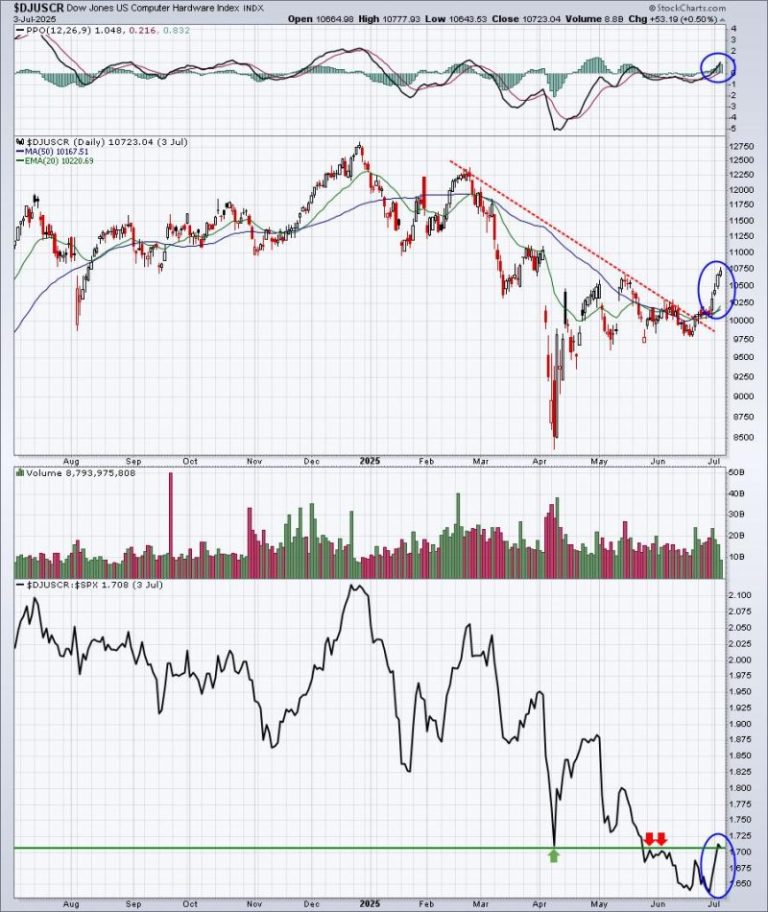
I know this group has been out of favor, but that seemed to change last week:

Its absolute downtrend seems to have been broken and we saw a glimpse of solid relative strength. Seasonality also leads me to believe that this run could very well just be getting started. Check this out:

Over the past 20 years, the DJUSCR has crushed the S&P 500 during the months of July and August. It’s easily been the group’s best two calendar months historically. These two months have consistently been great months for computer hardware stocks as they’ve each gained ground in roughly 3 out of every 4 years. Apple, Inc. (AAPL), the leading computer hardware stock, absolutely loves the months of July and August.

I expect last week’s rally to continue right up to AAPL’s earnings report on July 31st, and possibly beyond.

I’ll be featuring one other computer hardware stock in our FREE EB Digest newsletter on Monday morning that has CRUSHED the S&P 500 during July and August historically and it boasts one of the strongest charts in technology since the April low. If you’re not already an EB Digest subscriber, simply CLICK HERE to provide your name and email address. I’ll get that chart out to you first thing tomorrow morning!

Happy trading!

Tom