Author

admin

Browsing

President Donald Trump’s legislative agenda temporarily ground to a halt in the House of Representatives Wednesday afternoon.

Plans for an early afternoon vote to begin debate on Trump’s ‘big, beautiful bill’ slipped away as both conservative concerns and weather delays led to issues in passing two procedural votes ahead of the critical measure.

It’s not clear if the key vote will proceed today at this point. House Freedom Caucus Chairman Andy Harris, R-Md., one of the bill’s biggest critics, told reporters a vote was still ‘possible.’

‘No, not yet,’ he said when asked if he was getting what he needed from the White House to support the measure. ‘But the evening is so young.’

House GOP leaders had hoped to vote to begin debate on the vast tax and immigration bill, a maneuver known as a ‘rule vote,’ with the goal of teeing up a vote on the legislation’s final passage by late Wednesday or early Thursday at the latest.

The president has directed Republicans to get a bill to his desk for a signature by the Fourth of July, though he’s suggested in some recent comments he would not mind a delay of a few days.

The rule vote was meant to be the third in an early afternoon series of three votes. As of early evening Wednesday, that vote is still being held open, and the House floor is effectively paralyzed.

Lawmakers who expected a vote were told to return to their offices to await further instructions.

Multiple House Freedom Caucus members who left a meeting next to the House floor declined to comment on what they discussed, but several have made clear in recent days that they have serious issues with the Senate’s version of Trump’s agenda bill.

The mammoth piece of legislation includes Trump’s agenda on taxes, the border, energy, defense and the national debt.

Office of Management and Budget Director Russell Vought was seen briefly entering and exiting the room where the fiscal hawks were gathered.

He said little to reporters other than announcing they were ‘making good progress’ on his way out of the room.

Rep. Chip Roy, R-Texas, suggested that conservatives were speaking with the Trump administration about how Republicans could make up for what they saw as deficiencies in the current version of the bill.

Fiscal hawks were angered by last-minute moves made to placate Senate GOP moderates who were uneasy about the bill’s near-immediate phase-out of most green energy tax subsidies in former President Joe Biden’s Inflation Reduction Act (IRA).

They’ve also argued the Senate’s bill would add more to the federal deficit than the House’s earlier version, though Senate Republicans have pushed back.

‘We were not happy with what the Senate produced. We thought there was a path forward as of late last week, even though I had concerns in public about them. But then they jammed it through at the last minute in a way that, you know, we’re not overly excited about,’ Roy said. ‘So, now we’re trying to understand what our options are from this point.’

Other representatives, like Keith Self, R-Texas, and Josh Brecheen, R-Okla., declined to comment about the meeting to reporters.

Rep. Tim Burchett, R-Tenn., who is not a member of the Freedom Caucus but had some concerns about the bill, told reporters when leaving the meeting, ‘I’m just waiting to see what’s going on honestly. Everybody’s just discussing what’s going on and trying to get to some [resolution].’

Burchett told reporters earlier he was leaning in favor of voting to debate the bill.

But Speaker Mike Johnson, R-La., can afford just three defections to still pass the bill along party lines.

‘We’re going to get there tonight,’ Johnson told reporters.

This post appeared first on FOX NEWS

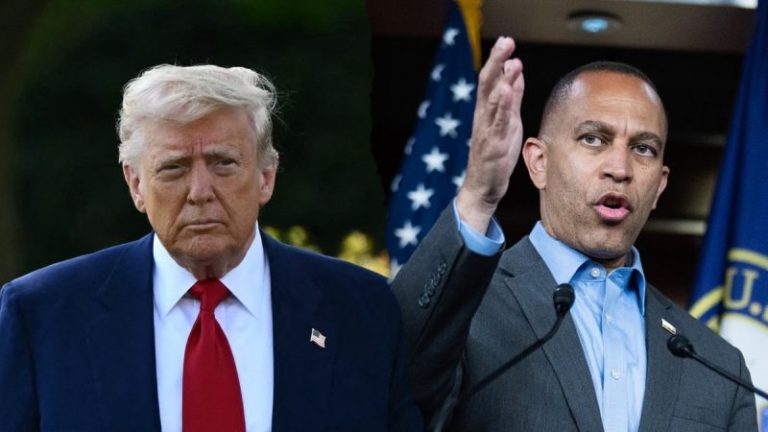
The House of Representatives’ progress on President Donald Trump’s ‘big, beautiful bill’ has temporarily come to a screeching halt thanks to the chamber’s top Democrat.

House Minority Leader Hakeem Jeffries, D-N.Y., began speaking in the chamber minutes before 5 a.m. and appears to be poised for hours more.

One GOP lawmaker told Fox News Digital that Jeffries was seen arriving with multiple binders, one of which he read from for roughly three hours. If the rest of the binders also hold portions of his speech, the New York Democrat could keep the House floor paused into the afternoon.

He’s able to command the House floor via a ‘magic minute,’ a privilege for party leaders in the chamber that allows them to speak for however long they want.

It comes after the House of Representatives voted to advance Trump’s $3.3 trillion ‘big, beautiful bill’ to its final phase in Congress, overcoming fears of a potential Republican mutiny.

It’s a significant victory for House Speaker Mike Johnson, R-La., though the fight is not over yet.

Lawmakers voted to proceed with debate on the mammoth-sized Trump agenda bill in the early hours of Thursday – a mechanism known as a ‘rule vote’ – teeing up a final House-wide vote sometime later Thursday morning.

The House adopted the rules for debate on the measure in a dramatic 219 to 213 vote – with all but moderate Rep. Brian Fitzpatrick, R-Pa., voting to proceed.

Next comes a vote on the actual measure, likely sometime on Thursday.

But the timing is largely contingent on when Jeffries finishes speaking. 

‘I feel the obligation, Mr. Speaker, to stand on this House floor and take my sweet time,’ he said at one point.

The first part of Jeffries’ speech saw him read from a binder that he said contained accounts of people who could lose their Medicaid coverage under the GOP bill, taken from residents of states with Republican lawmakers.

‘This Congress is on the verge of ripping food out of the mouths of children, veterans and seniors as a result of this one big ugly bill in order to reward billionaires with massive tax breaks and exploding the debt in the process,’ he said at one point.

Jeffries called it ‘one big, ugly bill’ that ‘our Republican colleagues are trying to jam down the throats of the American people will undermine their quality of life.’

The budget reconciliation process, which Republicans are using to pass the bill, is a mechanism that allows the party in power to completely sideline the minority in most cases. 

That means Jeffries nor his caucus have no real power to stop the bill from moving forward, making delay tactics their only tangible form of opposition right now.

The vote had been stalled for hours, since Wednesday afternoon, with five House Republicans poised to kill the measure before lawmakers could weigh the bill itself.

Several members of the conservative House Freedom Caucus and their allies, meanwhile, appeared ready to skip the vote altogether in protest of GOP leaders’ compromise bill.

But both Johnson and Trump spent hours negotiating with holdouts, apparently to some success.

But the process could still take hours. Democrats could still call up various procedural votes to delay the final measure, as they did when the legislation passed the House by just one vote for the first time in late May.

Plus, the bill itself could still face opposition from both moderates and conservative Republicans.

Conservative lawmakers were threatening to derail the rule vote as recently as Wednesday over changes the Senate made to the legislation, which fiscal hawks argued would add billions of dollars to the federal deficit.

But those concerns appear to have been outweighed by pressure from House GOP leaders and the president himself – who urged House Republicans to coalesce around the bill.

The Senate passed its version of the bill late on Tuesday morning, making modifications to the House’s provisions on Medicaid cost-sharing with states, some tax measures, and raising the debt ceiling.

Moderates are wary of Senate measures that would shift more Medicaid costs to states that expanded their programs under Obamacare, while conservatives have said those cuts are not enough to offset the additional spending in other parts of the bill.

Two members of the conservative House Freedom Caucus who also sit on the House Rules Committee, Reps. Ralph Norman, R-S.C., and Chip Roy, R-Texas, voted against the measure during the Rules Committee’s 12-hour hearing to consider the bill.

Johnson himself publicly urged the Senate to change as little as possible in the run-up to the vote. But the upper chamber’s bill ultimately passed by a similarly narrow margin as the House – with Vice President JD Vance casting the tie-breaking vote.

‘I’m not happy with what the Senate did to our product,’ Johnson told reporters late on Tuesday afternoon. ‘We understand this is a process that goes back and forth, and we’ll be working to get all of our members to yes.’

But Trump took to Truth Social after the Senate passed the bill to urge House Republicans to do the same.

‘It is no longer a ‘House Bill’ or a ‘Senate Bill’. It is everyone’s Bill. There is so much to be proud of, and EVERYONE got a major Policy WIN — But, the Biggest Winner of them all will be the American People, who will have Permanently Lower Taxes, Higher Wages and Take Home Pay, Secure Borders, and a Stronger and More Powerful Military,’ the president posted.

‘We can have all of this right now, but only if the House GOP UNITES, ignores its occasional ‘GRANDSTANDERS (You know who you are!), and does the right thing, which is sending this Bill to my desk. We are on schedule — Let’s keep it going, and be done before you and your family go on a July 4thvacation. The American People need and deserve it. They sent us here to, GET IT DONE.’

Both the House and Senate have been dealing with razor-thin GOP majorities of just three votes each.

The bill would permanently extend the income tax brackets lowered by Trump’s 2017 Tax Cuts and Jobs Act (TCJA), while temporarily adding new tax deductions to eliminate duties on tipped and overtime wages up to certain caps.

It also includes a new tax deduction for people aged 65 and over.

The legislation also rolls back green energy tax credits implemented under former President Joe Biden’s Inflation Reduction Act, which Trump and his allies have attacked as ‘the Green New Scam.’

The bill would also surge money toward the national defense, and to Immigrations and Customs Enforcement (ICE) in the name of Trump’s crackdown on illegal immigrants in the U.S.

The bill would also raise the debt limit by $5 trillion in order to avoid a potentially economically devastating credit default sometime this summer, if the U.S. runs out of cash to pay its obligations.

New and expanded work requirements would be implemented for Medicaid and federal food assistance, respectively.

Democrats have blasted the bill as a tax giveaway to the wealthy while cutting federal benefits for working-class Americans.

But Republicans have said their tax provisions are targeted toward the working and middle classes – citing measures eliminating taxes on tipped and overtime wages – while arguing they were reforming federal welfare programs to work better for those who truly need them.

Progressive Rep. Maxwell Frost, D-Fla., told reporters it was Democrats’ intent to delay proceedings on Wednesday for as long as possible.

‘This last go around, we were able to delay the bill upwards of 30 hours. And so we’re going to do the same thing, do everything we can from a procedural point of view to delay this,’ Frost said.

Meanwhile, there were earlier concerns about if weather delays in Washington could delay lawmakers from getting to Capitol Hill in time for the planned vote.

‘We’re monitoring the weather closely,’ Johnson told reporters. ‘There’s a lot of delays right now.’

Fox News’ Dan Scully contributed to this report.

This post appeared first on FOX NEWS

President Donald Trump’s administration released its annual report revealing the salaries for every staffer inside the White House on Thursday.

The report shows employees’ earnings in a range of $59,070 at the lowest to $225,700 at the highest, though a few aren’t accepting salaries at all.

The top-paid staffer at the White House is Jacalynne Klopp, a senior advisor and the sole staffer earning $225,700. Behind her is Edgar Mkrtchian, an associate counsel, making $203,645.

Behind them comes a group of 33 staffers making $195,200, which includes many well-known names. White House press secretary Karoline Leavitt takes in this level of salary, as does border czar Tom Homan, chief of staff Susan Wiles, trade advisor Peter Navarro, communications director Steven Cheung and police chief of staff and homeland security advisor Stephen Miller.

The White House did not immediately respond to a request for comment from Fox News Digital.

According to the report, there are 108 employees who make between $59,000 and $80,000, while Trump’s speechwriters earn between $92,500 and $121,500.

Eight employees do not receive salaries at all, though some of those are due to overlapping roles in other sections of government.

Secretary of State Marco Rubio is chief among these, not receiving any compensation for his White House role as national security advisor. Special envoy Steve Witkoff also receives compensation from the State Department rather than the White House.

Trump’s own compensation is not listed in the report, but the pay scheme for the president is laid out in federal law. As president, Trump earns a base salary of $400,000, as well as a $50,000 expense allowance, $100,000 for travel and $19,000 for entertainment.

Trump donated his salary to government agencies during his first term in office and said he will do the same during his second term.

The White House did not immediately respond when asked about Trump’s compensation.

This post appeared first on FOX NEWS

At this point, most Americans are aware that their personal information is often up for sale. But few would have expected their domestic flight records to be part of the trade. 

You might think that when you book a flight, the data stays between you, the airline and perhaps your travel agency, but a new report suggests otherwise. Internal documents reveal that major U.S. airlines have been funneling detailed passenger data to a little-known broker, which then sells that information directly to the Department of Homeland Security. 

Get my best tech tips, urgent security alerts and exclusive deals delivered straight to your inbox. Plus, you’ll get instant access to my Ultimate Scam Survival Guide — free when you join my CYBERGUY.COM/NEWSLETTER

Which airlines shared data and how the travel intelligence program works

At the center of the controversy is the Airlines Reporting Corporation (ARC), a company jointly owned by several of the largest U.S. airlines, including Delta, American Airlines and United. ARC’s core business includes managing ticket settlements between airlines and travel agencies. However, under a lesser-known initiative called the Travel Intelligence Program (TIP), ARC collects and monetizes vast amounts of data from domestic flight bookings. This includes names, complete itineraries and payment details.

Internal government records and procurement documents reveal that Customs and Border Protection (CBP), part of the Department of Homeland Security, has purchased access to ARC’s TIP data to track individuals of interest across the U.S. While CBP maintains that this data supports criminal and administrative investigations, critics argue that the arrangement raises major privacy concerns. 

The data is shared without travelers’ knowledge or consent, and ARC reportedly requested that the agency keep its identity confidential unless legally required to disclose it.

The documents confirm that CBP’s initial contract with ARC began in June 2024. It has already been extended and may continue through 2029. Although the initial amounts seem modest, around $11,000 with a recent $6,800 update, the implications are far-reaching.

What DHS is collecting from your flight bookings and why it’s concerning

ARC’s Travel Intelligence Program goes far beyond basic passenger manifests. It includes over a billion records spanning both past and future travel, updated daily. The system can be queried by name, credit card or even travel agency. Importantly, it does not include data from tickets purchased directly through airline websites, focusing instead on bookings made via travel agencies, such as Expedia.

The DHS has justified its use of TIP data in a public Privacy Impact Assessment, noting the program helps in active investigations. CBP echoed this, stating that data is only used when a case is already open. Still, this sets a dangerous precedent. It normalizes mass surveillance through third-party data purchases, undermining safeguards designed to limit unnecessary intrusion.

This isn’t an isolated incident. Last month, Immigration and Customs Enforcement also acknowledged purchasing ARC data. Other federal agencies listed in procurement records include the Secret Service, SEC, DEA, TSA and even the Air Force.

6 ways you can protect your privacy from data brokers

If you want to take back control of your personal information, here are six smart steps you can take right now to reduce your exposure to data brokers.

Whenever you can, avoid using third-party travel sites like Expedia, Orbitz or travel agencies. These platforms are the main sources of the data collected by the Airlines Reporting Corporation (ARC) through its Travel Intelligence Program. When you book directly on an airline’s official website or mobile app, your data is far less likely to be shared with ARC or sold to government agencies. While it might be tempting to look for deals on aggregator sites, once you find a fare you like, try to book it directly through the airline.

The ARC system allows queries by credit card number, which means your travel activity can be tracked even if your name is not directly searched. To protect yourself, consider using a virtual credit card or a disposable card number for flight bookings. These are often available through banking apps or fintech services like Revolut, Privacy.com or certain American Express accounts. Virtual cards are tied to your main account but generate a temporary number that can only be used once or at a specific merchant. This makes it much harder for brokers to link future bookings to you.

Be cautious about the personal information you enter during the booking process. Unless it is legally required, avoid adding unnecessary details like your frequent flyer number, passport data for domestic flights or secondary phone numbers. You can also create a separate email address specifically for travel bookings to reduce the risk of cross-linking data with your other online accounts. When it comes to loyalty programs, consider opting out or using a separate identity if you are concerned about data being shared across companies.

The most effective way to take control of your data and avoid data brokers from selling it is to opt for data removal services. While no service promises to remove all your data from the internet, having a removal service is great if you want to constantly monitor and automate the process of removing your information from hundreds of sites continuously over a longer period of time. Check out my top picks for data removal services and get a free scan to find out if your personal information is already out on the web by visiting Cyberguy.com/Delete

Prevent tracking at the source by using privacy-first tools. Switch to browsers like Brave, Firefox or DuckDuckGo, which block ads and data collectors by default. Set up a separate, secure alias email address for booking travel using services. This limits how easily brokers can link your travel data to your online identity. See my review of the best secure and private email services by visitingCyberguy.com/Mail

If your travel or payment data is ever leaked or abused, freezing your credit can help prevent identity theft. Identity theft companies can assist you in freezing your bank and credit card accounts to prevent further unauthorized use by criminals. They can also monitor personal information like your Social Security number, phone number and email address and alert you if it is being sold on the dark web or being used to open an account. 

One of the best parts of my No. 1 pick is that is it has identity theft insurance of  and a white glove fraud resolution team where a . See my tips and best picks on how to protect yourself from identity theft by visiting Cyberguy.com/IdentityTheft 

Kurt’s key takeaway

The ARC incident is yet another example of federal agencies bypassing traditional legal channels by buying sensitive data from private firms. Travelers are not just passengers, they are data points in a growing ecosystem where information is currency. The fact that this trade happened without informed consent and behind legal smokescreens should worry anyone who values privacy.

Would you change how you book flights if it meant protecting your personal data? Let us know by writing to us at Cyberguy.com/Contact

Get my best tech tips, urgent security alerts and exclusive deals delivered straight to your inbox. Plus, you’ll get instant access to my Ultimate Scam Survival Guide — free when you join my CYBERGUY.COM/NEWSLETTER

Copyright 2025 CyberGuy.com.  All rights reserved.  

This post appeared first on FOX NEWS
The ‘bunker busting’ bombs dropped on Iranian nuclear sites last month by U.S. forces have degraded Tehran’s atomic program by up to two years, the Pentagon confirmed Wednesday.

‘We have degraded their program by one to two years, at least intel assessments inside the Department [of Defense] assess that,’ Defense Department spokesman Sean Parnell told reporters. 

‘We believe that Iran’s nuclear capability has been severely degraded, perhaps even their ambition to build a bomb,’ he added, though security experts have told Fox News Digital that Tehran is unlikely to be deterred in its ambition to build a nuclear weapon.

The announcement reflects a far more positive assessment regarding the success of the June 22 strikes that targeted the Fordo, Isfahan and Natanz nuclear sites than previous estimates regarding the extent to which Tehran’s atomic capabilities had been degraded. 

Rafael Grossi, head of the U.N.’s International Atomic Energy Agency (IAEA), over the weekend warned that Iran may be able to resume enriching uranium within a matter of months. 

The comments also coincided with reports that Iran may have been able to move some of its stockpiles of near-weapons-grade enriched uranium, or possibly centrifuges, after satellite images showed more than a dozen cargo trucks were spotted at the Fordow nuclear site prior to the U.S. strikes. 

The U.S. has fervently denied that any intelligence suggests Iran was successful in moving its nuclear capabilities off site. Secretary of Defense Pete Hegseth became angry when asked about the possibility by reporters.

Fox News Digital has confirmed that Israel is continuing to monitor the security situation. 

Iranian Foreign Minister Abbas Aragchi this week acknowledged that there was severe damage to the Fordow facility, though he also insisted that ‘the technology and knowhow is still there.’

‘No one exactly knows what has transpired in Fordow. That being said, what we know so far is that the facilities have been seriously and heavily damaged,’ Aragchi said during a CBS interview this week.

Though according to Parnell on Wednesday, ‘All of the intelligence that we’ve seen (has) led us to believe that Iran’s – those facilities especially, have been completely obliterated.’

This post appeared first on FOX NEWS

 

(TheNewswire)


  NOT FOR DISTRIBUTION OR DISSEMINATION TO THE UNITED STATES  


Vancouver, British Columbia TheNewswire – July 3, 2025 ‑ Harvest Gold Corporation (TSXV: HVG) (‘ Harvest Gold ‘ or the ‘ Company ‘) announces that, subject to the approval of the TSX Venture Exchange (the ‘ Exchange ‘), it is proceeding with a non-brokered private placement to raise aggregate gross proceeds of approximately $2,200,000 (the ‘ Offering ‘). Under the Offering, the Company will raise up to approximately $800,000 through the issuance and sale of units of the Company (the ‘ Units ‘) at a price of $0.075 per Unit, and up to approximately $1,400,000 through the issuance and sale of charity flow-through units (the ‘ CFT Units ‘) at a price of $0.105 per CFT Unit.


Each CFT Unit is comprised of one common share of the Company (each, a ‘ Common   Share ‘) and one common share purchase warrant of the Company (a ‘ Warrant ‘), each of which qualifies as a ‘flow-through share’ (within the meaning of subsection 66(15) of the Income Tax Act (Canada) and 359.1 of the Taxation Act (Québec)). Each Unit consists of one Common Share and one Warrant. Each Warrant entitles the holder thereof to acquire one Common Share (each, a ‘ Warrant Share ‘) at a price of $0.12 per Warrant Share for a period of two years following the closing date of the Offering.


  The Company anticipates using the proceeds from the issue and sale of the Units for the 2025 drilling campaign, various exploration expenses and general working capital.  


  The gross proceeds raised from the CFT Units will be used by the Company to incur eligible ‘Canadian exploration expenses’ that qualify as ‘flow-through mining expenditures’ (as both terms are defined in the Income Tax Act (Canada)) (the ‘ Qualifying Expenditures ‘) related to the Company’s projects in Québec. The Company will renounce Qualifying Expenditures with an effective date of no later than December 31, 2025, in an amount of not less than the total amount of the gross proceeds raised from the issuance of the CFT Units, and incur such expenses by December 31, 2026.


All securities issued will be subject to a four-month hold period pursuant to securities laws in Canada and, where applicable, the Exchange Hold Period.  Finders’ fees may be payable to qualified parties.  


  About Harvest Gold Corporation  


  Harvest Gold has three active gold projects focused in the Urban Barry area, totalling 329 claims covering 17,539.25 ha , located approximately 45-70 km east of the Gold Fields Windfall Deposit.  


The Company’s board of directors, management team and technical advisors have collective geological and financing experience exceeding 400 years.


  Harvest Gold acknowledges that the Mosseau Gold Project straddles the Eeyou Istchee-James Bay and Abitibi territories.  Harvest Gold is committed to developing positive and mutually beneficial relationships based on respect and transparency with local Indigenous communities.  


  ON BEHALF OF THE BOARD OF DIRECTORS  


Rick Mark
President and CEO
Harvest Gold Corporation


  For more information please contact:  


  Rick Mark or Jan Urata
@ 604.737.2303 or
   info@harvestgoldcorp.com   


  Neither TSX Venture Exchange nor its Regulation Services Provider (as that term is defined in the policies of the TSX Venture Exchange) accepts responsibility for the adequacy or accuracy of this release.  


  Forward Looking Information  


  This news release includes certain statements that may be deemed ‘forward looking statements’. All statements in this news release, other than statements of historical facts, that address events or developments that Harvest Gold expects to occur, are forward looking statements. Forward looking statements are statements that are not historical facts and are generally, but not always, identified by the words ‘expects’, ‘plans’, ‘anticipates’, ‘believes’, ‘intends’, ‘estimates’, ‘projects’, ‘potential’ and similar expressions, or that events or conditions ‘will’, ‘would’, ‘may’, ‘could’ or ‘should’ occur.  


  Although the Company believes the expectations expressed in such forward-looking statements are based on reasonable assumptions, such statements are not guarantees of future performance and actual results may differ materially from those in the forward-looking statements. Factors that could cause the actual results to differ materially from those in forward looking statements include market prices, exploitation and exploration successes, and continued availability of capital and financing, and general economic, market or business conditions. Investors are cautioned that any such statements are not guarantees of future performance and actual results or developments may differ materially from those projected in the forward-looking statements. Forward looking statements are based on the beliefs, estimates and opinions of the Company’s management on the date the statements are made. Except as required by securities laws, the Company undertakes no obligation to update these forward-looking statements in the event that management’s beliefs, estimates or opinions, or other factors, should change.  


  The securities referred to in this news release have not been, and will not be, registered under the United States Securities Act of 1933, as amended (the ‘U.S. Securities Act’), or any applicable securities laws of any state of the United States, and may not be offered or sold within the United States or to, or for the account or benefit of, U.S. persons (as such term is defined in Regulation S under the U.S. Securities Act) or persons in the United States unless registered under the U.S. Securities Act and any other applicable securities laws of the United States or an exemption from such registration requirements is available.  


  This press release does not constitute an offer to sell or a solicitation of an offer to buy any of these securities within any jurisdiction, including the United States.  Any public offering of securities in the United States must be made by means of a prospectus containing detailed information about the company and management, as well as financial statements.  


Copyright (c) 2025 TheNewswire – All rights reserved.


News Provided by TheNewsWire via QuoteMedia

This post appeared first on investingnews.com

Robinhood Markets (NASDAQ:HOOD) rolled out a bold new push into tokenized equities on Monday (June 30), announcing the launch of commission-free stock tokens for EU customers.

The Menlo Park-based brokerage said the tokens will trade 24 hours a day, five days a week, via a partnership with blockchain firm Arbitrum. Robinhood also revealed plans to expand the service to “thousands” of stock tokens by the end of the year and to eventually develop its own blockchain to enable full 24/7 trading.

Robinhood surged nearly 13 percent to an all-time high of US$93.63 on Monday after the announcement.

“Tokenization is going to open the door to a massive trading revolution,” Robinhood CEO Vlad Tenev said at the company’s keynote event, held in Cannes, France.

In a significant first, Robinhood also introduced tokenized shares linked to private companies — specifically Sam Altman’s OpenAI and Elon Musk’s SpaceX — which will be made available exclusively to EU customers.

To mark the launch, Robinhood is offering 5 euros worth of OpenAI and SpaceX stock tokens to every eligible EU user who joins the platform by July 7. Altogether, the company has earmarked US$1 million worth of OpenAI tokens and US$500,000 worth of SpaceX tokens for the incentive program.

Johann Kerbrat, Robinhood’s general manager and senior vice president of crypto, said the move reflects a desire to break open traditionally exclusive investment opportunities.

“We wanted to make sure we were giving access,” he said in Cannes.

“What we discussed on stage was how to address the inequality between people who have historically had access to these kinds of companies and everyone else. That’s the really exciting part: Now everyone will be able to get it.”

He added: “The goal with tokenization is to let anyone participate in this economy.”

Access to private equity has historically been limited to institutional or ultra-wealthy investors, but the EU’s more flexible regulatory environment allowed Robinhood to move quickly.

The tokenized shares will be distributed directly into users’ Robinhood custody wallets and support dividend payments, the company said, promising the same ownership and rights as traditional shares.

Robinhood’s effort reflects growing enthusiasm around so-called tokenized equities, which merge the advantages of traditional finance with blockchain-powered flexibility and low costs.

The model allows round-the-clock trading, fractional ownership, and lower barriers to entry.

Still, regulatory uncertainties cloud the future of tokenized equities, especially in the United States, where definitions around securities and investor protection rules remain unresolved.

Robinhood execs made clear that US customers should not expect to see similar private equity tokens anytime soon. The company is lobbying for more open frameworks to let retail US users participate in private equity markets.

For now, Robinhood will continue rolling out tokenized assets in the EU and expand to other jurisdictions as rules evolve.

Robinhood also announced crypto perpetual futures for its EU users, as well as the launch of crypto staking for US customers.

Securities Disclosure: I, Giann Liguid, hold no direct investment interest in any company mentioned in this article.

This post appeared first on investingnews.com

Here’s a quick recap of the crypto landscape for Wednesday (July 2) as of 9:00 p.m. UTC.

Get the latest insights on Bitcoin, Ethereum and altcoins, along with a round-up of key cryptocurrency market news.

Bitcoin and Ethereum price update

Bitcoin (BTC) is priced at US$109,452, up by four percent in the last 24 hours, and its highest valuation of the day. The day’s range for the cryptocurrency brought a low of US$107,542.

Bitcoin price performance, July 2, 2025.

Chart via TradingView.

Bitcoin’s price gain was driven by a calming in Middle East tensions and growing optimism after the US Federal Reserve signaled a dovish tilt; both factors boosted investor risk appetite. Additionally, continued inflows into US spot Bitcoin exchange-traded funds (ETFs) and favorable regulation expectations helped sustain upward momentum.

Ethereum (ETH) is priced at US$2,584.30, up by 7.5 percent over the past 24 hours and its highest valuation of the day. Its lowest valuation on Wednesday was US$2,446.41.

Altcoin price update

  • Solana (SOL) was priced at US$152.55, up by five percent over 24 hours. Its highest valuation as of Wednesday was US$153.39, and its lowest was US$148.29.
  • XRP was trading for US$2.18, up by 4.9 percent in 24 hours. The cryptocurrency’s lowest valuation was US$2.15 and its highest was US$2.27.
  • Sui (SUI) is trading at US$2.92, showing an increaseof 9.3 percent over the past 24 hours and its highest valuation on Wednesday. Its lowest valuation was US$2.76.
  • Cardano (ADA) is priced at US$0.5932, up by 10.6 percent in the last 24 hours, and its highest valuation of the day. Its lowest valuation as of Wednesday was US$0.5605.

Today’s crypto news to know

Judge permits billion-dollar lawsuit against Tether

A US bankruptcy judge is allowing a US$40 billion lawsuit against stablecoin issuer Tether to proceed, according to court documents filed in New York on Monday (June 30). The lawsuit was launched by crypto lender Celsius, which accused Tether of improperly liquidating nearly 40,000 Bitcoin from its platform in June 2022.

Tether attempted to dismiss claims, arguing that the liquidation was to cover Celsius’s US$812 million debt when Bitcoin prices plummeted. Tether also claimed that US courts lacked authority over Tether’s non-US operations, a claim the judge disagreed with, and maintains that Celsius had directed the liquidation.

Coinbase buys Liquifi in undisclosed deal

Coinbase has acquired Liquifi, a startup that builds token management platforms for crypto projects, continuing its busy M&A streak in 2025. Liquifi, backed in its 2022 seed round by Dragonfly and investors like Balaji Srinivasan, helps projects track token vesting, manage crypto cap tables, and handle tax requirements. Coinbase declined to disclose the purchase price, but said Liquifi will help streamline token launches and distribution. This puts Coinbase closer to an “end-to-end” model, similar to Binance’s launchpad, which supports crypto creation from early stages.

Liquifi has been locked in a legal fight with competitor Toku over alleged business document theft, claims which it denies, and Coinbase said it will stand by Liquifi’s defense.

The deal follows other Coinbase acquisitions this year, including Spindl, Iron Fish’s team and the company’s record-breaking US$2.9 billion Deribit buy.

SEC considers streamlining ETF listings

The US Securities and Exchange Commission is reportedly considering a change to its listing structure that would allow ETF issuers to submit a Form S-1, the initial listing registration filing, without having to first file a Form 19b-4.

This is according to crypto journalist Eleanor Terrett, who added that she was told issuers would only need to wait 75 days before listing their tokens if they met the criteria for a general listing standard, the details of which are still unknown but could involve criteria like market capitalization, liquidity and trading volume.

Tech billionaires launch crypto-focused bank Erebor

A group of prominent tech investors, including Anduril’s Palmer Luckey, Peter Thiel’s Founders Fund and Palantir co-founder Joe Lonsdale, are backing a new US-based crypto bank called Erebor, as per the Financial Times.

Erebor has applied for a national banking charter and plans to serve technology-driven sectors like artificial intelligence, defense and crypto, as well as individuals working in these fields.

The digital-only bank will be headquartered in Columbus, Ohio, with an additional office in New York.

Erebor intends to hold stablecoins on its balance sheet, offering a stable value backed by reserves. The bank is led by Owen Rapaport and Jacob Hirshman, a former Circle adviser.

Erebor’s mission is to address the gap left by the collapse of Silicon Valley Bank, which had been a critical channel for startups and venture investors until its 2023 failure.

AllUnity to launch Euro stablecoin

Germany’s financial watchdog, BaFin, has granted regulatory approval to Deutsche Bank and its asset management arm, DWS, for their joint venture, AllUnity. They will launch a euro stablecoin called EURAU, pegged 1:1 to the euro.

The approval allows AllUnity to launch its stablecoin in compliance with new MiCA regulations. The stablecoin aims to facilitate secure, transparent and compliant digital payments for institutions and businesses across Europe.

In other news out of Europe, the European Central Bank said it plans to test a new system using blockchain technology by late 2026 to settle payments in euros. This initiative, called Pontes, is part of a two-track approach that will connect modern blockchain platforms with the eurozone’s existing payment systems.

China considers stablecoins to reinforce cross-border payment strategy

Policy advisors in China are pressing Beijing to explore stablecoins for cross-border payments, even as the country’s broad crypto ban remains in place, Bloomberg reported.

People’s Bank of China (PBOC) Governor Pan Gongsheng noted that stablecoins could make international finance more resilient to geopolitical disruptions, a view echoed by other senior officials.

Former PBOC governor Zhou Xiaochuan suggested dollar-linked stablecoins might even accelerate dollarization, while others see a case for yuan-backed coins to support China’s long-term currency goals.

The momentum comes after the US Senate passed a stablecoin bill in June, advancing President Donald Trump’s digital currency agenda. Stablecoin supply is projected to reach US$3.7 trillion by 2030, driven by cheaper, faster settlement options compared to traditional banking.

Securities Disclosure: I, Giann Liguid, hold no direct investment interest in any company mentioned in this article.

Securities Disclosure: I, Meagen Seatter, hold no direct investment interest in any company mentioned in this article.

This post appeared first on investingnews.com


(TheNewswire)


Vancouver, British Columbia July 3 rd 2025 TheNewswire – Juggernaut Exploration Ltd. (TSX-V: JUGR) (OTCQB: JUGRF) (FSE: 4JE) (the ‘Company’ or ‘Juggernaut’), is pleased to announce a $1,000,000 hard dollar financing from one strategic investor, further confirming the support and excitement of the newly discovered 11 km Highway of Gold surrounding the Eldorado porphyry system on the Big One property. The discovery is in an area of glacial and snowpack abatement next door to the gold-rich porphyry systems at Newmont Mining’s Galore Creek. The Big One Property is a discovery previously announced Jan 20 th (Click Link) with assays up to 79.01 gt gold (2.54 ozt gold) and 3157.89 gt silver (101.5 ozt silver) from over 200 gold-silver-copper rich polymetallic veins up to 8 m wide and striking for up to 500 m that all remain open at surface. The Big One Project covers 33,693 hectares in a globally ranked tier 1 jurisdiction with tremendous additional discovery potential in the heart of the Golden Triangle, British Columbia.


  View Juggernaut videos by     Clicking Here     .  


  Subject to approval from the TSXV Exchange, the Company will issue 1,562,500 hard dollar units priced at $0.64 each for gross proceeds of $1,000,000. Each hard dollar unit will consist of one common share plus one warrant at $0.84 for a sixty-month period, with a forced accelerated conversion after 10 consecutive trading days at or above $1.84, callable at management’s discretion. The fully subscribed placement is scheduled to close on July 14th, 2025. The proceeds will be used for general working capital.  


  Mr. Dan Stuart, Director, President, and CEO of Juggernaut, states:  


  This investment, coupled with the ongoing support and interest from other globally recognized Institutions and senior miners, is a strong endorsement that clearly demonstrates the significant near-term discovery potential of our 100% controlled properties. Since May of this year, the Company has raised ~ $12,500,000, and post-financing, Juggernaut will have an extremely tight capital structure of just 30,985,170 shares, no debt, and a strong cash position. As such, we are well-positioned to move forward with our plans of drilling The Big One Discovery. With much anticipation, we look forward to executing the inaugural exploration program and reporting results.’  


  All shares issued pursuant to this offering and any shares issued pursuant to the exercise of warrants will be subject to a four-month hold period from the closing date.  


  About Juggernaut Exploration Ltd.  


  Juggernaut Exploration Ltd. is an explorer and generator of precious metals projects in the prolific Golden Triangle of northwestern British Columbia. Its projects are in world-class geological settings   and geopolitical safe jurisdictions amenable to Tier 1 mining in Canada. Juggernaut is a member and active supporter of CASERM, an organization representing a collaborative venture between the Colorado School of Mines and Virginia Tech. Juggernaut’s key strategic cornerstone shareholder is Crescat Capital.  


  For more information, please contact  


  Juggernaut Exploration Ltd.  


  Dan Stuart  


  President, Director, and Chief Executive Officer  


  604-559-8028  


    info@juggernautexploration.com    


    www.juggernautexploration.com    


  Qualified Person  


  Rein Turna P. Geo is the independent qualified person as defined by National Instrument 43-101, for Juggernaut Exploration projects, and supervised the preparation of, and has reviewed and approved, the technical information in this release.  


  Grab samples are selected samples and may not represent true underlying mineralization.  


  NEITHER THE TSX VENTURE EXCHANGE NOR ITS REGULATION SERVICES PROVIDER (AS THAT TERM IS DEFINED IN THE POLICIES OF THE TSX VENTURE EXCHANGE) ACCEPTS RESPONSIBILITY FOR THE ADEQUACY OR ACCURACY OF THIS RELEASE.  


  FORWARD LOOKING STATEMENT  


  Certain disclosures in this release may constitute forward-looking statements that are subject to numerous risks and uncertainties relating to Juggernaut’s operations that may cause future results to differ materially from those expressed or implied by those forward-looking statements, including its ability to complete the contemplated private placement. Readers are cautioned not to place undue reliance on these statements. NOT FOR DISSEMINATION IN THE UNITED STATES OR TO U.S. PERSONS OR FOR DISTRIBUTION TO U.S. NEWSWIRE SERVICES. THIS PRESS RELEASE DOES NOT CONSTITUTE AN OFFER TO SELL OR AN INVITATION TO PURCHASE ANY SECURITIES DESCRIBED IN IT.  


Copyright (c) 2025 TheNewswire – All rights reserved.


News Provided by TheNewsWire via QuoteMedia

This post appeared first on investingnews.com


Anteros Metals Inc. (CSE: ANT) (‘Anteros’ or the ‘Company’) is pleased to announce assay results from six grab samples collected at the Main Mineralized Zone (‘MMZ’) of its wholly-owned, road-accessible Havens Steady VMS Property (‘Havens Steady’ or the ‘Property’) in central Newfoundland. These samples confirm high-grade lead-zinc-silver mineralization at surface and show associated gold and copper enrichment consistent with a polymetallic volcanogenic massive sulphide (‘VMS’) system.


The grab samples were collected during a recent field visit, focused on confirming the tenor and extent of exposed mineralization within the MMZ. All samples were collected from bedrock outcroppings of gossanous surface material. Surface grab sample highlights are given in Table 1, below.


Table 1: Outcrop grab sample1 highlights


Sample ID Pb (%) Zn (%) Cu (%) Ag (g/t) Au (g/t)
HS-25-004 1.56 9.60 0.15 45.0 0.366
HS-25-003 0.46 1.66 0.22 38.4 0.513
HS-25-006 0.06 0.40 0.30 26.1 0.568
HS-25-005 0.30 0.85 0.11 19.0 0.238
HS-25-001 0.10 0.07 0.04 5.5 0.043


1 Grab samples are selected samples and may not represent true underlying mineralization


‘These samples support the surface expression of MMZ, which we model as a laterally extensive high-grade zone,’ stated Trumbull Fisher, CEO of Anteros Metals. ‘The enrichment in base and precious metals positions the MMZ as a high-priority target for trenching and drill targeting later this season.’


GEOLOGICAL CONTEXT


The MMZ lies within a strongly prospective segment of the Exploits Subzone, an established host to VMS-style deposits in central Newfoundland. The Property area is characterized by felsic to intermediate volcaniclastics that are variably silicified and gossanous at surface. Historical drilling within the Property has documented high-grade VMS-style mineralization, and recent data compilation has revealed copper and gold enriched zones within the MMZ (see May 1, 2025 news release).


These results build on recent prospecting at Havens Steady, where sampling revealed angular float boulders with multi-percent copper grades along-strike from the MMZ (see June 16, 2025 news release), reinforcing the zones potential for further exploration (Figure 1).


Figure 1: Interpreted Property Geology with MMZ and Outcrop Grab Sample Locations


To view an enhanced version of this graphic, please visit:
https://images.newsfilecorp.com/files/9885/257584_4cc739fa04831847_002full.jpg


NEXT STEPS


The Company plans to commence a targeted trenching program at the MMZ in the coming weeks, with the aim of exposing and mapping the mineralized zone in detail. Results from trenching will guide a potential Phase I drill program planned for fall 2025, designed to test the down-dip and along-strike extent of mineralization.


QA/QC AND ANALYTICAL METHODS


Samples were collected by Anteros personnel and submitted to Eastern Analytical Ltd. (‘EAL’), an ISO/IEC 17025-accredited laboratory located in Springdale, Newfoundland. EAL regularly inserts certified blanks, reference standards, and sample duplicates into sample sequences to maintain accuracy and precision of results. Multi-element geochemistry was estimated using a 200mg subsample, dissolved in a four-acid solution, and analyzed with inductively coupled plasma optical emission spectroscopy (‘ICP-OES’). Overlimit assays, including lead, zinc, and silver, were completed using multi-acid digestion and atomic absorption spectroscopy (‘AAS’). Gold was estimated through fire assay and AAS of a 30g subsample.


ABOUT THE PROPERTY


Located approximately 40 kilometres southeast of Buchans, the Havens Steady Property hosts a laterally extensive polymetallic volcanogenic massive sulphide (‘VMS’) system within the Storm Brook Formation of the Red Cross Group in the Exploits Subzone of the Dunnage Zone, a prolific metallogenic belt in central Newfoundland. The Property benefits from existing road infrastructure and proximity to hydroelectric power. The region hosts active exploration and world class VMS deposits including the past-producing Duck Pond Mine. The Company cautions that mineralization hosted on adjacent and/or nearby properties is not necessarily indicative of mineralization on the Property.


Since acquiring the Property in January 2024, Anteros has compiled an extensive historical dataset that includes airborne electromagnetic surveys, geochemical surveys, and over 15,000 metres of historical drilling. Documented mineralization includes sphalerite, galena, chalcopyrite, and bornite in high-grade polymetallic zones. The known system has a strike length of over a kilometre and remains open at depth. Learn more: www.anterosmetals.com/havens-steady.


QUALIFIED PERSON


The technical content of this news release has been reviewed and approved by Jesse R. Halle, P.Geo., an independent Qualified Person as defined by National Instrument 43-101 – Standards of Disclosure for Mineral Projects.


ABOUT Anteros Metals Inc.


Anteros is a multimineral junior mining company applying data science and geological expertise to identify and advance critical mineral opportunities in Newfoundland and Labrador. The Company is currently focused on advancing four key projects across diverse commodities and development horizons. Immediate plans for their flagship Knob Lake Property include bringing the historical Fe-Mn Mineral Resource Estimate into current status as well as commencing baseline environmental and feasibility studies.


For further information please contact or visit:


Email: info@anterosmetals.com | Phone: +1-709-769-1151
Web: www.anterosmetals.com | Social: @anterosmetals


On behalf of the Board of Directors,


Chris Morrison
Director


Email: chris@anterosmetals.com | Phone: +1-709-725-6520 | Web: www.anterosmetals.com/contact

16 Forest Road, Suite 200
St. John’s, NL, Canada A1X 2B9


Cautionary Statement Regarding Forward-Looking Information


This news release may contain ‘forward-looking information’ and ‘forward-looking statements’ within the meaning of applicable Canadian securities legislation. All information contained herein that is not historical in nature may constitute forward-looking information. Forward-looking statements herein include but are not limited to statements relating to the prospects for development of the Company’s mineral properties, and are necessarily based upon a number of assumptions that, while considered reasonable by management, are inherently subject to business, market and economic risks, uncertainties and contingencies that may cause actual results, performance or achievements to be materially different from those expressed or implied by forward looking statements. Except as required by law, the Company disclaims any obligation to update or revise any forward-looking statements. Readers are cautioned not to put undue reliance on these forward-looking statements.


To view the source version of this press release, please visit https://www.newsfilecorp.com/release/257584


News Provided by Newsfile via QuoteMedia

This post appeared first on investingnews.com