Author

admin

Browsing

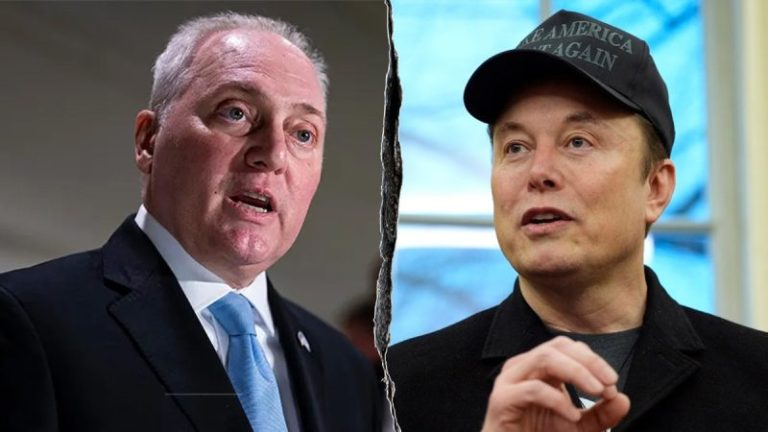
The No. 2 House Republican is dismissing Elon Musk’s attacks on President Donald Trump’s ‘big, beautiful bill’ after the tech billionaire once again jumped into the public fray over the legislation.

‘His criticism has been consistently off-base,’ House Majority Leader Steve Scalise, R-La., told Fox News Digital on Monday. 

‘You know, this is a bill that will create millions of jobs. And, you know, you go back and look at what happened in 2017 when we lowered rates and created a good atmosphere to create jobs, then we saw millions of jobs get created. And we’re at the point again today where the economy is waiting for this bill.’

Musk, who criticized the House version of the bill before appearing to back off, has launched another tirade against the legislation this week while it’s being pushed through the Senate.

‘It is obvious with the insane spending of this bill, which increases the debt ceiling by a record FIVE TRILLION DOLLARS, that we live in a one-party country – the PORKY PIG PARTY!! Time for a new political party that actually cares about the people,’ Musk posted on X.

But Scalise told Fox News Digital, ‘We’re moving fast to get it done because of the positive impacts it will have on our economy.’

The Senate is expected to pass the legislation sometime Wednesday, after which it is poised to move back to the House of Representatives.

An earlier version passed the House in late May by just one vote, but the two chambers must now sync up to get a bill on Trump’s desk by the Fourth of July.

Two sources told Fox News Digital on Tuesday morning that House GOP leaders are still planning for a 12 p.m. House Rules Committee meeting to advance the bill.

The House Rules Committee is the final gateway before most legislation gets a chamber-wide vote.

That could tee up a procedural vote on the bill as early as Wednesday morning, and final passage by Wednesday evening or Thursday.

‘I’ve always said failure’s not an option because, you know, there have been many times where the bill could have fallen apart. And it didn’t, because we always stayed focused on getting it done,’ Scalise said. ‘And that’s that’s where all the focus needs to be right now.’

But the Senate’s various modifications to the bill have angered both moderate and conservative Republicans. 

Moderates are wary of the Senate measures that would shift more Medicaid costs to states that expanded their programs under ObamaCare, while conservatives have said those cuts are not enough to offset the additional spending in other parts of the bill.

‘We’re having a lot of conversations with our members, and we are following what changes are being made to the bill because some could help fix some of those issues,’ Scalise said.

‘We’re definitely aware of the concerns from our members. But there are a lot of other members that do want to get this bill passed for the president and recognize that the bulk of what we sent over to them is still intact.’

Asked if he was optimistic about the timeline as of early Monday evening, Scalise said, ‘The plan is still to bring members back and have votes as early as Wednesday morning.’

The legislation is a 940-page bill advancing Trump’s agenda on taxes, the border, defense, energy and the national debt.

Fox News Digital reached out to Musk for comment via email to Tesla.

This post appeared first on FOX NEWS

Iran’s foreign minister is vowing that ‘the doors of diplomacy will never slam shut’ following the Trump administration’s airstrikes — a statement an Iran expert says shows that Tehran is trying to buy time. 

Abbas Araghchi was quoted as making the remark to CBS News after President Donald Trump told reporters last Wednesday that the U.S. would meet with Iranian officials this week. 

‘I don’t think negotiations will restart as quickly as that,’ Araghchi added. ‘In order for us to decide to reengage, we will have to first ensure that America will not revert back to targeting us in a military attack during the negotiations. And I think with all these considerations, we still need more time.’  

Behnam Ben Taleblu, the senior director of the Foundation for Defense of Democracies Iran Program, told Fox News Digital on Tuesday that ‘Tehran’s strongest weapon when it is weak is actually diplomacy. 

‘Negotiating to buy time and bail out the regime is an art form for Iranian political elites. Even when done from a position of weakness, one reason Tehran will not shut the door on talks is because it seeks to prevent widening military action from stiffening the spine of domestic dissidents at home. 

‘No doubt, the Islamic Republic will cause a ruckus about engaging in negotiations post-strike, but ultimately agreeing to talk when it has been conventionally bested on the battlefield does mean its mission accomplished,’ Taleblu added. 

Trump said following the conclusion of a NATO summit in the Netherlands last week that ‘I could get a statement’ that Iran is ‘not going to go nuclear.’ 

‘We’re probably going to ask for that… but they’re not going to be doing it anyway. They’ve had it,’ Trump added.  

‘We’re going to talk to them next week, with Iran. We may sign an agreement, I don’t know. To me, I don’t think it’s that necessary. I mean, they had a war. They fought. Now they’re going back to their world. I don’t care if I have an agreement or not. The only thing we would be asking for is what we’re asking for before about, we want no nuclear [program]. But we destroyed the nuclear,’ Trump also said.  

‘If we got a document, it wouldn’t be bad. We’re going to meet with them. Actually, we’re going to meet with them,’ the president continued. 

However, Trump then wrote on Truth Social Monday that he is not talking to Iran. 

‘The administration and namely our special envoy, Steve Witkoff, has been in communication both directly and indirectly with the Iranians. That communication continues. The president himself has not talked to Iran, which he pointed out in his Truth statement,’ White House Press Secretary Karoline Leavitt added later Monday. 

This post appeared first on FOX NEWS

Israel’s Coordinator for Government Activities in the Territories (COGAT), which oversees humanitarian and civil efforts in Gaza, released two revealing conversations between Gaza residents and officers from the Coordination and Liaison Administration (CLA) for Gaza.

The Gaza residents, who COGAT — an Israeli  says were at humanitarian aid distribution sites, told a CLA officer about how Hamas tries to disrupt the aid system through violence and manipulation. The testimonies reveal that ‘Hamas fires at Gaza residents near the aid distribution sites, spreads false claims about IDF fire, publishes fabricated data about large numbers of casualties, and circulates fake footage,’ according to COGAT.

State Department Spokesperson Tammy Bruce acknowledged Hamas’ use of violence to ‘interfere with aid deliveries to the people of Gaza.’

‘This is how Hamas operates — they deliberately fire at people and want it to appear as though the army is the one shooting, so that no one will approach the aid distribution areas,’ one Gaza resident told a CLA officer, according to COGAT’s translation.

Another Gaza resident told a CLA officer that Palestinians trying to get aid ‘encounter thugs on the way’ and that ‘those thugs definitely kill 2, 3, 5 people.’

Fox News Digital was unable to independently verify the identities of the residents.

The Gaza Humanitarian Foundation (GHF), a U.S.- and Israel-backed group,  has faced backlash over reports of violent and even deadly incidents around its secure sites. In response to the videos released by COGAT, a GHF spokesperson said that ‘Hamas is working to destroy the Gaza Humanitarian Foundation because our model is working.’

GHF has pushed back on claims that Palestinians are being killed at its sites. However, it does say that Hamas has killed some of its staff members, ‘put bounties on our American workers and threatened civilians for accepting aid.’

‘To date, there has not been a single casualty at or in the surrounding vicinity of any of our sites. Many of the alleged incidents had no correlation to our sites but deliberate misinformation orchestrated by Hamas-controlled [Gaza] Health Ministry,’ a GHF spokesperson told Fox News Digital. 

Despite the backlash, the GHF is encouraging other organizations — including its critics — to join its mission to bring aid to the people of Gaza while ensuring Hamas does not get its hands on it.

‘Ultimately, the solution is more aid. If other groups would join us, we could scale up… We could also collaborate with the U.N. and other groups on other means while ensuring their aid reaches the right people,’ the GHF spokesperson said.

This post appeared first on FOX NEWS

Terra Clean Energy (CSE:TCEC,OTCQB:TCEFF,FSE:C9O0) is advancing its 100 percent-owned South Falcon East Project, strategically located in the southeastern Athabasca Basin, Saskatchewan — one of the world’s premier uranium districts. The project stands out among uranium juniors for its shallow mineralization, strong discovery potential, and proximity to established infrastructure.

Anchored by a historical resource of nearly 7 million pounds (Mlbs) U₃O₈ at the Fraser Lakes Zone B, the project also hosts multiple zones of confirmed mineralization and structural alteration. Terra is advancing toward a NI 43-101-compliant resource update in 2025, with the goal of materially expanding its resource base. Situated along the highly prospective Way Lake Conductor — a folded, uranium-enriched corridor — the project offers significant upside for new discoveries beyond the existing resource.

South Falcon East, Terra Clean Energy’s flagship project, spans 12,234 hectares on the southeastern margin of the Athabasca Basin, Saskatchewan, just 55 km east of the historic Key Lake uranium mill. The project hosts the Fraser Lakes Zone B deposit, with a historical inferred resource of 6.96 Mlbs U₃O₈ at 0.03% and 5.34 Mlbs ThO₂ at 0.023 percent, contained within 10.35 Mt using a 0.01 percent U₃O₈ cutoff. While not yet classified under NI 43-101, Terra considers the resource data reliable and a strong foundation for future exploration and growth.

Company Highlights

  • Unique, Shallow Uranium System: Only micro-cap in the Athabasca Basin advancing a near-surface uranium deposit, with significantly reduced exploration and potential development costs.
  • Pounds-in-the-ground Upside: Historical resource of 6.96 Mlbs U₃O₈ and 5.34 Mlbs ThO₂, with considerable expansion potential from historical and recent drilling.
  • Prime Location: Situated 55 km east of the Key Lake Mill within the prolific Athabasca Basin – home to the world’s highest-grade uranium deposits.
  • Strong Technical Leadership: Led by a team with extensive uranium exploration and capital markets experience, including veterans from Skyharbour Resources and Azincourt Energy.
  • Resource Update Underway: 2024–25 infill and step-out drilling will support an NI 43-101 compliant mineral resource estimate, incorporating higher-grade intercepts from Terra’s 2024 campaign.
  • Re-rating Potential: Market cap under $5 million despite having a historical uranium resource, confirmed mineralized zones, and near-term catalysts.

This Terra Clean Energy profile is part of a paid investor education campaign.*

Click here to connect with Terra Clean Energy (CSE:TCEC) to receive an Investor Presentation

This post appeared first on investingnews.com

Investor Insight

With a clear, discovery-focused strategy, Terra Clean Energy is advancing one of the most unique near-surface uranium opportunities in the Athabasca Basin, targeting rapid resource growth and re-rating potential through continuous exploration, aggressive drilling, and disciplined capital deployment.

Overview

Terra Clean Energy (CSE:TCEC,OTCQB:TCEFF,FSE:C9O0) is unlocking value from its wholly owned South Falcon East project, located in the southeastern Athabasca Basin in Saskatchewan, Canada. The project uniquely positions Terra among uranium juniors due to its shallow mineralization and proximity to world-class infrastructure.

With a historical uranium resource of nearly 7 million lbs (Mlbs) U₃O₈ at Fraser Lakes Zone B, and multiple zones of confirmed mineralization and structural alteration, Terra is targeting an updated NI 43-101 resource in 2025, aiming to significantly grow its asset base. The project’s location along the Way Lake Conductor – a folded, fertile corridor – offers blue-sky potential for additional discoveries.

As global demand for uranium surges due to energy security concerns and the electrification boom (AI, EVs, nuclear baseload), Terra offers investors a rare combination of historical resource foundation, shallow mineralization, and transformational growth potential at a micro-cap valuation.

Company Highlights

  • Unique, Shallow Uranium System: Only micro-cap in the Athabasca Basin advancing a near-surface uranium deposit, with significantly reduced exploration and potential development costs.
  • Pounds-in-the-ground Upside: Historical resource of 6.96 Mlbs U₃O₈ and 5.34 Mlbs ThO₂, with considerable expansion potential from historical and recent drilling.
  • Prime Location: Situated 55 km east of the Key Lake Mill within the prolific Athabasca Basin – home to the world’s highest-grade uranium deposits.
  • Strong Technical Leadership: Led by a team with extensive uranium exploration and capital markets experience, including veterans from Skyharbour Resources and Azincourt Energy.
  • Resource Update Underway: 2024–25 infill and step-out drilling will support an NI 43-101 compliant mineral resource estimate, incorporating higher-grade intercepts from Terra’s 2024 campaign.
  • Re-rating Potential: Market cap under $5 million despite having a historical uranium resource, confirmed mineralized zones, and near-term catalysts.

Key Project

South Falcon East – Fraser Lakes B Deposit

Located in the southeastern margin of the Athabasca Basin, Saskatchewan, South Falcon East is Terra Clean Energy’s flagship project, covering approximately 12,234 hectares of prospective uranium ground. The property lies 55 km east of the historic Key Lake uranium mill and hosts the Fraser Lakes B deposit, which hosts an inferred historical resource of 6.96 Mlb U₃O₈ at 0.03 percent and 5.34 Mlb thorium dioxide (ThO₂) at 0.023 percent, within 10.35 Mt of material using a 0.01 percent U₃O₈ cutoff grade. While this resource is not currently classified under NI 43-101, Terra believes the data is reliable and serves as a robust foundation for continued exploration.

The mineralization is hosted in fractured and altered pegmatites and graphitic pelitic paragneiss, with the uranium accompanied by thorium and elevated concentrations of copper, nickel, vanadium, zinc, bismuth, molybdenum, lead and cobalt. Alteration assemblages include illite, dickite, kaolinite, chlorite, fluorite and hematite; these are classic markers of basement-hosted unconformity uranium systems. This setting, along with widespread clay alteration and structural disruption, mirrors some of the most prolific uranium systems in the basin, including Eagle Point, Millennium and Roughrider.

Fraser Lakes B sits on the central limb of the Way Lake Conductor, a folded EM corridor extending more than 25 km across the project area. This conductor hosts three major fold limbs (West, Central, and East), but only the central limb, where Fraser Lakes B is located, has been materially drilled. The deposit currently exhibits a strike length of approximately 1,400 meters, dipping northwest, and remains open in all directions. A north-northeast-trending fault, known as the T-Bone Lineament, intersects the deposit’s eastern margin, suggesting additional structural complexity and potential uranium conduits along strike.

Historic drilling from 2008 to 2015 by Skyharbour Resources and JNR Resources identified numerous mineralized intervals. Highlights include:

  • 0.165 percent U₃O₈ over 2 m (within a broader 6 m grading 0.103 percent U₃O₈) in FP-15-05.
  • 0.183 percent U₃O₈ over 1 m in WYL-50.
  • 0.242 percent U₃O₈ over 0.5 m in WYL-61.
  • 0.057 percent U₃O₈ over 5.5 m in the same hole.

These results demonstrate multiple stacked mineralized horizons over widths up to 65 m, open to depth and laterally.

In early 2024, Terra’s Phase 1 drill program confirmed the presence of uranium-bearing pegmatites in close proximity to historical intercepts. Hole SF-0059 intersected 13.5 m of mineralization, including 0.07 percent eU₃O₈ over 1.1 m, while SF-0060 returned intervals such as 0.02 percent eU₃O₈ over 1.3 m at 142.15 m. These intercepts confirm the extension of mineralization along strike and at depth from FP-15-05 and support the hypothesis of lateral continuity and stacked mineralized bodies.

Planning for an extensive summer 2025 drill program is underway, which consists of approximately 2,500 meters. The program will test areas identified during the winter 2024 program, where it is interpreted that a north-northwest trending brittle structure, a north dipping structure with strong clay alteration, and mineralized pegmatites with hydrothermal hematite alteration hosted in graphitic pelitic gneiss all intersect.

In addition to Fraser Lakes B, the company is evaluating regional targets such as T-Bone Lake, which has returned values up to 0.055 percent U₃O₈ over 0.9 m and features promising clay alteration and structural complexity similar to known high-grade deposits.

The overarching exploration thesis is that the Way Lake Conductor may host a clustered uranium system, with multiple deposits along its folded structure. Very little drilling has been conducted outside the current Fraser Lakes B footprint, giving Terra significant discovery potential across the entire 25 km strike length.

Management Team

Greg Cameron – President, CEO and Director

A seasoned capital markets professional, Greg Cameron has two decades of experience in business development, strategy and M&A. He is a former senior banker at Canaccord Genuity and Macquarie, and managing director at Colby Capital. He brings transactional and restructuring expertise critical to junior exploration growth.

C. Trevor Perkins – VP, Exploration

A professional geologist, C. Trevor Perkins has a track record in uranium exploration, including major results in the Athabasca Basin. He also serves as VP exploration for Azincourt Energy and has led exploration strategy and drill execution across multiple high-impact programs.

Alex Klenman – Director

Alex Klenman is a veteran junior mining executive with 30+ years’ experience, including uranium-specific roles. He is the CEO and director of Azincourt Energy, and has raised more than $18 million for Athabasca exploration. Klenman brings deep investor relations and financing expertise.

Tony Wonnacott – Director

Tony Wonnacott is a Toronto-based securities lawyer with more than 25 years of experience in capital markets. Instrumental in multiple successful listings and over $1 billion in financings and M&A transactions.

Brian Shin – CFO

Brian Shine is a chartered professional accountant with 15 years’ experience across roles in public companies. He specializes in reporting, risk management and corporate finance.

Jordan Trimble – Technical Advisor

Jordan Trimble is the CEO of Skyharbour Resources and a leading voice in the uranium investment community. He brings global capital markets insight and technical expertise, enhancing Terra’s industry reach and credibility.

This post appeared first on investingnews.com

Investor Insight

South Harz Potash (ASX:SHP) is an advanced-stage potash development company unlocking value from one of Europe’s most strategic fertilizer assets. Headquartered in Perth, Australia, the company is currently advancing a dual-asset acquisition strategy to complement and enhance the long-term value proposition of its wholly-owned South Harz Potash Project.

Overview

South Harz Potash (ASX:SHP) holds a high-potential critical minerals opportunity strategically located in central Europe. Due to its central location, the South Harz Potash Project is primely positioned to capitalise on long-term potash price upside via its direct access to European agricultural markets, electrified rail infrastructure, and existing brownfield underground access.

Europe is seeking to enhance critical mineral resilience amid tightening global potash supply chains. European MOP supply has declined over the past decade, while imports face growing geopolitical risk due to sanctions and restrictions on major exporters such as Belarus and Russia. South Harz Potash offers a potential reliable, low-carbon, and locally-sourced future potash supply to Western Europe’s agricultural centres.

South Harz Potash completed a Pre-Feasibility Study on Ohmgebirge in May 2024, which confirmed strong project economics and scalability. The company’s key potash assets are situated over perpetual mining licenses, underpinning sustained tenure security.

A disciplined capital allocation approach sees South Harz Potash exercising ‘strategic patience’ and aligning further advancement and development of Ohmgebirge with more favorable potash market dynamics. In the meantime, the company is carefully preserving and growing the long-term real option value that it holds from being a potential world-class future domestic potash supplier to Western Europe.

Company Highlights

  • Advancing a Dual-Asset Strategy: Targeting acquisition of a second critical minerals project complementary to the company’s flagship Ohmgebirge Development, part of its broader South Harz Potash Project in Germany.
  • Preservation and Growth of Long-Term Potash Option Value: Amidst current global and potash market volatility, the South Harz team is focussed on advancing its potash assets via non-dilutive funding sources such as German R&D tax rebates, ERMA funding, and ongoing engagement with financial and industry parties on potential strategic asset-level investment.
  • Western Europe’s Largest Potash Resource: The South Harz Potash Project comprises a dominant 659 sq km land position in Germany’s South Harz Potash District, being three perpetual mining licences (including Ohmgebirge) and two exploration tenements.
  • Perpetual Tenure: The South Harz mining licences are perpetual with no holding costs and no royalty obligations, ensuring maximum project flexibility and value retention.
  • Long-Term Macro Tailwinds for Potash: Europe faces declining MOP supply and is increasingly reliant on imports amid geopolitical disruption in Belarus and Russia. South Harz Potash is primely positioned to deliver stable future supply of sustainable, low-carbon potash to European markets.

The South Harz Opportunity: A Dual-Asset Strategy

South Harz Potash has a dual-asset strategy designed to drive long-term value growth complementary to its South Harz Potash Project.

#1 Acquire and Advance Second Critical Minerals Asset

Leveraging its existing corporate foundation and established presence in Europe and Australia, the company is targeting the strategic acquisition of new critical minerals assets that offer strong potential to drive shareholder value creation while potash markets progressively recover.

With global market conditions rapidly evolving, South Harz Potash holds the purpose and patience to explore new opportunities, backed by a steadfast and supportive major shareholder base.

#2 Preserve and Grow Long-Term Value in South Harz Potash Project

South Harz Potash’s flagship Ohmgebirge Development, part of its broader wholly-owned South Harz Potash Project, is centrally located in Germany’s historic South Harz mining district. It is associated with established regional infrastructure, offering valuable and highly differentiating brownfield development opportunity.

Ohmgebirge hosts a maiden Ore Reserve of 83.1 Mt at 12.6 percent potassium oxide (K₂O) and a total sylvinite Mineral Resource exceeding 286 Mt. The future development of Ohmgebirge benefits from access to over 60 percent renewable grid power, electrified rail to major European ports, and water recycling systems – supporting a low-impact, sustainable operation.

Ohmgebirge forms the foundation of South Harz’s potash strategy, with nearby licences – Ebeleben, Küllstedt, and Mühlhausen–Nohra – offering modular long-term expansion potential.

Management Team

Len Jubber – Executive Chairman

With over 30 years in the mining sector, Len Jubber has held leadership roles including managing director and CEO of Bannerman Resources, managing director/CEO of Perilya, and chief operating officer of OceanaGold. He began his career with Rio Tinto in Namibia and brings a wealth of technical, commercial, and entrepreneurial experience to the company.

Dr. Reinout Koopmans – Non-Executive Director

Dr. Reinout Koopmans brings 15 years of investment banking experience from London, having led global public equity raising for natural resource companies at Deutsche Bank and headed the European equity capital markets team at Jefferies International. He also served as a management consultant at McKinsey & Co in Germany and Southeast Asia. Koopmans holds a PhD and MSc from the London School of Economics and a degree from Erasmus University, Rotterdam.

Rory Luff – Non-Executive Director

Rory Luff is the founder of BW Equities, a specialist Melbourne-based equities advisory firm, with over 15 years of experience in the financial services industry. He has spent most of his career advising resource companies on capital raisings and financial market strategies.

Richard Pearce – Non-Executive Director

Richard Pearce has over 30+ years’ experience in the mineral industry across critical, industrial and energy minerals. His participation spans the full asset life cycle and value chains, and includes key roles held across board directorships, exploration and operations management, mining finance, M&A, business strategy and operational improvement. He has a proven business development and asset commercialisation track record.

Dr. Babette Winter – Regional Director & Managing Director of Südharz Kali GmbH

Dr. Babette Winter holds a PhD in chemistry and has extensive experience in politics, communication, public administration, environmental issues, and technology. She served for over five years as state secretary for Europe in Thuringia and held various leadership roles in environmental policy and public relations within German governmental bodies.

Graeme Smith – Company Secretary

Graeme Smith is an experienced finance professional with over 30 years in accounting, corporate governance, and company administration. He is a member of the Australian Society of Certified Practising Accountants, the Institute of Chartered Secretaries and Administrators, and the Governance Institute of Australia.

This post appeared first on investingnews.com

Investor Insight

Equity Metals offers investors exposure to high-grade silver and gold discoveries in British Columbia through a dual-track strategy of expanding its flagship Silver Queen resource and advancing the newly acquired Arlington district.

Overview

Equity Metals (TSXV:EQTY,OTCQB:EQMEF,FSE:EGSD) is fast-tracking exploration at its 100 percent owned Silver Queen project in British Columbia, targeting resource expansion and derisking of one of the province’s most prospective high-grade polymetallic deposits. Located within the prolific Skeena Arch near the historic Equity Silver and Huckleberry mines, Silver Queen boasts an NI 43-101 compliant resource of 62.8 million ounces (Moz) silver equivalent (indicated) and 22.5 Moz silver equivalent (inferred), with 2024 drilling extending known zones and identifying new mineralized areas.

Complementing this is the Arlington gold-copper-silver project, a newly acquired district-scale, never-before drill-tested project located in southern BC’s Greenwood Mining Division. With analogues to historic producers like Phoenix and Buckhorn, Arlington is being aggressively explored with 3,000 meters of drilling underway, focused on delineating high-grade gold-enriched polymetallic mineralization.

Parameters for the NI 43-101 Compliant Mineral Resource Estimate are in the Appendix and in the EQTY News Release, dated Dec 1, 2022

Together, Silver Queen and Arlington offer a balanced exposure to high-grade polymetallic and gold-rich systems. The former provides near-term resource expansion and development optionality, while the latter opens up district-scale discovery potential.

In addition, Equity Metals holds interests in the Monument and WO diamond properties in the Lac de Gras region (Northwest Territories), proximal to the Diavik and Ekati mines, and the La Ronge silica project in Saskatchewan. These projects offer upside optionality for strategic partnerships or asset sales.

Company Highlights

  • Flagship High-grade Project – Silver Queen: Over 85 million silver-equivalent ounces defined in the heart of BC’s Skeena Arch mineral belt, surrounded by Tier 1 infrastructure and historical producers.
  • New Gold Discovery Potential – Arlington project: A district-scale, early-stage gold-copper-silver system with analogues to major past-producing skarn and vein-hosted mines in the region.
  • Fully Funded for 2025: 9,000 meters of combined drilling is underway across both Silver Queen and Arlington with assay results expected to drive news flow through Q3 and Q4 2025.
  • Experienced Management and Technical Team: Track record of discovery and mine development across North America, including the Penasquito and Eskay Creek mines and the Wind Mountain project.
  • Exposure to Critical and Precious Metals: Balanced portfolio spanning silver, gold, copper and diamonds with optionality in battery materials (silica) and critical minerals.

Key Projects

Silver Queen Project

The Silver Queen project is Equity Metals’ 100 percent owned flagship asset located in central British Columbia’s prolific Skeena Arch, approximately 35 km south of Houston. This 18,871-hectare property consists of 17 crown-granted titles and 46 tenure claims in the Omineca Mining Division. Surrounded by past-producing and active mines, including the Equity silver mine, Berg, Endako and Mt. Milligan, the project benefits from established infrastructure such as roads, power and rail access.

Silver Queen hosts a high-grade polymetallic system featuring silver, gold, copper, lead and zinc mineralization. The project is underpinned by a robust NI 43-101 compliant resource estimate (as of December 2022) consisting of 62.8 million ounces (Moz) silver-equivalent (AgEq) in the indicated category grading 565 grams per ton (g/t) AgEq, and 22.5 Moz AgEq in the inferred category grading 365 g/t AgEq. This includes 3.46 million tons (Mt) of indicated resources averaging 189 g/t silver, 2.13 g/t gold, 0.24 percent copper, 0.6 percent lead, and 3.5 percent zinc, and 1.92 Mt of inferred resources grading 167 g/t silver, 0.82 g/t gold, 0.23 percent copper, 0.5 percent lead, and 2 percent zinc.

The mineralization occurs in multiple steeply dipping epithermal vein systems, subdivided into the No. 3, NG-3, Camp and Sveinson veins. Each exhibits distinct metal zonation – the Camp veins are silver-dominant, while the Sveinson, No. 3 and NG-3 show a stronger gold bias. Bonanza grades have been intercepted at multiple locations, including down-hole drill core intervals assaying up to 56,115 g/t silver over 0.3 metres in recent drill results. High sulphide and low sulphide vein environments have both been identified, suggesting a long-lived and multi-phase mineralizing event.

Since late 2020, Equity has completed 52,877 meters of drilling in 146 holes, targeting extensions and new zones of mineralization. In 2024 alone, four target areas – George Lake, Camp North, No. 3 North and Camp-Sveinson – were tested via 17,209 meters across 42 holes. Drilling resulted in the delineation of a 550-metre strike-length for mineralization in the George Lake target and a 400-metre strike-length for mineralization in the No. 3 North target, as well as several extensions of earlier identified veins in the Camp Deposit and a new discovery in the Camp North target. A 6,000-meter 2025 drilling program will further test these zones with updated modeling and resource growth expected in Q3 2025.

Metallurgical testing completed in both 1988 and 2022 yielded positive recoveries: 83 percent gold, 95 percent silver, 93 percent copper, 91 percent lead, and 98 percent zinc. A follow-up metallurgical program is planned to support preliminary development studies. With extensive underground development (~9 km of historic workings) and proximity to key infrastructure, the Silver Queen project is well positioned for advancement toward economic studies and ultimately, a potential strategic transaction.

Arlington Project

The Arlington project is a 3,584-hectare, early-stage exploration asset located in southern British Columbia’s Greenwood Mining Division, approximately 65 km south of Kelowna. The project sits within the prolific Quesnel Terrane and is accessible year-round via Highway 33 and a network of logging roads. The region hosts several historical producers including the Buckhorn, Phoenix, and Beaverdell mines, which have collectively yielded more than 2 Moz gold, 6 Moz silver and 500 Mlb copper.

Arlington encompasses multiple mineral occurrences and at least four deposit styles across a more than 5 km strike length. Historic and recent surface work has confirmed high-grade mineralization with rock samples returning values up to 11.67 g/t gold, 211 g/t silver, and 3.22 percent copper. The 2025 exploration program, currently underway, includes a 3,000-metre drill campaign primarily targeting the Fresh Pots gold-silver anomaly – a large (2 km x 1 km) intrusion-related gold system delineated by multi-element soil geochemistry and magnetic lows.

Other high-priority targets include:

  • Rona Porphyry Target: A copper-molybdenum-gold system with pyroxenite intrusive-hosted mineralization. Rock chip assays have returned >1 percent molybdenum, 0.6 g/t gold, and 32.4 g/t silver. The area is characterized by a large copper-nickel soil anomaly and widespread argillic alteration in adjacent sedimentary rocks.
  • Arlington Polymetallic Veins: A structurally controlled vein system with documented historic workings. Highlights include Arlington South (11.67 g/t gold, 3.22 percent copper) and Arlington North (1.86 g/t gold, 1.07 percent copper), suggesting vertical metal zonation and potential for stacked vein systems.
  • Skarn and Replacement Targets: Notably at the Bru and Arlington zones, analogous to Buckhorn and Phoenix, where gold-copper magnetite skarns produced over 1 Moz historically.

In early 2025, Equity Metals completed a property-wide airborne magnetic/radiometric survey and LiDAR mapping campaign to refine targeting. Soil and till geochemistry, IP surveying and mapping continue across the license area to delineate follow-up drill targets for 2026.

Management Team

Lawrence Page – Chairman and Director

A seasoned mining executive with over four decades of experience, Lawrence Page has helped finance and develop several major discoveries including Penasquito (Mexico), Eskay Creek and Hemlo. He brings strategic oversight and a deep network within the exploration and capital markets community.

Joseph A. Kizis Jr. – President and Director

With over 40 years of mineral exploration experience, Joseph Kizis has been instrumental in advancing gold, silver and base metal projects across North America. He is also president of Bravada Gold and has played key roles in advancing Wind Mountain in Nevada and Homestake Ridge in BC.

Robert W.J. Macdonald – VP Exploration

Robert Macdonald leads Equity Metals’ technical team and brings extensive epithermal and porphyry system expertise. His past project experience includes Homestake Ridge in BC and Cerro Las Minitas in Mexico, and he is the Qualified Person for all technical disclosures.

Killian Ruby – CFO and Director

As president and CEO of Malaspina Consultants and a former senior manager at KPMG LLP, Killian Ruby brings financial discipline, governance strength and tax expertise. He also serves as CFO for several junior resource companies.

John Kerr – Director

A professional engineer with five decades of exploration experience, John Kerr has contributed to the discovery and development of projects such as Santa Fe and Mindora in Nevada, and Frasergold in BC.

Courtney Shearer – Director

Courtney Shearer has served in executive and advisory roles with multiple Canadian mining companies, including San Gold Corporation, where he led strategic evaluations and project planning initiatives.

Arie Page – Corporate Secretary

Arie Page provides legal and corporate compliance support and has served as corporate secretary for numerous public companies within the Manex Resource Group.

Appendix:

Silver Queen Mineral Resource Estimate (NI 43-101 Compliant, Dec. 1, 2022) (C$100 NSR cut-off)

  1. The current Mineral Resource Estimate was prepared by Garth Kirkham, P.Geo., of Kirkham Geosystems Ltd and Eugene Puritch, P. Eng., FEC, CET and Fred Brown, P, Geo. of P&E Mining Consultants Inc. (“P&E”), Independent Qualified Persons (“QP”), as defined by National instrument 43-101.
  2. All Mineral Resources have been estimated in accordance with Canadian Institute of Mining and Metallurgy and Petroleum (“CIM”) definitions, as required under National Instrument 43-101 (“NI43-101”).
  3. Mineral Resources were constrained using continuous mining units demonstrating reasonable prospects of eventual economic extraction.
  4. Silver and Gold Equivalents were calculated from the interpolated block values using relative process recoveries and prices between the component metals and silver to determine a final AgEq and AuEq values.
  5. Silver and Gold Equivalents and NSR$/t values were calculated using average long-term prices of $20/oz silver, $1,700/oz gold, $3.50/lb copper, $0.95/lb lead and $1.45/lb zinc. All metal prices are stated in $USD. The C$100/tonne NSR cut-off grade value for the underground Mineral Resource was derived from mining costs of C$70/t, with process costs of C$20/t and G&A of C$10/t. Process recoveries used were Au 70%, Ag 80%, Cu 80%, Pb 81% and Zn 90%.
  6. Grade capping was performed on 1m composites for the No. 3 and NG-3 veins and whole vein composites for the Camp and Sveinson veins. For the No. 3 and NG-3 veins Inverse distance cubed (I/d3) was utilized for grade interpolation for Au and Ag and inverse distance squared (I/d2) was utilized for Cu, Pb and Zn. Inverse distance squared (I/d2) was used for all metals in the Camp and Sveinson veins.
  7. A bulk density of 3.56t/m3 was used for all tonnage calculations in the No. 3 and NG-3 veins. A variable density with a 3.15 average was used for the Camp and Sveinson veins.
  8. Mineral Resources are not Mineral Reserves until they have demonstrated economic viability. Mineral Resource Estimates do not account for a Mineral Resource’s mineability, selectivity, mining loss, or dilution.
  9. An Inferred Mineral Resource has a lower level of confidence than that applying to an Indicated Mineral Resource and must not be converted to a Mineral Reserve. It is reasonably expected that the majority of Inferred Mineral Resources could be upgraded to Indicated Mineral Resources with continued exploration.
  10. All figures are rounded to reflect the relative accuracy of the estimate and therefore numbers may not appear to add precisely.
This post appeared first on investingnews.com

China’s Zijin Mining Group (OTC Pink:ZIJMF,HKEX:2899,SHA:601899), the country’s largest producer of gold and copper, has agreed to acquire Kazakhstan’s Raygorodok gold mine for US$1.2 billion.

The deal, announced on Monday (June 30) through a filing to the Hong Kong Stock Exchange, furthers the company’s ambition of becoming one of the world’s top three gold producers by 2028.

Raygorodok is reportedly among the largest and most technologically advanced gold projects in Central Asia. It produced 6 metric tons of gold in 2024 at a production cost of US$796 per ounce, excluding non-cash items.

With a remaining mine life of 16 years and average annual output of 5.5 metric tons of gold, Zijin expects the mine, located in Northern Kazakhstan, to boost both its earnings and production starting this year.

Raygorodok’s total ore reserves are estimated at 94.9 million metric tons, containing approximately 100.6 metric tons (3.5 million ounces) of gold, based on a gold price of US$1,750 per ounce.

However, Zijin believes that considering the current market for the yellow metal, there is clear potential to expand production and reserves by improving the pit design under a higher gold price assumption. Furthermore, a US$420 million processing plant, operational since mid-2022, has significantly expanded the mine’s output capacity.

Annual production rose from 50,000 ounces in 2023 to an expected 190,000 ounces in 2025, using carbon-in-pulp and heap-leaching technologies that improve extraction efficiency from low-grade ore. As of the end of 2024, Raygorodok reported net assets of US$291 million and posted a net profit of US$202 million on US$473 million in revenue.

The asset is currently owned by Cantech, a Kazakhstan-based firm 65 percent held by V Group International, one of the country’s largest equity investment companies, and backed by US private equity firm Resource Capital Funds.

Through its subsidiaries, Zijin Gold International and Jinha Mining, Zijin signed definitive agreements to purchase all rights and interests in RG Gold and RG Processing, the Kazakhstan-based entities that own and operate the mine.

The acquisition is expected to close by the end of September of this year, pending regulatory approvals from both Chinese and Kazakh authorities.

Zijin Gold IPO in the works

Zijin operates gold mines in China and globally in locations such as Africa and South America.

But Raygorodok is set to become one of its flagship assets, aligning with the group’s goal of raising annual gold production by 35 percent — from 73 metric tons in 2024 to 100 to 110 metric tons by 2028.

The acquisition also serves a broader corporate strategy: the planned initial public offering (IPO) of Zijin Gold International, the group’s overseas gold division, on the Hong Kong Stock Exchange.

Established in 2007, Zijin Gold International is being positioned as the vehicle for consolidating Zijin’s foreign gold assets and unlocking shareholder value. The IPO is expected to raise between US$1.5 billion and US$2 billion. Proceeds will be used for further expansion across Africa and South America.

The spinoff remains subject to approval from Chinese regulators, Zijin shareholders, the Hong Kong Securities and Futures Commission and the Hong Kong Stock Exchange.

Zijin has emphasized that the listing will not affect its control over the subsidiary. Furthermore, Zijin Gold International will remain under Zijin’s consolidated financial statements post-listing.

Securities Disclosure: I, Giann Liguid, hold no direct investment interest in any company mentioned in this article.

This post appeared first on investingnews.com

Thanks to exchange-traded funds (ETFs), investors don’t have to be tied to one specific stock. When it comes to biotech ETFs, they give sector participants exposure to many biotech companies via one vehicle.

ETFs are a popular choice as they allow investors to enter the market more safely compared to investing in standalone stocks. A key advantage is that even if one company in the ETF takes a hit, the impact will be less direct.

All other figures were also current as of that date. Read on to learn more about these investment vehicles.

1. ALPS Medical Breakthroughs ETF (ARCA:SBIO)

AUM: US$81.2 million

Launched in December 2014, the ALPS Medical Breakthroughs ETF tracks small- and mid-cap biotech stocks that have one or more drugs in either Phase II or Phase III US FDA clinical trials. Its holdings must have a market cap between US$200 million and US$5 billion.

There are 104 holdings in this biotechnology fund, with about 50 percent being small- and micro-cap stocks. Its top holdings include Nuvalent (NASDAQ:NUVL) at a weight of 3.55 percent, Axsome Therapeutics (NASDAQ:AXSM) at 3.42 percent and Alkermes (NASDAQ:ALKS) at 3.18 percent.

2. Tema Oncology ETF (NASDAQ:CANC)

AUM: US$72.18 million

The Tema Oncology ETF provides exposure to biotech companies operating in the oncology industry. It includes companies developing a range of cancer treatments, including CAR-T cell therapies and bispecific antibodies.

Launched in August 2023, there are 51 holdings in this biotechnology fund, of which about half are small- to mid-cap stocks. Among its top holdings are Roche Holding (OTCQX:RHHBF,SWX:RO) at a weight of 5.32 percent, Eli Lilly and Company (NYSE:LLY) at 5.19 percent and BridgeBio Pharma (NASDAQ:BBIO) at 4.88 percent.

3. Direxion Daily S&P Biotech Bear 3x Shares (ARCA:LABD)

AUM: US$52.8 million

The Direxion Daily S&P Biotech Bear 3x Shares ETF is designed to provide three times the daily return of the inverse of the S&P Biotechnology Select Industry Index, meaning that the ETF rises in value when the index falls and falls in value when the index rises. Leveraged inverse ETFs are designed for short-term trading and are not suitable for holding long-term. They also carry a high degree of risk as they can be significantly affected by market volatility.

Unlike the other ETFs on this list, LABD achieves its investment objective through holding financial contracts such as futures rather than holding individual stocks.

4. Tema Heart and Health ETF (NASDAQ:HRTS)

AUM: US$50.83 million

Launched in November 2023, the Tema GLP-1 Obesity and Cardiometabolic ETF tracks biotech stocks with a focus on diabetes, obesity and cardiovascular diseases. The fund was renamed on March 25 from Tema Cardiovascular and Metabolic ETF, and again on June 27 from the GLP-1 Obesity and Cardiometabolic ETF.

There are 47 holdings in this biotechnology fund, with about 75 percent being large-cap stocks and 18 percent mid-cap. About three-quarters of its holdings are based in the US. Its top holdings are Eli Lilly and Company at a 9.78 percent weight, Abbott Laboratories (NYSE:ABT) at 4.58 percent and Novo Nordisk (NYSE:NVO) at 4.42 percent.

5. ProShares Ultra NASDAQ Biotechnology (NASDAQ:BIB)

AUM: US$47 million

The ProShares Ultra NASDAQ Biotechnology ETF was launched in April 2010 and is leveraged to offer twice daily long exposure to the broad-based NASDAQ Biotechnology Index, making it an ideal choice “for investors with a bullish short-term outlook for biotechnology or pharmaceutical companies.” However, analysts also advise investors with a low risk tolerance or a buy-and-hold strategy against investing in this fund due to its unique nature.

Of the 262 holdings in this ETF, the top biotech stocks are Gilead Sciences (NASDAQ:GILD) at a 5.57 percent weight, Vertex Pharmaceuticals (NASDAQ:VRTX) at 5.53 percent and Amgen (NASDAQ:AMGN) at 5.33 percent.

Securities Disclosure: I, Meagen Seatter, hold no direct investment interest in any company mentioned in this article.

This post appeared first on investingnews.com